Crude oil trading alert: Market risk appetite has rebounded, causing oil prices to fluctuate downwards; be wary of a breakout.
2026-05-26 09:32:48
International crude oil markets rebounded during Asian trading hours on Tuesday, with West Texas Intermediate (WTI) crude prices rising to around $91.80 per barrel, ending a four-day losing streak. The market is reassessing the impact of the Middle East situation on global energy supplies, particularly as geopolitical risks remain unresolved despite some progress in ceasefire negotiations between the US and Iran, leading to a renewed rise in risk aversion.

Previously, WTI crude oil prices had plummeted by more than 6% on Monday. US President Trump stated that negotiations with Iran regarding a ceasefire and the reopening of the Strait of Hormuz were "progressing well," leading the market to anticipate a gradual return to normalcy in Middle Eastern oil shipments. As a result, international oil prices initially fell sharply, with some long positions quickly exiting the market, and market risk premiums contracting significantly.
However, the situation changed again on Tuesday. A spokesperson for U.S. Central Command confirmed that the U.S. military conducted a "self-defense strike" on southern Iran on Monday, targeting missile launch sites and Iranian vessels. While the U.S. military emphasized that it would exercise restraint during the ceasefire, it stated that it would continue to protect U.S. forces in the Middle East and related maritime routes.
Meanwhile, explosions were heard in and around Bandar Abbas, a port city near the Strait of Hormuz. Market concerns are growing that the situation in the Middle East could escalate again, potentially causing another round of disruptions to global oil shipping. The Strait of Hormuz handles approximately 20% of global seaborne oil shipments and is also a crucial route for liquefied natural gas (LNG) transport; disruptions to these routes could trigger renewed volatility in global energy prices.
Currently, the United States and Iran are discussing a temporary ceasefire framework lasting approximately two months. According to preliminary plans circulating in the market, the US may lift some of its maritime blockade measures, while Iran would reopen the Strait of Hormuz to restore global energy transport order. Both sides are working on a memorandum of understanding, hoping to create conditions for subsequent 60 days of peace negotiations.
The market remains somewhat optimistic about a possible easing of tensions. Ship tracking data shows that three LNG carriers have recently successfully transited the Strait of Hormuz, bound for Pakistan, Asian countries, and India, respectively. Furthermore, a supertanker carrying Iraqi crude oil, after being stranded for nearly three months, has also resumed its voyage to Asian countries, indicating that some shipping risks are decreasing.
However, market sentiment remains highly sensitive. Analysts believe that as long as the situation in the Middle East remains unstable, the oil market will struggle to completely eliminate geopolitical risk premiums. Especially with the peak global energy demand season approaching in the summer, any new information regarding the Strait of Hormuz could trigger sharp short-term fluctuations in oil prices.
From the daily chart, WTI crude oil encountered significant selling pressure near $96 and quickly retreated. Currently, the price has returned above $90 , indicating that the bulls still have some defensive capability near this key psychological level. On the daily chart, the 5-day and 10-day moving averages have begun to form a death cross, indicating that short-term downward pressure remains. However, the MACD indicator's green histogram is contracting, suggesting that bearish momentum is weakening. If oil prices can subsequently break through $92.50 again, the market may retest the $95 area; key support levels are around $88 and $85 .
From the 4-hour chart, WTI crude oil has experienced a technical oversold rebound after a rapid decline, with the RSI indicator rising back to around 50, indicating that short-term selling pressure has eased. The current price is testing the middle Bollinger Band area on the 4-hour chart. If it can effectively hold above this level, it may rebound further towards the $91.80 to $93 range in the short term. However, if there are further signs of easing tensions in the Middle East and a decrease in market risk premium, a retest of the $88 support level cannot be ruled out.
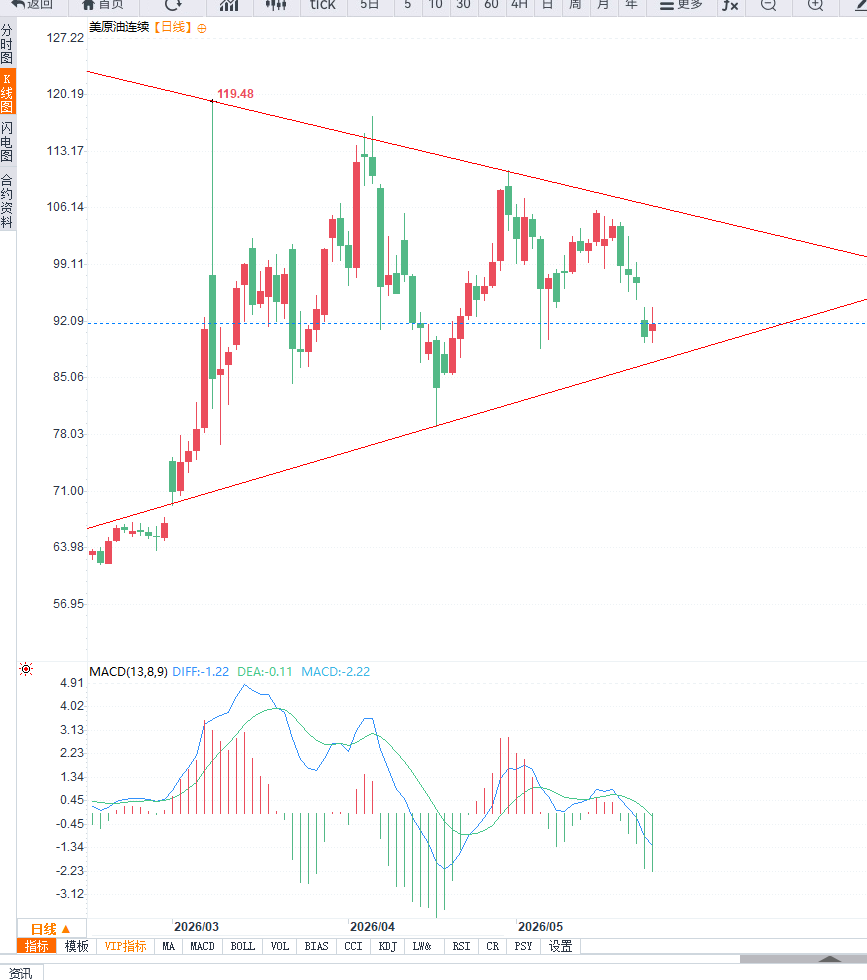
Overall, the international crude oil market is currently in a phase of intense struggle between "supply concerns" and "ceasefire expectations." Geopolitical news has a significant impact on the market, and short-term volatility is likely to remain high.
Editor's Summary
The recent sharp fluctuations in WTI crude oil prices essentially reflect the market's high sensitivity to Middle East supply security. Although some progress has been made in ceasefire negotiations between the US and Iran, the Strait of Hormuz, as one of the world's most important energy transport routes, remains a core variable influencing oil prices due to its security risks. In the short term, as long as geopolitical risks are not completely resolved, international oil prices are likely to maintain a high-level fluctuation pattern. On the other hand, with the global summer peak season for crude oil consumption approaching, market attention continues to increase regarding the speed of supply recovery, transportation security, and inventory changes. If a ceasefire agreement is formally implemented in the future, the crude oil risk premium may further decline; however, if the conflict escalates again, oil prices may retest $95 or even higher levels. Investors need to pay close attention to changes in the Middle East situation, US energy policy, and the recovery of global shipping.
Previously, WTI crude oil prices had plummeted by more than 6% on Monday. US President Trump stated that negotiations with Iran regarding a ceasefire and the reopening of the Strait of Hormuz were "progressing well," leading the market to anticipate a gradual return to normalcy in Middle Eastern oil shipments. As a result, international oil prices initially fell sharply, with some long positions quickly exiting the market, and market risk premiums contracting significantly.
However, the situation changed again on Tuesday. A spokesperson for U.S. Central Command confirmed that the U.S. military conducted a "self-defense strike" on southern Iran on Monday, targeting missile launch sites and Iranian vessels. While the U.S. military emphasized that it would exercise restraint during the ceasefire, it stated that it would continue to protect U.S. forces in the Middle East and related maritime routes.
Meanwhile, explosions were heard in and around Bandar Abbas, a port city near the Strait of Hormuz. Market concerns are growing that the situation in the Middle East could escalate again, potentially causing another round of disruptions to global oil shipping. The Strait of Hormuz handles approximately 20% of global seaborne oil shipments and is also a crucial route for liquefied natural gas (LNG) transport; disruptions to these routes could trigger renewed volatility in global energy prices.
Currently, the United States and Iran are discussing a temporary ceasefire framework lasting approximately two months. According to preliminary plans circulating in the market, the US may lift some of its maritime blockade measures, while Iran would reopen the Strait of Hormuz to restore global energy transport order. Both sides are working on a memorandum of understanding, hoping to create conditions for subsequent 60 days of peace negotiations.
The market remains somewhat optimistic about a possible easing of tensions. Ship tracking data shows that three LNG carriers have recently successfully transited the Strait of Hormuz, bound for Pakistan, Asian countries, and India, respectively. Furthermore, a supertanker carrying Iraqi crude oil, after being stranded for nearly three months, has also resumed its voyage to Asian countries, indicating that some shipping risks are decreasing.
However, market sentiment remains highly sensitive. Analysts believe that as long as the situation in the Middle East remains unstable, the oil market will struggle to completely eliminate geopolitical risk premiums. Especially with the peak global energy demand season approaching in the summer, any new information regarding the Strait of Hormuz could trigger sharp short-term fluctuations in oil prices.
From the daily chart, WTI crude oil encountered significant selling pressure near $96 and quickly retreated. Currently, the price has returned above $90 , indicating that the bulls still have some defensive capability near this key psychological level. On the daily chart, the 5-day and 10-day moving averages have begun to form a death cross, indicating that short-term downward pressure remains. However, the MACD indicator's green histogram is contracting, suggesting that bearish momentum is weakening. If oil prices can subsequently break through $92.50 again, the market may retest the $95 area; key support levels are around $88 and $85 .
From the 4-hour chart, WTI crude oil has experienced a technical oversold rebound after a rapid decline, with the RSI indicator rising back to around 50, indicating that short-term selling pressure has eased. The current price is testing the middle Bollinger Band area on the 4-hour chart. If it can effectively hold above this level, it may rebound further towards the $91.80 to $93 range in the short term. However, if there are further signs of easing tensions in the Middle East and a decrease in market risk premium, a retest of the $88 support level cannot be ruled out.
Overall, the international crude oil market is currently in a phase of intense struggle between "supply concerns" and "ceasefire expectations." Geopolitical news has a significant impact on the market, and short-term volatility is likely to remain high.
Editor's Summary
The recent sharp fluctuations in WTI crude oil prices essentially reflect the market's high sensitivity to Middle East supply security. Although some progress has been made in ceasefire negotiations between the US and Iran, the Strait of Hormuz, as one of the world's most important energy transport routes, remains a core variable influencing oil prices due to its security risks. In the short term, as long as geopolitical risks are not completely resolved, international oil prices are likely to maintain a high-level fluctuation pattern. On the other hand, with the global summer peak season for crude oil consumption approaching, market attention continues to increase regarding the speed of supply recovery, transportation security, and inventory changes. If a ceasefire agreement is formally implemented in the future, the crude oil risk premium may further decline; however, if the conflict escalates again, oil prices may retest $95 or even higher levels. Investors need to pay close attention to changes in the Middle East situation, US energy policy, and the recovery of global shipping.
- Risk Warning and Disclaimer
- The market involves risk, and trading may not be suitable for all investors. This article is for reference only and does not constitute personal investment advice, nor does it take into account certain users’ specific investment objectives, financial situation, or other needs. Any investment decisions made based on this information are at your own risk.