The central bank calls for an interest rate hike, while the government rushes to inject money—the yen is caught in a pincer movement.
2026-05-26 11:30:12
The US dollar traded around 158.90 against the Japanese yen in Asian trading on Tuesday (May 26), consolidating within a narrow range.
Bank of Japan Deputy Governor Ryozo Himino reiterated the central bank's commitment to raising interest rates during his testimony before parliament on Monday, sending a clear directional signal while maintaining clear flexibility on timing, given the unresolved conflict in the Middle East. Himino's core message was unambiguous: the Bank of Japan will continue to raise policy rates, gradually reduce the degree of monetary easing, and adjust the pace according to economic activity, price levels, and financial conditions.
This statement maintains the integrity of the austerity path while preserving the necessary policy discretion should the conflict with Iran have an unexpected negative impact on the Japanese economy.
The situation in the Middle East occupied a prominent position in Ryozo Himino's speech. He acknowledged that the Bank of Japan's economic outlook depends on how the situation develops, and stated that the central bank will weigh the timing and pace of further adjustments based on its assessment of how the regional situation transmits to the domestic situation and whether the baseline scenario is still on track. This is a cautious hedging strategy, but not a retreat: the direction forward is beyond doubt.
Ryozo Himino emphasized in the Diet that the premise for policy adjustments is that "current economic and price expectations can be achieved," implying that if the escalation of the situation in the Middle East causes the Japanese economy to deviate from its baseline, the timetable for raising interest rates may be forced to be postponed.
Regarding the bond market, Ryozo Himino pointed out that the recent rise in long-term interest rates reflects global inflation anxiety, rather than a deterioration unique to Japan. The yield on 40-year Japanese government bonds once broke through 4% to reach a record high, and the yield on 10-year Japanese government bonds rose to 2.8%, the highest since 1996. Behind this are both the common factors of rising global inflation expectations and the "fiscal risk premium" caused by Japan's fiscal expansion.
A survey of investors by the central bank revealed a divergence of opinion in the market regarding the pace of tapering bond purchases: some called for a pause to stabilize market function, while others advocated for a continued gradual reduction. The central bank is expected to formally review the bond-buying program at its June meeting.
Given the size of the central bank's balance sheet (holding over 50% of Japanese government bonds) and the risk of disorderly fluctuations in the Japanese government bond market, this process is highly sensitive. The central bank has slowed the pace of its bond purchases from 400 billion yen per quarter to 200 billion yen, seeking a balance between "market stability" and "functional improvement."
Ryozo Himino emphasized that the Bank of Japan will decide on interest rate hikes based on economic, inflation, and financial conditions, while closely monitoring bond market conditions and market functions to ensure that policy adjustments do not cause market turmoil.
Finance Minister Katsunobu Kato stated that the government will closely monitor the impact of the situation in the Middle East on Japanese prices and the economy, and pledged to respond promptly to ease the burden on households.
Prime Minister Sanae Takaichi has announced subsidies for electricity and gas bills from July to September and plans to allocate approximately 500 billion yen from the 2026 fiscal year budget reserve. A supplementary budget totaling over 3 trillion yen is expected to be submitted to the Diet as early as next week. These measures reflect that energy-driven inflation has become a cost-of-living issue requiring proactive government intervention.
However, the massive fiscal spending is raising concerns about the health of Japan's public finances. The supplementary budget will be financed by issuing additional deficit bonds, and with Japan's fiscal year 2026 budget already at 122.3 trillion yen, this supplementary budget is a further blow. As a result, the yield on 10-year Japanese government bonds rose to 2.8%, a new high since 1996.
There are also divisions within the Liberal Democratic Party. Secretary-General Shunichi Suzuki stated that the fiscal burden is too heavy and requires serious consideration, while Koichi Hagiuda believes that maintaining subsidies in the long term is unrealistic. While actively intervening to alleviate the pressure on people's livelihoods, the government faces a severe test of fiscal sustainability.
Deputy Chief Cabinet Secretary Hiroshi Ozaki addressed speculation about a possible change to the consumption tax, stating that the government was aware of the reports but had not yet made any decision. He declined to predict the outcome, a statement that neither dispelled nor confirmed the speculation.
The Liberal Democratic Party's tax system research committee has formally proposed a significant reduction in the food consumption tax from the current 8% to 1%, instead of the previously discussed zero tax rate. This would allow restaurants to complete their POS system upgrades more quickly (a zero tax rate would take about a year, while 1% would only take three to six months). Prime Minister Sanae Takaichi is expected to make a final decision by the end of June, but supporting measures have not yet been finalized.
In conclusion, Ryozo Himino's testimony to the Diet reinforced the Bank of Japan's tightening signals and injected confidence into the yen market amid uncertainty surrounding the Middle East situation and the outlook for Asian interest rates.
While the pace remains conditional, the clear commitment to continued interest rate hikes makes the direction forward unambiguous. Ryozo Himino acknowledged that rising long-term yields reflect global inflation concerns, which will complicate the Bank of Japan's review of bond tapering—a too-rapid reduction in purchases could further steepen the yield curve during a politically sensitive period.
Finance Minister Kato's separate comments suggest that the fiscal front is also on high alert, raising the question of to what extent coordinated household relief measures will offset or complicate the Bank of Japan's tightening path.
From the daily chart, USD/JPY is currently trading around 158.90, in a high-level consolidation phase after a continuous rise. Several technical indicators show bullish signals, but the momentum has slowed down.
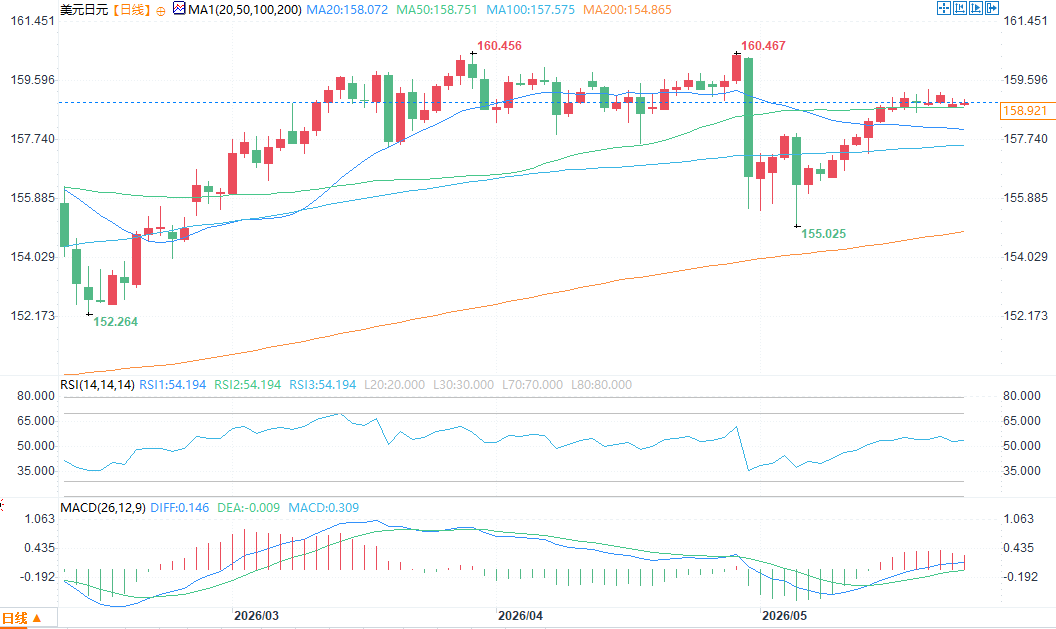
(USD/JPY daily chart, source: FX678)
Regarding the moving average system, the 20-day moving average (MA20) (158.07) and the 50-day moving average (MA50) are both below the current price, forming short-term support; while the 100-day moving average (MA100) (157.58) and the 200-day moving average (MA200) are well below the current price, showing a bullish alignment. This alignment of "price above all major moving averages" indicates that the USD/JPY pair remains in a clear upward trend.
At 11:29 Beijing time on May 26, the USD/JPY exchange rate was 158.91/92.
Bank of Japan Deputy Governor Ryozo Himino reiterated the central bank's commitment to raising interest rates during his testimony before parliament on Monday, sending a clear directional signal while maintaining clear flexibility on timing, given the unresolved conflict in the Middle East. Himino's core message was unambiguous: the Bank of Japan will continue to raise policy rates, gradually reduce the degree of monetary easing, and adjust the pace according to economic activity, price levels, and financial conditions.
This statement maintains the integrity of the austerity path while preserving the necessary policy discretion should the conflict with Iran have an unexpected negative impact on the Japanese economy.
The situation in the Middle East is a key variable: it will affect the timing and pace of interest rate hikes.
The situation in the Middle East occupied a prominent position in Ryozo Himino's speech. He acknowledged that the Bank of Japan's economic outlook depends on how the situation develops, and stated that the central bank will weigh the timing and pace of further adjustments based on its assessment of how the regional situation transmits to the domestic situation and whether the baseline scenario is still on track. This is a cautious hedging strategy, but not a retreat: the direction forward is beyond doubt.
Ryozo Himino emphasized in the Diet that the premise for policy adjustments is that "current economic and price expectations can be achieved," implying that if the escalation of the situation in the Middle East causes the Japanese economy to deviate from its baseline, the timetable for raising interest rates may be forced to be postponed.
Bond Market: Rising Long-Term Interest Rates Reflect Global Inflation Concerns
Regarding the bond market, Ryozo Himino pointed out that the recent rise in long-term interest rates reflects global inflation anxiety, rather than a deterioration unique to Japan. The yield on 40-year Japanese government bonds once broke through 4% to reach a record high, and the yield on 10-year Japanese government bonds rose to 2.8%, the highest since 1996. Behind this are both the common factors of rising global inflation expectations and the "fiscal risk premium" caused by Japan's fiscal expansion.
A survey of investors by the central bank revealed a divergence of opinion in the market regarding the pace of tapering bond purchases: some called for a pause to stabilize market function, while others advocated for a continued gradual reduction. The central bank is expected to formally review the bond-buying program at its June meeting.
Given the size of the central bank's balance sheet (holding over 50% of Japanese government bonds) and the risk of disorderly fluctuations in the Japanese government bond market, this process is highly sensitive. The central bank has slowed the pace of its bond purchases from 400 billion yen per quarter to 200 billion yen, seeking a balance between "market stability" and "functional improvement."
Ryozo Himino emphasized that the Bank of Japan will decide on interest rate hikes based on economic, inflation, and financial conditions, while closely monitoring bond market conditions and market functions to ensure that policy adjustments do not cause market turmoil.
On the fiscal front: The Finance Minister pledged to respond promptly to protect households.
Finance Minister Katsunobu Kato stated that the government will closely monitor the impact of the situation in the Middle East on Japanese prices and the economy, and pledged to respond promptly to ease the burden on households.
Prime Minister Sanae Takaichi has announced subsidies for electricity and gas bills from July to September and plans to allocate approximately 500 billion yen from the 2026 fiscal year budget reserve. A supplementary budget totaling over 3 trillion yen is expected to be submitted to the Diet as early as next week. These measures reflect that energy-driven inflation has become a cost-of-living issue requiring proactive government intervention.
However, the massive fiscal spending is raising concerns about the health of Japan's public finances. The supplementary budget will be financed by issuing additional deficit bonds, and with Japan's fiscal year 2026 budget already at 122.3 trillion yen, this supplementary budget is a further blow. As a result, the yield on 10-year Japanese government bonds rose to 2.8%, a new high since 1996.
There are also divisions within the Liberal Democratic Party. Secretary-General Shunichi Suzuki stated that the fiscal burden is too heavy and requires serious consideration, while Koichi Hagiuda believes that maintaining subsidies in the long term is unrealistic. While actively intervening to alleviate the pressure on people's livelihoods, the government faces a severe test of fiscal sustainability.
Consumption tax rate: The Deputy Chief Cabinet Secretary said no decision has been made yet.
Deputy Chief Cabinet Secretary Hiroshi Ozaki addressed speculation about a possible change to the consumption tax, stating that the government was aware of the reports but had not yet made any decision. He declined to predict the outcome, a statement that neither dispelled nor confirmed the speculation.
The Liberal Democratic Party's tax system research committee has formally proposed a significant reduction in the food consumption tax from the current 8% to 1%, instead of the previously discussed zero tax rate. This would allow restaurants to complete their POS system upgrades more quickly (a zero tax rate would take about a year, while 1% would only take three to six months). Prime Minister Sanae Takaichi is expected to make a final decision by the end of June, but supporting measures have not yet been finalized.
The direction of monetary tightening is clear, but the situation in the Middle East will determine the timing of interest rate hikes.
In conclusion, Ryozo Himino's testimony to the Diet reinforced the Bank of Japan's tightening signals and injected confidence into the yen market amid uncertainty surrounding the Middle East situation and the outlook for Asian interest rates.
While the pace remains conditional, the clear commitment to continued interest rate hikes makes the direction forward unambiguous. Ryozo Himino acknowledged that rising long-term yields reflect global inflation concerns, which will complicate the Bank of Japan's review of bond tapering—a too-rapid reduction in purchases could further steepen the yield curve during a politically sensitive period.
Finance Minister Kato's separate comments suggest that the fiscal front is also on high alert, raising the question of to what extent coordinated household relief measures will offset or complicate the Bank of Japan's tightening path.
USD/JPY Daily Technical Analysis
From the daily chart, USD/JPY is currently trading around 158.90, in a high-level consolidation phase after a continuous rise. Several technical indicators show bullish signals, but the momentum has slowed down.
(USD/JPY daily chart, source: FX678)
Regarding the moving average system, the 20-day moving average (MA20) (158.07) and the 50-day moving average (MA50) are both below the current price, forming short-term support; while the 100-day moving average (MA100) (157.58) and the 200-day moving average (MA200) are well below the current price, showing a bullish alignment. This alignment of "price above all major moving averages" indicates that the USD/JPY pair remains in a clear upward trend.
At 11:29 Beijing time on May 26, the USD/JPY exchange rate was 158.91/92.
- Risk Warning and Disclaimer
- The market involves risk, and trading may not be suitable for all investors. This article is for reference only and does not constitute personal investment advice, nor does it take into account certain users’ specific investment objectives, financial situation, or other needs. Any investment decisions made based on this information are at your own risk.