Divergent expectations for Fed rate cuts persist, but Bank of America remains bullish on gold in the medium term.
2026-05-26 11:47:26
The international gold market has recently been fluctuating at high levels, and Bank of America's latest views have once again attracted market attention. Michael Widmer, Managing Director and Head of Metals Research at Bank of America, said that gold may continue to be under pressure in the short term as the market is reassessing the future path of US interest rates, but in the medium to long term, the bank remains firmly bullish on gold and maintains its forecast that gold prices will rise to $6,000 per ounce in the next 12 months.

Widmer points out that the main pressure currently facing the gold market comes from the rapid cooling of global investors' expectations for US interest rate cuts. Previously, the market generally believed that the Federal Reserve would gradually enter a rate-cutting cycle in the coming months, but with recent resilient US inflation data and the Middle East situation pushing up energy prices, the market is beginning to worry that the risk of imported inflation may resurface.
Especially against the backdrop of ongoing tensions between the US and Iran, international crude oil prices have recently remained volatile at high levels. Market concerns that shipping risks through the Strait of Hormuz could impact global energy supplies, thereby pushing up crude oil and natural gas prices and further exacerbating inflationary pressures in the US. In this environment, market bets on a rapid future interest rate cut by the Federal Reserve have significantly decreased. Some institutions have even begun to discuss again whether the Fed needs to maintain high interest rates for a longer period to prevent rising energy prices from pushing up overall inflation.
High interest rate environments typically exert temporary pressure on the white metals market. Since gold itself does not generate interest income, when US Treasury yields remain high, investors tend to prefer holding higher-yielding dollar assets, thus diminishing the appeal of gold. Recently, the yield on 10-year US Treasury bonds has remained high, and the dollar index has also been supported by safe-haven demand and expectations of high interest rates, which has somewhat suppressed the short-term upward trend of gold.
However, Bank of America believes that this pressure is more of a temporary effect and will not change the long-term upward trend of gold. Widmer emphasized that the continued increase in gold reserves by global central banks remains the key factor driving the long-term rise in gold prices. In recent years, central banks in Asian countries, the Middle East, and some emerging economies have continuously expanded their gold reserves. The market generally believes that against the backdrop of increasing global geopolitical risks, rising dollar credit risk, and the continued expansion of global debt, central banks are increasing their gold holdings to enhance the security of their reserve assets.
Furthermore, Bank of America noted that global investor demand for gold ETFs and physical gold is gradually recovering. As global economic growth slows and market concerns about the risk of a future recession rise, gold's importance as a traditional safe-haven asset has been strengthened once again.
Recently, some US economic data have shown signs of slowing, including manufacturing activity, consumer confidence, and some employment data, all indicating that economic growth is cooling. The market believes that if the US economy weakens further, the Federal Reserve may eventually enter a rate-cutting cycle, which would again benefit the gold market. At the same time, the situation in the Middle East, global debt problems, and uncertainty in the global financial system continue to enhance the strategic allocation value of gold. Analysts point out that the gold market is no longer solely driven by traditional interest rate logic; global central bank gold purchases and geopolitical risks are becoming more important long-term supports.
From the daily chart, spot gold previously consolidated around $4620 and is currently fluctuating around $4540 . On the daily chart, the 20-day moving average continues its upward trend, indicating that the overall bullish structure remains intact. Although the MACD indicator has pulled back from its highs, the green histogram bars are shortening, suggesting a weakening of bearish momentum. The key resistance levels are currently around $4600 and $4650 ; a break above these levels could lead to a retest of historical highs. Key support levels are around $4520 and $4480 .
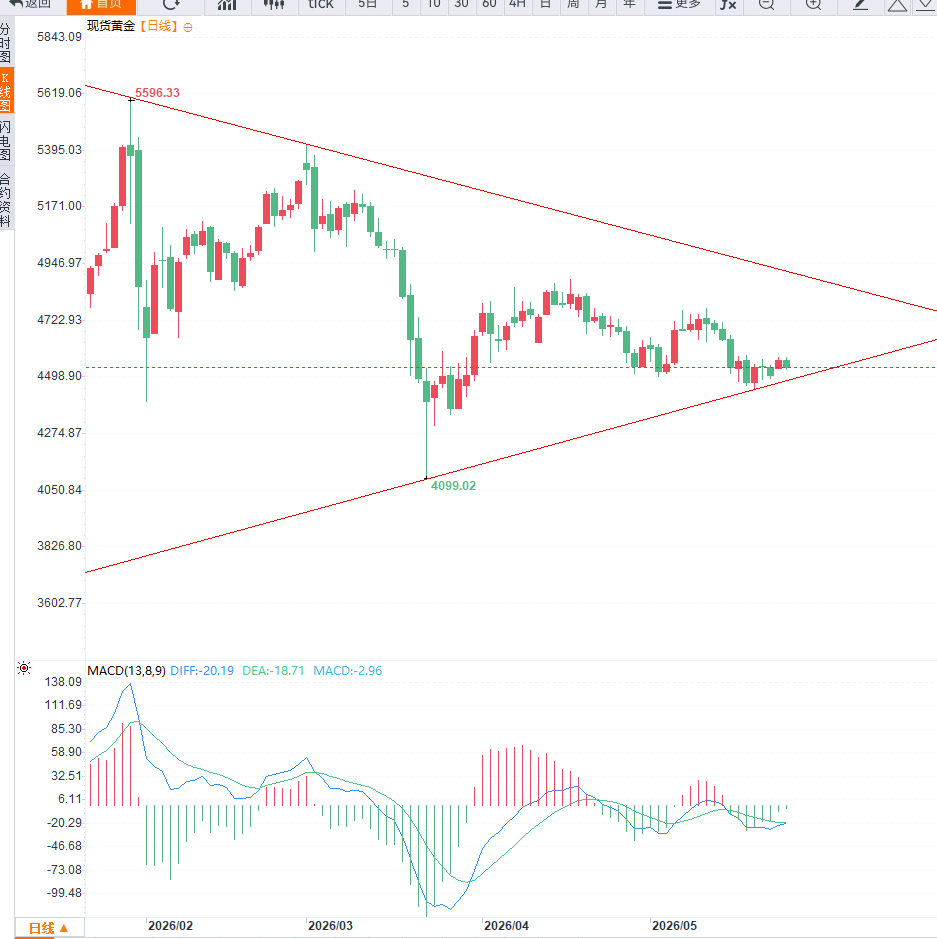
If subsequent US inflation data continues to be strong, the dollar and US Treasury yields may rise further, thus suppressing gold's short-term performance; however, if economic data weakens further, gold may regain upward momentum. Overall, the gold market is currently in a phase of balancing between "high interest rate pressure" and "long-term safe-haven demand," and short-term volatility may remain high.
Editor's Summary : Bank of America maintains its long-term bullish view on gold, reflecting that institutional concerns about long-term risks to the global economy and financial system have not disappeared. While in the short term, cooling expectations of a Fed rate cut and rising energy inflation risks have exerted some downward pressure on gold, continued gold purchases by global central banks, slowing economic growth, and geopolitical uncertainty still constitute important long-term support for gold. The future trend of the gold market will largely depend on changes in US inflation, the Fed's policy direction, and changes in global safe-haven demand. If the US economy slows further and the Fed eventually enters a rate-cutting cycle, the long-term upward logic for gold may be further strengthened.
Widmer points out that the main pressure currently facing the gold market comes from the rapid cooling of global investors' expectations for US interest rate cuts. Previously, the market generally believed that the Federal Reserve would gradually enter a rate-cutting cycle in the coming months, but with recent resilient US inflation data and the Middle East situation pushing up energy prices, the market is beginning to worry that the risk of imported inflation may resurface.
Especially against the backdrop of ongoing tensions between the US and Iran, international crude oil prices have recently remained volatile at high levels. Market concerns that shipping risks through the Strait of Hormuz could impact global energy supplies, thereby pushing up crude oil and natural gas prices and further exacerbating inflationary pressures in the US. In this environment, market bets on a rapid future interest rate cut by the Federal Reserve have significantly decreased. Some institutions have even begun to discuss again whether the Fed needs to maintain high interest rates for a longer period to prevent rising energy prices from pushing up overall inflation.
High interest rate environments typically exert temporary pressure on the white metals market. Since gold itself does not generate interest income, when US Treasury yields remain high, investors tend to prefer holding higher-yielding dollar assets, thus diminishing the appeal of gold. Recently, the yield on 10-year US Treasury bonds has remained high, and the dollar index has also been supported by safe-haven demand and expectations of high interest rates, which has somewhat suppressed the short-term upward trend of gold.
However, Bank of America believes that this pressure is more of a temporary effect and will not change the long-term upward trend of gold. Widmer emphasized that the continued increase in gold reserves by global central banks remains the key factor driving the long-term rise in gold prices. In recent years, central banks in Asian countries, the Middle East, and some emerging economies have continuously expanded their gold reserves. The market generally believes that against the backdrop of increasing global geopolitical risks, rising dollar credit risk, and the continued expansion of global debt, central banks are increasing their gold holdings to enhance the security of their reserve assets.
Furthermore, Bank of America noted that global investor demand for gold ETFs and physical gold is gradually recovering. As global economic growth slows and market concerns about the risk of a future recession rise, gold's importance as a traditional safe-haven asset has been strengthened once again.
Recently, some US economic data have shown signs of slowing, including manufacturing activity, consumer confidence, and some employment data, all indicating that economic growth is cooling. The market believes that if the US economy weakens further, the Federal Reserve may eventually enter a rate-cutting cycle, which would again benefit the gold market. At the same time, the situation in the Middle East, global debt problems, and uncertainty in the global financial system continue to enhance the strategic allocation value of gold. Analysts point out that the gold market is no longer solely driven by traditional interest rate logic; global central bank gold purchases and geopolitical risks are becoming more important long-term supports.
From the daily chart, spot gold previously consolidated around $4620 and is currently fluctuating around $4540 . On the daily chart, the 20-day moving average continues its upward trend, indicating that the overall bullish structure remains intact. Although the MACD indicator has pulled back from its highs, the green histogram bars are shortening, suggesting a weakening of bearish momentum. The key resistance levels are currently around $4600 and $4650 ; a break above these levels could lead to a retest of historical highs. Key support levels are around $4520 and $4480 .
If subsequent US inflation data continues to be strong, the dollar and US Treasury yields may rise further, thus suppressing gold's short-term performance; however, if economic data weakens further, gold may regain upward momentum. Overall, the gold market is currently in a phase of balancing between "high interest rate pressure" and "long-term safe-haven demand," and short-term volatility may remain high.
Editor's Summary : Bank of America maintains its long-term bullish view on gold, reflecting that institutional concerns about long-term risks to the global economy and financial system have not disappeared. While in the short term, cooling expectations of a Fed rate cut and rising energy inflation risks have exerted some downward pressure on gold, continued gold purchases by global central banks, slowing economic growth, and geopolitical uncertainty still constitute important long-term support for gold. The future trend of the gold market will largely depend on changes in US inflation, the Fed's policy direction, and changes in global safe-haven demand. If the US economy slows further and the Fed eventually enters a rate-cutting cycle, the long-term upward logic for gold may be further strengthened.
- Risk Warning and Disclaimer
- The market involves risk, and trading may not be suitable for all investors. This article is for reference only and does not constitute personal investment advice, nor does it take into account certain users’ specific investment objectives, financial situation, or other needs. Any investment decisions made based on this information are at your own risk.