Geopolitical tensions persist, and the US dollar index remains volatile at high levels.
2026-05-26 13:10:22
The US dollar index (DXY) extended its rebound in Asian trading on Tuesday, rising back to around 99.10 after a brief pullback. Current market reassessment of the situation in the Middle East, the Federal Reserve's policy path, and global risk sentiment is driving renewed safe-haven buying for the dollar.
Recently, negotiations between the United States and Iran regarding a ceasefire agreement and the reopening of the Strait of Hormuz have continued to be a focus of global financial markets. Previously, US President Trump stated that the negotiations were "progressing well," leading to market expectations that the situation in the Middle East might gradually ease, thus causing a temporary decline in demand for the US dollar as a safe haven.
However, the situation subsequently fluctuated again. On Monday, the US military launched a "self-defense strike" against southern Iran, targeting missile launch sites. US Central Command stated that the US military would exercise restraint during the ceasefire, but emphasized that it would continue to protect troops stationed in the Middle East and maritime transport. This news quickly increased risk aversion in the market. Since the Strait of Hormuz handles approximately 20% of global seaborne crude oil transport, investors are concerned that any new military conflict could impact global energy supplies and further push up international oil prices.
Amid rising risk aversion in global markets, the US dollar, as a core safe-haven currency, has once again become a sought-after asset. The dollar index had previously fallen to a more than one-week low, but as markets reassessed Middle East risks, funds flowed back into the dollar and US Treasury markets, driving the dollar index back up. In addition to safe-haven demand, changes in expectations regarding the Federal Reserve's monetary policy have further supported the dollar's performance. Recently, some US inflation data have remained high, while the situation in the Middle East has led to a resurgence in international energy prices, raising concerns that energy-related inflation could again push up overall US price levels.
The market currently widely believes that the Federal Reserve may need to maintain a high-interest-rate environment for an extended period to control potential inflationary pressures. According to the CME FedWatch tool, the market is already pricing in a near 41% probability of another 25 basis point rate hike by the Fed this year. This expectation is driving US Treasury yields to remain high and further enhancing the attractiveness of the US dollar. The high-interest-rate environment not only increases the yields of dollar-denominated assets but also attracts continuous global capital flows into the US market.
The market's focus has now shifted to the upcoming release of the US Personal Consumption Expenditures Price Index (PCE). As one of the core inflation indicators most closely watched by the Federal Reserve, the PCE data will directly influence market expectations regarding future policy paths. If the PCE data shows that US inflation remains higher than expected, the market may further strengthen its expectation that the Fed will maintain a hawkish stance, thereby pushing the dollar higher. However, if inflation shows clear signs of slowing, it may weaken the dollar's short-term upward momentum.
Meanwhile, the situation in the Middle East remains a crucial variable influencing the US dollar. Although negotiations between the US and Iran continue, significant differences remain on key areas such as shipping safety in the Strait of Hormuz and the Iranian nuclear issue. The market believes that as long as the situation in the Middle East remains unstable, the demand for the US dollar as a safe haven will be difficult to completely subside. Furthermore, persistently high international oil prices may further intensify market concerns about inflation risks.
From the daily chart, the US dollar index rebounded after stabilizing around 97.80 , and has now risen back above the 99 level. On the daily chart, the 20-day moving average is gradually flattening, and the MACD indicator has returned to near the zero line, indicating that bearish pressure in the market is weakening. The current key resistance levels are at 99.50 and 100.20 . A decisive break above the 100 level could open up further upside potential; while key support levels are around 98.60 and 97.90 .
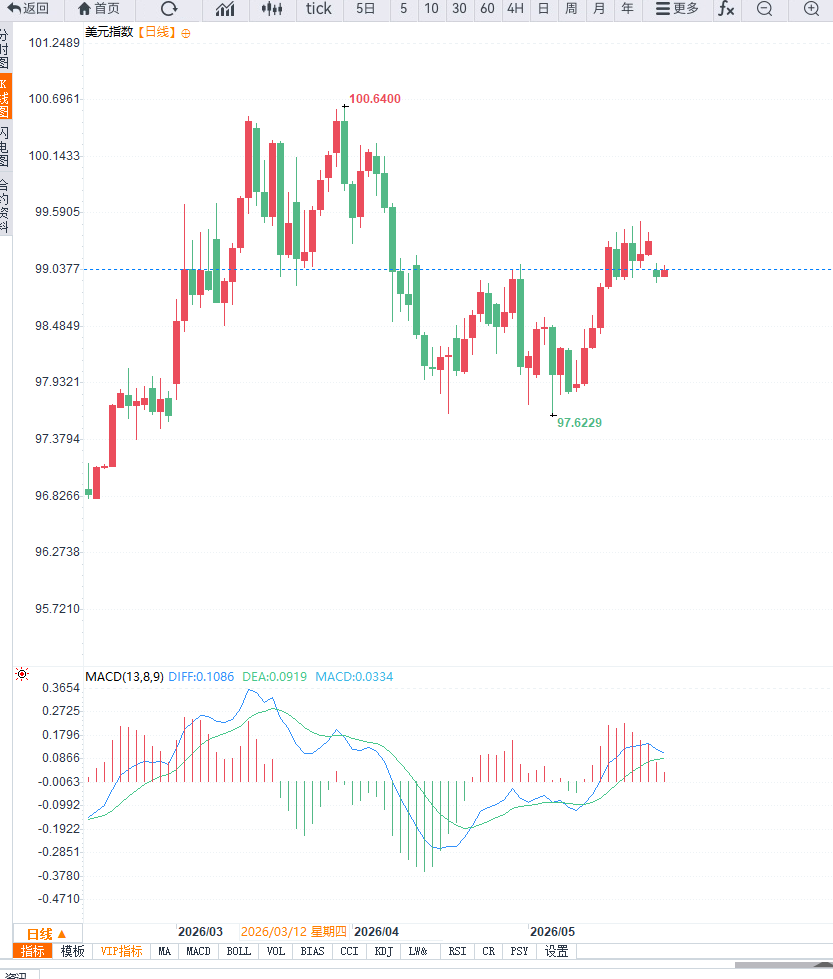
If subsequent US PCE data continues to be strong, the US dollar index may further test the 100 level; however, if the situation in the Middle East eases significantly and US inflation data cools down, the dollar may re-enter a period of consolidation at high levels. Overall, the current trend of the US dollar index is mainly driven by three factors: "safe-haven demand," "expectations of high interest rates from the Federal Reserve," and "global energy risks," and short-term market volatility may remain high.
Editor's Summary : The recent strengthening of the US dollar index reflects a market reassessment of the global risk environment and the path of US monetary policy. Uncertainty surrounding the Middle East is driving funds back into safe-haven assets like the US dollar, while rising international oil prices and resulting inflationary risks have reinforced market expectations that the Federal Reserve will maintain high interest rates for an extended period. However, the future trajectory of the dollar remains highly uncertain. If US inflation data remains high, the dollar may receive further support; but if signs of economic slowdown intensify and market expectations for future interest rate cuts resurface, the dollar's upside potential may be limited. Investors should pay close attention to US PCE data, developments in the Middle East, and statements from Federal Reserve officials.
Recently, negotiations between the United States and Iran regarding a ceasefire agreement and the reopening of the Strait of Hormuz have continued to be a focus of global financial markets. Previously, US President Trump stated that the negotiations were "progressing well," leading to market expectations that the situation in the Middle East might gradually ease, thus causing a temporary decline in demand for the US dollar as a safe haven.
However, the situation subsequently fluctuated again. On Monday, the US military launched a "self-defense strike" against southern Iran, targeting missile launch sites. US Central Command stated that the US military would exercise restraint during the ceasefire, but emphasized that it would continue to protect troops stationed in the Middle East and maritime transport. This news quickly increased risk aversion in the market. Since the Strait of Hormuz handles approximately 20% of global seaborne crude oil transport, investors are concerned that any new military conflict could impact global energy supplies and further push up international oil prices.
Amid rising risk aversion in global markets, the US dollar, as a core safe-haven currency, has once again become a sought-after asset. The dollar index had previously fallen to a more than one-week low, but as markets reassessed Middle East risks, funds flowed back into the dollar and US Treasury markets, driving the dollar index back up. In addition to safe-haven demand, changes in expectations regarding the Federal Reserve's monetary policy have further supported the dollar's performance. Recently, some US inflation data have remained high, while the situation in the Middle East has led to a resurgence in international energy prices, raising concerns that energy-related inflation could again push up overall US price levels.
The market currently widely believes that the Federal Reserve may need to maintain a high-interest-rate environment for an extended period to control potential inflationary pressures. According to the CME FedWatch tool, the market is already pricing in a near 41% probability of another 25 basis point rate hike by the Fed this year. This expectation is driving US Treasury yields to remain high and further enhancing the attractiveness of the US dollar. The high-interest-rate environment not only increases the yields of dollar-denominated assets but also attracts continuous global capital flows into the US market.
The market's focus has now shifted to the upcoming release of the US Personal Consumption Expenditures Price Index (PCE). As one of the core inflation indicators most closely watched by the Federal Reserve, the PCE data will directly influence market expectations regarding future policy paths. If the PCE data shows that US inflation remains higher than expected, the market may further strengthen its expectation that the Fed will maintain a hawkish stance, thereby pushing the dollar higher. However, if inflation shows clear signs of slowing, it may weaken the dollar's short-term upward momentum.
Meanwhile, the situation in the Middle East remains a crucial variable influencing the US dollar. Although negotiations between the US and Iran continue, significant differences remain on key areas such as shipping safety in the Strait of Hormuz and the Iranian nuclear issue. The market believes that as long as the situation in the Middle East remains unstable, the demand for the US dollar as a safe haven will be difficult to completely subside. Furthermore, persistently high international oil prices may further intensify market concerns about inflation risks.
From the daily chart, the US dollar index rebounded after stabilizing around 97.80 , and has now risen back above the 99 level. On the daily chart, the 20-day moving average is gradually flattening, and the MACD indicator has returned to near the zero line, indicating that bearish pressure in the market is weakening. The current key resistance levels are at 99.50 and 100.20 . A decisive break above the 100 level could open up further upside potential; while key support levels are around 98.60 and 97.90 .
If subsequent US PCE data continues to be strong, the US dollar index may further test the 100 level; however, if the situation in the Middle East eases significantly and US inflation data cools down, the dollar may re-enter a period of consolidation at high levels. Overall, the current trend of the US dollar index is mainly driven by three factors: "safe-haven demand," "expectations of high interest rates from the Federal Reserve," and "global energy risks," and short-term market volatility may remain high.
Editor's Summary : The recent strengthening of the US dollar index reflects a market reassessment of the global risk environment and the path of US monetary policy. Uncertainty surrounding the Middle East is driving funds back into safe-haven assets like the US dollar, while rising international oil prices and resulting inflationary risks have reinforced market expectations that the Federal Reserve will maintain high interest rates for an extended period. However, the future trajectory of the dollar remains highly uncertain. If US inflation data remains high, the dollar may receive further support; but if signs of economic slowdown intensify and market expectations for future interest rate cuts resurface, the dollar's upside potential may be limited. Investors should pay close attention to US PCE data, developments in the Middle East, and statements from Federal Reserve officials.
- Risk Warning and Disclaimer
- The market involves risk, and trading may not be suitable for all investors. This article is for reference only and does not constitute personal investment advice, nor does it take into account certain users’ specific investment objectives, financial situation, or other needs. Any investment decisions made based on this information are at your own risk.