Demand for the US dollar as a safe haven increased, causing the euro to fall slightly against the dollar.
2026-05-26 14:18:42
The euro continued to be pressured against the dollar (EUR/USD) during Tuesday's European trading session, falling back to around 1.1630 . The dollar regained safe-haven buying support amid renewed tensions in the Middle East, while the euro experienced a temporary pullback due to cooling market risk appetite.

The core focus of global financial markets remains on the ceasefire negotiations between the United States and Iran and the security situation in the Strait of Hormuz. Previously, US President Trump stated that the negotiations were "progressing well," leading to market expectations that the situation in the Middle East might gradually ease, thus pushing down the US dollar index and supporting a rebound in risk currencies such as the euro.
However, the situation subsequently shifted significantly. The U.S. Central Command stated that the U.S. military had launched a "self-defense strike" against southern Iran. The U.S. military stated that the operation was intended to protect U.S. forces and emphasized that it would exercise restraint during the current ceasefire. This military action reignited market concerns about an escalation of the Middle East conflict. Since the Strait of Hormuz handles approximately 20% of global seaborne crude oil transport, investors worry that any military escalation could impact global energy supplies and push up international oil prices again.
U.S. Secretary of State Marco Rubio further stated that the Strait of Hormuz must "remain open in some way," while noting that negotiations between the U.S. and Iran regarding the specific wording of the agreement could still take several days. Markets interpret this as meaning that while the U.S. and Iran are still working towards a ceasefire framework, significant differences remain on key issues, including shipping safety in the Strait of Hormuz and the Iranian nuclear issue.
Against this backdrop, risk aversion has resurfaced in global markets, leading to a renewed flow of funds into dollar assets. The dollar index has therefore rebounded from its previous lows, putting pressure on the euro against the dollar.
Meanwhile, energy risks stemming from the situation in the Middle East are also beginning to influence the European Central Bank's policy expectations. Given Europe's sensitivity to energy price fluctuations, rising international oil prices could further push up inflation in the Eurozone.
European Central Bank (ECB) official Martin Koch recently stated that the ECB is increasingly inclined to raise interest rates again next month as the situation in Iran pushes up energy prices and inflation risks. Market data shows that financial markets have already priced in nearly an 85% probability of a 25 basis point rate hike at the ECB's next meeting.
Hawkish expectations from the European Central Bank (ECB) have somewhat limited the euro's decline. The market believes that if the ECB continues its tightening policy and eurozone inflation remains high, the euro will still have some support in the medium to long term. However, the safe-haven demand for the US dollar still dominates in the short term. Especially given the unresolved situation in the Middle East, funds are more inclined to flow into the US dollar and US Treasury markets.
Furthermore, overall US economic data remains resilient, and market expectations that the Federal Reserve will maintain high interest rates for an extended period continue to support the dollar's performance. Recent increases in international oil prices have fueled concerns about energy inflation, prompting some investors to revisit the possibility of further Fed rate hikes this year.
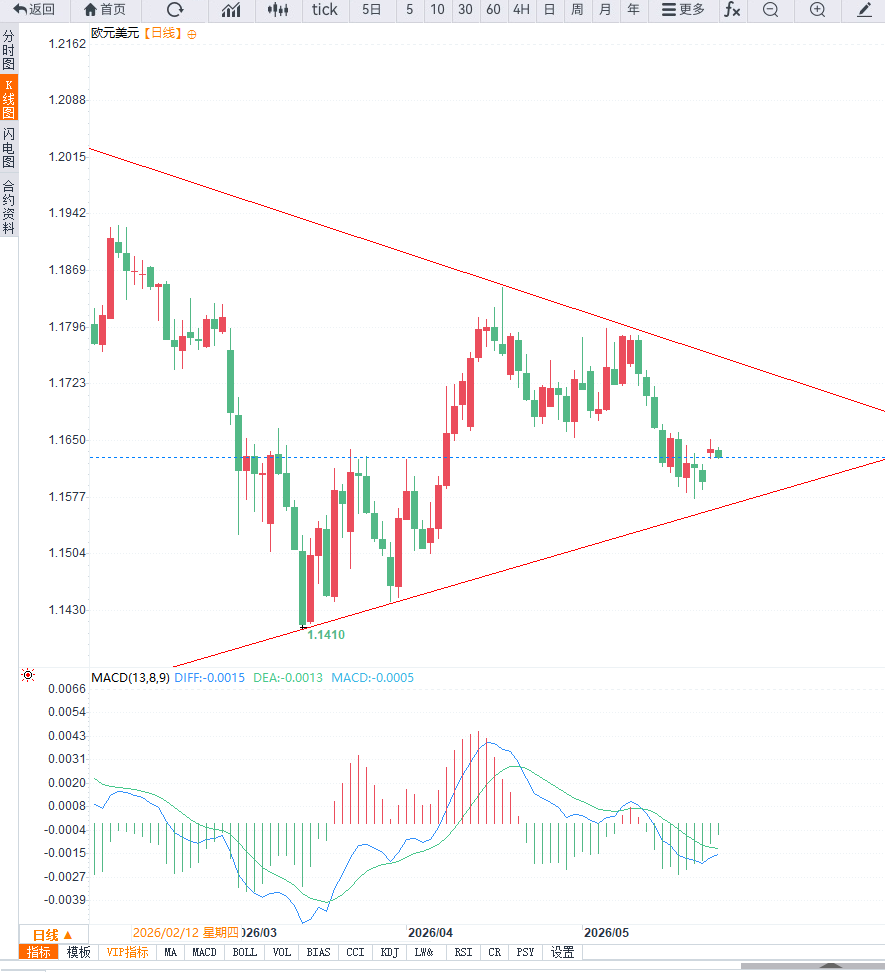
From the daily chart, the euro/dollar pair experienced a technical pullback after encountering resistance near 1.1700 , and the exchange rate has currently fallen back to the 1.1630 area. On the daily chart, the 20-day moving average remains upward, indicating that the overall uptrend has not been completely broken. The MACD indicator's red histogram bars are beginning to shorten, indicating a weakening of bullish momentum. The current key resistance levels are at 1.1665 and the 1.1700 area; a break above these levels could lead to a retest of the monthly high. On the downside, the first key support level is around 1.1600 , with further support at 1.1565 and 1.1520 .
If the situation in the Middle East escalates further, the demand for the US dollar as a safe haven may continue to increase, further suppressing the euro. However, if expectations of a European Central Bank (ECB) interest rate hike continue to rise, the downside potential of the exchange rate may be limited. Overall, the current euro/dollar exchange rate movement is mainly influenced by three factors: Middle East geopolitical risks, demand for the US dollar as a safe haven, and expectations of an ECB interest rate hike. Short-term market volatility is likely to remain high.
Editor's Summary : The recent decline in the euro against the US dollar reflects the market's rebalancing between safe-haven demand and hawkish expectations from the European Central Bank. Escalating tensions in the Middle East have driven renewed safe-haven inflows into the dollar, while rising international oil prices have further strengthened expectations of global inflation risks. However, the continued increase in the probability of an ECB rate hike provides some medium- to long-term support for the euro. Therefore, the future trend of the euro against the dollar will still depend on developments in the Middle East, the policy paths of the Federal Reserve and the European Central Bank, and changes in global risk sentiment.
The core focus of global financial markets remains on the ceasefire negotiations between the United States and Iran and the security situation in the Strait of Hormuz. Previously, US President Trump stated that the negotiations were "progressing well," leading to market expectations that the situation in the Middle East might gradually ease, thus pushing down the US dollar index and supporting a rebound in risk currencies such as the euro.
However, the situation subsequently shifted significantly. The U.S. Central Command stated that the U.S. military had launched a "self-defense strike" against southern Iran. The U.S. military stated that the operation was intended to protect U.S. forces and emphasized that it would exercise restraint during the current ceasefire. This military action reignited market concerns about an escalation of the Middle East conflict. Since the Strait of Hormuz handles approximately 20% of global seaborne crude oil transport, investors worry that any military escalation could impact global energy supplies and push up international oil prices again.
U.S. Secretary of State Marco Rubio further stated that the Strait of Hormuz must "remain open in some way," while noting that negotiations between the U.S. and Iran regarding the specific wording of the agreement could still take several days. Markets interpret this as meaning that while the U.S. and Iran are still working towards a ceasefire framework, significant differences remain on key issues, including shipping safety in the Strait of Hormuz and the Iranian nuclear issue.
Against this backdrop, risk aversion has resurfaced in global markets, leading to a renewed flow of funds into dollar assets. The dollar index has therefore rebounded from its previous lows, putting pressure on the euro against the dollar.
Meanwhile, energy risks stemming from the situation in the Middle East are also beginning to influence the European Central Bank's policy expectations. Given Europe's sensitivity to energy price fluctuations, rising international oil prices could further push up inflation in the Eurozone.
European Central Bank (ECB) official Martin Koch recently stated that the ECB is increasingly inclined to raise interest rates again next month as the situation in Iran pushes up energy prices and inflation risks. Market data shows that financial markets have already priced in nearly an 85% probability of a 25 basis point rate hike at the ECB's next meeting.
Hawkish expectations from the European Central Bank (ECB) have somewhat limited the euro's decline. The market believes that if the ECB continues its tightening policy and eurozone inflation remains high, the euro will still have some support in the medium to long term. However, the safe-haven demand for the US dollar still dominates in the short term. Especially given the unresolved situation in the Middle East, funds are more inclined to flow into the US dollar and US Treasury markets.
Furthermore, overall US economic data remains resilient, and market expectations that the Federal Reserve will maintain high interest rates for an extended period continue to support the dollar's performance. Recent increases in international oil prices have fueled concerns about energy inflation, prompting some investors to revisit the possibility of further Fed rate hikes this year.
From the daily chart, the euro/dollar pair experienced a technical pullback after encountering resistance near 1.1700 , and the exchange rate has currently fallen back to the 1.1630 area. On the daily chart, the 20-day moving average remains upward, indicating that the overall uptrend has not been completely broken. The MACD indicator's red histogram bars are beginning to shorten, indicating a weakening of bullish momentum. The current key resistance levels are at 1.1665 and the 1.1700 area; a break above these levels could lead to a retest of the monthly high. On the downside, the first key support level is around 1.1600 , with further support at 1.1565 and 1.1520 .
If the situation in the Middle East escalates further, the demand for the US dollar as a safe haven may continue to increase, further suppressing the euro. However, if expectations of a European Central Bank (ECB) interest rate hike continue to rise, the downside potential of the exchange rate may be limited. Overall, the current euro/dollar exchange rate movement is mainly influenced by three factors: Middle East geopolitical risks, demand for the US dollar as a safe haven, and expectations of an ECB interest rate hike. Short-term market volatility is likely to remain high.
Editor's Summary : The recent decline in the euro against the US dollar reflects the market's rebalancing between safe-haven demand and hawkish expectations from the European Central Bank. Escalating tensions in the Middle East have driven renewed safe-haven inflows into the dollar, while rising international oil prices have further strengthened expectations of global inflation risks. However, the continued increase in the probability of an ECB rate hike provides some medium- to long-term support for the euro. Therefore, the future trend of the euro against the dollar will still depend on developments in the Middle East, the policy paths of the Federal Reserve and the European Central Bank, and changes in global risk sentiment.
- Risk Warning and Disclaimer
- The market involves risk, and trading may not be suitable for all investors. This article is for reference only and does not constitute personal investment advice, nor does it take into account certain users’ specific investment objectives, financial situation, or other needs. Any investment decisions made based on this information are at your own risk.