Rubio declares: "If the Strait doesn't open, we'll fight!" Oil prices hover around $92, awaiting a directional move.
2026-05-26 14:38:04
On Tuesday (May 26), West Texas Intermediate crude oil futures on the New York Mercantile Exchange rose about 1.5%, trading around $91.70. Oil prices extended their earlier gains, driven by renewed uncertainty in the Middle East following the US military strikes on Iranian missile launch sites and mine-laying vessels.
However, the impact of the renewed uncertainty in the Middle East appears to be limited, as U.S. Central Command has clarified that the strikes were "self-defense" in nature and not intended to undermine the ceasefire. Central Command spokesman Tim Hawkins emphasized in a statement that the U.S. military will continue to "exercise restraint" during the ongoing ceasefire, and that the strikes were solely to protect U.S. forces from "threats posed by Iranian forces." This statement was interpreted by the market as a signal that the U.S. has no intention of proactively escalating the conflict, thus limiting the upside potential for oil prices.
However, Iranian media, in reporting on this matter, pointed out that "the US military admitted to violating the ceasefire agreement," implying a fundamental difference in the understanding of the nature of "self-defense" between the two sides.
Meanwhile, the highest levels of the US government continue to send diplomatic signals of optimism. According to media reports, US President Trump continues to express confidence that negotiations with Iran are "going well," posting on social media: "Negotiations with Iran are going well!" However, he also warned that if no agreement is reached, "we'll go back to the front lines, back to a state of fighting, but on a larger scale than ever before."
This dual-track strategy of "fighting while negotiating" preserves hope for an agreement and the reopening of the Strait of Hormuz, while maintaining a geopolitical risk premium through military deterrence. Iran, however, emphasizes that while both sides have reached conclusions on most issues, this "does not mean an agreement is imminent," indicating that uncertainties remain in the negotiations.
U.S. Secretary of State Marco Rubio further reinforced the U.S.'s hardline stance on Tuesday. He stated that the Strait of Hormuz—a critical waterway carrying nearly 20% of the world's energy supply—must be open "no matter what," and called its closure "illegal, unacceptable, and unsustainable" for the world.
When asked whether a US strike would affect the diplomatic process, Rubio stated unequivocally that an agreement could still be reached within days, and that both sides were engaged in a protracted discussion regarding the specific wording of the preliminary document. This statement places both "diplomatic mediation" and "military options" on the table simultaneously, implying that regardless of the outcome of the negotiations, the US will ensure the reopening of the Strait—the only difference being the path taken. For the energy market, in the short term, oil prices will still need to be priced in both scenarios: an agreement reached and an escalation of conflict.
A report from the International Energy Agency shows that global oil inventories are being depleted at a record rate. In March and April, global oil inventories fell by a combined 246 million barrels, currently standing at 7.952 billion barrels, the lowest level in 11 years. In April alone, global crude oil and refined product inventories declined by nearly 4 million barrels per day, equivalent to the combined consumption of the UK and Germany. If oil stranded in the Gulf region due to the near-blockade of the Strait of Hormuz is excluded, the actual decline is even steeper.
A Goldman Sachs report on May 20 indicated that global crude oil and product inventories saw a record daily decline of 8.7 million barrels in May. This is the fastest rate of depletion since the outbreak of the war, primarily driven by the dual blockade of the Strait of Hormuz, where crude oil exports have now fallen to 5% of normal capacity.
Analysts at BNP Paribas pointed out that US Secretary of State Rubio's statement that "the Strait will be open no matter what" actually limited the upside potential for oil prices. This is because it indicates that the US has no intention of escalating the conflict proactively, and that even if negotiations break down, the US will use military means to forcibly open the Strait, giving the market the expectation that "supply will eventually be restored."
TD Securities strategists believe the market is undergoing a structural reassessment of geopolitical risks. The core risk of a prolonged closure of the Strait of Hormuz has been significantly reduced due to the US's explicit statement that it will take military action to ensure the passage of troops through the Strait. Therefore, even with the ongoing military standoff between the US and Iran, the geopolitical premium in oil prices continues to diminish.
Barclays maintained its 2026 average Brent crude oil price forecast of $100 last week, while also warning of increased upside risks. The bank had previously described the current situation as "extremely difficult" and stated that "this is the largest supply disruption we have ever experienced." Their logic is that even if the conflict eases, supply chain repairs will take a long time, making it difficult for oil prices to quickly return to pre-war levels.
From the daily chart, US crude oil is currently trading around $91.80, in a weak consolidation phase after a recent pullback from highs, with multiple technical indicators showing bearish signals.
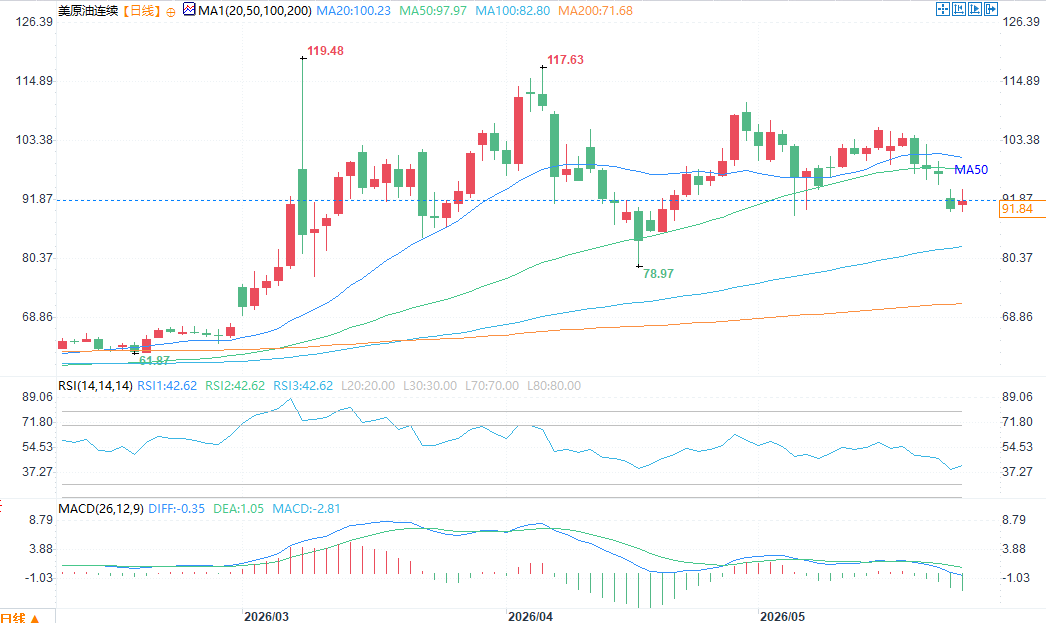
(US crude oil futures daily chart, source: FX678)
Regarding the moving average system, the 20-day moving average (MA20) (100.23) and the 50-day moving average (MA50) are both above the current price, forming significant resistance. The current price has broken below both MA20 and MA50, indicating a weak short-term trend. The 100-day moving average (MA100) (82.80) and the 200-day moving average (MA200) are significantly lower than the current price, suggesting that the long-term upward trend has not been completely broken, but short-term downward pressure is increasing. It is worth noting that the price has been trading below MA20 and MA50 for several consecutive trading days, indicating a relatively clear short-term bearish pattern.
In summary, US crude oil is currently supported by geopolitical uncertainties in the Middle East, but the self-defense nature of the US military strikes and Trump's confidence in negotiations limit the upside potential for oil prices. Technically, oil prices remain under pressure below the 20-day moving average, indicating a short-term bearish bias. Traders need to closely monitor the substantive progress of US-Iran negotiations and the navigation status of the Strait of Hormuz to determine the next direction of oil prices.
At 14:37 Beijing time on May 26, US crude oil futures were trading at $91.67 per barrel.
Geopolitical dynamics: Uncertainty rises after US "self-defense strike," but impact is limited.
However, the impact of the renewed uncertainty in the Middle East appears to be limited, as U.S. Central Command has clarified that the strikes were "self-defense" in nature and not intended to undermine the ceasefire. Central Command spokesman Tim Hawkins emphasized in a statement that the U.S. military will continue to "exercise restraint" during the ongoing ceasefire, and that the strikes were solely to protect U.S. forces from "threats posed by Iranian forces." This statement was interpreted by the market as a signal that the U.S. has no intention of proactively escalating the conflict, thus limiting the upside potential for oil prices.
However, Iranian media, in reporting on this matter, pointed out that "the US military admitted to violating the ceasefire agreement," implying a fundamental difference in the understanding of the nature of "self-defense" between the two sides.
Meanwhile, the highest levels of the US government continue to send diplomatic signals of optimism. According to media reports, US President Trump continues to express confidence that negotiations with Iran are "going well," posting on social media: "Negotiations with Iran are going well!" However, he also warned that if no agreement is reached, "we'll go back to the front lines, back to a state of fighting, but on a larger scale than ever before."
This dual-track strategy of "fighting while negotiating" preserves hope for an agreement and the reopening of the Strait of Hormuz, while maintaining a geopolitical risk premium through military deterrence. Iran, however, emphasizes that while both sides have reached conclusions on most issues, this "does not mean an agreement is imminent," indicating that uncertainties remain in the negotiations.
U.S. Secretary of State Marco Rubio further reinforced the U.S.'s hardline stance on Tuesday. He stated that the Strait of Hormuz—a critical waterway carrying nearly 20% of the world's energy supply—must be open "no matter what," and called its closure "illegal, unacceptable, and unsustainable" for the world.
When asked whether a US strike would affect the diplomatic process, Rubio stated unequivocally that an agreement could still be reached within days, and that both sides were engaged in a protracted discussion regarding the specific wording of the preliminary document. This statement places both "diplomatic mediation" and "military options" on the table simultaneously, implying that regardless of the outcome of the negotiations, the US will ensure the reopening of the Strait—the only difference being the path taken. For the energy market, in the short term, oil prices will still need to be priced in both scenarios: an agreement reached and an escalation of conflict.
Inventory running low
A report from the International Energy Agency shows that global oil inventories are being depleted at a record rate. In March and April, global oil inventories fell by a combined 246 million barrels, currently standing at 7.952 billion barrels, the lowest level in 11 years. In April alone, global crude oil and refined product inventories declined by nearly 4 million barrels per day, equivalent to the combined consumption of the UK and Germany. If oil stranded in the Gulf region due to the near-blockade of the Strait of Hormuz is excluded, the actual decline is even steeper.
A Goldman Sachs report on May 20 indicated that global crude oil and product inventories saw a record daily decline of 8.7 million barrels in May. This is the fastest rate of depletion since the outbreak of the war, primarily driven by the dual blockade of the Strait of Hormuz, where crude oil exports have now fallen to 5% of normal capacity.
Institutional Views
Analysts at BNP Paribas pointed out that US Secretary of State Rubio's statement that "the Strait will be open no matter what" actually limited the upside potential for oil prices. This is because it indicates that the US has no intention of escalating the conflict proactively, and that even if negotiations break down, the US will use military means to forcibly open the Strait, giving the market the expectation that "supply will eventually be restored."
TD Securities strategists believe the market is undergoing a structural reassessment of geopolitical risks. The core risk of a prolonged closure of the Strait of Hormuz has been significantly reduced due to the US's explicit statement that it will take military action to ensure the passage of troops through the Strait. Therefore, even with the ongoing military standoff between the US and Iran, the geopolitical premium in oil prices continues to diminish.
Barclays maintained its 2026 average Brent crude oil price forecast of $100 last week, while also warning of increased upside risks. The bank had previously described the current situation as "extremely difficult" and stated that "this is the largest supply disruption we have ever experienced." Their logic is that even if the conflict eases, supply chain repairs will take a long time, making it difficult for oil prices to quickly return to pre-war levels.
The moving average is providing significant resistance, and the short-term trend is weak.
From the daily chart, US crude oil is currently trading around $91.80, in a weak consolidation phase after a recent pullback from highs, with multiple technical indicators showing bearish signals.
(US crude oil futures daily chart, source: FX678)
Regarding the moving average system, the 20-day moving average (MA20) (100.23) and the 50-day moving average (MA50) are both above the current price, forming significant resistance. The current price has broken below both MA20 and MA50, indicating a weak short-term trend. The 100-day moving average (MA100) (82.80) and the 200-day moving average (MA200) are significantly lower than the current price, suggesting that the long-term upward trend has not been completely broken, but short-term downward pressure is increasing. It is worth noting that the price has been trading below MA20 and MA50 for several consecutive trading days, indicating a relatively clear short-term bearish pattern.
Geopolitical risks are providing support for oil prices, but they remain technically suppressed by moving averages.
In summary, US crude oil is currently supported by geopolitical uncertainties in the Middle East, but the self-defense nature of the US military strikes and Trump's confidence in negotiations limit the upside potential for oil prices. Technically, oil prices remain under pressure below the 20-day moving average, indicating a short-term bearish bias. Traders need to closely monitor the substantive progress of US-Iran negotiations and the navigation status of the Strait of Hormuz to determine the next direction of oil prices.
At 14:37 Beijing time on May 26, US crude oil futures were trading at $91.67 per barrel.
- Risk Warning and Disclaimer
- The market involves risk, and trading may not be suitable for all investors. This article is for reference only and does not constitute personal investment advice, nor does it take into account certain users’ specific investment objectives, financial situation, or other needs. Any investment decisions made based on this information are at your own risk.