Cooling inflation in Australia provides a reason to pause interest rate hikes; the Australian dollar faces short-term pressure but medium-term support remains.
2026-05-27 16:32:10
On Wednesday (May 27) during Asian trading hours, the Australian dollar weakened slightly against the US dollar after the release of April CPI data, trading below 0.7150, down about 0.3% on the day.
Data shows that Australia's overall inflation rate in April fell sharply to 4.2% year-on-year from 4.6%, lower than the market expectation of 4.4%; the monthly CPI increase plummeted from 1.1% to 0.4%, indicating that price pressures are easing. This data supports the Reserve Bank of Australia's decision to pause interest rate hikes at its June 15-16 meeting, and market expectations for a June rate hike have clearly cooled.

Commerzbank analyst Volkmar Bauer stated, "Unlike the Reserve Bank of New Zealand, the Reserve Bank of Australia has raised its key interest rate three times in recent months. However, the inflation data released this morning confirms our assessment: a pause in rate hikes is likely going forward." Prices unexpectedly fell in April, declining 0.1% month-on-month, primarily driven by lower transportation costs, partly due to a drop in gasoline prices compared to the previous month. After rising 33% in March, gasoline prices fell 7% in April.
Overall, prices are still significantly higher than pre-conflict levels in Iran, but this development has at least provided some relief to the market. Consequently, the annualized rate also fell from 4.6% to 4.2%—although still well above the Reserve Bank of Australia's target range of 2%-3%.
The central bank’s preferred measure of inflation—mean inflation, which excludes outliers at both ends of the calculation—rose slightly from the previous month. This is certainly a minor warning sign.
However, over the past three months, the annualized average inflation rate has been only 3.1%, just slightly above the central bank's target range. This should give the Reserve Bank of Australia confidence to allow the implemented interest rate hikes to take effect while temporarily observing the developments in the Iranian situation.
In conclusion, Commerzbank believes that the weaker-than-expected April inflation data in Australia provides ample justification for the Reserve Bank of Australia to pause interest rate hikes.
Although mean inflation, excluding volatility, has risen slightly, the three-month annualized average is close to the target range, which should give the central bank confidence to observe developments in Iran. Compared to other central banks, the Reserve Bank of Australia has already taken tightening action and now has more room to adopt a "wait and see" strategy.
From the daily chart, the Australian dollar is currently trading around 0.7150 against the US dollar, in a consolidation phase after the recent rebound, with multiple technical indicators showing neutral to weak signals.
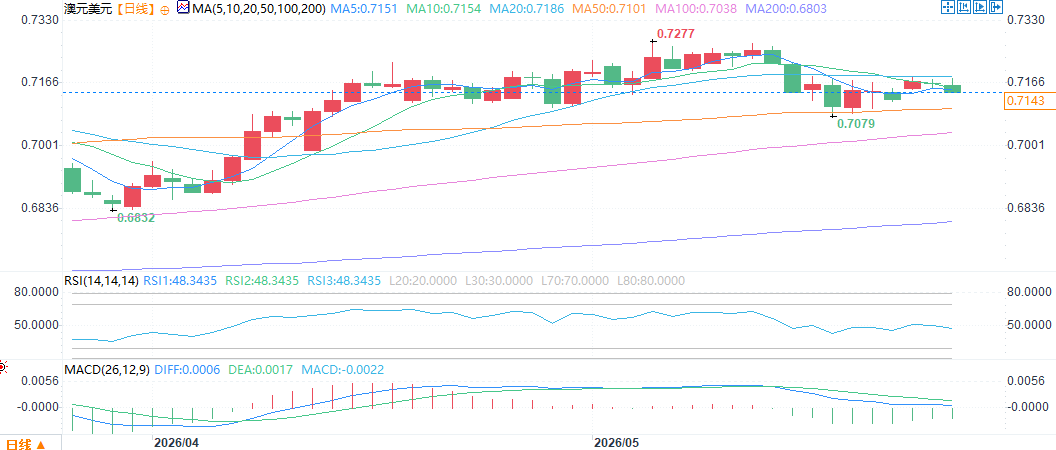
(AUD/USD daily chart, source: FX678)
Regarding the moving average system, the short-term moving averages MA5 (0.7151) and MA10 (0.7154) are roughly in line with the current price, while MA20 (0.7186) is above the current price, forming short-term resistance. MA50 (0.7101), MA100 (0.7038), and MA200 (0.6803) are below the current price, forming medium-term support. This arrangement of "price sandwiched between MA20 and MA50" indicates that the Australian dollar against the US dollar is at a critical juncture, facing short-term pressure but still possessing medium-term support.
Regarding the MACD indicator, the DIFF line is at 0.0006, and the DEA line is at 0.0017. The DIFF has crossed below the DEA, forming a death cross signal, but the angle of the death cross is extremely gentle. The MACD histogram value is -0.0022, which is negative but the amplitude is very small, indicating that the bearish momentum is very weak, and the bulls and bears are in a stalemate.
Regarding the RSI indicator, it is slightly below the 50 neutral threshold, indicating that bearish forces have a slight advantage, but this advantage is not significant. This reading is in the neutral zone, suggesting that the market still has room for further two-way fluctuations and has not yet entered an oversold state.
At 15:35 Beijing time on May 27, the Australian dollar was trading at 0.7143/44 against the Japanese yen.
Data shows that Australia's overall inflation rate in April fell sharply to 4.2% year-on-year from 4.6%, lower than the market expectation of 4.4%; the monthly CPI increase plummeted from 1.1% to 0.4%, indicating that price pressures are easing. This data supports the Reserve Bank of Australia's decision to pause interest rate hikes at its June 15-16 meeting, and market expectations for a June rate hike have clearly cooled.
Inflation data provides a reason to keep interest rates unchanged.
Commerzbank analyst Volkmar Bauer stated, "Unlike the Reserve Bank of New Zealand, the Reserve Bank of Australia has raised its key interest rate three times in recent months. However, the inflation data released this morning confirms our assessment: a pause in rate hikes is likely going forward." Prices unexpectedly fell in April, declining 0.1% month-on-month, primarily driven by lower transportation costs, partly due to a drop in gasoline prices compared to the previous month. After rising 33% in March, gasoline prices fell 7% in April.
Overall, prices are still significantly higher than pre-conflict levels in Iran, but this development has at least provided some relief to the market. Consequently, the annualized rate also fell from 4.6% to 4.2%—although still well above the Reserve Bank of Australia's target range of 2%-3%.
Excluding volatility, mean inflation is moderate, with the three-month annualized mean close to the target.
The central bank’s preferred measure of inflation—mean inflation, which excludes outliers at both ends of the calculation—rose slightly from the previous month. This is certainly a minor warning sign.
However, over the past three months, the annualized average inflation rate has been only 3.1%, just slightly above the central bank's target range. This should give the Reserve Bank of Australia confidence to allow the implemented interest rate hikes to take effect while temporarily observing the developments in the Iranian situation.
The Reserve Bank of Australia has reason to pause interest rate hikes and is monitoring developments in the Middle East.
In conclusion, Commerzbank believes that the weaker-than-expected April inflation data in Australia provides ample justification for the Reserve Bank of Australia to pause interest rate hikes.
Although mean inflation, excluding volatility, has risen slightly, the three-month annualized average is close to the target range, which should give the central bank confidence to observe developments in Iran. Compared to other central banks, the Reserve Bank of Australia has already taken tightening action and now has more room to adopt a "wait and see" strategy.
Australian Dollar to US Dollar Daily Technical Analysis
From the daily chart, the Australian dollar is currently trading around 0.7150 against the US dollar, in a consolidation phase after the recent rebound, with multiple technical indicators showing neutral to weak signals.
(AUD/USD daily chart, source: FX678)
Regarding the moving average system, the short-term moving averages MA5 (0.7151) and MA10 (0.7154) are roughly in line with the current price, while MA20 (0.7186) is above the current price, forming short-term resistance. MA50 (0.7101), MA100 (0.7038), and MA200 (0.6803) are below the current price, forming medium-term support. This arrangement of "price sandwiched between MA20 and MA50" indicates that the Australian dollar against the US dollar is at a critical juncture, facing short-term pressure but still possessing medium-term support.
Regarding the MACD indicator, the DIFF line is at 0.0006, and the DEA line is at 0.0017. The DIFF has crossed below the DEA, forming a death cross signal, but the angle of the death cross is extremely gentle. The MACD histogram value is -0.0022, which is negative but the amplitude is very small, indicating that the bearish momentum is very weak, and the bulls and bears are in a stalemate.
Regarding the RSI indicator, it is slightly below the 50 neutral threshold, indicating that bearish forces have a slight advantage, but this advantage is not significant. This reading is in the neutral zone, suggesting that the market still has room for further two-way fluctuations and has not yet entered an oversold state.
At 15:35 Beijing time on May 27, the Australian dollar was trading at 0.7143/44 against the Japanese yen.
- Risk Warning and Disclaimer
- The market involves risk, and trading may not be suitable for all investors. This article is for reference only and does not constitute personal investment advice, nor does it take into account certain users’ specific investment objectives, financial situation, or other needs. Any investment decisions made based on this information are at your own risk.