Escalating US-Iran conflict vs. UBS lowering its target: Who should we trust for silver?
2026-05-27 16:31:37
On Wednesday (May 27), silver prices fell for the second consecutive trading day, trading below $75, currently at $74.73 per ounce.
Renewed tensions in the Strait of Hormuz have fueled market concerns about energy-driven inflation, putting continued downward pressure on silver prices. These supply-side anxieties have reinforced market expectations that central banks will maintain a hawkish stance and keep interest rates high for an extended period.
Following the U.S. military's "self-defense" airstrikes in southern Iran, market optimism regarding a U.S.-Iran peace agreement quickly faded.
In response, Iran's Revolutionary Guard claimed that a U.S. F-35 fighter jet and several drones had violated Iranian airspace and were its targets. Iran's Foreign Ministry strongly condemned the airstrikes in southern Hormozgan province, calling it a "serious violation" of the fragile seven-week ceasefire.
Earlier, Iranian state media reported that a loud explosion was heard in the region early Tuesday morning.
Silver traders are closely watching the Federal Reserve's monetary policy outlook—a key driver influencing non-interest-bearing silver. Market sentiment was dampened by a slight decline in the U.S. consumer confidence index for May, falling 0.7 points to 93.1 from an upwardly revised 93.8 in April. This decline was primarily driven by escalating inflation anxieties related to the conflict with Iran. While households remain pessimistic about the current labor market in the short term, they are optimistic that conditions will improve by the end of the year.
Looking ahead, markets are closely watching speeches by Federal Reserve Vice Chairman Philip Jefferson and Governor Lisa Cook for clues about how sticky inflation will affect interest rates.
From the daily chart, spot silver is currently trading below $75.00, in a weak consolidation phase after a recent pullback from highs, with multiple technical indicators showing bearish signals.
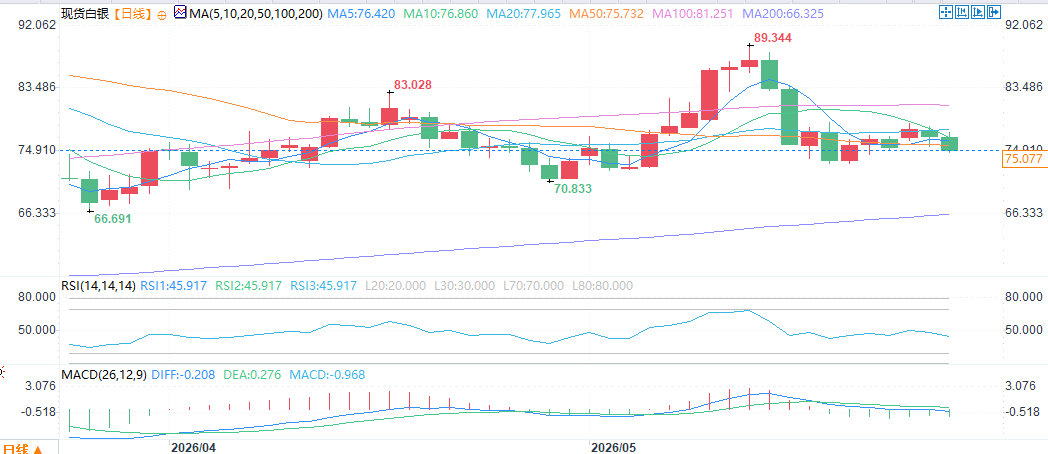
(Spot silver daily chart, source: EasyForex)
Regarding the moving average system, the current price has fallen below the MA5 (76.42), MA10 (76.86), and MA20 (77.97), indicating significant short-term pressure. The MA50 (75.73) is above the current price, representing a key level for the battle between bulls and bears; the MA100 (81.25) is significantly higher than the current price, indicating substantial medium-term resistance; and the MA200 (66.33) is below the current price, forming long-term support. This arrangement of "price below most short-term moving averages, testing the MA50 support" suggests that silver is in a short-term correction phase, with the 50-day moving average acting as a crucial dividing line between bulls and bears in the near term.
Regarding the MACD indicator, the DIFF line is at -0.208, and the DEA line is at 0.276. The DIFF has crossed below the DEA, forming a death cross signal, and the gap between the two lines is widening. The MACD histogram value is -0.968, which is negative and expanding, indicating that bearish momentum is continuing to be released.
The RSI is 45.92, below the 50 neutral threshold, indicating that bears are in control. This reading is still some distance from the oversold zone of 30, meaning there is still room for further price declines, and the extreme conditions for a technical rebound have not yet been met.
UBS strategists point out that silver is facing triple pressures: cooling investment demand, weakening industrial consumption, and a rebound in mine supply. The silver supply gap in 2026 is expected to narrow sharply from the previously estimated 300 million ounces to 60-70 million ounces.
Accordingly, the silver price targets for each stage have been lowered: from $100 to $85 at the end of the second quarter of 2026, from $95 to $85 at the end of the third quarter, from $85 to $80 at the end of the year, and the long-term target for March 2027 has been lowered from $85 to $75.
UBS points out that demand for silver in the photovoltaic industry has weakened due to high silver prices, and consumption of silverware and jewelry has also been suppressed by high prices, resulting in a combined reduction of approximately 50 million ounces in demand. The investment side is also weak, with global silver ETF holdings decreasing by nearly 70 million ounces, and speculative net long positions in futures also contracting significantly.
UBS believes that silver will mainly trade within a range, with little chance of a significant upward trend. They recommend a "sell volatility" strategy rather than going long.
In summary, silver is currently under pressure from both the uncertainty surrounding the US-Iran situation and expectations of a Federal Reserve interest rate hike. While the ongoing geopolitical conflict may generate safe-haven demand, concerns about energy-driven inflation reinforce expectations that central banks will maintain high interest rates, limiting silver's upside potential. In the short term, silver's price movement will depend on substantial progress in US-Iran negotiations, US PCE data, and subsequent statements from Federal Reserve officials.
At 15:53 Beijing time on May 27, spot silver was trading at $74.79 per ounce.
Renewed tensions in the Strait of Hormuz have fueled market concerns about energy-driven inflation, putting continued downward pressure on silver prices. These supply-side anxieties have reinforced market expectations that central banks will maintain a hawkish stance and keep interest rates high for an extended period.
US-Iran situation: Peace optimism rapidly fades, military conflict continues to escalate.
Following the U.S. military's "self-defense" airstrikes in southern Iran, market optimism regarding a U.S.-Iran peace agreement quickly faded.
In response, Iran's Revolutionary Guard claimed that a U.S. F-35 fighter jet and several drones had violated Iranian airspace and were its targets. Iran's Foreign Ministry strongly condemned the airstrikes in southern Hormozgan province, calling it a "serious violation" of the fragile seven-week ceasefire.
Earlier, Iranian state media reported that a loud explosion was heard in the region early Tuesday morning.
Fed Outlook: Consumer confidence index declines, market focuses on PCE data
Silver traders are closely watching the Federal Reserve's monetary policy outlook—a key driver influencing non-interest-bearing silver. Market sentiment was dampened by a slight decline in the U.S. consumer confidence index for May, falling 0.7 points to 93.1 from an upwardly revised 93.8 in April. This decline was primarily driven by escalating inflation anxieties related to the conflict with Iran. While households remain pessimistic about the current labor market in the short term, they are optimistic that conditions will improve by the end of the year.
Looking ahead, markets are closely watching speeches by Federal Reserve Vice Chairman Philip Jefferson and Governor Lisa Cook for clues about how sticky inflation will affect interest rates.
Spot silver daily chart technical analysis
From the daily chart, spot silver is currently trading below $75.00, in a weak consolidation phase after a recent pullback from highs, with multiple technical indicators showing bearish signals.
(Spot silver daily chart, source: EasyForex)
Regarding the moving average system, the current price has fallen below the MA5 (76.42), MA10 (76.86), and MA20 (77.97), indicating significant short-term pressure. The MA50 (75.73) is above the current price, representing a key level for the battle between bulls and bears; the MA100 (81.25) is significantly higher than the current price, indicating substantial medium-term resistance; and the MA200 (66.33) is below the current price, forming long-term support. This arrangement of "price below most short-term moving averages, testing the MA50 support" suggests that silver is in a short-term correction phase, with the 50-day moving average acting as a crucial dividing line between bulls and bears in the near term.
Regarding the MACD indicator, the DIFF line is at -0.208, and the DEA line is at 0.276. The DIFF has crossed below the DEA, forming a death cross signal, and the gap between the two lines is widening. The MACD histogram value is -0.968, which is negative and expanding, indicating that bearish momentum is continuing to be released.
The RSI is 45.92, below the 50 neutral threshold, indicating that bears are in control. This reading is still some distance from the oversold zone of 30, meaning there is still room for further price declines, and the extreme conditions for a technical rebound have not yet been met.
Institutional Views
UBS strategists point out that silver is facing triple pressures: cooling investment demand, weakening industrial consumption, and a rebound in mine supply. The silver supply gap in 2026 is expected to narrow sharply from the previously estimated 300 million ounces to 60-70 million ounces.
Accordingly, the silver price targets for each stage have been lowered: from $100 to $85 at the end of the second quarter of 2026, from $95 to $85 at the end of the third quarter, from $85 to $80 at the end of the year, and the long-term target for March 2027 has been lowered from $85 to $75.
UBS points out that demand for silver in the photovoltaic industry has weakened due to high silver prices, and consumption of silverware and jewelry has also been suppressed by high prices, resulting in a combined reduction of approximately 50 million ounces in demand. The investment side is also weak, with global silver ETF holdings decreasing by nearly 70 million ounces, and speculative net long positions in futures also contracting significantly.
UBS believes that silver will mainly trade within a range, with little chance of a significant upward trend. They recommend a "sell volatility" strategy rather than going long.
Geopolitical risks and interest rate hike expectations are creating a tug-of-war, putting short-term pressure on silver prices.
In summary, silver is currently under pressure from both the uncertainty surrounding the US-Iran situation and expectations of a Federal Reserve interest rate hike. While the ongoing geopolitical conflict may generate safe-haven demand, concerns about energy-driven inflation reinforce expectations that central banks will maintain high interest rates, limiting silver's upside potential. In the short term, silver's price movement will depend on substantial progress in US-Iran negotiations, US PCE data, and subsequent statements from Federal Reserve officials.
At 15:53 Beijing time on May 27, spot silver was trading at $74.79 per ounce.
- Risk Warning and Disclaimer
- The market involves risk, and trading may not be suitable for all investors. This article is for reference only and does not constitute personal investment advice, nor does it take into account certain users’ specific investment objectives, financial situation, or other needs. Any investment decisions made based on this information are at your own risk.