The ongoing Middle East situation has repeatedly strained oil prices, causing them to fall below key levels.
2026-05-27 19:39:58
On Wednesday (May 27), international oil prices fell significantly during the Asian and European sessions. US WTI crude oil fell 3.84%, and oil prices as a whole fell by about 4% in early trading on Wednesday. Market optimism about a reconciliation between the US and Iran offset the positive support from declining crude oil inventories.
Although the Strait of Hormuz remains closed due to the US-Iran conflict, betting on a easing of tensions has directly led to a decline in oil prices.
However, the situation remains volatile and serious. Iran has officially announced that the framework has been clarified, with the United States committing to a 60-day comprehensive ceasefire on all fronts, including Lebanon, as its first step. However, Iran and the United States have not yet reached an agreement on issues related to the Strait of Hormuz, with both sides stating that they will only sign an agreement if it aligns with their own interests. Meanwhile, Trump will convene a full cabinet meeting tonight to discuss the contents of the agreement.
Traders and speculators are generally optimistic, believing that the US and Iran are likely to quickly finalize a framework agreement, extending the ceasefire for 60 days and restarting negotiations on issues such as navigation through the Strait of Hormuz and Iran's nuclear program. However, during trading, Iran added that it and the US have not yet reached an agreement on issues related to the Strait of Hormuz.
In a research report published Wednesday morning, ING commodity strategists Warren Paterson and Eva Mansi analyzed that the pressure on oil prices in the early morning was mainly driven by expectations of a US-Iran agreement, but geopolitical tensions around the Taiwan Strait have not been resolved, and the geopolitical risk premium for crude oil has not completely subsided.
The two analysts further stated that even though the conflict between the two sides continues and the strait is effectively closed to navigation, the market focus remains on potential cooperation agreements, thus putting continued pressure on oil prices.
Military activities are frequent around the Taiwan Strait, with reports of US airstrikes and Iranian retaliations constantly emerging.
On Tuesday, Iran formally accused the United States of serious violations of the ceasefire agreement after the U.S. military launched a new round of strikes against missile facilities and ships in southern Iran. The U.S. Central Command stated that the operation was in self-defense.
U.S. Secretary of State Marco Rubio, who earlier this week downplayed the possibility of a short-term agreement, has now stated that there is still room for negotiation; while the Trump administration has taken a hard line, making it clear that it will only accept an agreement that is beneficial to the U.S., otherwise it will refuse to negotiate.
In recent weeks, geopolitical expectations have become the core factor influencing the oil market, while crude oil fundamentals have been ignored by the market.
A large amount of trading funds are betting on a thaw in US-Iran relations, ignoring the already tight global energy supply and the continued obstruction of crude oil exports from major oil-producing regions in the Middle East due to the Straits blockade.
As a vital global energy transport route, the Strait of Hormuz is generally blocked, but many ships have attempted to pass through it.
Shipping data shows that the second liquefied natural gas (LNG) carrier of the UAE's Abu Dhabi National Oil Company has successfully passed through the Strait of Hormuz and is currently en route to India.
Earlier this week, the company began using its own fleet of tankers to transport oil and gas across the strait in a "silent navigation" mode with positioning signals turned off.
The LNG carrier "Umm Ashtan" which made this voyage also adopted the same approach. The ship cut off its positioning signal as early as May 2 when it docked empty at the entrance of the strait. The positioning equipment was also turned off throughout the loading process at the LNG export terminal on Das Island.
To ensure the safety of shipping lanes, Iran has proposed a new plan to negotiate separately with Gulf states and energy-importing countries, offering security guarantees to passing ships in exchange for toll fees.
As a result, the number of LNG carriers and crude oil tankers transiting the strait has gradually increased.
This week, two liquefied natural gas (LNG) carriers also transited the strait, bound for Pakistan and China respectively, while a very large crude carrier (VLCC) also used the route to China. Abu Dhabi National Oil Company (ADNOC) revealed that three other of its tankers also transited the strait silently.
The signing of the agreement is now on the fast track, Trump will hold a full cabinet meeting tonight, and Iran has also completed negotiations in Qatar regarding freezing funds.
However, the release of official news around the same time, stating that the framework for a 60-day ceasefire between the US and Iran had been agreed upon, but that the opening of the Strait of Hormuz was still unresolved, caused oil prices to fall initially and then rebound.
The API crude oil inventory data released tonight and the EIA weekly crude oil report released on Thursday will be key references for the oil market, but the market's main focus remains on the implementation of the US-Iran agreement.
From a technical perspective, international oil prices have all fallen below the 0.618 percentile of this round of gains. Among them, WTI crude oil futures have continuous support around 87, and resistance around 94.5 and the 5-day moving average.
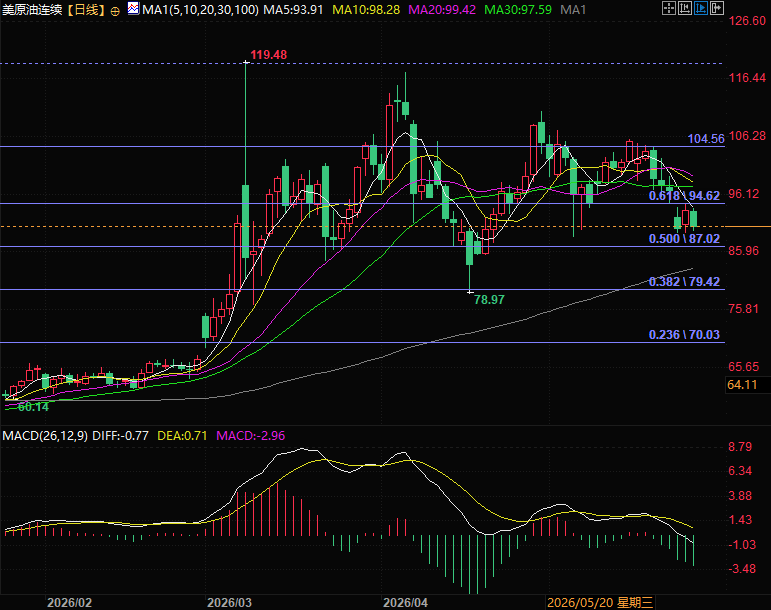
(WTI crude oil futures daily chart, source: EasyForex)
At 19:37 Beijing time, WTI crude oil futures were trading at $90.94 per barrel.
Although the Strait of Hormuz remains closed due to the US-Iran conflict, betting on a easing of tensions has directly led to a decline in oil prices.
However, the situation remains volatile and serious. Iran has officially announced that the framework has been clarified, with the United States committing to a 60-day comprehensive ceasefire on all fronts, including Lebanon, as its first step. However, Iran and the United States have not yet reached an agreement on issues related to the Strait of Hormuz, with both sides stating that they will only sign an agreement if it aligns with their own interests. Meanwhile, Trump will convene a full cabinet meeting tonight to discuss the contents of the agreement.
The ongoing US-Iran standoff has fueled market optimism for a short-term agreement.
Traders and speculators are generally optimistic, believing that the US and Iran are likely to quickly finalize a framework agreement, extending the ceasefire for 60 days and restarting negotiations on issues such as navigation through the Strait of Hormuz and Iran's nuclear program. However, during trading, Iran added that it and the US have not yet reached an agreement on issues related to the Strait of Hormuz.
In a research report published Wednesday morning, ING commodity strategists Warren Paterson and Eva Mansi analyzed that the pressure on oil prices in the early morning was mainly driven by expectations of a US-Iran agreement, but geopolitical tensions around the Taiwan Strait have not been resolved, and the geopolitical risk premium for crude oil has not completely subsided.
The two analysts further stated that even though the conflict between the two sides continues and the strait is effectively closed to navigation, the market focus remains on potential cooperation agreements, thus putting continued pressure on oil prices.
Military activities are frequent around the Taiwan Strait, with reports of US airstrikes and Iranian retaliations constantly emerging.
On Tuesday, Iran formally accused the United States of serious violations of the ceasefire agreement after the U.S. military launched a new round of strikes against missile facilities and ships in southern Iran. The U.S. Central Command stated that the operation was in self-defense.
U.S. Secretary of State Marco Rubio, who earlier this week downplayed the possibility of a short-term agreement, has now stated that there is still room for negotiation; while the Trump administration has taken a hard line, making it clear that it will only accept an agreement that is beneficial to the U.S., otherwise it will refuse to negotiate.
In recent weeks, geopolitical expectations have become the core factor influencing the oil market, while crude oil fundamentals have been ignored by the market.
A large amount of trading funds are betting on a thaw in US-Iran relations, ignoring the already tight global energy supply and the continued obstruction of crude oil exports from major oil-producing regions in the Middle East due to the Straits blockade.
The current navigation situation in the strait is complex, with many vessels adopting silent navigation.
As a vital global energy transport route, the Strait of Hormuz is generally blocked, but many ships have attempted to pass through it.
Shipping data shows that the second liquefied natural gas (LNG) carrier of the UAE's Abu Dhabi National Oil Company has successfully passed through the Strait of Hormuz and is currently en route to India.
Earlier this week, the company began using its own fleet of tankers to transport oil and gas across the strait in a "silent navigation" mode with positioning signals turned off.
The LNG carrier "Umm Ashtan" which made this voyage also adopted the same approach. The ship cut off its positioning signal as early as May 2 when it docked empty at the entrance of the strait. The positioning equipment was also turned off throughout the loading process at the LNG export terminal on Das Island.
To ensure the safety of shipping lanes, Iran has proposed a new plan to negotiate separately with Gulf states and energy-importing countries, offering security guarantees to passing ships in exchange for toll fees.
As a result, the number of LNG carriers and crude oil tankers transiting the strait has gradually increased.
This week, two liquefied natural gas (LNG) carriers also transited the strait, bound for Pakistan and China respectively, while a very large crude carrier (VLCC) also used the route to China. Abu Dhabi National Oil Company (ADNOC) revealed that three other of its tankers also transited the strait silently.
Summary and Technical Analysis:
The signing of the agreement is now on the fast track, Trump will hold a full cabinet meeting tonight, and Iran has also completed negotiations in Qatar regarding freezing funds.
However, the release of official news around the same time, stating that the framework for a 60-day ceasefire between the US and Iran had been agreed upon, but that the opening of the Strait of Hormuz was still unresolved, caused oil prices to fall initially and then rebound.
The API crude oil inventory data released tonight and the EIA weekly crude oil report released on Thursday will be key references for the oil market, but the market's main focus remains on the implementation of the US-Iran agreement.
From a technical perspective, international oil prices have all fallen below the 0.618 percentile of this round of gains. Among them, WTI crude oil futures have continuous support around 87, and resistance around 94.5 and the 5-day moving average.
(WTI crude oil futures daily chart, source: EasyForex)
At 19:37 Beijing time, WTI crude oil futures were trading at $90.94 per barrel.
- Risk Warning and Disclaimer
- The market involves risk, and trading may not be suitable for all investors. This article is for reference only and does not constitute personal investment advice, nor does it take into account certain users’ specific investment objectives, financial situation, or other needs. Any investment decisions made based on this information are at your own risk.