The safe-haven premium has been violently squeezed out! Is this drop in gold prices even more brutal than interest rate hikes?
2026-05-27 21:58:51
On Wednesday, May 27th, spot gold fluctuated around $4415 per ounce during the North American session, with an intraday low approaching $4405 per ounce, a significant drop from the previous trading day; Brent crude oil briefly fell below $92 per barrel. Expectations of a temporary easing of tensions in the Middle East were the direct trigger for the gold price decline.
This round of gold price decline is not solely driven by the US dollar or interest rates, but rather by the rapid compression of geopolitical risk premiums. Iran has released information indicating the existence of a draft informal memorandum of understanding between the US and Iran. Key points include the restoration of commercial shipping in the Strait of Hormuz to pre-conflict levels within a month of the agreement, the lifting of the US maritime blockade, and the withdrawal of US military forces from the Iranian region. While this news is not yet a final agreement, it has already been enough to alter short-term asset pricing.
Gold's previous pricing was partly driven by concerns about energy supply disruptions, shipping bottlenecks, and the spillover risks of Middle East conflict. Once the market begins trading in "resuming shipping" and "cooling oil prices," profit-taking typically occurs first at the most crowded end of the safe-haven asset market. In other words, the decline in gold prices is not due to the disappearance of macroeconomic uncertainty, but rather to the market's perception that the probability of the most extreme scenarios has decreased.
The importance of the Strait of Hormuz determines the speed at which crude oil flows into gold. The U.S. Energy Information Administration previously disclosed that in 2024, the average daily oil flow through the strait was about 20 million barrels, equivalent to about 20% of global liquid oil consumption; the International Energy Agency also pointed out that in 2025, more than 110 billion cubic meters of liquefied natural gas will be transported through this channel, accounting for nearly one-fifth of global liquefied natural gas trade.
Therefore, the anticipated recovery in shipping will simultaneously impact two chains: first, energy supply risks will decrease, leading to a decline in the risk premium for crude oil; second, the upward pressure of energy prices on future inflation will ease. For gold, the decrease in inflation risk is not inherently bearish, but if previous price increases were primarily driven by conflict-driven defensive demand, a sharp drop in oil prices will prompt funds to reassess the cost-effectiveness of their holdings. Currently, gold faces a combination of weakening demand for inflation protection and persistent pressure on real interest rates.
It's worth noting that the decline in gold prices occurred against the backdrop of a weakening US dollar index and US Treasury yields. Latest market quotes show the US dollar index slightly lower around 99.0 to 99.1, and the 10-year US Treasury yield at approximately 4.47%, down from the previous trading day. Typically, a decline in the dollar and yields would alleviate pressure on gold, but the fact that gold prices still fell this time indicates that the dominant factor is not the traditional interest rate channel, but rather safe-haven premiums and the rebalancing of long positions.
The Federal Reserve's policy stance has not provided a clear expectation of easing for gold. The April FOMC meeting maintained the target range for the federal funds rate at 3.5% to 3.75%, and emphasized that it would continue to assess the balance of data, outlook, and risks. As long as the inflation path does not return to a clearer downward trend, gold's non-interest-bearing asset status will remain constrained by medium- to long-term interest rates.
From the daily chart, spot gold is currently priced at approximately $4415 per ounce, having approached and at one point fallen below the lower Bollinger Band at $4428.15 per ounce. The middle Bollinger Band is around $4609.21 per ounce, indicating that the price has shifted from the previous consolidation around the middle band to the lower band resistance zone. The MACD indicator remains below the zero line, with the DIFF at approximately -57.39 and the DEA at approximately -44.70, and the momentum line has not yet shown significant signs of recovery.
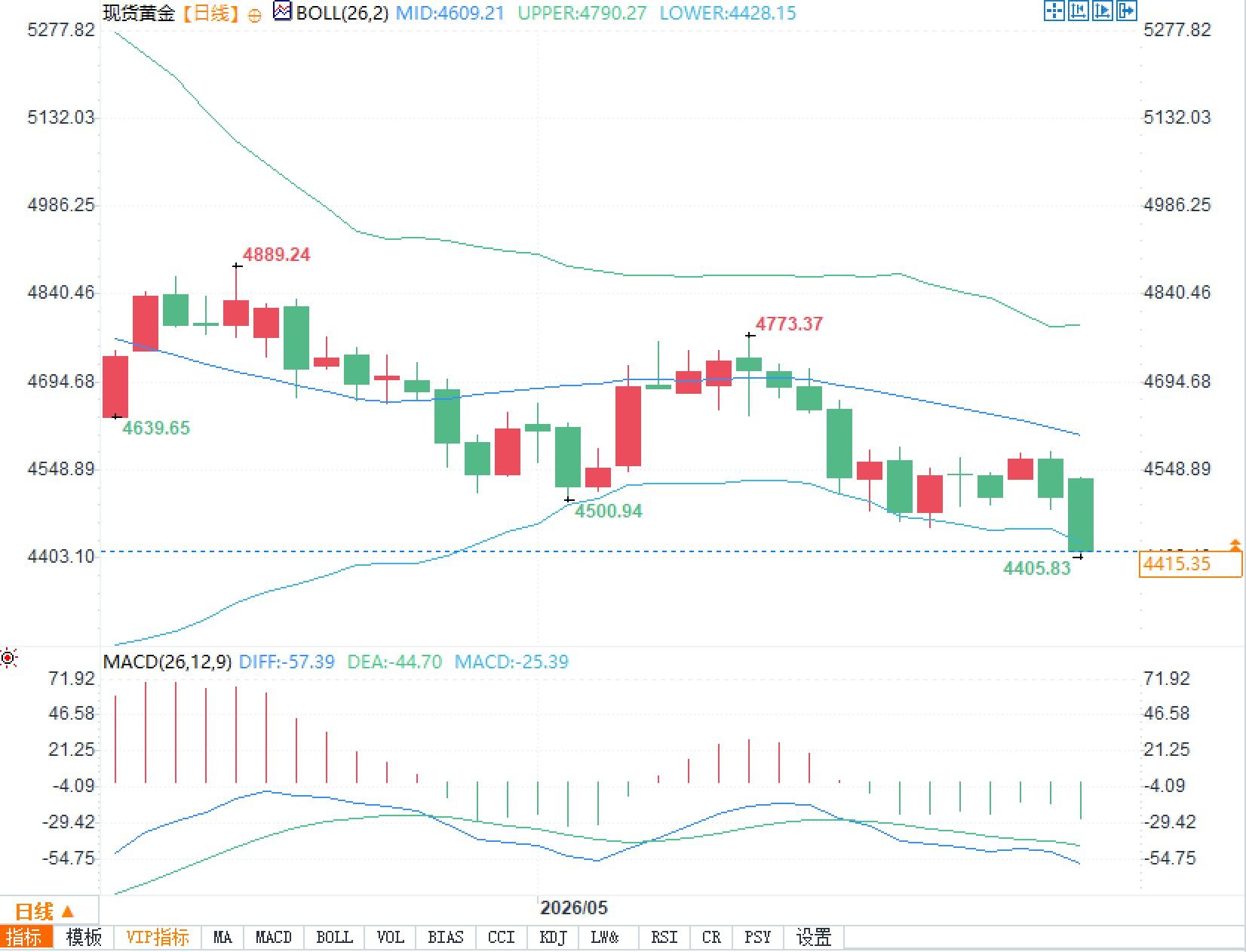
This type of structure doesn't simply mean a bearish outlook for traders; rather, it indicates that volatility is shifting from event-driven to technology-driven. If subsequent news continues to point to a easing, gold may need to digest more risk premiums; if the details of the agreement are inconsistent and shipping recovery falls short of expectations, the lower levels may attract defensive funds again. The key is not the single-day drop, but whether there is sustained pricing acceptance around $4400.
Question 1: Is the current decline in gold prices solely due to a drop in safe-haven demand?
A: It's not a single factor. The retracement of the safe-haven premium was the direct trigger, but the decline in oil prices weakened the inflationary impact, interest rate expectations did not shift significantly towards easing, and the technical indicators showed a drop towards the lower Bollinger Band, all of which amplified the volatility of gold prices.
Question 2: Why did the weakening dollar fail to support gold?
A: Because the current dominant logic is not the US dollar, but the repricing of the Middle East risk premium. When event risks decrease, funds that previously entered gold for safe-haven purposes will adjust their positions first, and the short-term impact may outweigh the US dollar factor.
The decline in safe-haven premiums and the subsequent drop in gold prices are not accidental.
This round of gold price decline is not solely driven by the US dollar or interest rates, but rather by the rapid compression of geopolitical risk premiums. Iran has released information indicating the existence of a draft informal memorandum of understanding between the US and Iran. Key points include the restoration of commercial shipping in the Strait of Hormuz to pre-conflict levels within a month of the agreement, the lifting of the US maritime blockade, and the withdrawal of US military forces from the Iranian region. While this news is not yet a final agreement, it has already been enough to alter short-term asset pricing.
Gold's previous pricing was partly driven by concerns about energy supply disruptions, shipping bottlenecks, and the spillover risks of Middle East conflict. Once the market begins trading in "resuming shipping" and "cooling oil prices," profit-taking typically occurs first at the most crowded end of the safe-haven asset market. In other words, the decline in gold prices is not due to the disappearance of macroeconomic uncertainty, but rather to the market's perception that the probability of the most extreme scenarios has decreased.
The decline in oil prices has mitigated the impact of inflation and also reduced the demand for gold as a defensive asset.
The importance of the Strait of Hormuz determines the speed at which crude oil flows into gold. The U.S. Energy Information Administration previously disclosed that in 2024, the average daily oil flow through the strait was about 20 million barrels, equivalent to about 20% of global liquid oil consumption; the International Energy Agency also pointed out that in 2025, more than 110 billion cubic meters of liquefied natural gas will be transported through this channel, accounting for nearly one-fifth of global liquefied natural gas trade.
Therefore, the anticipated recovery in shipping will simultaneously impact two chains: first, energy supply risks will decrease, leading to a decline in the risk premium for crude oil; second, the upward pressure of energy prices on future inflation will ease. For gold, the decrease in inflation risk is not inherently bearish, but if previous price increases were primarily driven by conflict-driven defensive demand, a sharp drop in oil prices will prompt funds to reassess the cost-effectiveness of their holdings. Currently, gold faces a combination of weakening demand for inflation protection and persistent pressure on real interest rates.
The lack of strong support from the US dollar and US Treasury bonds suggests that positioning factors are more crucial.
It's worth noting that the decline in gold prices occurred against the backdrop of a weakening US dollar index and US Treasury yields. Latest market quotes show the US dollar index slightly lower around 99.0 to 99.1, and the 10-year US Treasury yield at approximately 4.47%, down from the previous trading day. Typically, a decline in the dollar and yields would alleviate pressure on gold, but the fact that gold prices still fell this time indicates that the dominant factor is not the traditional interest rate channel, but rather safe-haven premiums and the rebalancing of long positions.
The Federal Reserve's policy stance has not provided a clear expectation of easing for gold. The April FOMC meeting maintained the target range for the federal funds rate at 3.5% to 3.75%, and emphasized that it would continue to assess the balance of data, outlook, and risks. As long as the inflation path does not return to a clearer downward trend, gold's non-interest-bearing asset status will remain constrained by medium- to long-term interest rates.
The technical structure has weakened, and the $4,400 area has become a test of sentiment.
From the daily chart, spot gold is currently priced at approximately $4415 per ounce, having approached and at one point fallen below the lower Bollinger Band at $4428.15 per ounce. The middle Bollinger Band is around $4609.21 per ounce, indicating that the price has shifted from the previous consolidation around the middle band to the lower band resistance zone. The MACD indicator remains below the zero line, with the DIFF at approximately -57.39 and the DEA at approximately -44.70, and the momentum line has not yet shown significant signs of recovery.
This type of structure doesn't simply mean a bearish outlook for traders; rather, it indicates that volatility is shifting from event-driven to technology-driven. If subsequent news continues to point to a easing, gold may need to digest more risk premiums; if the details of the agreement are inconsistent and shipping recovery falls short of expectations, the lower levels may attract defensive funds again. The key is not the single-day drop, but whether there is sustained pricing acceptance around $4400.
Frequently Asked Questions
Question 1: Is the current decline in gold prices solely due to a drop in safe-haven demand?
A: It's not a single factor. The retracement of the safe-haven premium was the direct trigger, but the decline in oil prices weakened the inflationary impact, interest rate expectations did not shift significantly towards easing, and the technical indicators showed a drop towards the lower Bollinger Band, all of which amplified the volatility of gold prices.
Question 2: Why did the weakening dollar fail to support gold?
A: Because the current dominant logic is not the US dollar, but the repricing of the Middle East risk premium. When event risks decrease, funds that previously entered gold for safe-haven purposes will adjust their positions first, and the short-term impact may outweigh the US dollar factor.
- Risk Warning and Disclaimer
- The market involves risk, and trading may not be suitable for all investors. This article is for reference only and does not constitute personal investment advice, nor does it take into account certain users’ specific investment objectives, financial situation, or other needs. Any investment decisions made based on this information are at your own risk.