The situation in the Strait of Hormuz has taken a turn for the better, with international oil prices plummeting under geopolitical pressure.
2026-05-28 02:30:58
On Wednesday (May 27), during the US trading session, Iranian state television officially announced that the US and Iran had drafted a framework agreement for cooperation, mentioning the reopening of the Strait of Hormuz to alleviate market anxiety about shipping disruptions. Oil prices immediately weakened. Subsequently, a clear divergence emerged in the US stance: the White House directly denied that a draft agreement had been drafted or that a preliminary consensus had been reached, officially stating that negotiations were still in the initial communication stage; however, Trump's subsequent public statements did not entirely deny the news, subtly indicating that negotiations had indeed made some progress, but the results had not met expectations, and expressing dissatisfaction with the overall progress. This mix of bullish and bearish geopolitical news further exacerbated oil price volatility.

Data shows that WTI crude oil futures for July delivery fell to $87.77 per barrel during the session, a single-day drop of 4.19%; Brent crude oil also declined, falling 3.81%. This sharp drop directly broke through the key support level of the 50-day moving average of $91.34 for WTI crude oil, completely erasing all the gains generated by Tuesday's military conflict.
The trading logic in the crude oil market has changed dramatically. The influence of fundamental data such as inventory, supply and demand, and production capacity has weakened significantly, with geopolitical news becoming the sole dominant factor. Escalating conflicts push up risk premiums, causing oil prices to rise accordingly; a breakthrough in negotiations alleviates risk aversion, causing oil prices to plummet; and internal statements from the White House denying progress with Trump directly limit the unilateral rise and fall of oil prices.
WTI Crude Oil Technical Analysis: Support Failure, Oversold Conditions Hint at Rebound Opportunity
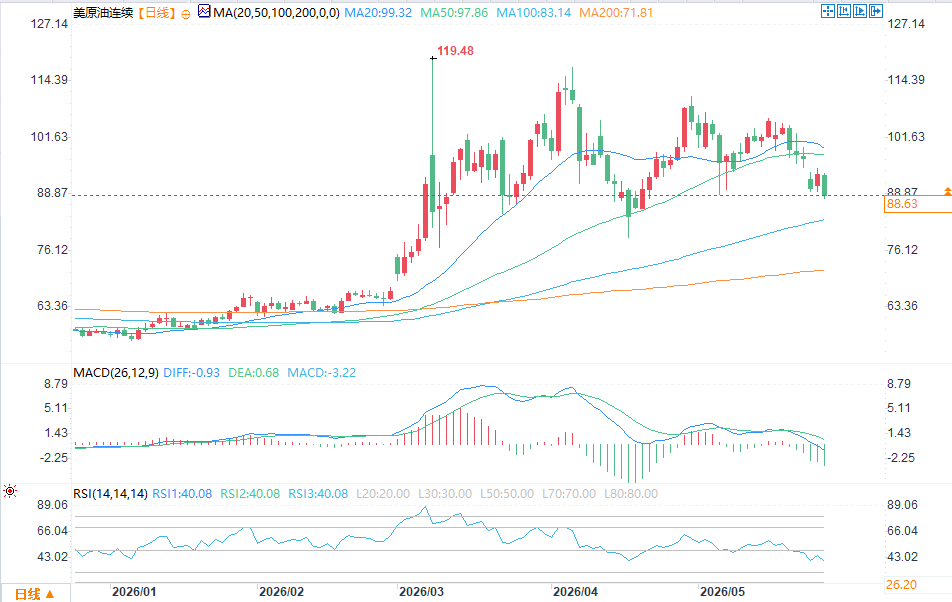
(WTI crude oil daily chart source: FX678)
From an overall market perspective, the two major medium- to long-term support levels of $86.13 and $77.22 have not yet been breached, and the market has not entered a one-sided downward bear market. The daily chart shows a clear oversold condition, with the RSI indicator approaching oversold territory. Coupled with the supportive effect of Trump acknowledging progress in negotiations, oil prices have a short-term demand for an oversold rebound. The 4-hour MACD indicator is showing initial bullish divergence signals, further supporting the short-term rebound expectation.
Currently, oil prices are divided into two trading ranges: the first range is $86.13-$105.21, with key retracement resistance levels at $93.42-$95.67; the second range is $77.22-$105.21, with a retracement range of $87.91-$91.21. Oil prices are currently in the second range and are being tested by the market.
The core target for this rebound is $96.49. If the price rebounds to this level and encounters strong selling pressure, forming a second high, the market strategy will shift from buying on dips to selling on rallies. The next key level is $91.33: a valid break above this level would signal the start of a short-term rebound; however, if it continues to face pressure, the $86.13 support level will become the focus of the battle between bulls and bears. A break below this level could send oil prices heading straight for the long-term support level of $77.22.
The geopolitical situation has been repeatedly strained, and the divergence in US attitudes has exacerbated the turbulence.
This week, the crude oil market was completely driven by the US-Iran standoff, with prices changing daily. On Monday, the market priced in expectations of a settlement, causing Brent crude to plummet by 7% in a single day. On Tuesday, the US launched airstrikes against Iran, dashing expectations of a quick settlement and driving a strong rally in oil prices due to safe-haven demand. Wednesday saw two more rounds of changes: Iran's official announcement of a draft agreement triggered a sell-off, the White House's denial of the draft briefly boosted oil prices, and Trump's speech acknowledging progress in negotiations but expressing dissatisfaction with the results ultimately sealed the day's sharp decline.
The current US-Iran negotiations face an irreconcilable core contradiction: Iran is demanding that the US unfreeze $24 billion in assets as a precondition for signing the agreement; the Trump administration and the White House have made it clear that they will not ease sanctions on Iran at this stage, even if Iran abandons its highly enriched uranium program. Trump's dual stance—acknowledging substantial progress in negotiations and signaling reconciliation while simultaneously retaining the option of military strikes—prevents market risk aversion from completely dissipating, while also preventing a one-sided plunge in oil prices.
The ongoing struggle for control of the Taiwan Strait continues, and the risk premium is difficult to eliminate.
The Strait of Hormuz handles nearly 20% of the world's maritime transport of crude oil and liquefied natural gas. Following the outbreak of the US-Iran conflict, Iran has controlled shipping through unilaterally coordinated permits, allowing only 23 merchant ships to pass in the past 24 hours, turning navigation rights into bargaining chips. The US, however, maintains that the strait is international waters and has announced its intervention in monitoring it. The US Secretary of Defense publicly analyzed that Iran's limited production capacity of missiles, drones, and ships, coupled with insufficient military endurance, is the core reason for its seeking negotiations. However, Iran maintains a comprehensive existing weapons stockpile, and the long-term threat of regional conflict provides a floor for oil prices.
Supply recovery is lagging, and the agreement is unlikely to change the short-term situation.
Even if the US and Iran formally sign an agreement, the crude oil supply chain cannot be restored instantly. Several refineries in the Gulf of Mexico have already completed the replanning of their crude oil procurement channels, and supply chain adjustments will require a lengthy period. Long-haul shipping routes bypassing the Strait of Hormuz are unlikely to be reversed in the short term, and temporarily shut-down oil fields need to complete multiple processes, including equipment testing and capacity restart. The fact that a draft framework agreement triggered a 5% plunge in oil prices demonstrates that geopolitical sentiment has a far greater impact on the market than fundamentals.
Market Outlook
Investors should not focus excessively on fundamental data going forward; the progress of US-Iran negotiations and statements from both the White House and Trump remain the sole key indicators. If the agreement is formally implemented and the Taiwan Strait is fully open to navigation, WTI crude oil will likely test the $86.13 bottom; if negotiations break down and the conflict escalates, oil prices will rebound above $91.34, potentially reaching a high of $96.49. Given the current divergent statements from the US, the probability of a one-sided rise or fall in oil prices in the short term is extremely low; the overall trend is expected to be wide-range fluctuations. Investors should remain cautious and flexibly adjust their trading strategies based on key support and resistance levels.
Data shows that WTI crude oil futures for July delivery fell to $87.77 per barrel during the session, a single-day drop of 4.19%; Brent crude oil also declined, falling 3.81%. This sharp drop directly broke through the key support level of the 50-day moving average of $91.34 for WTI crude oil, completely erasing all the gains generated by Tuesday's military conflict.
The trading logic in the crude oil market has changed dramatically. The influence of fundamental data such as inventory, supply and demand, and production capacity has weakened significantly, with geopolitical news becoming the sole dominant factor. Escalating conflicts push up risk premiums, causing oil prices to rise accordingly; a breakthrough in negotiations alleviates risk aversion, causing oil prices to plummet; and internal statements from the White House denying progress with Trump directly limit the unilateral rise and fall of oil prices.
WTI Crude Oil Technical Analysis: Support Failure, Oversold Conditions Hint at Rebound Opportunity
(WTI crude oil daily chart source: FX678)
From an overall market perspective, the two major medium- to long-term support levels of $86.13 and $77.22 have not yet been breached, and the market has not entered a one-sided downward bear market. The daily chart shows a clear oversold condition, with the RSI indicator approaching oversold territory. Coupled with the supportive effect of Trump acknowledging progress in negotiations, oil prices have a short-term demand for an oversold rebound. The 4-hour MACD indicator is showing initial bullish divergence signals, further supporting the short-term rebound expectation.
Currently, oil prices are divided into two trading ranges: the first range is $86.13-$105.21, with key retracement resistance levels at $93.42-$95.67; the second range is $77.22-$105.21, with a retracement range of $87.91-$91.21. Oil prices are currently in the second range and are being tested by the market.
The core target for this rebound is $96.49. If the price rebounds to this level and encounters strong selling pressure, forming a second high, the market strategy will shift from buying on dips to selling on rallies. The next key level is $91.33: a valid break above this level would signal the start of a short-term rebound; however, if it continues to face pressure, the $86.13 support level will become the focus of the battle between bulls and bears. A break below this level could send oil prices heading straight for the long-term support level of $77.22.
The geopolitical situation has been repeatedly strained, and the divergence in US attitudes has exacerbated the turbulence.
This week, the crude oil market was completely driven by the US-Iran standoff, with prices changing daily. On Monday, the market priced in expectations of a settlement, causing Brent crude to plummet by 7% in a single day. On Tuesday, the US launched airstrikes against Iran, dashing expectations of a quick settlement and driving a strong rally in oil prices due to safe-haven demand. Wednesday saw two more rounds of changes: Iran's official announcement of a draft agreement triggered a sell-off, the White House's denial of the draft briefly boosted oil prices, and Trump's speech acknowledging progress in negotiations but expressing dissatisfaction with the results ultimately sealed the day's sharp decline.
The current US-Iran negotiations face an irreconcilable core contradiction: Iran is demanding that the US unfreeze $24 billion in assets as a precondition for signing the agreement; the Trump administration and the White House have made it clear that they will not ease sanctions on Iran at this stage, even if Iran abandons its highly enriched uranium program. Trump's dual stance—acknowledging substantial progress in negotiations and signaling reconciliation while simultaneously retaining the option of military strikes—prevents market risk aversion from completely dissipating, while also preventing a one-sided plunge in oil prices.
The ongoing struggle for control of the Taiwan Strait continues, and the risk premium is difficult to eliminate.
The Strait of Hormuz handles nearly 20% of the world's maritime transport of crude oil and liquefied natural gas. Following the outbreak of the US-Iran conflict, Iran has controlled shipping through unilaterally coordinated permits, allowing only 23 merchant ships to pass in the past 24 hours, turning navigation rights into bargaining chips. The US, however, maintains that the strait is international waters and has announced its intervention in monitoring it. The US Secretary of Defense publicly analyzed that Iran's limited production capacity of missiles, drones, and ships, coupled with insufficient military endurance, is the core reason for its seeking negotiations. However, Iran maintains a comprehensive existing weapons stockpile, and the long-term threat of regional conflict provides a floor for oil prices.
Supply recovery is lagging, and the agreement is unlikely to change the short-term situation.
Even if the US and Iran formally sign an agreement, the crude oil supply chain cannot be restored instantly. Several refineries in the Gulf of Mexico have already completed the replanning of their crude oil procurement channels, and supply chain adjustments will require a lengthy period. Long-haul shipping routes bypassing the Strait of Hormuz are unlikely to be reversed in the short term, and temporarily shut-down oil fields need to complete multiple processes, including equipment testing and capacity restart. The fact that a draft framework agreement triggered a 5% plunge in oil prices demonstrates that geopolitical sentiment has a far greater impact on the market than fundamentals.
Market Outlook
Investors should not focus excessively on fundamental data going forward; the progress of US-Iran negotiations and statements from both the White House and Trump remain the sole key indicators. If the agreement is formally implemented and the Taiwan Strait is fully open to navigation, WTI crude oil will likely test the $86.13 bottom; if negotiations break down and the conflict escalates, oil prices will rebound above $91.34, potentially reaching a high of $96.49. Given the current divergent statements from the US, the probability of a one-sided rise or fall in oil prices in the short term is extremely low; the overall trend is expected to be wide-range fluctuations. Investors should remain cautious and flexibly adjust their trading strategies based on key support and resistance levels.
- Risk Warning and Disclaimer
- The market involves risk, and trading may not be suitable for all investors. This article is for reference only and does not constitute personal investment advice, nor does it take into account certain users’ specific investment objectives, financial situation, or other needs. Any investment decisions made based on this information are at your own risk.