













Revolutionary! The balance of power in US-Iran peace talks tilts, gold poised for a counterattack.
2026-05-28 16:24:39
Spot gold continued to weaken on Thursday (Asian and European sessions), falling more than 2% at one point during the session, and is currently trading at $4,386, down 1.57%.
Recently, the conflict between the US and Iran has intensified amid a mix of military strikes and negotiation maneuvering.
Early on May 28 local time, explosions were heard in Bandar Abbas, southern Iran. The air defense system was immediately activated. The Iranian Islamic Revolutionary Guard Corps confirmed that the US had launched an airstrike and subsequently carried out retaliatory strikes against the US air base, vowing to respond "more decisively" to any further US airstrikes.
This marks the second time this week that the U.S. military has launched a "defensive strike" against Iran. On the previous day, the U.S. military had already launched airstrikes against Iranian mine-laying vessels and air defense missile sites in the Strait of Hormuz on the 25th. In the past four days, Iran has shot down a large U.S. drone and an Israeli reconnaissance drone, and the military standoff between the two sides around the Strait continues to escalate.

Behind the military conflict, although the US-Iran negotiations have made some progress at the framework level, they are deeply mired in multiple core differences.
The Trump administration’s core demands are clear: Iran must hand over all 440.9 kilograms of 60% enriched uranium (just one step away from weapons grade), and it will never accept Russia or China as a third party to manage the uranium.
He also demanded that Kuwait, Saudi Arabia, and other countries join the Abraham Accords to normalize relations between Middle Eastern countries and Israel; otherwise, Trump stated that he was "unsure whether an agreement would still be reached."
However, Iran took a hard line, not only adhering to the "red lines" of uranium enrichment capacity and control of the Strait of Hormuz, but also proposing preconditions—the US must unfreeze $24 billion in frozen assets, with $12 billion to be disbursed immediately after the agreement is announced, and the remaining funds to be received within 60 days. These funds come from Iran's oil and gas revenues frozen by sanctions, distributed in countries such as South Korea, Qatar, Iran, and Germany. The Trump camp firmly opposed this "compromise" clause, which became the core obstacle to the negotiations.
In addition, the terms of the agreement have sparked divisions within the United States, with Republican allies such as Lindsey Graham and Ted Cruz criticizing it for being too similar to the Obama-era Iran nuclear deal and too favorable to Iran.
The geopolitical rivalry between Israel and Lebanon has also hampered the agreement. Iran insists that the ceasefire agreement must cover Lebanon, while the United States has left room for flexibility and clarified Israel's right to self-defense. Israeli forces and Hezbollah, which is supported by Iran, continue to clash in southern Lebanon.
Trump's push to expand the "Abraham Accords" also met with a cold reception. Saudi Arabia and other countries insisted on the premise of "guaranteeing the path to Palestinian statehood," a demand that was rejected by Israel. Officials in the Gulf states even fell silent in response to Trump's proposal.
Although the strait is not completely closed, the nearly three months of obstruction have resulted in about 1,500 ships being stranded. Even if the US and Iran reach a ceasefire agreement, the resumption of navigation still faces multiple practical obstacles.
Iran has established the "Persian Gulf Straits Authority," announcing that all transit vessels only need to be authorized by it, establishing a tiered passage system that prioritizes the passage of vessels from allies and closely related countries. Some vessels not included in intergovernmental agreements only need to pay a fee of more than $150,000 and must undergo strict scrutiny by the Revolutionary Guard.
Iran's previously laid sea mines are extremely destructive. The International Energy Agency pointed out that the mine-clearing work will take several weeks to complete, and the ships that have been stranded for a long time will not only require large-scale cleaning due to the marine life attached to their hulls, but their speed will also be far below normal levels.
Global shipping organizations estimate that even if orderly passage procedures are established, traffic volume across the strait will only recover to 40%-50% of normal levels within three to four weeks, and full recovery may take several months.
More noteworthy is that the struggle between the US and Iran over control of the Strait continues. Iran insists on its management rights over the Strait, while the US military has repeatedly taken military actions under the pretext of "anti-mine laying." On the 28th, an incident occurred in which the Iranian Navy fired shots to drive away vessels that were not authorized to pass through, and the safety of navigation remains uncertain.
Doug Bandow, a senior fellow at the Cato Institute, a conservative think tank in the United States, pointed out that the US-Iran rivalry has shifted from a military front to an economic front. Trump's decision to close the Strait of Hormuz "inadvertently gave Iran a very powerful weapon," but he was unwilling to risk forcibly reopening it, putting Iran in a dilemma. "It is difficult not to reach an agreement that satisfies Iran."
Bandow also questioned Trump's statement that he "doesn't care about the midterm elections," arguing that the Republican Party's prospects in the November elections are his core concern, and that persistently high energy costs and fuel prices have affected voter sentiment, making it imperative for Trump to end the conflict as soon as possible.
Jonathan Conricus, a senior fellow at a Washington-based hawkish think tank, worries that if sanctions are lifted, Iran will quickly rebuild its military capabilities and increase its support for proxy armed groups such as Hezbollah and Hamas. "The battle is far from over, and Iran's strategic ambitions have never waned."
Shipping and energy experts generally warn that even if navigation resumes in the strait, the recovery of oil fields and the repair of facilities will still take a long time, and the restoration of the global crude oil supply chain will not be achieved overnight.
Although the current situation looks complicated, it is actually more favorable to the United States. First of all, Iran's recent dispatch of the central bank governor and repeated mentions of unfreezing sanctions funds indicate that Iran's fiscal expenditure has encountered significant problems after the restrictions on Iranian cruise ships were imposed.
Meanwhile, the United States took the initiative to test the waters, and Iran showed relative restraint, giving the impression that the United States had the upper hand.
In terms of physical constraints, the US blockade of Iranian cruise ships has not yet been classified as a military action, allowing the US to bypass Congress's requirement for a 60-day application period for military action and use its military. However, the internal concerns of reduced Iranian oil production and overflowing inventories have not been alleviated.
Although the United States is under pressure from the midterm elections and hopes to end the war sooner, if the United States signs a very unfavorable agreement, even if the war ends, it will still be subject to reckoning in the midterm elections. Here, the United States may turn to getting a bigger result and ultimately use the result to offset the adverse effects of inflation on the midterm elections.
Trump even claimed that the US would not lift sanctions against Iran even if it abandoned its uranium-related activities. This is similar to the recent probing and gaining the upper hand, followed by a move to increase the leverage, which also supports the above point.
Technical Analysis: Spot gold touched the lower boundary of the descending channel. Coupled with the potential negative impact of tonight's PCE data, a temporary rebound buying opportunity may emerge. Support is at the lower boundary, while resistance is at the 5-day moving average and the middle boundary of the channel.
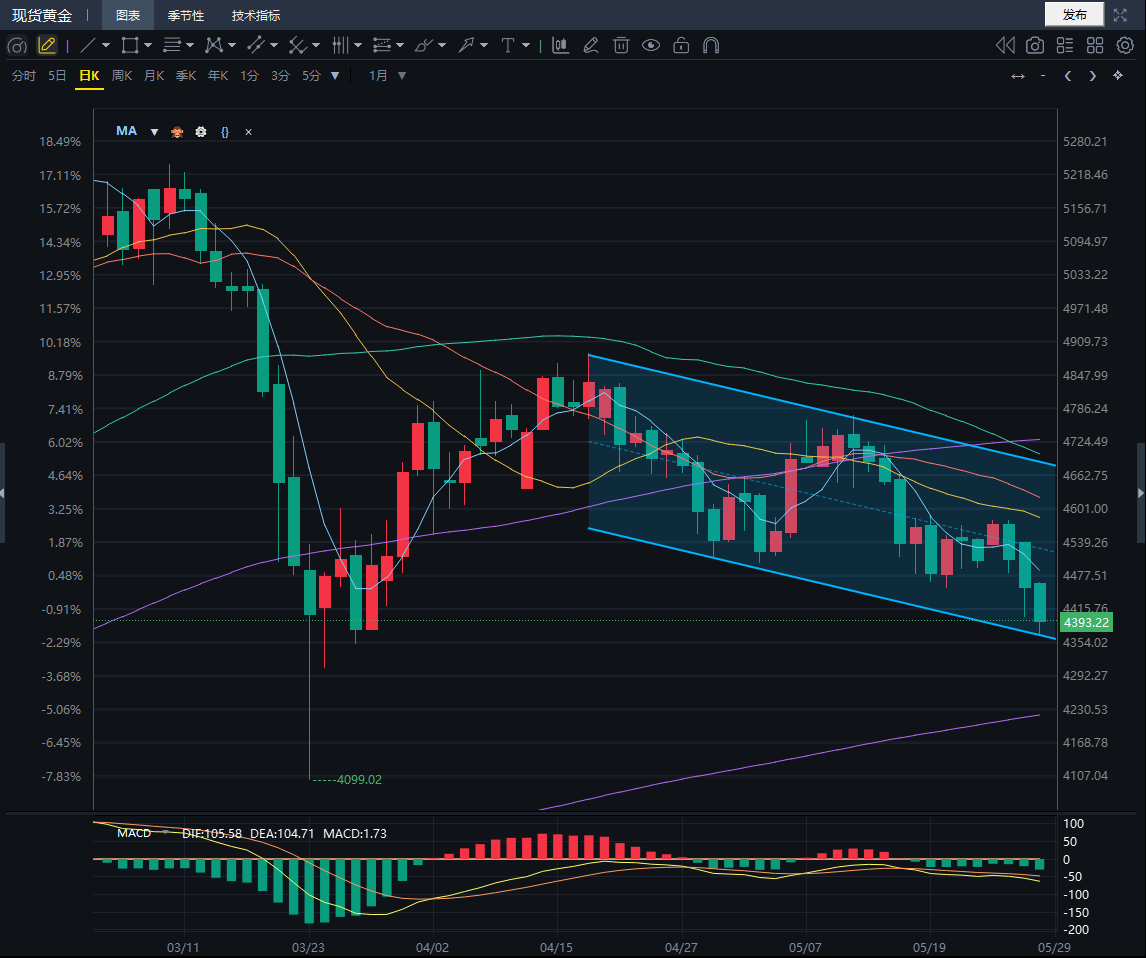
(Spot gold daily chart, source: EasyForex subsidiary)
At 16:21 Beijing time, spot gold was trading at $4,393 per ounce.
Recently, the conflict between the US and Iran has intensified amid a mix of military strikes and negotiation maneuvering.
Early on May 28 local time, explosions were heard in Bandar Abbas, southern Iran. The air defense system was immediately activated. The Iranian Islamic Revolutionary Guard Corps confirmed that the US had launched an airstrike and subsequently carried out retaliatory strikes against the US air base, vowing to respond "more decisively" to any further US airstrikes.
This marks the second time this week that the U.S. military has launched a "defensive strike" against Iran. On the previous day, the U.S. military had already launched airstrikes against Iranian mine-laying vessels and air defense missile sites in the Strait of Hormuz on the 25th. In the past four days, Iran has shot down a large U.S. drone and an Israeli reconnaissance drone, and the military standoff between the two sides around the Strait continues to escalate.
The core demands are sharply opposed, with asset unfreezing becoming a key obstacle.
Behind the military conflict, although the US-Iran negotiations have made some progress at the framework level, they are deeply mired in multiple core differences.
The Trump administration’s core demands are clear: Iran must hand over all 440.9 kilograms of 60% enriched uranium (just one step away from weapons grade), and it will never accept Russia or China as a third party to manage the uranium.
He also demanded that Kuwait, Saudi Arabia, and other countries join the Abraham Accords to normalize relations between Middle Eastern countries and Israel; otherwise, Trump stated that he was "unsure whether an agreement would still be reached."
However, Iran took a hard line, not only adhering to the "red lines" of uranium enrichment capacity and control of the Strait of Hormuz, but also proposing preconditions—the US must unfreeze $24 billion in frozen assets, with $12 billion to be disbursed immediately after the agreement is announced, and the remaining funds to be received within 60 days. These funds come from Iran's oil and gas revenues frozen by sanctions, distributed in countries such as South Korea, Qatar, Iran, and Germany. The Trump camp firmly opposed this "compromise" clause, which became the core obstacle to the negotiations.
Internal disagreements and geopolitical maneuvering have made progress on the agreement extremely difficult.
In addition, the terms of the agreement have sparked divisions within the United States, with Republican allies such as Lindsey Graham and Ted Cruz criticizing it for being too similar to the Obama-era Iran nuclear deal and too favorable to Iran.
The geopolitical rivalry between Israel and Lebanon has also hampered the agreement. Iran insists that the ceasefire agreement must cover Lebanon, while the United States has left room for flexibility and clarified Israel's right to self-defense. Israeli forces and Hezbollah, which is supported by Iran, continue to clash in southern Lebanon.
Trump's push to expand the "Abraham Accords" also met with a cold reception. Saudi Arabia and other countries insisted on the premise of "guaranteeing the path to Palestinian statehood," a demand that was rejected by Israel. Officials in the Gulf states even fell silent in response to Trump's proposal.
Navigation in the Strait of Hormuz is facing multiple difficulties, and it will take time to return to normal.
Although the strait is not completely closed, the nearly three months of obstruction have resulted in about 1,500 ships being stranded. Even if the US and Iran reach a ceasefire agreement, the resumption of navigation still faces multiple practical obstacles.
Iran has established the "Persian Gulf Straits Authority," announcing that all transit vessels only need to be authorized by it, establishing a tiered passage system that prioritizes the passage of vessels from allies and closely related countries. Some vessels not included in intergovernmental agreements only need to pay a fee of more than $150,000 and must undergo strict scrutiny by the Revolutionary Guard.
Iran's previously laid sea mines are extremely destructive. The International Energy Agency pointed out that the mine-clearing work will take several weeks to complete, and the ships that have been stranded for a long time will not only require large-scale cleaning due to the marine life attached to their hulls, but their speed will also be far below normal levels.
Global shipping organizations estimate that even if orderly passage procedures are established, traffic volume across the strait will only recover to 40%-50% of normal levels within three to four weeks, and full recovery may take several months.
More noteworthy is that the struggle between the US and Iran over control of the Strait continues. Iran insists on its management rights over the Strait, while the US military has repeatedly taken military actions under the pretext of "anti-mine laying." On the 28th, an incident occurred in which the Iranian Navy fired shots to drive away vessels that were not authorized to pass through, and the safety of navigation remains uncertain.
Experts analyze: Trump is caught in the dual pressures of election and political maneuvering.
Doug Bandow, a senior fellow at the Cato Institute, a conservative think tank in the United States, pointed out that the US-Iran rivalry has shifted from a military front to an economic front. Trump's decision to close the Strait of Hormuz "inadvertently gave Iran a very powerful weapon," but he was unwilling to risk forcibly reopening it, putting Iran in a dilemma. "It is difficult not to reach an agreement that satisfies Iran."
Bandow also questioned Trump's statement that he "doesn't care about the midterm elections," arguing that the Republican Party's prospects in the November elections are his core concern, and that persistently high energy costs and fuel prices have affected voter sentiment, making it imperative for Trump to end the conflict as soon as possible.
Jonathan Conricus, a senior fellow at a Washington-based hawkish think tank, worries that if sanctions are lifted, Iran will quickly rebuild its military capabilities and increase its support for proxy armed groups such as Hezbollah and Hamas. "The battle is far from over, and Iran's strategic ambitions have never waned."
Shipping and energy experts generally warn that even if navigation resumes in the strait, the recovery of oil fields and the repair of facilities will still take a long time, and the restoration of the global crude oil supply chain will not be achieved overnight.
Summary and Technical Analysis:
Although the current situation looks complicated, it is actually more favorable to the United States. First of all, Iran's recent dispatch of the central bank governor and repeated mentions of unfreezing sanctions funds indicate that Iran's fiscal expenditure has encountered significant problems after the restrictions on Iranian cruise ships were imposed.
Meanwhile, the United States took the initiative to test the waters, and Iran showed relative restraint, giving the impression that the United States had the upper hand.
In terms of physical constraints, the US blockade of Iranian cruise ships has not yet been classified as a military action, allowing the US to bypass Congress's requirement for a 60-day application period for military action and use its military. However, the internal concerns of reduced Iranian oil production and overflowing inventories have not been alleviated.
Although the United States is under pressure from the midterm elections and hopes to end the war sooner, if the United States signs a very unfavorable agreement, even if the war ends, it will still be subject to reckoning in the midterm elections. Here, the United States may turn to getting a bigger result and ultimately use the result to offset the adverse effects of inflation on the midterm elections.
Trump even claimed that the US would not lift sanctions against Iran even if it abandoned its uranium-related activities. This is similar to the recent probing and gaining the upper hand, followed by a move to increase the leverage, which also supports the above point.
Technical Analysis: Spot gold touched the lower boundary of the descending channel. Coupled with the potential negative impact of tonight's PCE data, a temporary rebound buying opportunity may emerge. Support is at the lower boundary, while resistance is at the 5-day moving average and the middle boundary of the channel.
(Spot gold daily chart, source: EasyForex subsidiary)
At 16:21 Beijing time, spot gold was trading at $4,393 per ounce.
- Risk Warning and Disclaimer
- The market involves risk, and trading may not be suitable for all investors. This article is for reference only and does not constitute personal investment advice, nor does it take into account certain users’ specific investment objectives, financial situation, or other needs. Any investment decisions made based on this information are at your own risk.

