The US dollar is hovering around the 1,500 level against the South Korean won, with two dissenters at the Bank of Korea hinting at an imminent rate hike in July.
2026-05-28 16:36:03
On Thursday (May 28), the US dollar rose slightly against the South Korean won, trading around 1503, retreating from a four-week high of 1520.96 reached on Monday, but still remaining above the psychological level of 1500.
The weakness of the Korean won contrasts subtly with the hawkish signals released by the Bank of Korea on the same day.
The Bank of Korea kept its benchmark interest rate unchanged at 2.50% on Thursday (May 28), but two dissenting members on the seven-member Monetary Policy Committee supported raising rates, and the latest dot plot showed a tendency to raise rates to 3% within the next six months.
The central bank raised its inflation forecast for this year to 2.7% and its growth forecast to 2.6%, reflecting considerations of rising oil prices and strong domestic growth. Against the backdrop of the Korean won depreciating by 4.5% this year, rising housing prices, and a booming semiconductor export sector, the market widely expects new Governor Shin Hyun-song to begin a rate hike cycle in July.
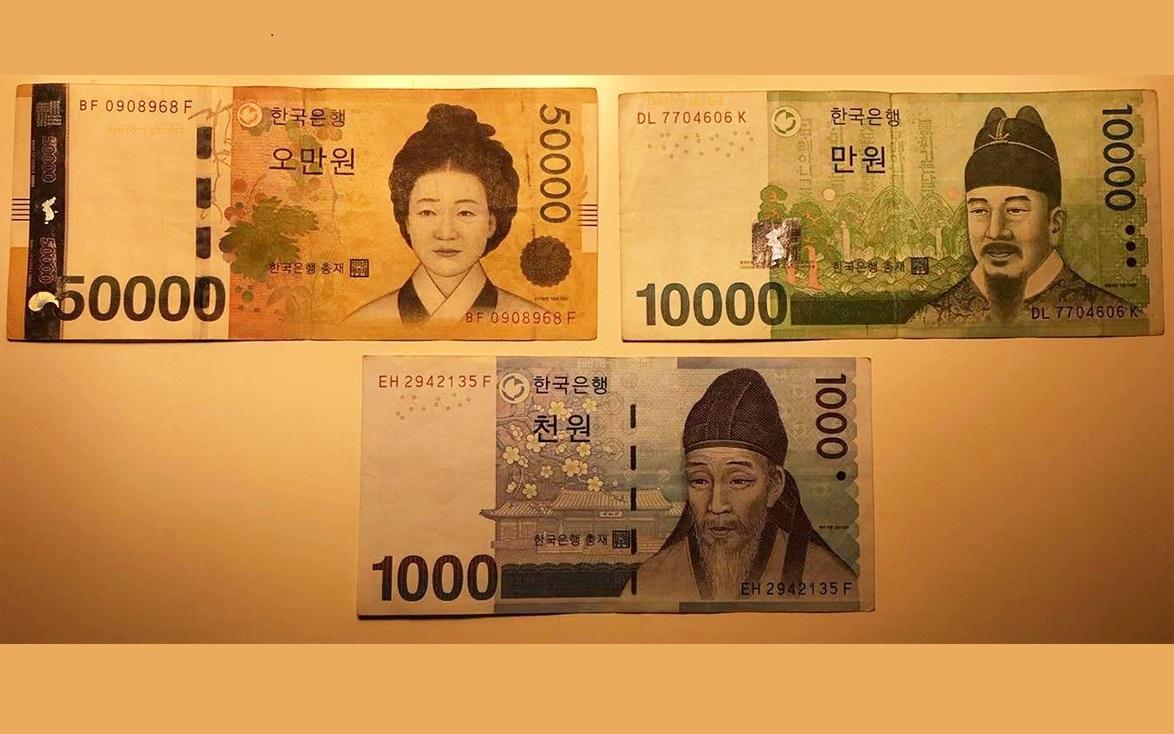
The Bank of Korea kept its benchmark interest rate unchanged on Thursday, but hawkish divisions within its seven-member monetary policy committee suggested the central bank may soon shift to a tighter policy stance to curb inflation and support the persistently depreciating won.
Five of the seven committee members voted to keep the benchmark interest rate unchanged at 2.50%, while the two dissenting members voted to raise the rate. This decision to keep the rate unchanged was in line with economists' expectations.
This meeting also marks the policy debut of the newly appointed central bank governor, Shin Hyun-song. The market will closely watch his remarks at the subsequent press conference to determine whether the central bank is prepared to raise interest rates if inflationary pressures spread further.
Analysts expect Shin Hyun-song to be more hawkish than his predecessor, Lee Chang-yong, prioritizing price stability and currency defense over supporting growth.
The central bank raised its inflation forecast for this year to 2.7% from 2.2% before the outbreak of the Iran war, taking into account the spillover effects of rising oil prices.
Meanwhile, the central bank raised its growth forecast for this year from 2.0% to 2.6%, reflecting the strong expansion of 1.7% in the first quarter—the fastest pace in nearly six years.
In line with the hawkish shift, the central bank’s updated dot plot—showing committee members’ forecasts for the policy rate over the next six months in 21-dot increments—revealed a clear inclination to raise rates to 3%.
Two of these forecasts even predicted that interest rates would rise to 3.25%. This signal had an immediate impact on the market.
South Korean policy-sensitive three-year government bond futures reversed sharply and fell after the release of the dot plot and policy statement, giving back all previous gains.
This indicates that the market is repricing the future interest rate path, and previous expectations that the central bank would maintain an accommodative stance are rapidly fading.
Stephen Lee, an economist at Meritz Securities in Seoul, said, "We expect the Bank of Korea to raise interest rates by 25 basis points to 2.75% at its next meeting in July, followed by another rate hike in October, pushing rates to 3.00% by the end of the year."
He added, "Inflation data itself is not high, but the positive output gap, rising inflation expectations, and soaring housing prices will be the main reasons behind the interest rate hikes."
The overall inflation rate in April was 2.6%, exceeding the central bank's 2% target and marking the fastest growth rate in nearly two years.
Meanwhile, the South Korean won has depreciated by 4.5% against the US dollar this year, which is actually injecting inflation into domestic supermarkets and factories, adding additional price pressure to the country that relies on Middle Eastern energy imports.
Strong global demand for semiconductors is driving a robust export cycle in South Korea, helping the benchmark Kospi index nearly double this year and generating spillover benefits for local suppliers and factories.
However, the export boom has not offset the pressure from inflation and exchange rates, and may instead further reinforce the need for the central bank to raise interest rates.
The market has been betting on an interest rate hike. Prior to this decision, about two-thirds of the economists surveyed expected at least one rate hike before the end of September.
This contrasts sharply with last month's survey, when only three out of 30 economists predicted a 25-basis-point rate hike.
In summary, while the Bank of Korea's decision to maintain interest rates unchanged in February was the mainstream market expectation, the presence of two dissenting voices, the dot plot indicating a 3% inclination towards rate hikes, and the significant upward revision of economic forecasts collectively constitute a clear hawkish signal. Under the leadership of new Governor Shin Hyun-song, the central bank is shifting its policy focus from supporting growth to controlling inflation and stabilizing the exchange rate. The market has reacted swiftly to this shift, with government bond futures falling and expectations of a rate hike rising sharply. Against the backdrop of a continued depreciation of the won, rising housing prices, and a booming semiconductor export market, a rate hike cycle starting in July has become the mainstream market view. In the coming months, the won exchange rate, inflation data, and subsequent statements from Shin Hyun-song will be key variables in determining the pace of rate hikes.
The USD/KRW pair is showing a generally strong, high-level consolidation pattern on the daily chart, with a slight pullback in the short term. The current price is around 1502.62, above the 20-day, 50-day, 100-day, and 200-day moving averages, with the medium-term moving averages in a bullish alignment. Support is concentrated around 1488. The RSI is 41.89, below the 50 neutral line, indicating weakening bullish momentum. The MACD indicator shows a death cross, with the DIFF line crossing below the DEA line, suggesting the release of bearish momentum and potential short-term pullback pressure. Overall, the medium-term upward trend remains intact, but short-term resistance is seen near the previous high of 1520. A break below 1488 could lead to a further decline towards 1474; conversely, holding above this support could allow for a challenge of the previous high.
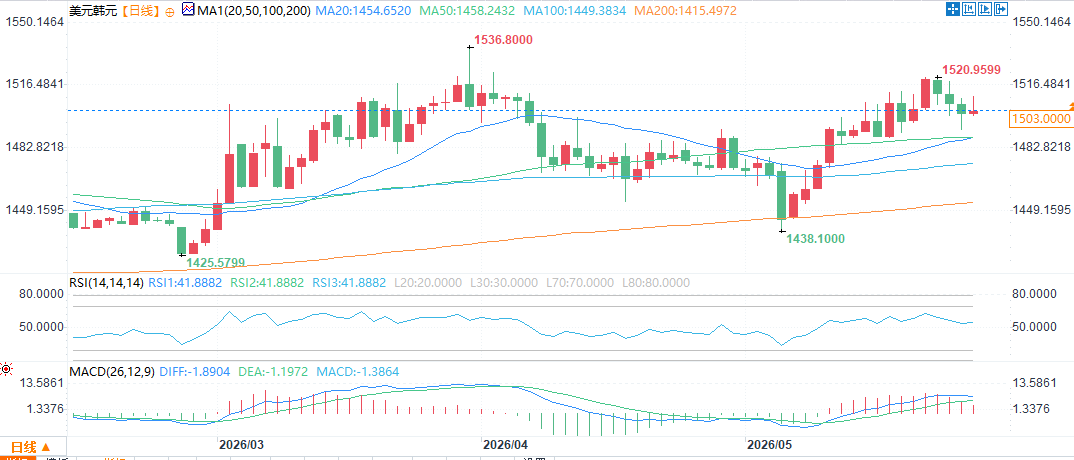
(USD/KRW daily chart, source: FX678)
At 16:29 Beijing time on May 28, the US dollar was trading at 1502.50/51 against the South Korean won.
The weakness of the Korean won contrasts subtly with the hawkish signals released by the Bank of Korea on the same day.
The Bank of Korea kept its benchmark interest rate unchanged at 2.50% on Thursday (May 28), but two dissenting members on the seven-member Monetary Policy Committee supported raising rates, and the latest dot plot showed a tendency to raise rates to 3% within the next six months.
The central bank raised its inflation forecast for this year to 2.7% and its growth forecast to 2.6%, reflecting considerations of rising oil prices and strong domestic growth. Against the backdrop of the Korean won depreciating by 4.5% this year, rising housing prices, and a booming semiconductor export sector, the market widely expects new Governor Shin Hyun-song to begin a rate hike cycle in July.
Interest rate decision: unchanged, but internal hawkish divisions emerge.
The Bank of Korea kept its benchmark interest rate unchanged on Thursday, but hawkish divisions within its seven-member monetary policy committee suggested the central bank may soon shift to a tighter policy stance to curb inflation and support the persistently depreciating won.
Five of the seven committee members voted to keep the benchmark interest rate unchanged at 2.50%, while the two dissenting members voted to raise the rate. This decision to keep the rate unchanged was in line with economists' expectations.
Shin Hyun-song's debut as new bank governor: His policy presentation draws significant attention.
This meeting also marks the policy debut of the newly appointed central bank governor, Shin Hyun-song. The market will closely watch his remarks at the subsequent press conference to determine whether the central bank is prepared to raise interest rates if inflationary pressures spread further.
Analysts expect Shin Hyun-song to be more hawkish than his predecessor, Lee Chang-yong, prioritizing price stability and currency defense over supporting growth.
Economic forecasts revised upward: Inflation and growth expectations both raised.
The central bank raised its inflation forecast for this year to 2.7% from 2.2% before the outbreak of the Iran war, taking into account the spillover effects of rising oil prices.
Meanwhile, the central bank raised its growth forecast for this year from 2.0% to 2.6%, reflecting the strong expansion of 1.7% in the first quarter—the fastest pace in nearly six years.
Dot plot signal: Clear inclination towards interest rate hikes in the next six months
In line with the hawkish shift, the central bank’s updated dot plot—showing committee members’ forecasts for the policy rate over the next six months in 21-dot increments—revealed a clear inclination to raise rates to 3%.
Two of these forecasts even predicted that interest rates would rise to 3.25%. This signal had an immediate impact on the market.
Market reaction: Three-year Treasury bond futures reversed course and fell.
South Korean policy-sensitive three-year government bond futures reversed sharply and fell after the release of the dot plot and policy statement, giving back all previous gains.
This indicates that the market is repricing the future interest rate path, and previous expectations that the central bank would maintain an accommodative stance are rapidly fading.
Analysts predict a July rate hike, potentially reaching 3.00% by year-to-date.
Stephen Lee, an economist at Meritz Securities in Seoul, said, "We expect the Bank of Korea to raise interest rates by 25 basis points to 2.75% at its next meeting in July, followed by another rate hike in October, pushing rates to 3.00% by the end of the year."
He added, "Inflation data itself is not high, but the positive output gap, rising inflation expectations, and soaring housing prices will be the main reasons behind the interest rate hikes."
Inflation and Exchange Rates: Prices Exceed Targets, Korean Won Continues to Depreciate
The overall inflation rate in April was 2.6%, exceeding the central bank's 2% target and marking the fastest growth rate in nearly two years.
Meanwhile, the South Korean won has depreciated by 4.5% against the US dollar this year, which is actually injecting inflation into domestic supermarkets and factories, adding additional price pressure to the country that relies on Middle Eastern energy imports.
Export Boom: Semiconductor Craze Supports Economy and Stock Market
Strong global demand for semiconductors is driving a robust export cycle in South Korea, helping the benchmark Kospi index nearly double this year and generating spillover benefits for local suppliers and factories.
However, the export boom has not offset the pressure from inflation and exchange rates, and may instead further reinforce the need for the central bank to raise interest rates.
Market expectations: Two-thirds of economists expect an interest rate hike before the end of September.
The market has been betting on an interest rate hike. Prior to this decision, about two-thirds of the economists surveyed expected at least one rate hike before the end of September.
This contrasts sharply with last month's survey, when only three out of 30 economists predicted a 25-basis-point rate hike.
In summary, while the Bank of Korea's decision to maintain interest rates unchanged in February was the mainstream market expectation, the presence of two dissenting voices, the dot plot indicating a 3% inclination towards rate hikes, and the significant upward revision of economic forecasts collectively constitute a clear hawkish signal. Under the leadership of new Governor Shin Hyun-song, the central bank is shifting its policy focus from supporting growth to controlling inflation and stabilizing the exchange rate. The market has reacted swiftly to this shift, with government bond futures falling and expectations of a rate hike rising sharply. Against the backdrop of a continued depreciation of the won, rising housing prices, and a booming semiconductor export market, a rate hike cycle starting in July has become the mainstream market view. In the coming months, the won exchange rate, inflation data, and subsequent statements from Shin Hyun-song will be key variables in determining the pace of rate hikes.
The USD/KRW pair is showing a generally strong, high-level consolidation pattern on the daily chart, with a slight pullback in the short term. The current price is around 1502.62, above the 20-day, 50-day, 100-day, and 200-day moving averages, with the medium-term moving averages in a bullish alignment. Support is concentrated around 1488. The RSI is 41.89, below the 50 neutral line, indicating weakening bullish momentum. The MACD indicator shows a death cross, with the DIFF line crossing below the DEA line, suggesting the release of bearish momentum and potential short-term pullback pressure. Overall, the medium-term upward trend remains intact, but short-term resistance is seen near the previous high of 1520. A break below 1488 could lead to a further decline towards 1474; conversely, holding above this support could allow for a challenge of the previous high.
(USD/KRW daily chart, source: FX678)
At 16:29 Beijing time on May 28, the US dollar was trading at 1502.50/51 against the South Korean won.
- Risk Warning and Disclaimer
- The market involves risk, and trading may not be suitable for all investors. This article is for reference only and does not constitute personal investment advice, nor does it take into account certain users’ specific investment objectives, financial situation, or other needs. Any investment decisions made based on this information are at your own risk.