













Escalating US-Iran conflict, yet oil prices fail to break $100? Rabobank provides the answer.
2026-05-28 16:29:43
On Thursday (May 28), international oil prices rebounded due to the renewed escalation of the military conflict between the US and Iran—US crude oil rose 3.4% to $92.50 per barrel, and Brent crude oil rose 3.2% to above $95. The previous day (Wednesday), oil prices had plummeted by more than 5% due to rising expectations of US-Iran peace talks, with Brent crude oil briefly falling below $92.
Behind the dramatic fluctuations in oil prices lies the market's repeated digestion of geopolitical news—Rabobank offers a sober perspective on this.
Rabobank global strategist Michael Avery points out that despite escalating geopolitical risks in the Middle East, oil prices have remained firmly below $100. The stalemate in US-Iran negotiations, the dispute over control of the Strait of Hormuz, and a new round of US military strikes have all failed to push oil prices above this psychological threshold.
Meanwhile, the European Central Bank warned that a war with Iran could trigger a financial crisis, Asia is facing a "plastics shock," and the global geoeconomic landscape is undergoing subtle changes. However, the market's core focus remains on the "right and wrong" of the Middle East situation.
Rabobank global strategist Michael Avery points out that despite escalating geopolitical risks in the Middle East, oil prices have remained firmly below $100, a phenomenon that is noteworthy.
"Trump said the U.S. was 'dissatisfied' with the negotiations with Iran—just days after he claimed a deal was close—and hours later he said the leaked U.S. agreement terms from Iran were 'complete fabrications.' Against this backdrop, it is quite remarkable that oil prices remain virtually unchanged below $100 today."
"More notably, Trump later added that Iran and Oman would not control the Strait of Hormuz—while Iran claims they will; Trump also vowed to 'bomb' Oman if it 'misbehaves'; the US military again launched a strike against Iran under the pretext of 'defensive action'."
He also reiterated that any agreement requires the region to sign the Abraham Accords, emphasizing that this must be a turning point toward a new geopolitical/economic architecture.
In the relevant geoeconomic sphere, the European Central Bank (ECB) warned that the impact of the war with Iran could trigger a financial crisis. Rising energy costs are squeezing profit margins in industries such as chemicals and transportation, increasing the risk of corporate defaults; meanwhile, European banks' lending exposure in the Middle East could turn into bad debts. The ECB has called for strengthened stress testing and is prepared to inject liquidity if necessary.
Meanwhile, a "plastic shock" is hitting Asia. High oil prices have driven up the cost of plastic raw materials, leading to price increases in downstream products ranging from packaging to electronics and auto parts.
For Asian economies, which are primarily manufacturing-based, this means declining export competitiveness. Some small and medium-sized enterprises have already been forced to reduce production due to excessively high raw material prices, and the "plastic shock" is becoming a hidden driver of inflation in Asia, putting central banks in the region in a dilemma between curbing inflation and supporting the manufacturing sector.
"But at present, the core focus of the market is still on what is happening and what has not yet happened in the Middle East—what has been said and what has not been done; what is true and what is false."
This uncertainty is the fundamental reason why oil prices can neither break through $100 nor fall significantly.
Rabobank believes that despite the escalating US-Iran conflict, tensions in the Strait of Hormuz, and strong threats from Trump, oil prices have surprisingly remained below $100. This reflects market fatigue with geopolitical news and the assessment that no substantial supply disruptions have yet occurred. Meanwhile, the European Central Bank's warnings of a financial crisis, the "plastic shock" in Asia, and water resource issues in Central Asia are reshaping the broader geoeconomic landscape.
However, the complex interplay between reality and illusion in the Middle East remains a core issue that the market cannot avoid. Without a genuine supply disruption, oil prices may continue to hover in the $90-$100 range, awaiting the next catalyst.
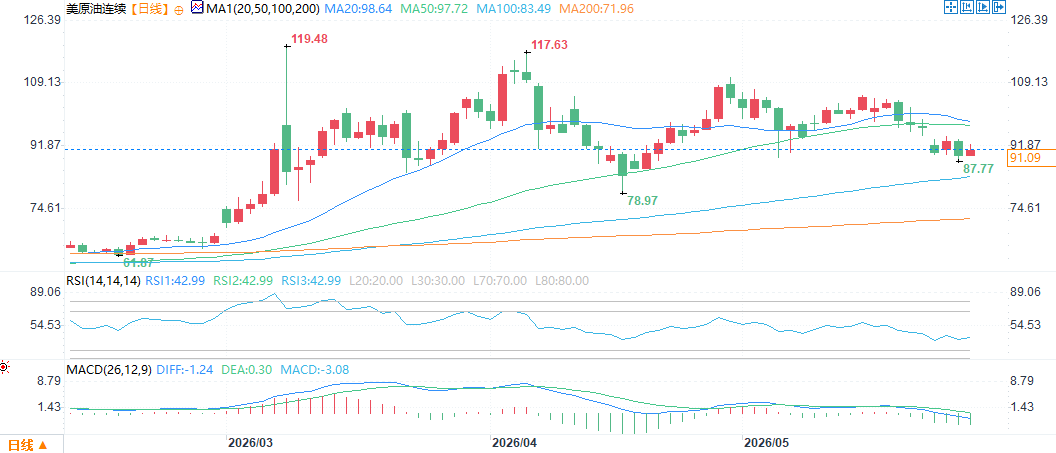
(US crude oil futures daily chart, source: FX678)
At 15:33 Beijing time on May 28, US crude oil futures were trading at $91.10 per barrel.
Behind the dramatic fluctuations in oil prices lies the market's repeated digestion of geopolitical news—Rabobank offers a sober perspective on this.
Rabobank global strategist Michael Avery points out that despite escalating geopolitical risks in the Middle East, oil prices have remained firmly below $100. The stalemate in US-Iran negotiations, the dispute over control of the Strait of Hormuz, and a new round of US military strikes have all failed to push oil prices above this psychological threshold.
Meanwhile, the European Central Bank warned that a war with Iran could trigger a financial crisis, Asia is facing a "plastics shock," and the global geoeconomic landscape is undergoing subtle changes. However, the market's core focus remains on the "right and wrong" of the Middle East situation.
Oil prices unusually calm: escalating conflict fails to push prices higher.
Rabobank global strategist Michael Avery points out that despite escalating geopolitical risks in the Middle East, oil prices have remained firmly below $100, a phenomenon that is noteworthy.
"Trump said the U.S. was 'dissatisfied' with the negotiations with Iran—just days after he claimed a deal was close—and hours later he said the leaked U.S. agreement terms from Iran were 'complete fabrications.' Against this backdrop, it is quite remarkable that oil prices remain virtually unchanged below $100 today."
Multiple Upgrades: Trump's Tough Stance and Military Actions
"More notably, Trump later added that Iran and Oman would not control the Strait of Hormuz—while Iran claims they will; Trump also vowed to 'bomb' Oman if it 'misbehaves'; the US military again launched a strike against Iran under the pretext of 'defensive action'."
He also reiterated that any agreement requires the region to sign the Abraham Accords, emphasizing that this must be a turning point toward a new geopolitical/economic architecture.
A broader impact: From the financial crisis to the "plastics shock"
In the relevant geoeconomic sphere, the European Central Bank (ECB) warned that the impact of the war with Iran could trigger a financial crisis. Rising energy costs are squeezing profit margins in industries such as chemicals and transportation, increasing the risk of corporate defaults; meanwhile, European banks' lending exposure in the Middle East could turn into bad debts. The ECB has called for strengthened stress testing and is prepared to inject liquidity if necessary.
Meanwhile, a "plastic shock" is hitting Asia. High oil prices have driven up the cost of plastic raw materials, leading to price increases in downstream products ranging from packaging to electronics and auto parts.
For Asian economies, which are primarily manufacturing-based, this means declining export competitiveness. Some small and medium-sized enterprises have already been forced to reduce production due to excessively high raw material prices, and the "plastic shock" is becoming a hidden driver of inflation in Asia, putting central banks in the region in a dilemma between curbing inflation and supporting the manufacturing sector.
Key Focus: The Middle East situation remains the main theme of the market.
"But at present, the core focus of the market is still on what is happening and what has not yet happened in the Middle East—what has been said and what has not been done; what is true and what is false."
This uncertainty is the fundamental reason why oil prices can neither break through $100 nor fall significantly.
Rabobank believes that despite the escalating US-Iran conflict, tensions in the Strait of Hormuz, and strong threats from Trump, oil prices have surprisingly remained below $100. This reflects market fatigue with geopolitical news and the assessment that no substantial supply disruptions have yet occurred. Meanwhile, the European Central Bank's warnings of a financial crisis, the "plastic shock" in Asia, and water resource issues in Central Asia are reshaping the broader geoeconomic landscape.
However, the complex interplay between reality and illusion in the Middle East remains a core issue that the market cannot avoid. Without a genuine supply disruption, oil prices may continue to hover in the $90-$100 range, awaiting the next catalyst.
(US crude oil futures daily chart, source: FX678)
At 15:33 Beijing time on May 28, US crude oil futures were trading at $91.10 per barrel.
- Risk Warning and Disclaimer
- The market involves risk, and trading may not be suitable for all investors. This article is for reference only and does not constitute personal investment advice, nor does it take into account certain users’ specific investment objectives, financial situation, or other needs. Any investment decisions made based on this information are at your own risk.

