Despite soaring US inflation and a hawkish Fed, the dollar has been dethroned by a proposed "ceasefire draft."
2026-05-30 11:23:16
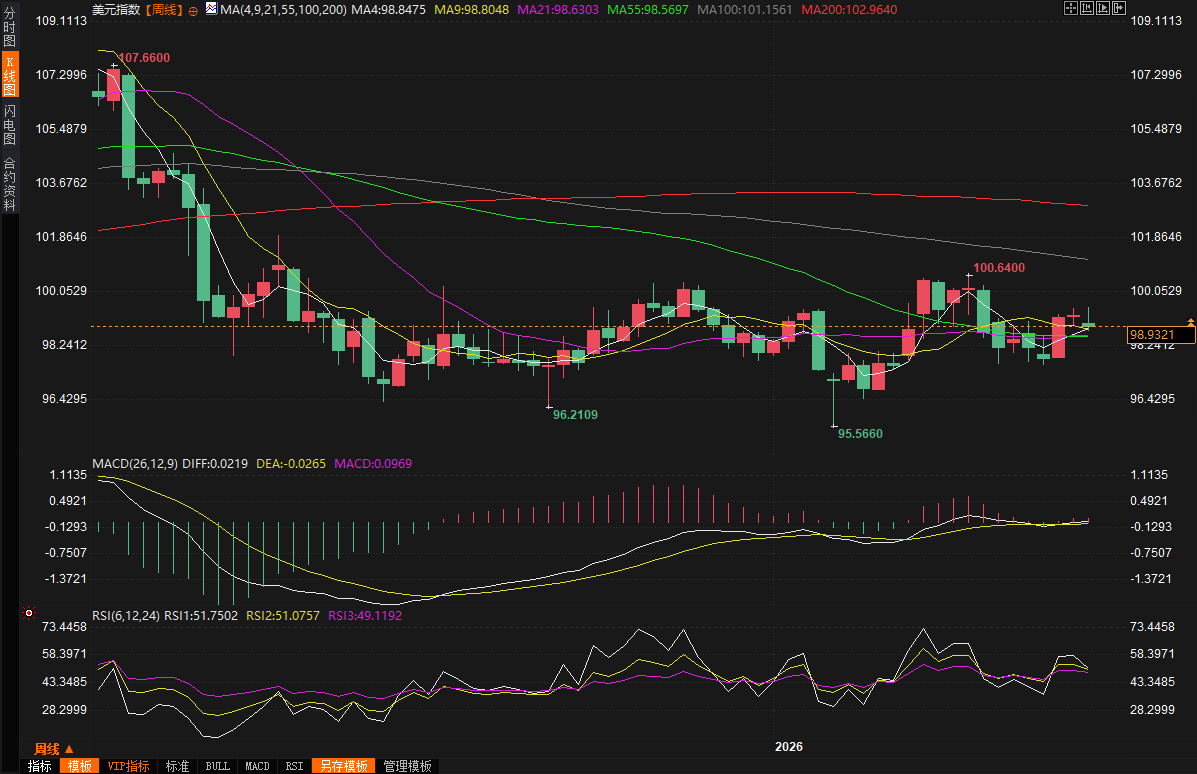
Over the past week, the global foreign exchange market has struggled amidst a double whammy of contradictions and uncertainties. On one hand, the alternating military conflict and peace talks between the US and Iran, even leading to a tense situation of fighting while negotiating, have left investors highly skeptical about the possibility of a genuine easing of tensions in the Middle East. On the other hand, the latest US inflation data hit a three-year high, economic growth was revised downwards, and several Federal Reserve officials released hawkish signals, making the interest rate outlook a core focus of market speculation once again. The US dollar index fluctuated at high levels amid the tug-of-war between risk aversion and ceasefire expectations. On Thursday (May 28), it briefly refreshed its highest point since April 8 to 99.54, but ultimately turned lower due to news of an extension of the ceasefire agreement between the US and Iran. On Friday (May 29), it touched a low of 98.75, a new low since May 14, before closing at 98.93, down 0.4% for the week, ending a two-week winning streak. Meanwhile, the yen approached its warning line, the New Zealand dollar unexpectedly rebounded strongly, and the debate within the European Central Bank regarding the pace of interest rate hikes intensified.
Earlier this week, conflicting signals emerged from peace talks between the United States and Iran, with direct clashes even breaking out between the two militaries. This three-month-long conflict, far from showing signs of ending, has instead made investors more cautious about a lasting solution due to the renewed military friction.
However, the situation subtly shifted later this week. Reports indicated that the US and Iran had reached a draft agreement to extend the ceasefire and restore freedom of navigation in the Strait of Hormuz, though the draft still awaits final approval from US President Trump. According to sources, the agreement plans to extend the existing ceasefire for another 60 days, while allowing ships to safely pass through this crucial global oil shipping route again. Negotiators will use this time to address deeper, more complex issues such as Iran's nuclear program. By Friday, Trump stated he would make a final decision on the ceasefire extension plan that day. This news significantly weakened market demand for the safe-haven dollar, pushing it down from a more than one-and-a-half-month high.
On the economic data front, U.S. inflation climbed to its highest level in three years in April, while first-quarter economic growth was revised downward. This data further reinforces economists' general consensus that the Federal Reserve will maintain current interest rates until at least next year, rather than cutting them easily. Olu Sonora, head of U.S. economics at Fitch Ratings, commented that the inflation situation is becoming increasingly unsettling for the Fed, and price pressures are likely to persist in the coming months. He emphasized that while the Fed cannot directly address supply shocks triggered by geopolitical conflicts, it cannot ignore the transmission effects of such shocks on potential inflation.
Hawkish voices within the Federal Reserve have noticeably increased this week. Vice Chairman Jefferson pointed out that given the remarkable resilience of the U.S. labor market to the current energy shock, focusing policy on bringing inflation back to the 2% target level is appropriate. Governor Cook expressed a similar view, further warning that spending related to artificial intelligence could be adding to the existing inflationary shock. St. Louis Fed President Mussaleam revealed that he, like several policymakers, believed last month that the phrase "accommodative bias" should be removed from the post-meeting statement to create the possibility of future rate hikes. Mussaleam explicitly stated that he supported the then-current interest rate decision, but believed that the accommodative bias was no longer consistent with the economic outlook and risk balance. This growing hawkish sentiment foreshadows a heated debate at the first policy meeting chaired by new Fed Chairman Warsh next month.
Amidst the interplay of US-Iran tensions and inflation data, the US dollar hovered near its one-week high for most of the week. However, as news regarding the draft extension of the ceasefire agreement became clearer, market demand for safe-haven assets weakened significantly. Coupled with a subsequent decline in international oil prices, the dollar index fell to 98.75 on Friday, a two-week low, before closing at 98.93, a weekly decline of 0.4%, ending its two-week winning streak. The foreign exchange market as a whole exhibited a lack of clear direction. Analysts pointed out that although futures market pricing almost unanimously anticipates a future interest rate hike, the dollar interest rate itself did not rise as a result, reflecting investors' lack of a complete narrative framework regarding central bank policy paths.
The yen faced significant depreciation pressure this week. A shift in market sentiment pushed the dollar/yen exchange rate to 159.65 on Thursday, its highest level since April 30, just shy of the 160 level that triggered intervention by Japanese authorities last month. Bank of Japan Governor Kazuo Ueda stated on Wednesday that central banks should not view oil price fluctuations in isolation, as temporary energy shocks can evolve into persistent inflationary pressures if they alter wage levels, public expectations, and corporate pricing behavior. Therefore, the line between temporary and persistent inflation is not mechanically drawn.
Matthew Ryan, head of market strategy at foreign exchange brokerage Ebury, analyzed that although market concerns about the risk of intervention by the Bank of Japan and the increasing number of investors betting that the central bank will raise interest rates in June should theoretically support the yen, the high exposure of the Japanese economy to the energy crisis is continuing to drag down the yen's exchange rate.
Data released by the Japanese government on Friday showed that the core consumer price index in the Tokyo area rose 1.3% year-on-year in May, falling below the central bank's 2% target for the fourth consecutive month. This was mainly attributed to government subsidies implemented to curb rising utility bills and tuition fees.
Another set of data showed that industrial production rebounded in April, mainly driven by strong demand fueled by artificial intelligence, but this masked the weak performance of other sectors affected by the Middle East conflict.
Analysts generally believe that with soaring oil prices and rising import costs due to the yen's depreciation, Japanese consumer inflation will rebound in the coming months, and the central bank still faces real pressure to raise interest rates. The market currently expects the Bank of Japan to raise its short-term policy rate from the current 0.75% to 1% next month. Furthermore, the Japanese Ministry of Finance confirmed on Friday that the government has injected 11.7 trillion yen (approximately US$73.5 billion) into the foreign exchange market over the past month to support the yen's exchange rate, confirming previous widespread speculation among traders.
In other parts of the Asia-Pacific region, the Bank of Korea, as expected, kept its benchmark interest rate unchanged at 2.50%, aiming to assess whether the war with Iran would dampen economic growth. Meanwhile, the continued depreciation of the won and persistent inflationary pressures are forcing policymakers to consider tightening monetary policy in the coming months. This meeting also marked the first policy meeting chaired by the newly appointed central bank governor, Shin Hyun-song. Analysts expect Shin to adopt a more hawkish stance than his predecessor, Lee Chang-yong, prioritizing price stability and currency defense over supporting economic growth.
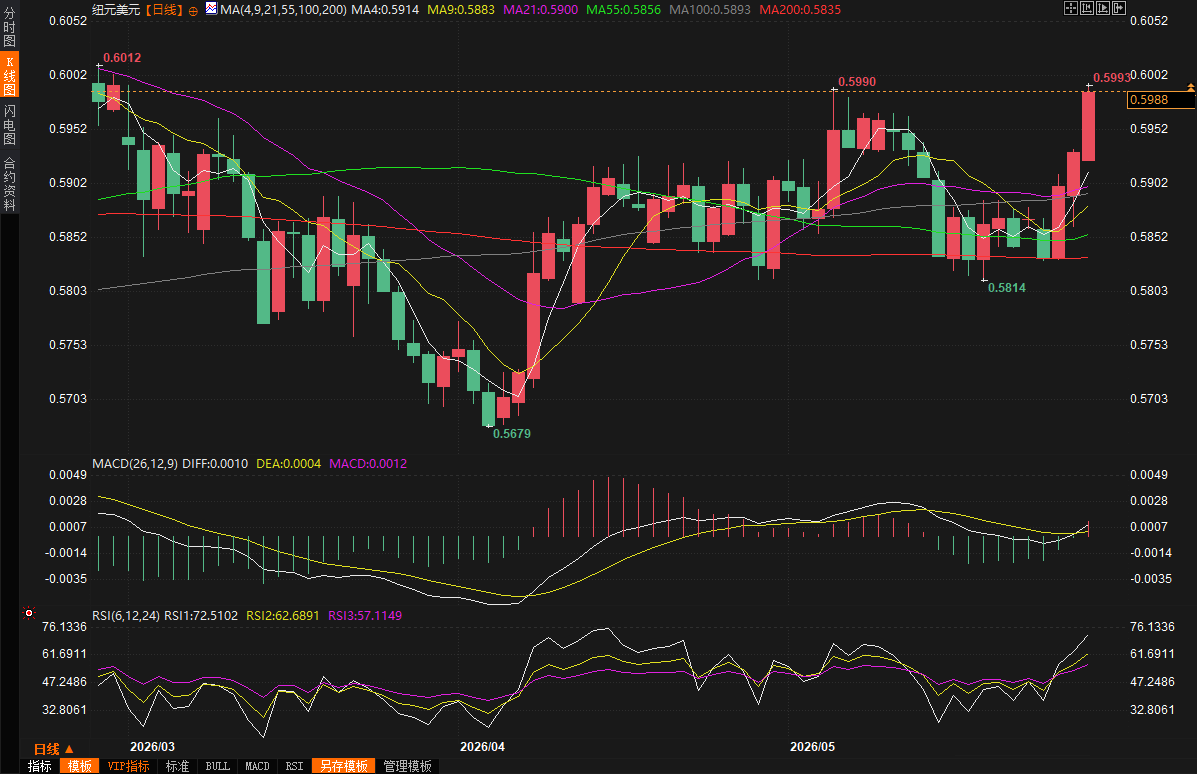
The New Zealand dollar performed exceptionally well this week, hitting a three-month high of 0.5993 against the US dollar, and rising 2.45% for the week. Although the Reserve Bank of New Zealand kept interest rates unchanged at its latest meeting, its unexpected signal that it might need to tighten monetary policy sooner and more aggressively than previously expected surprised the market and propelled the New Zealand dollar to continue its recent upward trend. On Friday, the New Zealand dollar rose nearly 1% against the US dollar, reaching a high of 0.5993, a new high since March 2, before closing at 0.5988, its highest closing price since February 27.
The euro traded within a narrow range this week, rising slightly against the dollar. ECB Governing Council member Pereira stated that the Middle East conflict will have a significant impact on price trends in the eurozone, and the central bank will focus on the effects of a second round of inflation at its June meeting. Executive Board member Schnabel, however, adopted a more hawkish stance: even if a deal is ultimately reached between the US and Iran, the ECB should raise interest rates in June, as the conflict has lasted far longer than expected, and high energy prices are spreading to a wider segment of the economy.
The minutes of the European Central Bank's April meeting, released this week, showed that the stance of holding rates steady held only a slight advantage at the time. Persistently high inflation makes it increasingly difficult for policymakers to ignore the impact of energy price shocks on the economy. Financial markets expect the ECB to raise interest rates nearly three times in the next year, with the market already fully pricing in the first rate hike in July and anticipating a second hike in October. On Friday in late New York trading, the euro touched 1.1685 against the dollar, a near two-week high, before closing at 1.1659, a weekly gain of 0.5%; the pound rose 0.1% against the dollar on Friday to 1.3455, a weekly gain of 0.17%.
Looking back at this week's global currency markets, geopolitics and monetary policy were intertwined, driving major currency pairs to exhibit volatile and divergent trends. The complex situation of ongoing negotiations and conflict between the US and Iran keeps shipping safety in the Strait of Hormuz and oil price trends uncertain, directly impacting inflation prospects and central bank decisions worldwide. In the US, inflation hitting a three-year high coupled with downward revisions to economic growth has shifted hawkish voices within the Federal Reserve from isolated individuals to a unified group. New Chairman Warsh's debut next month could be a key turning point for policy. Japan, meanwhile, is at a crossroads between intervention and interest rate hikes, with the 160 yen level potentially triggering official action at any time. The European Central Bank also faces the thorny issue of the energy shock transmitting to core inflation, with expectations of a July rate hike almost fully priced in.
Looking ahead, with the finalization of the US-Iran ceasefire agreement, the upcoming June policy meetings of central banks worldwide, and the release of further key economic data, the global foreign exchange market is likely to enter a period of significantly increased volatility. Investors need to closely monitor substantive developments in the geopolitical situation and whether the specter of inflation will force central banks to make more decisive policy adjustments than currently anticipated.
The US-Iran situation is constantly shifting: a dramatic turn from fighting to a ceasefire draft.
Earlier this week, conflicting signals emerged from peace talks between the United States and Iran, with direct clashes even breaking out between the two militaries. This three-month-long conflict, far from showing signs of ending, has instead made investors more cautious about a lasting solution due to the renewed military friction.
However, the situation subtly shifted later this week. Reports indicated that the US and Iran had reached a draft agreement to extend the ceasefire and restore freedom of navigation in the Strait of Hormuz, though the draft still awaits final approval from US President Trump. According to sources, the agreement plans to extend the existing ceasefire for another 60 days, while allowing ships to safely pass through this crucial global oil shipping route again. Negotiators will use this time to address deeper, more complex issues such as Iran's nuclear program. By Friday, Trump stated he would make a final decision on the ceasefire extension plan that day. This news significantly weakened market demand for the safe-haven dollar, pushing it down from a more than one-and-a-half-month high.
US inflation hits a three-year high; Federal Reserve's hawkish camp expands.
On the economic data front, U.S. inflation climbed to its highest level in three years in April, while first-quarter economic growth was revised downward. This data further reinforces economists' general consensus that the Federal Reserve will maintain current interest rates until at least next year, rather than cutting them easily. Olu Sonora, head of U.S. economics at Fitch Ratings, commented that the inflation situation is becoming increasingly unsettling for the Fed, and price pressures are likely to persist in the coming months. He emphasized that while the Fed cannot directly address supply shocks triggered by geopolitical conflicts, it cannot ignore the transmission effects of such shocks on potential inflation.
Hawkish voices within the Federal Reserve have noticeably increased this week. Vice Chairman Jefferson pointed out that given the remarkable resilience of the U.S. labor market to the current energy shock, focusing policy on bringing inflation back to the 2% target level is appropriate. Governor Cook expressed a similar view, further warning that spending related to artificial intelligence could be adding to the existing inflationary shock. St. Louis Fed President Mussaleam revealed that he, like several policymakers, believed last month that the phrase "accommodative bias" should be removed from the post-meeting statement to create the possibility of future rate hikes. Mussaleam explicitly stated that he supported the then-current interest rate decision, but believed that the accommodative bias was no longer consistent with the economic outlook and risk balance. This growing hawkish sentiment foreshadows a heated debate at the first policy meeting chaired by new Fed Chairman Warsh next month.
US Dollar Performance: Safe-haven demand recedes, weekly gains halted.
Amidst the interplay of US-Iran tensions and inflation data, the US dollar hovered near its one-week high for most of the week. However, as news regarding the draft extension of the ceasefire agreement became clearer, market demand for safe-haven assets weakened significantly. Coupled with a subsequent decline in international oil prices, the dollar index fell to 98.75 on Friday, a two-week low, before closing at 98.93, a weekly decline of 0.4%, ending its two-week winning streak. The foreign exchange market as a whole exhibited a lack of clear direction. Analysts pointed out that although futures market pricing almost unanimously anticipates a future interest rate hike, the dollar interest rate itself did not rise as a result, reflecting investors' lack of a complete narrative framework regarding central bank policy paths.
The yen is approaching the 160 mark, with intervention risks and interest rate hike expectations coexisting.
The yen faced significant depreciation pressure this week. A shift in market sentiment pushed the dollar/yen exchange rate to 159.65 on Thursday, its highest level since April 30, just shy of the 160 level that triggered intervention by Japanese authorities last month. Bank of Japan Governor Kazuo Ueda stated on Wednesday that central banks should not view oil price fluctuations in isolation, as temporary energy shocks can evolve into persistent inflationary pressures if they alter wage levels, public expectations, and corporate pricing behavior. Therefore, the line between temporary and persistent inflation is not mechanically drawn.
Matthew Ryan, head of market strategy at foreign exchange brokerage Ebury, analyzed that although market concerns about the risk of intervention by the Bank of Japan and the increasing number of investors betting that the central bank will raise interest rates in June should theoretically support the yen, the high exposure of the Japanese economy to the energy crisis is continuing to drag down the yen's exchange rate.
Data released by the Japanese government on Friday showed that the core consumer price index in the Tokyo area rose 1.3% year-on-year in May, falling below the central bank's 2% target for the fourth consecutive month. This was mainly attributed to government subsidies implemented to curb rising utility bills and tuition fees.
Another set of data showed that industrial production rebounded in April, mainly driven by strong demand fueled by artificial intelligence, but this masked the weak performance of other sectors affected by the Middle East conflict.
Analysts generally believe that with soaring oil prices and rising import costs due to the yen's depreciation, Japanese consumer inflation will rebound in the coming months, and the central bank still faces real pressure to raise interest rates. The market currently expects the Bank of Japan to raise its short-term policy rate from the current 0.75% to 1% next month. Furthermore, the Japanese Ministry of Finance confirmed on Friday that the government has injected 11.7 trillion yen (approximately US$73.5 billion) into the foreign exchange market over the past month to support the yen's exchange rate, confirming previous widespread speculation among traders.
Other Asia-Pacific markets: The Bank of Korea held rates steady, while the New Zealand dollar surged.
In other parts of the Asia-Pacific region, the Bank of Korea, as expected, kept its benchmark interest rate unchanged at 2.50%, aiming to assess whether the war with Iran would dampen economic growth. Meanwhile, the continued depreciation of the won and persistent inflationary pressures are forcing policymakers to consider tightening monetary policy in the coming months. This meeting also marked the first policy meeting chaired by the newly appointed central bank governor, Shin Hyun-song. Analysts expect Shin to adopt a more hawkish stance than his predecessor, Lee Chang-yong, prioritizing price stability and currency defense over supporting economic growth.
The New Zealand dollar performed exceptionally well this week, hitting a three-month high of 0.5993 against the US dollar, and rising 2.45% for the week. Although the Reserve Bank of New Zealand kept interest rates unchanged at its latest meeting, its unexpected signal that it might need to tighten monetary policy sooner and more aggressively than previously expected surprised the market and propelled the New Zealand dollar to continue its recent upward trend. On Friday, the New Zealand dollar rose nearly 1% against the US dollar, reaching a high of 0.5993, a new high since March 2, before closing at 0.5988, its highest closing price since February 27.
European Markets: Inflationary pressures intensify, interest rate hikes drawing ever closer.
The euro traded within a narrow range this week, rising slightly against the dollar. ECB Governing Council member Pereira stated that the Middle East conflict will have a significant impact on price trends in the eurozone, and the central bank will focus on the effects of a second round of inflation at its June meeting. Executive Board member Schnabel, however, adopted a more hawkish stance: even if a deal is ultimately reached between the US and Iran, the ECB should raise interest rates in June, as the conflict has lasted far longer than expected, and high energy prices are spreading to a wider segment of the economy.
The minutes of the European Central Bank's April meeting, released this week, showed that the stance of holding rates steady held only a slight advantage at the time. Persistently high inflation makes it increasingly difficult for policymakers to ignore the impact of energy price shocks on the economy. Financial markets expect the ECB to raise interest rates nearly three times in the next year, with the market already fully pricing in the first rate hike in July and anticipating a second hike in October. On Friday in late New York trading, the euro touched 1.1685 against the dollar, a near two-week high, before closing at 1.1659, a weekly gain of 0.5%; the pound rose 0.1% against the dollar on Friday to 1.3455, a weekly gain of 0.17%.
Summary: Multiple uncertainties remain, and the foreign exchange market is entering a period of high volatility.
Looking back at this week's global currency markets, geopolitics and monetary policy were intertwined, driving major currency pairs to exhibit volatile and divergent trends. The complex situation of ongoing negotiations and conflict between the US and Iran keeps shipping safety in the Strait of Hormuz and oil price trends uncertain, directly impacting inflation prospects and central bank decisions worldwide. In the US, inflation hitting a three-year high coupled with downward revisions to economic growth has shifted hawkish voices within the Federal Reserve from isolated individuals to a unified group. New Chairman Warsh's debut next month could be a key turning point for policy. Japan, meanwhile, is at a crossroads between intervention and interest rate hikes, with the 160 yen level potentially triggering official action at any time. The European Central Bank also faces the thorny issue of the energy shock transmitting to core inflation, with expectations of a July rate hike almost fully priced in.
Looking ahead, with the finalization of the US-Iran ceasefire agreement, the upcoming June policy meetings of central banks worldwide, and the release of further key economic data, the global foreign exchange market is likely to enter a period of significantly increased volatility. Investors need to closely monitor substantive developments in the geopolitical situation and whether the specter of inflation will force central banks to make more decisive policy adjustments than currently anticipated.
- Risk Warning and Disclaimer
- The market involves risk, and trading may not be suitable for all investors. This article is for reference only and does not constitute personal investment advice, nor does it take into account certain users’ specific investment objectives, financial situation, or other needs. Any investment decisions made based on this information are at your own risk.