The Australian dollar enters a crucial week: Australian GDP, US non-farm payrolls, and manufacturing PMI data will be released in quick succession, putting the exchange rate at a crossroads.
2026-06-01 11:20:53
On Monday (June 1) during the Asian session, the Australian dollar opened 0.2% lower at 0.7168 against the US dollar before rebounding. It is currently trading around 0.7180, having largely recovered its earlier losses and not far from the two-week high of 0.7200 reached last week.
The Australian dollar is entering a crucial week against the US dollar, with Australian GDP, US manufacturing PMI, and non-farm payroll data determining whether the exchange rate will continue its upward trend or begin a deeper correction.
The Australian dollar rose against all major currencies except the New Zealand dollar last week, boosted by improved risk sentiment following Trump's announcement of the lifting of the blockade on Iranian ships.

The Australian dollar traded in a relatively high range against the US dollar in the new week. Driven by improved risk sentiment and a weaker US dollar, the Australian dollar maintained its strength against most major currencies, but positioning data and technical signals both indicate that the risk of a pullback still exists.
Last week, near the end of the week, Trump announced that the US would lift the blockade on Iranian ships, and optimism dominated the market. This news pushed crude oil prices to a three-week low, Wall Street stocks hit record highs, while gold declined. A weaker dollar and improved risk sentiment propelled the Australian dollar to a 10-day high against the US dollar, briefly touching the 0.7200 level.
The Australian dollar once again finds itself caught between two opposing forces: the situation in the Middle East and interest rate expectations, although the driving factors have shifted. Hopes for de-escalation remain, while expectations for further rate hikes by the Reserve Bank of Australia have softened. This combination could lead to a volatile but slightly upward-biased trading pattern this week.
After three consecutive rate hikes totaling 25 basis points, weak employment and household spending data may prompt the Reserve Bank of Australia (RBA) to pause its wait-and-see approach. While cut-off mean inflation remains high at 3.4%, allowing the RBA to maintain a hawkish stance, the weak economic data provides a reason to pause rate hikes.
In Australia, the focus will be on the Q1 GDP report released on Monday. Tuesday will see the release of data on the contribution of net exports to growth. If the data falls short of expectations, it could trigger updated forecasts from the four major banks, potentially having a greater impact on the Australian dollar against the US dollar than the GDP report itself.
On the inflation front, the overall CPI slowed to 4.2% from 4.4%, but the cut-off mean inflation remained high at 3.4%, allowing the Reserve Bank of Australia (RBA) to maintain a hawkish stance. However, weak employment and household spending data provided the RBA with room to pause.
US PMI: Expansion expected to continue, but risks remain.
The ISM Purchasing Managers' Index will be closely watched. Both the manufacturing and services PMIs remain above 50, indicating continued expansion. However, the longer high oil prices and inflationary pressures persist, the greater the risk that the overall PMI will fall below 50, foreshadowing contraction.
If the PMI continues to show positive growth, it will indicate that the economy has a relatively strong ability to absorb high prices, and provide a reason for the Federal Reserve to raise interest rates further.
Non-Farm Payrolls: Potential for Increased Rate Hike Expectations <br />Non-farm payroll data will be released on Friday. The past two reports have both exceeded expectations, with job growth sufficient to offset the negative growth in February. The renewed acceleration in job growth and the apparent peak in the unemployment rate are another reason for traders to remain wary of further Fed rate hikes.
It is worth noting that job growth has been steadily slowing since its post-pandemic peak, while the recent resurgence coincides with what appears to be a peak in the unemployment rate—a combination that warrants caution.
How will the contradictory signals from the US job market affect the Australian dollar's trajectory? From a technical perspective, the Australian dollar is at a crucial juncture against the US dollar.
The Australian dollar is currently in a high-level consolidation phase within a long-term upward trend on the daily chart. The overall bullish pattern remains unchanged, and the short-term balance between bullish and bearish forces is trending towards equilibrium.
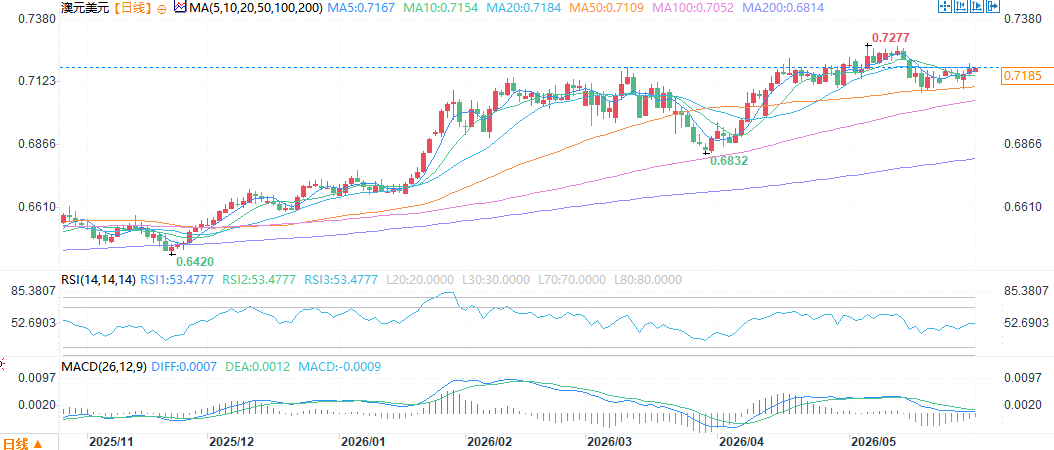
(AUD/USD daily chart, source: FX678)
On the moving average system, the price is currently trading above all moving averages: MA5, MA10, MA20, MA50, MA100, and MA200. The moving averages are in a bullish alignment, indicating a clear long-term upward trend, while short-term moving averages continue to provide support. After a previous high of 0.7277, the price has slightly retreated and is currently trading around 0.7185, above the previous consolidation range.
Regarding key support and resistance levels, short-term support lies at the 20-day moving average (MA20) (0.7184) and the 50-day moving average (MA50) (0.7109), with strong support below at the previous low of 0.6832. Resistance is at the recent high of 0.7277, and a break above this level could open up new upside potential.
The Australian dollar is entering a crucial week against the US dollar, with Australian GDP, US manufacturing PMI, and non-farm payroll data determining whether the exchange rate continues its upward trend or enters a deeper correction. Driven by expectations of easing tensions in the Middle East, the Australian dollar briefly touched around 0.7200 last week. Currently, the price action on the daily chart remains corrective; if the Middle East situation continues to ease and US data weakens, the Australian dollar may find further support.
At 11:20 Beijing time on June 1, the Australian dollar was trading at 0.7177/78 against the US dollar.
The Australian dollar is entering a crucial week against the US dollar, with Australian GDP, US manufacturing PMI, and non-farm payroll data determining whether the exchange rate will continue its upward trend or begin a deeper correction.
The Australian dollar rose against all major currencies except the New Zealand dollar last week, boosted by improved risk sentiment following Trump's announcement of the lifting of the blockade on Iranian ships.
The Australian dollar's rally faces a test from economic data.
The Australian dollar traded in a relatively high range against the US dollar in the new week. Driven by improved risk sentiment and a weaker US dollar, the Australian dollar maintained its strength against most major currencies, but positioning data and technical signals both indicate that the risk of a pullback still exists.
Last week, near the end of the week, Trump announced that the US would lift the blockade on Iranian ships, and optimism dominated the market. This news pushed crude oil prices to a three-week low, Wall Street stocks hit record highs, while gold declined. A weaker dollar and improved risk sentiment propelled the Australian dollar to a 10-day high against the US dollar, briefly touching the 0.7200 level.
The Australian dollar is caught between the Middle East situation and interest rate expectations.
The Australian dollar once again finds itself caught between two opposing forces: the situation in the Middle East and interest rate expectations, although the driving factors have shifted. Hopes for de-escalation remain, while expectations for further rate hikes by the Reserve Bank of Australia have softened. This combination could lead to a volatile but slightly upward-biased trading pattern this week.
After three consecutive rate hikes totaling 25 basis points, weak employment and household spending data may prompt the Reserve Bank of Australia (RBA) to pause its wait-and-see approach. While cut-off mean inflation remains high at 3.4%, allowing the RBA to maintain a hawkish stance, the weak economic data provides a reason to pause rate hikes.
This week's economic data: Australian GDP and US non-farm payrolls.
In Australia, the focus will be on the Q1 GDP report released on Monday. Tuesday will see the release of data on the contribution of net exports to growth. If the data falls short of expectations, it could trigger updated forecasts from the four major banks, potentially having a greater impact on the Australian dollar against the US dollar than the GDP report itself.
On the inflation front, the overall CPI slowed to 4.2% from 4.4%, but the cut-off mean inflation remained high at 3.4%, allowing the Reserve Bank of Australia (RBA) to maintain a hawkish stance. However, weak employment and household spending data provided the RBA with room to pause.
US PMI: Expansion expected to continue, but risks remain.
The ISM Purchasing Managers' Index will be closely watched. Both the manufacturing and services PMIs remain above 50, indicating continued expansion. However, the longer high oil prices and inflationary pressures persist, the greater the risk that the overall PMI will fall below 50, foreshadowing contraction.
If the PMI continues to show positive growth, it will indicate that the economy has a relatively strong ability to absorb high prices, and provide a reason for the Federal Reserve to raise interest rates further.
Non-Farm Payrolls: Potential for Increased Rate Hike Expectations <br />Non-farm payroll data will be released on Friday. The past two reports have both exceeded expectations, with job growth sufficient to offset the negative growth in February. The renewed acceleration in job growth and the apparent peak in the unemployment rate are another reason for traders to remain wary of further Fed rate hikes.
It is worth noting that job growth has been steadily slowing since its post-pandemic peak, while the recent resurgence coincides with what appears to be a peak in the unemployment rate—a combination that warrants caution.
How will the contradictory signals from the US job market affect the Australian dollar's trajectory? From a technical perspective, the Australian dollar is at a crucial juncture against the US dollar.
The Australian dollar is currently in a high-level consolidation phase within a long-term upward trend on the daily chart. The overall bullish pattern remains unchanged, and the short-term balance between bullish and bearish forces is trending towards equilibrium.
(AUD/USD daily chart, source: FX678)
On the moving average system, the price is currently trading above all moving averages: MA5, MA10, MA20, MA50, MA100, and MA200. The moving averages are in a bullish alignment, indicating a clear long-term upward trend, while short-term moving averages continue to provide support. After a previous high of 0.7277, the price has slightly retreated and is currently trading around 0.7185, above the previous consolidation range.
Regarding key support and resistance levels, short-term support lies at the 20-day moving average (MA20) (0.7184) and the 50-day moving average (MA50) (0.7109), with strong support below at the previous low of 0.6832. Resistance is at the recent high of 0.7277, and a break above this level could open up new upside potential.
The Australian dollar is entering a crucial week against the US dollar, with Australian GDP, US manufacturing PMI, and non-farm payroll data determining whether the exchange rate continues its upward trend or enters a deeper correction. Driven by expectations of easing tensions in the Middle East, the Australian dollar briefly touched around 0.7200 last week. Currently, the price action on the daily chart remains corrective; if the Middle East situation continues to ease and US data weakens, the Australian dollar may find further support.
At 11:20 Beijing time on June 1, the Australian dollar was trading at 0.7177/78 against the US dollar.
- Risk Warning and Disclaimer
- The market involves risk, and trading may not be suitable for all investors. This article is for reference only and does not constitute personal investment advice, nor does it take into account certain users’ specific investment objectives, financial situation, or other needs. Any investment decisions made based on this information are at your own risk.