Inventory alerts sound as industry giants warn of a potential surge in international oil prices.
2026-06-01 12:16:03
The ongoing conflict with Iran has disrupted shipping through the Strait of Hormuz, leading to a structural shortage in the global crude oil supply chain. Currently, the market is barely maintaining a supply-demand balance by depleting commercial inventories and releasing strategic oil reserves by various countries. Coupled with short-term disturbances caused by media manipulation, oil prices are temporarily fluctuating. However, institutions such as JPMorgan Chase and Goldman Sachs, as well as industry giants like Chevron and ExxonMobil, have issued warnings that global crude oil inventories are rapidly approaching operational limits, and the buffer space is about to run out.
The current low prices are unlikely to continue, and oil prices are likely to surge in the next two to three months, posing a new and severe challenge to the global energy market and the macroeconomy.
Two months ago, JPMorgan Chase took the lead in calculating the minimum operating inventory of global crude oil, comparing the crude oil inventory cycle to human blood pressure, pointing out that sufficient total inventory does not mean safe operation, and insufficient liquidity is the core risk.
Four weeks later, the bank released another in-depth analysis, focusing on the prospects for navigation in the Strait of Hormuz. Data shows that at the beginning of 2026, global crude oil inventories totaled 8.4 billion barrels, of which only 800 million barrels were safe for use and would not cause operational pressure on the system. According to calculations, if the strait is closed for an extended period, even if daily crude oil demand shrinks steadily to 5.5 million barrels, OECD commercial inventories will enter a period of pressure in June, and global crude oil inventories will completely reach operational thresholds in September.
However, the market trend showed a clear divergence. The blockade of the strait caused the daily transportation of tens of millions of barrels of crude oil to be interrupted. After oil prices surged in late March, they fell instead of rising. The low prices stimulated a recovery in crude oil demand, and the rate of demand contraction slowed down further.
The unusual market movements led JPMorgan Chase to state that the global oil supply and demand logic was distorted. Goldman Sachs subsequently released data showing that in May, with continued traffic disruptions in the Strait of Hormuz, global crude oil inventories saw a record daily drop of 8.7 million barrels, exacerbating the fundamental supply-demand imbalance. Meanwhile, influenced by speculation of an impending US-Iran agreement, oil prices continued to decline, prompting leading industry players to abandon their wait-and-see approach and issue risk warnings.
Last Thursday (May 28), Chevron CEO Mike Wirth made a public statement at the Bernstein industry conference. He said that with the continued reduction in global crude oil buffer inventories, the market's ability to withstand supply and demand imbalances has significantly decreased, and upward pressure on spot oil prices will gradually emerge in the coming weeks, with the price increase becoming more pronounced in June and July.
Oil prices fell in the past week due to market optimism about a reconciliation between the US and Iran and the resumption of cross-strait shipping. However, the three-month-long conflict has created a global daily oil supply gap of 12 to 13 million barrels, and its impact is far from over.
Sultan al-Jaber, CEO of Abu Dhabi National Oil Company, previously predicted that even if the conflict ends, crude oil shipping capacity in the Strait of Hormuz will not recover quickly, and it will take at least four months to recover to 80% of pre-war traffic. Full navigation is likely to not resume until 2027.
Worth added that the reason why oil prices did not surge in the early stages was due to the relatively high commercial inventories before the outbreak of the conflict, the release of strategic petroleum reserves by the United States, and the circulation of some sanctioned crude oil. However, these buffer resources are now gradually being depleted.
The energy crisis will also reshape national energy policies, prompting countries to accelerate the replenishment of their oil reserves to mitigate the impact of geopolitical conflicts and public events. This restocking demand will further amplify crude oil consumption, providing additional support for oil prices. Meanwhile, the enormous costs of repairing damaged oil and gas infrastructure in the Middle East will also drive up energy costs in the long term.
ExxonMobil, Chevron's main competitor, is even more pessimistic. Neil Chapman, Senior Vice President of the company, pointed out at the same conference that commercial inventories of all categories of crude oil, gasoline, diesel, and jet fuel are declining rapidly. This, coupled with the release of strategic reserves by many countries, has only temporarily offset the supply gap, and this model is nearing its end.
He admitted that global crude oil inventories will soon fall to historically low levels, most likely within two to three weeks. Industry models predict that once inventories reach a critical threshold, Brent crude oil prices could surge to $150 to $160 per barrel . At that point, high oil prices will suppress consumption, relying on shrinking demand to rebalance the market. The fact that oil prices have remained between $90 and $110 per barrel for the past six weeks, entirely dependent on continuous inventory reduction, is unsustainable.
Based on information from various sources, the current low oil prices are merely a short-term illusion. Media manipulation, inventory depletion, and reserve releases have collectively masked the underlying problem of supply chain disruptions. Global crude oil inventories are shrinking at a rate exceeding ten million barrels per day, with less than three months remaining before reaching operational limits. Once inventories are depleted, oil prices will experience a retaliatory surge, with a volatility comparable to the extreme negative price swings of 2020, only in the opposite direction. Until geopolitical conflicts are fully resolved and the Strait of Hormuz remains open for navigation, risks in the global energy market will continue to accumulate, potentially accelerating the arrival of an era of high oil prices.
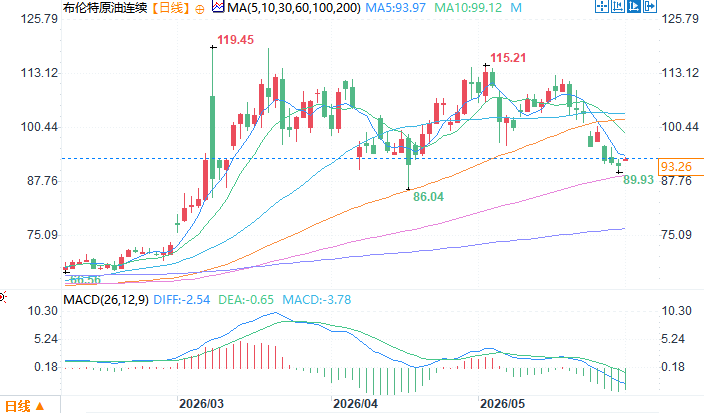
Brent crude oil daily chart source: EasyForex
At 12:15 Beijing time on June 1, Brent crude oil futures were trading at $93.36 per barrel.
The current low prices are unlikely to continue, and oil prices are likely to surge in the next two to three months, posing a new and severe challenge to the global energy market and the macroeconomy.
According to continuous analysis by institutions, the crude oil inventory red line is gradually approaching.
Two months ago, JPMorgan Chase took the lead in calculating the minimum operating inventory of global crude oil, comparing the crude oil inventory cycle to human blood pressure, pointing out that sufficient total inventory does not mean safe operation, and insufficient liquidity is the core risk.
Four weeks later, the bank released another in-depth analysis, focusing on the prospects for navigation in the Strait of Hormuz. Data shows that at the beginning of 2026, global crude oil inventories totaled 8.4 billion barrels, of which only 800 million barrels were safe for use and would not cause operational pressure on the system. According to calculations, if the strait is closed for an extended period, even if daily crude oil demand shrinks steadily to 5.5 million barrels, OECD commercial inventories will enter a period of pressure in June, and global crude oil inventories will completely reach operational thresholds in September.
However, the market trend showed a clear divergence. The blockade of the strait caused the daily transportation of tens of millions of barrels of crude oil to be interrupted. After oil prices surged in late March, they fell instead of rising. The low prices stimulated a recovery in crude oil demand, and the rate of demand contraction slowed down further.
The unusual market movements led JPMorgan Chase to state that the global oil supply and demand logic was distorted. Goldman Sachs subsequently released data showing that in May, with continued traffic disruptions in the Strait of Hormuz, global crude oil inventories saw a record daily drop of 8.7 million barrels, exacerbating the fundamental supply-demand imbalance. Meanwhile, influenced by speculation of an impending US-Iran agreement, oil prices continued to decline, prompting leading industry players to abandon their wait-and-see approach and issue risk warnings.
Industry giants warn that the upward trend in oil prices is unlikely to reverse.
Last Thursday (May 28), Chevron CEO Mike Wirth made a public statement at the Bernstein industry conference. He said that with the continued reduction in global crude oil buffer inventories, the market's ability to withstand supply and demand imbalances has significantly decreased, and upward pressure on spot oil prices will gradually emerge in the coming weeks, with the price increase becoming more pronounced in June and July.
Oil prices fell in the past week due to market optimism about a reconciliation between the US and Iran and the resumption of cross-strait shipping. However, the three-month-long conflict has created a global daily oil supply gap of 12 to 13 million barrels, and its impact is far from over.
Sultan al-Jaber, CEO of Abu Dhabi National Oil Company, previously predicted that even if the conflict ends, crude oil shipping capacity in the Strait of Hormuz will not recover quickly, and it will take at least four months to recover to 80% of pre-war traffic. Full navigation is likely to not resume until 2027.
Worth added that the reason why oil prices did not surge in the early stages was due to the relatively high commercial inventories before the outbreak of the conflict, the release of strategic petroleum reserves by the United States, and the circulation of some sanctioned crude oil. However, these buffer resources are now gradually being depleted.
The energy crisis will also reshape national energy policies, prompting countries to accelerate the replenishment of their oil reserves to mitigate the impact of geopolitical conflicts and public events. This restocking demand will further amplify crude oil consumption, providing additional support for oil prices. Meanwhile, the enormous costs of repairing damaged oil and gas infrastructure in the Middle East will also drive up energy costs in the long term.
Inventory levels are nearing their limit, and the risks of extreme market conditions are becoming increasingly apparent.
ExxonMobil, Chevron's main competitor, is even more pessimistic. Neil Chapman, Senior Vice President of the company, pointed out at the same conference that commercial inventories of all categories of crude oil, gasoline, diesel, and jet fuel are declining rapidly. This, coupled with the release of strategic reserves by many countries, has only temporarily offset the supply gap, and this model is nearing its end.
He admitted that global crude oil inventories will soon fall to historically low levels, most likely within two to three weeks. Industry models predict that once inventories reach a critical threshold, Brent crude oil prices could surge to $150 to $160 per barrel . At that point, high oil prices will suppress consumption, relying on shrinking demand to rebalance the market. The fact that oil prices have remained between $90 and $110 per barrel for the past six weeks, entirely dependent on continuous inventory reduction, is unsustainable.
Summarize
Based on information from various sources, the current low oil prices are merely a short-term illusion. Media manipulation, inventory depletion, and reserve releases have collectively masked the underlying problem of supply chain disruptions. Global crude oil inventories are shrinking at a rate exceeding ten million barrels per day, with less than three months remaining before reaching operational limits. Once inventories are depleted, oil prices will experience a retaliatory surge, with a volatility comparable to the extreme negative price swings of 2020, only in the opposite direction. Until geopolitical conflicts are fully resolved and the Strait of Hormuz remains open for navigation, risks in the global energy market will continue to accumulate, potentially accelerating the arrival of an era of high oil prices.
Brent crude oil daily chart source: EasyForex
At 12:15 Beijing time on June 1, Brent crude oil futures were trading at $93.36 per barrel.
- Risk Warning and Disclaimer
- The market involves risk, and trading may not be suitable for all investors. This article is for reference only and does not constitute personal investment advice, nor does it take into account certain users’ specific investment objectives, financial situation, or other needs. Any investment decisions made based on this information are at your own risk.