With a June rate hike by the European Central Bank almost a certainty, why are officials collectively "silent" about the subsequent path?
2026-06-01 13:08:53
On Monday (June 1) during the Asian session, the euro fluctuated slightly lower against the US dollar, currently trading around 1.1650, down about 0.1%. Last Friday, it rebounded to around 1.1685 driven by optimism about a ceasefire between the US and Iran, but failed to hold above that level and subsequently fluctuated downwards.
Echoing the fluctuating decline in exchange rates, the reasons for the European Central Bank's interest rate hike are far less straightforward than the market believes.
Eurozone inflation rose from 1.9% in February to 3.0% in April, primarily driven by energy price increases due to disruptions in the Strait of Hormuz, but most underlying inflation indicators remained relatively moderate. Preliminary data for May suggested inflation might be flat or slightly higher, but most were below market expectations. Policymakers are more concerned about the potential for inflationary pressures to widen in the future than about existing deep-seated issues. This is a predictive judgment based on "what might happen," rather than a response to realized inflation.
The current environment is exceptionally uncertain, largely dependent on unpredictable geopolitical developments. Meanwhile, the Eurozone economy does not appear to require significant monetary tightening—the composite PMI shows growth has declined for three consecutive months. The European Central Bank is betting that inflationary pressures will expand sufficiently and the economy will be resilient enough. The relevant historical precedent is not 2022, but 2011—when the ECB tightened policy due to energy-driven inflation, only to reverse it a few months later due to a sharp weakening in growth.
Recently, several members of the European Central Bank's Governing Council have set the tone for an interest rate hike on June 11. However, their own arguments reveal that the rationale for tightening policy is far less straightforward than the market assumed.
A June rate hike now seems highly likely. The market has already priced it in, and several Governing Council members have clearly stated that they expect action. However, the same officials have emphasized that they are unwilling to commit to further rate hikes.
The core issue is that the existing data is insufficient to support a complete tightening cycle. Eurozone inflation rose from 1.9% in February to 3.0% in April, primarily due to higher energy prices following the disruption of shipping in the Strait of Hormuz. However, most underlying inflation indicators remain relatively mild. Other indicators of inflationary pressures have so far shown little evidence of widespread problems.
Preliminary national data for May, released last Friday, suggests that eurozone inflation may have remained flat or risen slightly. However, in most cases, the actual figures were slightly lower than market expectations. Full eurozone flash estimates will not be released until Tuesday, but it is clear that inflation has not surged as it did in 2022-2023.
Even European Central Bank policymakers acknowledge this ambiguity.
Finnish central bank governor Rehn noted that "medium- to long-term inflation expectations have not deviated significantly," and wage growth continues to slow. What policymakers are truly concerned about is that inflationary pressures may widen over time.
This distinction is crucial. The European Central Bank is prepared to tighten policy not because inflation is already deeply entrenched, but because it fears it might be in the future.
European Central Bank Executive Board member Schnabel recently stated that “ignoring” the energy shock is “no longer an option.”
Chief Economist Ryan also warned that the longer the Gulf conflict continues, the less likely the ECB's "most benign scenario" (where a temporary rise in energy prices can be largely ignored) becomes.
Lane points out that the survey shows many businesses expect to raise prices, which poses a risk of "broader inflation," a "significant problem." But this is fundamentally still a prediction of "what might happen," rather than a response to inflation that has already materialized.
Monetary policy based primarily on forecasts rather than realized inflation is inherently difficult to implement. The current environment is exceptionally uncertain because it depends heavily on geopolitical developments that cannot be accurately predicted. No one knows how long the Strait of Hormuz will remain blocked, how the energy market will evolve, or how much of the shock will ultimately translate into wages and prices.
At the same time, the overall economy does not appear to require significant monetary tightening. The composite PMI shows growth has declined for three consecutive months. Fiscal support is also relatively modest compared to the massive energy subsidies implemented in 2022. This does not appear to be an economy requiring substantial monetary restrictions.
Conversely, the Eurozone increasingly resembles a mild stagflation scenario: weakening growth coupled with rising energy prices and increased inflation risks. This is precisely the type of environment most difficult for central banks to manage, because monetary tightening does little to address fundamental supply shocks. Raising interest rates won't reopen the Strait of Hormuz or lower oil prices, but it will certainly further weaken demand.
Not all members of the governing board are convinced. Bank of France Governor Villeroy stated last month that "it is necessary to collect a sufficient amount of data before any possible tightening." Rein himself directly responded to market pressure: "Market forces have priced in some rate hikes, but our policy is not determined by market forces. We make decisions independently."
The market is currently pricing in two or more rate hikes over the next year. ECB officials appear reluctant to support such expectations. Even a safety net rate hike in June would be a judgmental decision: inflationary pressures would have sufficiently amplified to justify the tightening and the economy would have demonstrated sufficient resilience to absorb it.
Perhaps this judgment will prove correct. The relevant historical precedent is not 2022 (when inflation was already widespread and persistent), but 2011—when the European Central Bank tightened its policy due to energy-driven inflation, only to reverse it a few months later due to a sharp weakening of growth.
The European Central Bank's interest rate hike on June 11 is almost a foregone conclusion, and the market has already priced it in. However, the rationale for the hike is far from straightforward—the rise in inflation from 1.9% to 3.0% is mainly driven by energy prices, underlying inflation indicators remain moderate, and most preliminary data for May were below expectations.
The real concern for policymakers is the potential for inflationary pressures to widen in the future; this is a decision based on forecasts rather than actual inflation. The economy doesn't need significant monetary tightening (the composite PMI has declined for three consecutive months), and the Eurozone is more like experiencing mild stagflation—the most difficult environment for central banks to manage. The market is pricing in more than two rate hikes in the coming year, but officials are reluctant to support this expectation. The historical precedent is not 2022, but 2011 (where rate hikes were reversed within months). The May Eurozone inflation data will be the last key data point before the June 11th decision.
Echoing the policy indecisiveness, the technical picture of the euro against the US dollar also shows a stalemate between bulls and bears, with no clear direction.
The euro/dollar pair has maintained a wide range of fluctuations on the daily chart. The price has fallen from the previous high of 1.2081, rebounded to a high of 1.1848 in April after bottoming out at 1.1410 in March, and has recently come under pressure again. It is currently trading around 1.1645, in a dense range where multiple moving averages are intertwined. The battle between bulls and bears is fierce, and no clear one-sided trend has yet formed.
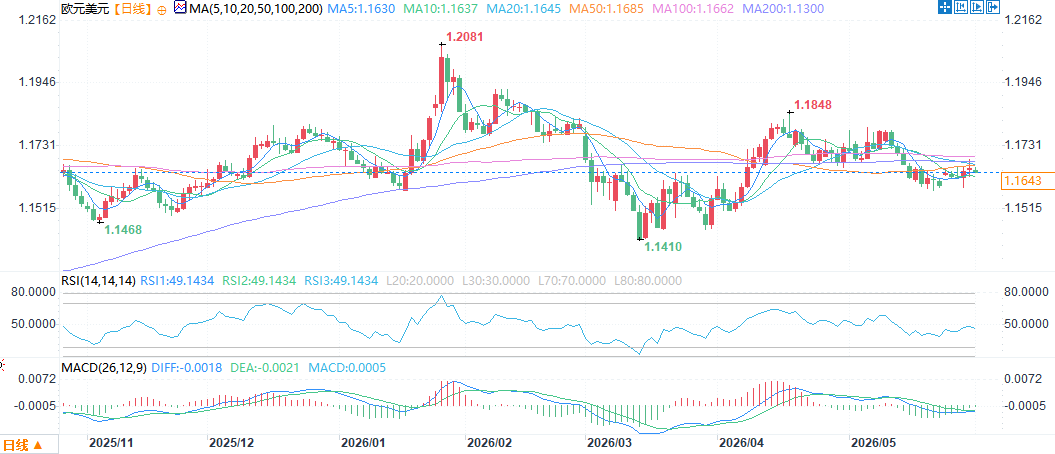
(Euro/USD daily chart, source: FX678)
In terms of technical indicators, the moving average system shows a clear entanglement, with prices fluctuating around the moving averages in the short term, resulting in ambiguous trend signals. The RSI indicator is in the middle of the neutral range, neither entering overbought nor oversold territory, indicating a lack of clear unilateral driving momentum in the market. The MACD indicator's DIFF and DEA lines are almost converging, with weak histogram momentum, suggesting a near balance between bullish and bearish forces. Overall, the current technical picture lacks clear directional guidance, and the market is likely to continue its range-bound consolidation in the short term. Further confirmation of the subsequent trend will require a breakout of key resistance or support levels.
At 13:08 Beijing time on June 1, the euro was trading at 1.1651/52 against the US dollar.
Echoing the fluctuating decline in exchange rates, the reasons for the European Central Bank's interest rate hike are far less straightforward than the market believes.
Eurozone inflation rose from 1.9% in February to 3.0% in April, primarily driven by energy price increases due to disruptions in the Strait of Hormuz, but most underlying inflation indicators remained relatively moderate. Preliminary data for May suggested inflation might be flat or slightly higher, but most were below market expectations. Policymakers are more concerned about the potential for inflationary pressures to widen in the future than about existing deep-seated issues. This is a predictive judgment based on "what might happen," rather than a response to realized inflation.
The current environment is exceptionally uncertain, largely dependent on unpredictable geopolitical developments. Meanwhile, the Eurozone economy does not appear to require significant monetary tightening—the composite PMI shows growth has declined for three consecutive months. The European Central Bank is betting that inflationary pressures will expand sufficiently and the economy will be resilient enough. The relevant historical precedent is not 2022, but 2011—when the ECB tightened policy due to energy-driven inflation, only to reverse it a few months later due to a sharp weakening in growth.
A June rate hike is imminent, but the subsequent path remains unclear.
Recently, several members of the European Central Bank's Governing Council have set the tone for an interest rate hike on June 11. However, their own arguments reveal that the rationale for tightening policy is far less straightforward than the market assumed.
A June rate hike now seems highly likely. The market has already priced it in, and several Governing Council members have clearly stated that they expect action. However, the same officials have emphasized that they are unwilling to commit to further rate hikes.
The data does not support traditional contraction cycles.
The core issue is that the existing data is insufficient to support a complete tightening cycle. Eurozone inflation rose from 1.9% in February to 3.0% in April, primarily due to higher energy prices following the disruption of shipping in the Strait of Hormuz. However, most underlying inflation indicators remain relatively mild. Other indicators of inflationary pressures have so far shown little evidence of widespread problems.
Preliminary national data for May, released last Friday, suggests that eurozone inflation may have remained flat or risen slightly. However, in most cases, the actual figures were slightly lower than market expectations. Full eurozone flash estimates will not be released until Tuesday, but it is clear that inflation has not surged as it did in 2022-2023.
Policymakers' real concern: Inflation may widen in the future.
Even European Central Bank policymakers acknowledge this ambiguity.
Finnish central bank governor Rehn noted that "medium- to long-term inflation expectations have not deviated significantly," and wage growth continues to slow. What policymakers are truly concerned about is that inflationary pressures may widen over time.
This distinction is crucial. The European Central Bank is prepared to tighten policy not because inflation is already deeply entrenched, but because it fears it might be in the future.
Policy Dilemma Based on Forecasted Rather Than Realized Inflation
European Central Bank Executive Board member Schnabel recently stated that “ignoring” the energy shock is “no longer an option.”
Chief Economist Ryan also warned that the longer the Gulf conflict continues, the less likely the ECB's "most benign scenario" (where a temporary rise in energy prices can be largely ignored) becomes.
Lane points out that the survey shows many businesses expect to raise prices, which poses a risk of "broader inflation," a "significant problem." But this is fundamentally still a prediction of "what might happen," rather than a response to inflation that has already materialized.
The economy does not need a major monetary tightening.
Monetary policy based primarily on forecasts rather than realized inflation is inherently difficult to implement. The current environment is exceptionally uncertain because it depends heavily on geopolitical developments that cannot be accurately predicted. No one knows how long the Strait of Hormuz will remain blocked, how the energy market will evolve, or how much of the shock will ultimately translate into wages and prices.
At the same time, the overall economy does not appear to require significant monetary tightening. The composite PMI shows growth has declined for three consecutive months. Fiscal support is also relatively modest compared to the massive energy subsidies implemented in 2022. This does not appear to be an economy requiring substantial monetary restrictions.
Mild stagflation: The most difficult environment for central banks to manage
Conversely, the Eurozone increasingly resembles a mild stagflation scenario: weakening growth coupled with rising energy prices and increased inflation risks. This is precisely the type of environment most difficult for central banks to manage, because monetary tightening does little to address fundamental supply shocks. Raising interest rates won't reopen the Strait of Hormuz or lower oil prices, but it will certainly further weaken demand.
Not all members of the governing board are convinced. Bank of France Governor Villeroy stated last month that "it is necessary to collect a sufficient amount of data before any possible tightening." Rein himself directly responded to market pressure: "Market forces have priced in some rate hikes, but our policy is not determined by market forces. We make decisions independently."
The gap between market expectations and the central bank's caution
The market is currently pricing in two or more rate hikes over the next year. ECB officials appear reluctant to support such expectations. Even a safety net rate hike in June would be a judgmental decision: inflationary pressures would have sufficiently amplified to justify the tightening and the economy would have demonstrated sufficient resilience to absorb it.
Perhaps this judgment will prove correct. The relevant historical precedent is not 2022 (when inflation was already widespread and persistent), but 2011—when the European Central Bank tightened its policy due to energy-driven inflation, only to reverse it a few months later due to a sharp weakening of growth.
The European Central Bank's interest rate hike on June 11 is almost a foregone conclusion, and the market has already priced it in. However, the rationale for the hike is far from straightforward—the rise in inflation from 1.9% to 3.0% is mainly driven by energy prices, underlying inflation indicators remain moderate, and most preliminary data for May were below expectations.
The real concern for policymakers is the potential for inflationary pressures to widen in the future; this is a decision based on forecasts rather than actual inflation. The economy doesn't need significant monetary tightening (the composite PMI has declined for three consecutive months), and the Eurozone is more like experiencing mild stagflation—the most difficult environment for central banks to manage. The market is pricing in more than two rate hikes in the coming year, but officials are reluctant to support this expectation. The historical precedent is not 2022, but 2011 (where rate hikes were reversed within months). The May Eurozone inflation data will be the last key data point before the June 11th decision.
Echoing the policy indecisiveness, the technical picture of the euro against the US dollar also shows a stalemate between bulls and bears, with no clear direction.
The euro/dollar pair has maintained a wide range of fluctuations on the daily chart. The price has fallen from the previous high of 1.2081, rebounded to a high of 1.1848 in April after bottoming out at 1.1410 in March, and has recently come under pressure again. It is currently trading around 1.1645, in a dense range where multiple moving averages are intertwined. The battle between bulls and bears is fierce, and no clear one-sided trend has yet formed.
(Euro/USD daily chart, source: FX678)
In terms of technical indicators, the moving average system shows a clear entanglement, with prices fluctuating around the moving averages in the short term, resulting in ambiguous trend signals. The RSI indicator is in the middle of the neutral range, neither entering overbought nor oversold territory, indicating a lack of clear unilateral driving momentum in the market. The MACD indicator's DIFF and DEA lines are almost converging, with weak histogram momentum, suggesting a near balance between bullish and bearish forces. Overall, the current technical picture lacks clear directional guidance, and the market is likely to continue its range-bound consolidation in the short term. Further confirmation of the subsequent trend will require a breakout of key resistance or support levels.
At 13:08 Beijing time on June 1, the euro was trading at 1.1651/52 against the US dollar.
- Risk Warning and Disclaimer
- The market involves risk, and trading may not be suitable for all investors. This article is for reference only and does not constitute personal investment advice, nor does it take into account certain users’ specific investment objectives, financial situation, or other needs. Any investment decisions made based on this information are at your own risk.