Eurozone manufacturing exceeded expectations but has now fallen into a vicious cycle?
2026-06-01 21:42:34
On Monday (June 1), during the Asian and European sessions, the Eurozone's overall PMI exceeded expectations but did not elicit a significant reaction from the euro. This was partly due to the fact that the US dollar is still being influenced by geopolitics, and partly due to the quality of the Eurozone PMI.
Recently, bullish sentiment in the foreign exchange market has been severely dampened, and the euro has continued to be under pressure against the US dollar.
On the surface, the Eurozone manufacturing PMI has shown a steady upward trend over the past two years, with the latest final reading of the S&P Global Manufacturing PMI for May (51.6) even exceeding market expectations.
However, beneath the veneer of "better-than-expected" results, the intertwined geopolitical conflicts in the Middle East, soaring energy prices, and deteriorating supply chains are pushing the Eurozone's real economy into a vicious cycle of supply-side inflation and demand-side contraction.

In terms of trends, the Eurozone's overall PMI has indeed experienced a recovery process over the past two years, rising from a deep contraction of around 45 and crossing the 50-point threshold.
The final May PMI reading was revised slightly upward to 51.6, which was indeed better than the market's initial pessimistic expectations. However, behind this "steady improvement" is not a positive drive from the recovery of end-consumer demand, but rather a "bloated" prosperity fueled by panic.
The impressive rebound in the PMI in the past few months was primarily driven by companies' "defensive large-scale purchasing."
Due to the ongoing tensions in the Middle East, European companies, fearing a complete disruption of the Red Sea shipping route and a surge in freight costs, have launched a rush to stockpile goods.
In the calculation of the PMI, the surge in "purchasing volume" and "production volume" directly pushed up the overall index, but this prosperity is essentially a serious overdraft of future demand.
As the initial gains from the early bird season faded, in-depth research data in May tore away this "better-than-expected" facade, completely exposing the true wounds within the Eurozone manufacturing sector and officially kicking off a vicious cycle:
Demand came to an abrupt halt (new orders stagnated): The most dangerous signal in May was the complete standstill in new domestic orders for goods, with export orders declining in tandem.
The raw materials that companies had previously stockpiled and the products they had produced failed to be converted into end consumers.
This indicates that the actual purchasing power of both overseas and domestic consumers remains weak, and "ineffective inventory" is accumulating.
Supply-side costs surge (stagflation characteristics become more prominent): Driven by geopolitical and supply concerns, international oil prices have surged by more than 3% compared to last week's close.
Soaring raw material and energy prices have led to the highest increase in manufacturing input costs in four years, and global supply chain delays have worsened to their worst level since June 2022.
The job market continues to suffer losses: If the industry outlook is truly improving steadily, companies should expand recruitment.
However, the eurozone unemployment rate remained at 6.3% in April, below the market expectation of 6.2%; more critically, manufacturing employment has contracted for three consecutive years. Employers lack confidence in long-term orders and would rather reduce staff than bear long-term costs.
It is the intertwining of these three major contradictions that has created a vicious cycle of negative feedback within the Eurozone, characterized by "cost transmission and shrinking demand," which is difficult to break.
First, the escalating conflict in the Middle East has disrupted global supply chains and caused energy prices to soar, directly pushing raw material input costs for manufacturing to their highest point in four years.
Secondly, faced with soaring production costs, European companies have had to rapidly increase the final ex-factory price of their products in order to protect themselves and maintain profit margins, resulting in the highest rate of price increases in three and a half years.
Finally, this pressure to pass on costs quickly spread to the consumer end, and high prices further deprived consumers of their actual purchasing power, causing manufacturing orders, which had been recovering for three months, to come to an abrupt halt in May.
The stagnation of new orders and the contraction of demand have in turn exacerbated the survival crisis of enterprises, forcing them to further reduce their scale or maintain high prices, thus abruptly interrupting the recovery of the real economy.
This inflation, triggered by a "supply-side disruption," has plunged the entire Eurozone manufacturing sector into a dilemma: without price increases, businesses struggle to survive under heavy cost pressures; however, price increases would directly freeze market demand.
As long as external supply chain and energy risks cannot be eliminated, this inherent vicious cycle will be difficult to break.
This situation, characterized by "good-looking data but toxic structure," has pushed the European Central Bank (ECB) to a crossroads in its monetary policy:
Rising energy prices could easily escalate into widespread inflation. Market estimates suggest that inflation in the Eurozone has once again exceeded the 2% target. Most economists believe that the European Central Bank will be forced to raise deposit rates this month due to inflationary pressures, and will raise rates again this year.
Against the backdrop of stagnant new orders and insufficient momentum for real economic recovery, raising interest rates could lead to a hard landing for the economy. If aggressive tightening policies are adopted rashly, high interest rates will directly put a "tight rein" on the fragile manufacturing sector, which could easily turn a "weak recovery" into a "real recession".
Looking at the global foreign exchange market, the underlying risks to the Eurozone's domestic economy have significantly limited the euro's upside potential. In the short term, market attention has turned to the upcoming US non-farm payroll report.
Before the macroeconomic landscape of "strong US and weak Europe" fundamentally changes, the strong economic fundamentals of the US will support the Federal Reserve in maintaining a high interest rate range, while the European Central Bank will face the dual tug-of-war between "controlling inflation" and "maintaining growth".
Coupled with the influx of safe-haven funds into the US dollar due to the situation in the Middle East, the euro will continue to face strong downward pressure in the short term, caught between a triple whammy of inflation, supply chain issues, and weak demand.
Technical Analysis: The euro has retraced to the previous double bottom breakout level, and there is currently strong technical support.
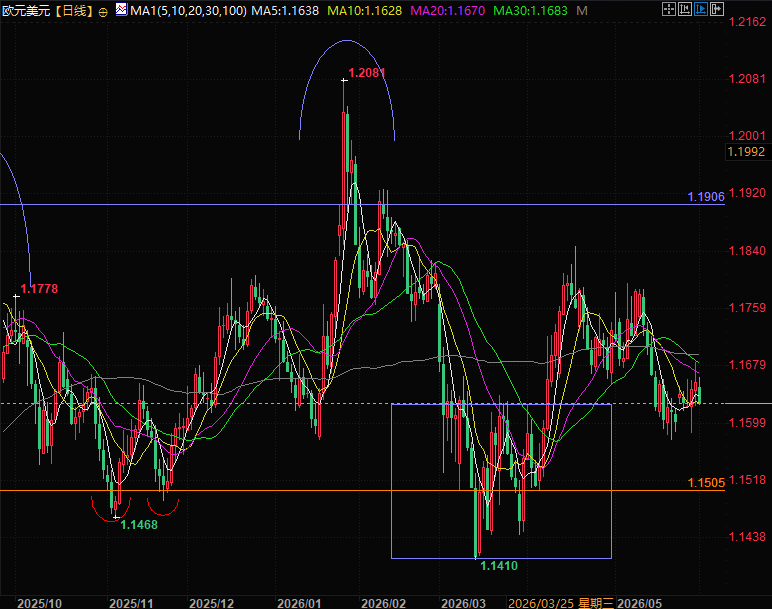
(Euro/USD daily chart, source: FX678)
At 21:39 Beijing time, the euro was trading at 1.1627/28 against the US dollar.
Recently, bullish sentiment in the foreign exchange market has been severely dampened, and the euro has continued to be under pressure against the US dollar.
On the surface, the Eurozone manufacturing PMI has shown a steady upward trend over the past two years, with the latest final reading of the S&P Global Manufacturing PMI for May (51.6) even exceeding market expectations.
However, beneath the veneer of "better-than-expected" results, the intertwined geopolitical conflicts in the Middle East, soaring energy prices, and deteriorating supply chains are pushing the Eurozone's real economy into a vicious cycle of supply-side inflation and demand-side contraction.
The Contrast Trap Behind “Better Than Expectations”: Is the Steady Improvement in PMI a Genuine Strength or Just a False Guts?
In terms of trends, the Eurozone's overall PMI has indeed experienced a recovery process over the past two years, rising from a deep contraction of around 45 and crossing the 50-point threshold.
The final May PMI reading was revised slightly upward to 51.6, which was indeed better than the market's initial pessimistic expectations. However, behind this "steady improvement" is not a positive drive from the recovery of end-consumer demand, but rather a "bloated" prosperity fueled by panic.
The impressive rebound in the PMI in the past few months was primarily driven by companies' "defensive large-scale purchasing."
Due to the ongoing tensions in the Middle East, European companies, fearing a complete disruption of the Red Sea shipping route and a surge in freight costs, have launched a rush to stockpile goods.
In the calculation of the PMI, the surge in "purchasing volume" and "production volume" directly pushed up the overall index, but this prosperity is essentially a serious overdraft of future demand.
May data tears away the disguise: Manufacturing enters three core headwinds
As the initial gains from the early bird season faded, in-depth research data in May tore away this "better-than-expected" facade, completely exposing the true wounds within the Eurozone manufacturing sector and officially kicking off a vicious cycle:
Demand came to an abrupt halt (new orders stagnated): The most dangerous signal in May was the complete standstill in new domestic orders for goods, with export orders declining in tandem.
The raw materials that companies had previously stockpiled and the products they had produced failed to be converted into end consumers.
This indicates that the actual purchasing power of both overseas and domestic consumers remains weak, and "ineffective inventory" is accumulating.
Supply-side costs surge (stagflation characteristics become more prominent): Driven by geopolitical and supply concerns, international oil prices have surged by more than 3% compared to last week's close.
Soaring raw material and energy prices have led to the highest increase in manufacturing input costs in four years, and global supply chain delays have worsened to their worst level since June 2022.
The job market continues to suffer losses: If the industry outlook is truly improving steadily, companies should expand recruitment.
However, the eurozone unemployment rate remained at 6.3% in April, below the market expectation of 6.2%; more critically, manufacturing employment has contracted for three consecutive years. Employers lack confidence in long-term orders and would rather reduce staff than bear long-term costs.
Negative feedback loop: A recovery abruptly interrupted
It is the intertwining of these three major contradictions that has created a vicious cycle of negative feedback within the Eurozone, characterized by "cost transmission and shrinking demand," which is difficult to break.
First, the escalating conflict in the Middle East has disrupted global supply chains and caused energy prices to soar, directly pushing raw material input costs for manufacturing to their highest point in four years.
Secondly, faced with soaring production costs, European companies have had to rapidly increase the final ex-factory price of their products in order to protect themselves and maintain profit margins, resulting in the highest rate of price increases in three and a half years.
Finally, this pressure to pass on costs quickly spread to the consumer end, and high prices further deprived consumers of their actual purchasing power, causing manufacturing orders, which had been recovering for three months, to come to an abrupt halt in May.
The stagnation of new orders and the contraction of demand have in turn exacerbated the survival crisis of enterprises, forcing them to further reduce their scale or maintain high prices, thus abruptly interrupting the recovery of the real economy.
This inflation, triggered by a "supply-side disruption," has plunged the entire Eurozone manufacturing sector into a dilemma: without price increases, businesses struggle to survive under heavy cost pressures; however, price increases would directly freeze market demand.
As long as external supply chain and energy risks cannot be eliminated, this inherent vicious cycle will be difficult to break.
The ECB's Dilemma and the Outlook for the Foreign Exchange Market
This situation, characterized by "good-looking data but toxic structure," has pushed the European Central Bank (ECB) to a crossroads in its monetary policy:
Rising energy prices could easily escalate into widespread inflation. Market estimates suggest that inflation in the Eurozone has once again exceeded the 2% target. Most economists believe that the European Central Bank will be forced to raise deposit rates this month due to inflationary pressures, and will raise rates again this year.
Against the backdrop of stagnant new orders and insufficient momentum for real economic recovery, raising interest rates could lead to a hard landing for the economy. If aggressive tightening policies are adopted rashly, high interest rates will directly put a "tight rein" on the fragile manufacturing sector, which could easily turn a "weak recovery" into a "real recession".
Summary and Technical Analysis:
Looking at the global foreign exchange market, the underlying risks to the Eurozone's domestic economy have significantly limited the euro's upside potential. In the short term, market attention has turned to the upcoming US non-farm payroll report.
Before the macroeconomic landscape of "strong US and weak Europe" fundamentally changes, the strong economic fundamentals of the US will support the Federal Reserve in maintaining a high interest rate range, while the European Central Bank will face the dual tug-of-war between "controlling inflation" and "maintaining growth".
Coupled with the influx of safe-haven funds into the US dollar due to the situation in the Middle East, the euro will continue to face strong downward pressure in the short term, caught between a triple whammy of inflation, supply chain issues, and weak demand.
Technical Analysis: The euro has retraced to the previous double bottom breakout level, and there is currently strong technical support.
(Euro/USD daily chart, source: FX678)
At 21:39 Beijing time, the euro was trading at 1.1627/28 against the US dollar.
- Risk Warning and Disclaimer
- The market involves risk, and trading may not be suitable for all investors. This article is for reference only and does not constitute personal investment advice, nor does it take into account certain users’ specific investment objectives, financial situation, or other needs. Any investment decisions made based on this information are at your own risk.