On one hand, there's Iran's "blockade order," and on the other, Schnabel's "hawkish warning"—the euro struggles to survive.
2026-06-02 09:16:33
On Tuesday (June 2) in early Asian trading, the euro opened lower against the dollar before rebounding to around 1.1631, unchanged from the previous day's closing price.
The euro's rebound from its low opening reflects the tug-of-war between these two forces: the Middle East conflict suppressing risk appetite, and the ECB's hawkish rhetoric providing bottom support.
According to Iranian sources on June 1, in light of Israel's ongoing military operations in Lebanon, the Iranian negotiating team has suspended dialogue with the United States through intermediaries. Iran and the "Resistance Front" plan to completely blockade the Strait of Hormuz and launch operations on other "fronts," including the Bab el-Mandeb Strait.
Meanwhile, European Central Bank Executive Board member Schnabel said on Monday that the central bank can no longer ignore the inflationary impact of the Iranian conflict, as price pressures have spread beyond the energy sector and the risk of inflation expectations becoming unanchored has increased.
The preliminary reading of the Eurozone Harmonized Index of Consumer Prices (HICP) will be released later on Tuesday, and the market will be looking for more clues about the European Central Bank's policy path.
Markets expect the Eurozone's overall CPI to rise to 3.2% year-on-year in May, up from 3.0% in April, while core CPI is projected to rise to 2.4% from 2.2%. If the actual data is higher than expected, it will strengthen the necessity for the European Central Bank to raise interest rates in June, and may even increase market expectations for a second rate hike in July, which would provide short-term support for the euro. Conversely, if the data is lower than expected, it may weaken the ECB's hawkish stance, and the euro may give back its recent gains.
In addition, investors will closely watch the CPI sub-items, particularly the contributions of services inflation and energy prices, to determine whether inflation is spreading from "energy-driven" to "broader sectors"—key evidence of what Schnabel calls "price pressures have spread beyond the energy sector." If services inflation continues to rise, the ECB may have to take more aggressive tightening measures, but this would further drag down the already weak eurozone economic growth.
Therefore, tonight's CPI data will be an important indicator for judging the ECB's subsequent path after its June rate hike.
According to Iranian sources on June 1, in light of Israel's ongoing military operations in Lebanon, the Iranian negotiating team has suspended dialogue with the United States through intermediaries. Iran and the "Resistance Front" plan to completely blockade the Strait of Hormuz and launch operations on other "fronts," including the Bab el-Mandeb Strait.
On June 1, local time, US President Trump stated that he expects to reach an agreement with Iran "within the next week" to extend the current ceasefire and reopen the Strait of Hormuz. Trump said the negotiations are progressing well and expressed optimism about reaching an agreement. All fighting between Israel and Hezbollah will cease immediately.
Escalating conflicts in the Middle East could boost safe-haven currencies like the US dollar and put headwinds on the euro against the dollar. Military confrontations intensified significantly over the past weekend: the US military fired missiles at a merchant ship in the Gulf of Oman attempting to circumvent a blockade, Iran launched a missile attack on a Kuwaiti airbase, and the conflict between Israel and Hezbollah further escalated.
Although US-Iran negotiations are reportedly still being conducted through intermediaries, fundamental differences between the two sides on core issues such as their nuclear programs, enriched uranium stockpiles, and control of the Strait of Hormuz are complicating diplomatic efforts. Any breakthrough in a ceasefire agreement requires Trump's final approval, which appears unlikely in the short term.
Across the Atlantic, the European Central Bank's hawkish stance may provide some support for the euro.
European Central Bank Executive Board member Isabel Schnabel said on Monday that the central bank can no longer ignore the inflationary impact of the Iranian conflict, as price pressures have spread beyond the energy sector and the risk of inflation expectations becoming unanchored has increased.
Schnabel's remarks were consistent with the tone of the ECB's April meeting minutes, which showed that several members supported raising interest rates.
The market is currently pricing in a greater than 90% probability of a 25 basis point rate hike by the European Central Bank in June, providing a floor for the euro. However, Schnabel has not made a clear commitment to the subsequent rate hike path, which limits the euro's upside potential.
Technically, the euro/dollar pair is currently in a wide-range, directionless consolidation phase on the daily chart. The price fell from the previous high of 1.2081, bottomed out at 1.1410, rebounded to 1.1848, and has recently fallen back again, currently trading around 1.1631. It is located in a dense area where multiple moving averages intersect, indicating a stalemate between bulls and bears, with no clear one-sided trend at the moment.
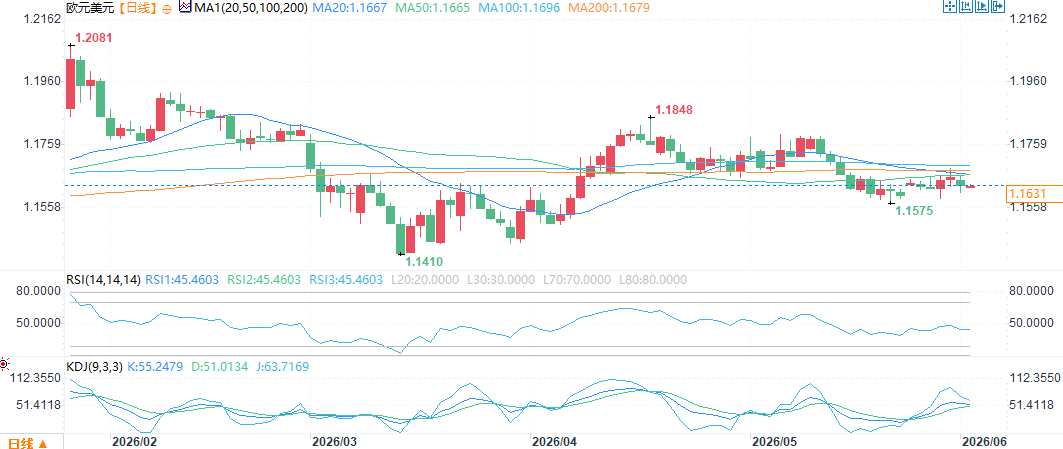
(Euro/USD daily chart, source: FX678)
On the moving average system, the price is fluctuating around the MA20/50/100/200, and has not yet formed a bullish or bearish alignment; the RSI indicator is at 45.46, which is in the neutral to weak range, with no obvious overbought or oversold signals, and it is likely to continue to fluctuate within the range in the short term.
At 09:16 Beijing time on June 2, the euro was trading at 1.1635/36 against the US dollar.
The euro's rebound from its low opening reflects the tug-of-war between these two forces: the Middle East conflict suppressing risk appetite, and the ECB's hawkish rhetoric providing bottom support.
According to Iranian sources on June 1, in light of Israel's ongoing military operations in Lebanon, the Iranian negotiating team has suspended dialogue with the United States through intermediaries. Iran and the "Resistance Front" plan to completely blockade the Strait of Hormuz and launch operations on other "fronts," including the Bab el-Mandeb Strait.
Meanwhile, European Central Bank Executive Board member Schnabel said on Monday that the central bank can no longer ignore the inflationary impact of the Iranian conflict, as price pressures have spread beyond the energy sector and the risk of inflation expectations becoming unanchored has increased.
CPI data is key.
The preliminary reading of the Eurozone Harmonized Index of Consumer Prices (HICP) will be released later on Tuesday, and the market will be looking for more clues about the European Central Bank's policy path.
Markets expect the Eurozone's overall CPI to rise to 3.2% year-on-year in May, up from 3.0% in April, while core CPI is projected to rise to 2.4% from 2.2%. If the actual data is higher than expected, it will strengthen the necessity for the European Central Bank to raise interest rates in June, and may even increase market expectations for a second rate hike in July, which would provide short-term support for the euro. Conversely, if the data is lower than expected, it may weaken the ECB's hawkish stance, and the euro may give back its recent gains.
In addition, investors will closely watch the CPI sub-items, particularly the contributions of services inflation and energy prices, to determine whether inflation is spreading from "energy-driven" to "broader sectors"—key evidence of what Schnabel calls "price pressures have spread beyond the energy sector." If services inflation continues to rise, the ECB may have to take more aggressive tightening measures, but this would further drag down the already weak eurozone economic growth.
Therefore, tonight's CPI data will be an important indicator for judging the ECB's subsequent path after its June rate hike.
Middle East Situation: Iran Suspends Negotiations, Threatens to Completely Close Straits
According to Iranian sources on June 1, in light of Israel's ongoing military operations in Lebanon, the Iranian negotiating team has suspended dialogue with the United States through intermediaries. Iran and the "Resistance Front" plan to completely blockade the Strait of Hormuz and launch operations on other "fronts," including the Bab el-Mandeb Strait.
On June 1, local time, US President Trump stated that he expects to reach an agreement with Iran "within the next week" to extend the current ceasefire and reopen the Strait of Hormuz. Trump said the negotiations are progressing well and expressed optimism about reaching an agreement. All fighting between Israel and Hezbollah will cease immediately.
Risk aversion intensifies: Escalating conflict supports the US dollar
Escalating conflicts in the Middle East could boost safe-haven currencies like the US dollar and put headwinds on the euro against the dollar. Military confrontations intensified significantly over the past weekend: the US military fired missiles at a merchant ship in the Gulf of Oman attempting to circumvent a blockade, Iran launched a missile attack on a Kuwaiti airbase, and the conflict between Israel and Hezbollah further escalated.
Although US-Iran negotiations are reportedly still being conducted through intermediaries, fundamental differences between the two sides on core issues such as their nuclear programs, enriched uranium stockpiles, and control of the Strait of Hormuz are complicating diplomatic efforts. Any breakthrough in a ceasefire agreement requires Trump's final approval, which appears unlikely in the short term.
European Central Bank: Schnabel warns that inflation shocks can no longer be ignored.
Across the Atlantic, the European Central Bank's hawkish stance may provide some support for the euro.
European Central Bank Executive Board member Isabel Schnabel said on Monday that the central bank can no longer ignore the inflationary impact of the Iranian conflict, as price pressures have spread beyond the energy sector and the risk of inflation expectations becoming unanchored has increased.
Schnabel's remarks were consistent with the tone of the ECB's April meeting minutes, which showed that several members supported raising interest rates.
The market is currently pricing in a greater than 90% probability of a 25 basis point rate hike by the European Central Bank in June, providing a floor for the euro. However, Schnabel has not made a clear commitment to the subsequent rate hike path, which limits the euro's upside potential.
Technically, the euro/dollar pair is currently in a wide-range, directionless consolidation phase on the daily chart. The price fell from the previous high of 1.2081, bottomed out at 1.1410, rebounded to 1.1848, and has recently fallen back again, currently trading around 1.1631. It is located in a dense area where multiple moving averages intersect, indicating a stalemate between bulls and bears, with no clear one-sided trend at the moment.
(Euro/USD daily chart, source: FX678)
On the moving average system, the price is fluctuating around the MA20/50/100/200, and has not yet formed a bullish or bearish alignment; the RSI indicator is at 45.46, which is in the neutral to weak range, with no obvious overbought or oversold signals, and it is likely to continue to fluctuate within the range in the short term.
At 09:16 Beijing time on June 2, the euro was trading at 1.1635/36 against the US dollar.
- Risk Warning and Disclaimer
- The market involves risk, and trading may not be suitable for all investors. This article is for reference only and does not constitute personal investment advice, nor does it take into account certain users’ specific investment objectives, financial situation, or other needs. Any investment decisions made based on this information are at your own risk.