Surging physical demand versus suppressed expectations of interest rate hikes: When will the tug-of-war around $75 for silver end?
2026-06-02 11:04:19
On Tuesday (June 2nd) during Asian trading hours, silver opened higher and rose by more than 1% to $75.88 per ounce before retreating somewhat. It is currently trading around $75. Since falling from $89.34 per ounce in mid-May, silver prices have been consolidating around $75 for several trading days.
Beneath the surface of silver prices stagnating around $75, the physical market is experiencing an unprecedented supply crisis. Data shows that COMEX silver inventories have halved since October 2025, with delivery demand reaching 165 million ounces in the first quarter of 2026 alone. The total delivery volume for 2024 was 203 million ounces, surging to 474 million ounces in 2025, demonstrating explosive growth.
More importantly, Western futures markets (COMEX/LBMA) have long artificially suppressed silver prices through paper futures contracts, which are primarily settled in cash. However, the surge in demand for physical delivery is rapidly depleting exchange inventories. Eric Sprott, founder of Sprott Asset Management, warned: "Western futures exchanges' ability to suppress silver prices through paper settlement is rapidly dwindling."
Industrial demand for silver is experiencing a surge. Demand is soaring in a wide range of applications, including artificial intelligence data centers, electric vehicles, solar panels, smartphones, and humanoid robots.
Currently, industrial demand for silver accounts for more than 50% of total demand, with the photovoltaic sector accounting for over 55%. N-type battery technologies (TOPCon, HJT, etc.) consume 15%-30% more silver per watt than traditional batteries. New energy vehicles use approximately seven times more silver per vehicle than gasoline vehicles, and AI servers consume 30% more silver than traditional models. Large industrial users such as Samsung have begun to directly transact with silver mines at significant premiums, bypassing third-party distributors and further reducing the available supply on COMEX.
From a financial perspective, the continued rise in expectations of a Federal Reserve interest rate hike exerts clear downward pressure on silver in the short term. The transmission path is clear and direct: a rise in the 10-year US Treasury yield means an increased opportunity cost of holding non-interest-bearing assets like silver, leading institutional investors to reduce their holdings; simultaneously, a stronger dollar increases the purchase cost for non-US dollar buyers, thereby suppressing physical demand.
In mid-May, the yield on 10-year US Treasury bonds briefly exceeded 4.68%, and the yield on 30-year Treasury bonds surged above 5.2%, both reaching their highest levels since the subprime mortgage crisis. This change in the interest rate environment is reshaping the short-term pricing logic of silver.
UBS lowered its end-June target from $100 to $85, its September and December targets to $85 and $80 respectively, and its March 2027 target to $75.
UBS expects the silver market deficit to narrow significantly to approximately 60-70 million ounces by 2026, down from the previous estimate of around 300 million ounces. This is primarily due to high silver prices leading photovoltaic manufacturers to reduce their silver usage, suppressed demand for silver jewelry and accessories, and a slight increase in mine supply. UBS strategists stated that with the smaller deficit expected, silver is likely to trade largely sideways.
Bank of America believes that silver still has the potential to break through $100/ounce in the short term, especially against the backdrop of continued gold price increases, but the foundation for this rally is becoming increasingly fragile – analysts expect silver prices to fall back to around $75 in the second quarter of 2027.
Bank of America's core concern is that high silver prices are forcing the photovoltaic industry to systematically reduce its silver usage or shift to alternative metals. Bank of America judges that silver demand in the photovoltaic sector may have peaked in 2025; once industrial demand continues to weaken, even moderate selling by financial investors will be enough to push the market into a physical surplus.
Technically, spot silver is currently trading in a range-bound pattern on the daily chart, with prices hovering around $75. It is facing resistance from the 20-day and 50-day moving averages, which are at 78.26 and 76.04 respectively. However, it is supported by a solid bottom formed by the 200-day moving average, limiting the potential for a significant drop in the medium term.
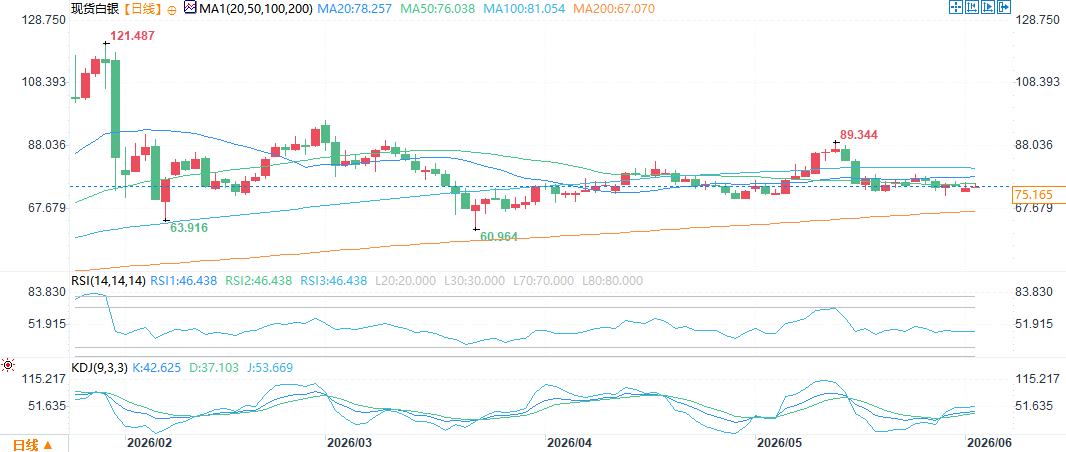
(Spot silver daily chart, source: EasyForex)
After falling from the previous high of 89.34, the market has been consolidating sideways, repeatedly adjusting within the 71-78 yuan range. The previous lows of 60.96 and 63.92, along with the 200-day moving average, form a key medium- to long-term support zone, while 89.34 is a strong resistance level for this phase.
In terms of indicators, the RSI indicator is 46.44, which is below the 50 midline, indicating a balance between bullish and bearish forces, with no extreme overbought or oversold conditions. The KDJ indicator has formed a golden cross at a low level, suggesting a slight rebound in the short term. However, the overall indicator is in the middle range, so the rebound is limited and it is difficult to break through the short-term moving average resistance quickly.
In summary, a slight rebound is expected in the short term, with the primary resistance level concentrated in the 76-78.3 range. After encountering resistance, prices are likely to return to a range-bound pattern. In the medium term, the market is expected to remain within a large range of 67-89, with solid support below. Without significant fundamental drivers, it is unlikely to break out of the current one-sided trend. On any pullback, the effectiveness of the support levels at 74 and 70 should be closely monitored.
At 11:03 AM Beijing time on June 2, spot silver was trading at $75.31 per ounce.
Surge in physical demand depletes inventory
Beneath the surface of silver prices stagnating around $75, the physical market is experiencing an unprecedented supply crisis. Data shows that COMEX silver inventories have halved since October 2025, with delivery demand reaching 165 million ounces in the first quarter of 2026 alone. The total delivery volume for 2024 was 203 million ounces, surging to 474 million ounces in 2025, demonstrating explosive growth.
More importantly, Western futures markets (COMEX/LBMA) have long artificially suppressed silver prices through paper futures contracts, which are primarily settled in cash. However, the surge in demand for physical delivery is rapidly depleting exchange inventories. Eric Sprott, founder of Sprott Asset Management, warned: "Western futures exchanges' ability to suppress silver prices through paper settlement is rapidly dwindling."
Industrial demand surged across the board, and premiums in Asian markets continued.
Industrial demand for silver is experiencing a surge. Demand is soaring in a wide range of applications, including artificial intelligence data centers, electric vehicles, solar panels, smartphones, and humanoid robots.
Currently, industrial demand for silver accounts for more than 50% of total demand, with the photovoltaic sector accounting for over 55%. N-type battery technologies (TOPCon, HJT, etc.) consume 15%-30% more silver per watt than traditional batteries. New energy vehicles use approximately seven times more silver per vehicle than gasoline vehicles, and AI servers consume 30% more silver than traditional models. Large industrial users such as Samsung have begun to directly transact with silver mines at significant premiums, bypassing third-party distributors and further reducing the available supply on COMEX.
Interest rate environment reshapes the logic of silver
From a financial perspective, the continued rise in expectations of a Federal Reserve interest rate hike exerts clear downward pressure on silver in the short term. The transmission path is clear and direct: a rise in the 10-year US Treasury yield means an increased opportunity cost of holding non-interest-bearing assets like silver, leading institutional investors to reduce their holdings; simultaneously, a stronger dollar increases the purchase cost for non-US dollar buyers, thereby suppressing physical demand.
In mid-May, the yield on 10-year US Treasury bonds briefly exceeded 4.68%, and the yield on 30-year Treasury bonds surged above 5.2%, both reaching their highest levels since the subprime mortgage crisis. This change in the interest rate environment is reshaping the short-term pricing logic of silver.
Institutional Views
UBS lowered its end-June target from $100 to $85, its September and December targets to $85 and $80 respectively, and its March 2027 target to $75.
UBS expects the silver market deficit to narrow significantly to approximately 60-70 million ounces by 2026, down from the previous estimate of around 300 million ounces. This is primarily due to high silver prices leading photovoltaic manufacturers to reduce their silver usage, suppressed demand for silver jewelry and accessories, and a slight increase in mine supply. UBS strategists stated that with the smaller deficit expected, silver is likely to trade largely sideways.
Bank of America believes that silver still has the potential to break through $100/ounce in the short term, especially against the backdrop of continued gold price increases, but the foundation for this rally is becoming increasingly fragile – analysts expect silver prices to fall back to around $75 in the second quarter of 2027.
Bank of America's core concern is that high silver prices are forcing the photovoltaic industry to systematically reduce its silver usage or shift to alternative metals. Bank of America judges that silver demand in the photovoltaic sector may have peaked in 2025; once industrial demand continues to weaken, even moderate selling by financial investors will be enough to push the market into a physical surplus.
Technically, spot silver is currently trading in a range-bound pattern on the daily chart, with prices hovering around $75. It is facing resistance from the 20-day and 50-day moving averages, which are at 78.26 and 76.04 respectively. However, it is supported by a solid bottom formed by the 200-day moving average, limiting the potential for a significant drop in the medium term.
(Spot silver daily chart, source: EasyForex)
After falling from the previous high of 89.34, the market has been consolidating sideways, repeatedly adjusting within the 71-78 yuan range. The previous lows of 60.96 and 63.92, along with the 200-day moving average, form a key medium- to long-term support zone, while 89.34 is a strong resistance level for this phase.
In terms of indicators, the RSI indicator is 46.44, which is below the 50 midline, indicating a balance between bullish and bearish forces, with no extreme overbought or oversold conditions. The KDJ indicator has formed a golden cross at a low level, suggesting a slight rebound in the short term. However, the overall indicator is in the middle range, so the rebound is limited and it is difficult to break through the short-term moving average resistance quickly.
In summary, a slight rebound is expected in the short term, with the primary resistance level concentrated in the 76-78.3 range. After encountering resistance, prices are likely to return to a range-bound pattern. In the medium term, the market is expected to remain within a large range of 67-89, with solid support below. Without significant fundamental drivers, it is unlikely to break out of the current one-sided trend. On any pullback, the effectiveness of the support levels at 74 and 70 should be closely monitored.
At 11:03 AM Beijing time on June 2, spot silver was trading at $75.31 per ounce.
- Risk Warning and Disclaimer
- The market involves risk, and trading may not be suitable for all investors. This article is for reference only and does not constitute personal investment advice, nor does it take into account certain users’ specific investment objectives, financial situation, or other needs. Any investment decisions made based on this information are at your own risk.