The US dollar index traded sideways, awaiting guidance from key data releases this week.
2026-06-02 13:44:19
The US dollar index (DXY) remained high during Tuesday's Asian trading session, trading around 99.20. While gains were relatively limited, the dollar remained relatively stable overall, supported by both safe-haven demand and interest rate expectations. Market focus remains on developments in the Middle East. Iran has suspended indirect communication with the United States and plans to take stronger measures in response to the ongoing ceasefire dispute. Meanwhile, tensions around the Strait of Hormuz have escalated, significantly increasing market concerns about the security of the global energy supply chain.
The Strait of Hormuz handles approximately 20% of global seaborne crude oil transport and a significant amount of liquefied natural gas exports, making it one of the most important strategic waterways for global energy transportation. Iran and its regional allies are exploring ways to expand their influence over key energy transport routes, including the Strait of Hormuz and the Bab el-Mandeb Strait, a vital shipping route connecting the Red Sea. Meanwhile, reports indicate that Iran has recently deployed more maritime defense facilities in the Strait of Hormuz, further increasing market concerns about supply disruptions.
For financial markets, the deteriorating situation in the Middle East has primarily led to increased risk aversion. Against the backdrop of declining global risk appetite, the US dollar, as the world's primary reserve currency and safe-haven asset, continues to attract international capital. Simultaneously, the inflationary risks from rising energy prices have also become a significant factor supporting the dollar. With the sharp rebound in international crude oil prices, the market has begun to worry that the downward trend in global inflation may be interrupted. Rising energy costs not only affect consumer spending but may also lead to a sustained increase in business production costs, thereby pushing up future inflation levels.
Recent market pricing suggests that some investors are beginning to bet again on the possibility of further monetary tightening by the Federal Reserve. As inflation expectations rise, US Treasury yields remain high, providing additional support for the US dollar. Market analysts believe that if energy prices continue to rise and drive core inflation back up, the Fed may maintain its restrictive policies for an extended period, thus benefiting the dollar's performance.
However, the market is not entirely pessimistic. US President Trump stated that communication channels between the US and Iran remain open, and that an agreement on restoring normal navigation in the Strait of Hormuz may be reached within the next week. This statement has alleviated market concerns to some extent about the situation escalating further.
Meanwhile, Lebanon has called for expanding the scope of the ceasefire agreement, hoping to ease regional tensions through diplomatic means. Substantial progress in these negotiations could reduce demand for the US dollar as a safe haven and alleviate market concerns about energy supply disruptions.
This week, the market will also see a series of important US economic data releases, including the Job Openings Survey (JOLTS) and Friday's non-farm payrolls report. The performance of the job market will directly impact market expectations regarding the Federal Reserve's future interest rate policy.
If US employment data continues to be strong, the market may further increase its expectations for the duration of the high-interest-rate environment, thereby driving the dollar to continue to strengthen; conversely, if there are signs of a cooling job market, it may trigger a phase of dollar correction.
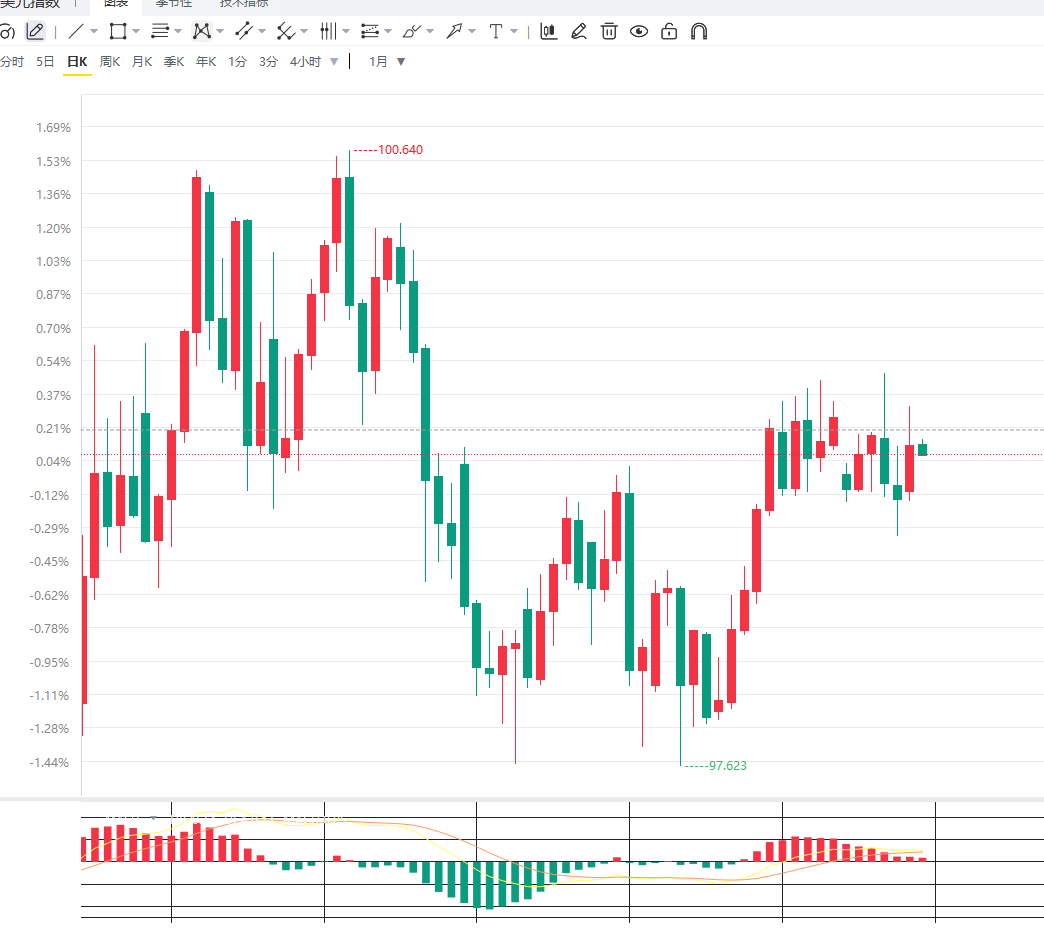
From the daily chart, the US dollar index recently stabilized and rebounded near the 97 level, and has now regained its footing above the 99 mark. The MACD indicator has formed a golden cross and continues to diverge upwards, indicating that the medium-term rebound momentum is still strengthening. The RSI indicator is around 58, reflecting a slightly bullish market but not yet entering overbought territory. Key resistance levels to watch are 99.80, 100.50, and 101.30; support levels are around 98.70, 98.00, and 97.20. The overall trend shows a slightly bullish, oscillating pattern.
Observing the 4-hour chart, the US dollar index is maintaining its movement along a short-term upward channel. The moving average system is gradually forming a bullish alignment, indicating that short-term buying power still dominates. The MACD histogram has contracted somewhat, suggesting a slight slowdown in short-term momentum, but the overall structure remains bullish. The RSI indicator is running around 60, indicating that the market still has further upside potential. If the price breaks through the 99.80 resistance area, it may further challenge 100.50; if it falls below the 98.70 support, a technical pullback may occur, but the overall trend has not yet weakened.
Editor's Summary:
The current upward trend in the US dollar index is primarily driven by safe-haven demand and inflation expectations. Escalating tensions in the Middle East are driving international capital flows to the dollar, while rising energy prices are reinforcing market expectations that the Federal Reserve will maintain high interest rates. These two factors are jointly supporting the dollar's strength. However, if the situation in the Middle East shows signs of easing, safe-haven demand could cool rapidly, weakening the dollar's support. In the short term, US employment data and the situation in the Strait of Hormuz will remain the core variables determining the dollar's direction. Whether the dollar index can regain its footing above 100 will depend on the performance of risk events and economic data in the coming days.
The Strait of Hormuz handles approximately 20% of global seaborne crude oil transport and a significant amount of liquefied natural gas exports, making it one of the most important strategic waterways for global energy transportation. Iran and its regional allies are exploring ways to expand their influence over key energy transport routes, including the Strait of Hormuz and the Bab el-Mandeb Strait, a vital shipping route connecting the Red Sea. Meanwhile, reports indicate that Iran has recently deployed more maritime defense facilities in the Strait of Hormuz, further increasing market concerns about supply disruptions.
For financial markets, the deteriorating situation in the Middle East has primarily led to increased risk aversion. Against the backdrop of declining global risk appetite, the US dollar, as the world's primary reserve currency and safe-haven asset, continues to attract international capital. Simultaneously, the inflationary risks from rising energy prices have also become a significant factor supporting the dollar. With the sharp rebound in international crude oil prices, the market has begun to worry that the downward trend in global inflation may be interrupted. Rising energy costs not only affect consumer spending but may also lead to a sustained increase in business production costs, thereby pushing up future inflation levels.
Recent market pricing suggests that some investors are beginning to bet again on the possibility of further monetary tightening by the Federal Reserve. As inflation expectations rise, US Treasury yields remain high, providing additional support for the US dollar. Market analysts believe that if energy prices continue to rise and drive core inflation back up, the Fed may maintain its restrictive policies for an extended period, thus benefiting the dollar's performance.
However, the market is not entirely pessimistic. US President Trump stated that communication channels between the US and Iran remain open, and that an agreement on restoring normal navigation in the Strait of Hormuz may be reached within the next week. This statement has alleviated market concerns to some extent about the situation escalating further.
Meanwhile, Lebanon has called for expanding the scope of the ceasefire agreement, hoping to ease regional tensions through diplomatic means. Substantial progress in these negotiations could reduce demand for the US dollar as a safe haven and alleviate market concerns about energy supply disruptions.
This week, the market will also see a series of important US economic data releases, including the Job Openings Survey (JOLTS) and Friday's non-farm payrolls report. The performance of the job market will directly impact market expectations regarding the Federal Reserve's future interest rate policy.
If US employment data continues to be strong, the market may further increase its expectations for the duration of the high-interest-rate environment, thereby driving the dollar to continue to strengthen; conversely, if there are signs of a cooling job market, it may trigger a phase of dollar correction.
From the daily chart, the US dollar index recently stabilized and rebounded near the 97 level, and has now regained its footing above the 99 mark. The MACD indicator has formed a golden cross and continues to diverge upwards, indicating that the medium-term rebound momentum is still strengthening. The RSI indicator is around 58, reflecting a slightly bullish market but not yet entering overbought territory. Key resistance levels to watch are 99.80, 100.50, and 101.30; support levels are around 98.70, 98.00, and 97.20. The overall trend shows a slightly bullish, oscillating pattern.
Observing the 4-hour chart, the US dollar index is maintaining its movement along a short-term upward channel. The moving average system is gradually forming a bullish alignment, indicating that short-term buying power still dominates. The MACD histogram has contracted somewhat, suggesting a slight slowdown in short-term momentum, but the overall structure remains bullish. The RSI indicator is running around 60, indicating that the market still has further upside potential. If the price breaks through the 99.80 resistance area, it may further challenge 100.50; if it falls below the 98.70 support, a technical pullback may occur, but the overall trend has not yet weakened.
Editor's Summary:
The current upward trend in the US dollar index is primarily driven by safe-haven demand and inflation expectations. Escalating tensions in the Middle East are driving international capital flows to the dollar, while rising energy prices are reinforcing market expectations that the Federal Reserve will maintain high interest rates. These two factors are jointly supporting the dollar's strength. However, if the situation in the Middle East shows signs of easing, safe-haven demand could cool rapidly, weakening the dollar's support. In the short term, US employment data and the situation in the Strait of Hormuz will remain the core variables determining the dollar's direction. Whether the dollar index can regain its footing above 100 will depend on the performance of risk events and economic data in the coming days.
- Risk Warning and Disclaimer
- The market involves risk, and trading may not be suitable for all investors. This article is for reference only and does not constitute personal investment advice, nor does it take into account certain users’ specific investment objectives, financial situation, or other needs. Any investment decisions made based on this information are at your own risk.