The ECB suddenly takes a hawkish stance! Schnabel hints at an interest rate hike, and the euro will face a test from CPI data.
2026-06-02 14:37:31
On Tuesday (June 2) during Asian trading hours, the euro rose slightly against the US dollar, currently trading around 1.1650, up about 0.16%, recovering most of the overnight losses.
The European Central Bank's hawkish stance provided some support for the euro – Executive Board member Schnabel stated that the inflationary impact of the Iranian conflict has spread beyond the energy sector, increasing the risk of inflation expectations becoming unanchored, suggesting the need for interest rate hikes.
European Central Bank Executive Board member Schnabel hinted at an interest rate hike on Monday, saying the central bank can no longer ignore the inflationary impact of the Iranian conflict, as price pressures have spread beyond the energy sector and the risk of inflation expectations becoming unanchored has increased.
Schnabel points out that disruptions to energy infrastructure and supply chains have altered price dynamics, and shocks are increasingly driving up production costs, much like global demand shocks. This analytical framework eliminates the standard rationale for central banks to hold rates steady—that supply-side shocks are self-correcting and should be “ignored.”
Schnabel made it clear that even if the war ended today, energy infrastructure and supply chains would have been severely damaged, so "a monetary policy response would still be necessary."
Schnabel's remarks were consistent with the tone of the ECB's April meeting minutes—which showed that several members had supported raising interest rates. Some officials believe the focus of policy discussions has shifted from "whether to raise rates" to "when is the most appropriate time to raise rates." Schnabel refused to set a limit on the number of rate hikes, saying it was too early to say that rate hikes would end after a certain number.
UBS economists point out that the European Central Bank may need to raise interest rates "at least twice" this year, with the possibility of even three rate hikes. The market is currently pricing in a greater than 90% probability of a 25 basis point rate hike by the ECB in June, with a cumulative rate hike of approximately 50 basis points this year.
Eurozone harmonized CPI data for May will be released later on Tuesday. Markets expect overall inflation to rise to 3.2% year-on-year from 3.0% in April, and core inflation to rise to 2.4% from 2.2%. This expectation reflects the combined effects of high energy prices and sticky inflation in the services sector.
Preliminary inflation figures for May in Germany, France, Italy, and Spain have diverged: France, Italy, and Spain were largely in line with expectations, while Germany's unexpectedly low CPI dragged down overall expectations, but energy-driven pressures were still enough to push the reading up to 3.2%.
If the actual data exceeds expectations, it will strengthen the necessity for the European Central Bank to raise interest rates in June, and may even increase market expectations for a second rate hike in July. Currently, the market is pricing in a more than 90% probability of a June rate hike, but only about a 35% probability of a second rate hike in July.
If the harmonized CPI exceeds 3.2%, the probability of a rate hike in July may rise to over 50%, and the euro could test the 1.1700 level. Conversely, if the data falls short of expectations, it may weaken the ECB's hawkish stance, and the euro may retest the 1.1580 support area.
Investors will also be watching the services inflation component to determine whether inflation is spreading from “energy-driven” to a wider range of sectors—which is key evidence of what Schnabel calls “price pressures have spread beyond the energy sector.”
Tonight's harmonized CPI data is not only the "final confirmation" of a June rate hike, but also a key indicator of whether the European Central Bank is implementing a one-off "insurance rate hike" or initiating a tightening cycle.
On the other hand, broader geopolitical uncertainty may keep traders on their toes and support safe-haven currencies such as the US dollar.
Iranian state media reported that Tehran suspended negotiations on Monday due to Israel's actions in Lebanon.
Meanwhile, US President Trump stated that he believed an agreement to reopen the Strait of Hormuz and extend the ceasefire with Iran could be reached "within the next week." This contradictory situation of "fighting while negotiating" has further complicated market sentiment.
The euro is currently trading around 1.1650 against the dollar, with the price below the 20-day and 50-day moving averages, which are acting as resistance.
After falling from the previous high of 1.2081, the market bottomed out at 1.1410 in March, followed by a period of consolidation and recovery. In April, it rebounded to a secondary high of 1.1848 before falling back again. Recently, it has been consolidating in a narrow range around 1.16. The key resistance levels are 1.1734 and 1.1848, while the support levels are 1.1410 and 1.1468, forming a medium-term support zone.
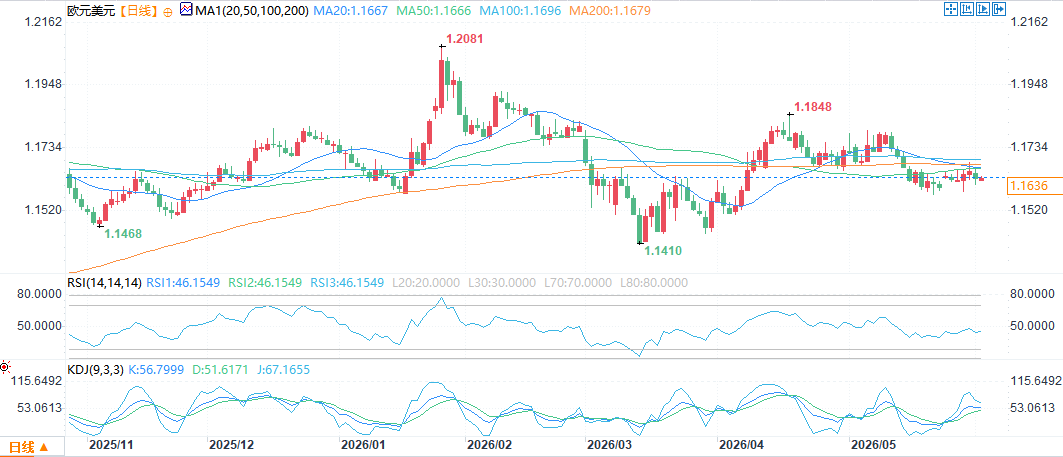
(Euro/USD daily chart, source: FX678)
In terms of indicators, the RSI value is 46.15, which is below the 50 midline. The bears have a slight advantage but have not entered the oversold zone.
With the strengthening of the US dollar due to expectations of a Fed rate hike, the euro's medium-term upward movement is under pressure. In the short term, it has rebounded slightly with support from the annual moving average. The first resistance level for the rebound is around 1.167-1.173. After encountering resistance, it is likely to continue to consolidate within the range. Only a decisive break below 1.1410 will open up downside potential.
At 14:36 Beijing time on June 2, the euro was trading at 1.1651/52 against the US dollar.
The European Central Bank's hawkish stance provided some support for the euro – Executive Board member Schnabel stated that the inflationary impact of the Iranian conflict has spread beyond the energy sector, increasing the risk of inflation expectations becoming unanchored, suggesting the need for interest rate hikes.
ECB Hawkish Signals: Schnabel Hints at Rate Hike
European Central Bank Executive Board member Schnabel hinted at an interest rate hike on Monday, saying the central bank can no longer ignore the inflationary impact of the Iranian conflict, as price pressures have spread beyond the energy sector and the risk of inflation expectations becoming unanchored has increased.
Schnabel points out that disruptions to energy infrastructure and supply chains have altered price dynamics, and shocks are increasingly driving up production costs, much like global demand shocks. This analytical framework eliminates the standard rationale for central banks to hold rates steady—that supply-side shocks are self-correcting and should be “ignored.”
Schnabel made it clear that even if the war ended today, energy infrastructure and supply chains would have been severely damaged, so "a monetary policy response would still be necessary."
Schnabel's remarks were consistent with the tone of the ECB's April meeting minutes—which showed that several members had supported raising interest rates. Some officials believe the focus of policy discussions has shifted from "whether to raise rates" to "when is the most appropriate time to raise rates." Schnabel refused to set a limit on the number of rate hikes, saying it was too early to say that rate hikes would end after a certain number.
UBS economists point out that the European Central Bank may need to raise interest rates "at least twice" this year, with the possibility of even three rate hikes. The market is currently pricing in a greater than 90% probability of a 25 basis point rate hike by the ECB in June, with a cumulative rate hike of approximately 50 basis points this year.
Data Preview: Eurozone Harmonized CPI for May is expected to rise to 3.2%.
Eurozone harmonized CPI data for May will be released later on Tuesday. Markets expect overall inflation to rise to 3.2% year-on-year from 3.0% in April, and core inflation to rise to 2.4% from 2.2%. This expectation reflects the combined effects of high energy prices and sticky inflation in the services sector.
Preliminary inflation figures for May in Germany, France, Italy, and Spain have diverged: France, Italy, and Spain were largely in line with expectations, while Germany's unexpectedly low CPI dragged down overall expectations, but energy-driven pressures were still enough to push the reading up to 3.2%.
If the actual data exceeds expectations, it will strengthen the necessity for the European Central Bank to raise interest rates in June, and may even increase market expectations for a second rate hike in July. Currently, the market is pricing in a more than 90% probability of a June rate hike, but only about a 35% probability of a second rate hike in July.
If the harmonized CPI exceeds 3.2%, the probability of a rate hike in July may rise to over 50%, and the euro could test the 1.1700 level. Conversely, if the data falls short of expectations, it may weaken the ECB's hawkish stance, and the euro may retest the 1.1580 support area.
Investors will also be watching the services inflation component to determine whether inflation is spreading from “energy-driven” to a wider range of sectors—which is key evidence of what Schnabel calls “price pressures have spread beyond the energy sector.”
Tonight's harmonized CPI data is not only the "final confirmation" of a June rate hike, but also a key indicator of whether the European Central Bank is implementing a one-off "insurance rate hike" or initiating a tightening cycle.
Geopolitical risks: Iran suspends negotiations; Trump says agreement could be reached "within a week".
On the other hand, broader geopolitical uncertainty may keep traders on their toes and support safe-haven currencies such as the US dollar.
Iranian state media reported that Tehran suspended negotiations on Monday due to Israel's actions in Lebanon.
Meanwhile, US President Trump stated that he believed an agreement to reopen the Strait of Hormuz and extend the ceasefire with Iran could be reached "within the next week." This contradictory situation of "fighting while negotiating" has further complicated market sentiment.
EUR/USD Daily Technical Analysis
The euro is currently trading around 1.1650 against the dollar, with the price below the 20-day and 50-day moving averages, which are acting as resistance.
After falling from the previous high of 1.2081, the market bottomed out at 1.1410 in March, followed by a period of consolidation and recovery. In April, it rebounded to a secondary high of 1.1848 before falling back again. Recently, it has been consolidating in a narrow range around 1.16. The key resistance levels are 1.1734 and 1.1848, while the support levels are 1.1410 and 1.1468, forming a medium-term support zone.
(Euro/USD daily chart, source: FX678)
In terms of indicators, the RSI value is 46.15, which is below the 50 midline. The bears have a slight advantage but have not entered the oversold zone.
With the strengthening of the US dollar due to expectations of a Fed rate hike, the euro's medium-term upward movement is under pressure. In the short term, it has rebounded slightly with support from the annual moving average. The first resistance level for the rebound is around 1.167-1.173. After encountering resistance, it is likely to continue to consolidate within the range. Only a decisive break below 1.1410 will open up downside potential.
At 14:36 Beijing time on June 2, the euro was trading at 1.1651/52 against the US dollar.
- Risk Warning and Disclaimer
- The market involves risk, and trading may not be suitable for all investors. This article is for reference only and does not constitute personal investment advice, nor does it take into account certain users’ specific investment objectives, financial situation, or other needs. Any investment decisions made based on this information are at your own risk.