Central banks' buying spree shows no signs of stopping! Gold has officially replaced US Treasury bonds, its reserve status upgraded to provide a medium- to long-term anchor.
2026-06-03 09:19:01
On Wednesday (June 3) during the Asian session, spot gold opened slightly under pressure and is currently trading around $4470. Tensions between the US and Iran provided support for the US dollar, while rising oil prices fueled inflation concerns and reinforced hawkish expectations from the Federal Reserve, putting downward pressure on gold prices at the open.
While short-term gold prices are constrained by hawkish expectations from the Federal Reserve and fluctuating geopolitical tensions, the structural trend revealed in the latest report from the European Central Bank—gold has surpassed US Treasury bonds to become the world's largest reserve asset—provides solid medium- to long-term support for gold prices. Central bank gold purchases are reshaping the supply and demand landscape for gold, adding a layer of "strategic allocation by official institutions" to its pricing mechanism, beyond the traditional interest rate-driven logic.
According to the latest report from the European Central Bank, by the end of 2025, gold will account for 27% of global official reserves, surpassing US Treasury bonds (22%) and the euro (15%) to become the world's largest reserve asset.
Amidst escalating geopolitical risks, central banks around the world have continued to increase their gold reserves, driving this historic shift.

In its June 2026 report, "The International Role of the Euro," the European Central Bank stated that by the end of 2025, gold would account for 27% of total official reserves, including foreign exchange and gold, surpassing US Treasury bonds (22%) and the euro (15%) to become the world's largest reserve asset. This historic shift has attracted widespread attention from the market.
However, the report also clearly points out that the increase in gold's share is largely driven by valuation effects rather than simply active buying. After rising nearly 30% in 2024, gold prices surged again by about 60% in 2025, with a cumulative increase of over 100% in two years. This price surge mechanically increased the dollar-denominated value of existing gold holdings by central banks, thereby amplifying the proportion of gold in total reserves.
The report shows that official gold purchases in 2025 are estimated at around 850 tons, lower than the over 1,000 tons purchased annually between 2022 and 2024, but still significantly higher than the historical average. This data indicates that although historically high gold prices have somewhat curbed the pace of central bank gold purchases, the trend of systemic accumulation has not been reversed.
Central banks' continued increase in gold holdings reflects the deeper considerations of many central banks in strengthening their balance sheets and mitigating geopolitical risks. Since the outbreak of the Russia-Ukraine conflict in 2022, the "weaponization" of Western financial sanctions against Russia has made many non-Western countries realize the potential risks of over-reliance on dollar-denominated reserve assets. Gold, as the "ultimate asset" without sovereign rights or counterparty risk, has naturally become the preferred choice for reserve diversification.
Furthermore, the ongoing instability in the Middle East and the increasing fragmentation of global geopolitics have prompted central banks to view gold as a "ballast" against external shocks. As long as these structural factors persist, the long-term logic behind central bank gold purchases will not fundamentally change.
Since the Russia-Ukraine conflict in 2022, the global central bank gold purchasing pattern has undergone significant changes. China ranks first with a cumulative purchase of over 350 tons, reflecting its systematic approach to diversifying its reserve assets. Poland follows closely behind with a cumulative purchase of 320 tons; Turkey and India purchased 220 tons and approximately 130 tons, respectively.
By 2025, Poland had become the world's largest official gold buyer, adding nearly 100 tons in a single year. This increase brought Poland's total gold reserves to over 450 tons, further solidifying its position as the leading gold reserve holder in Central and Eastern Europe. Polish Central Bank Governor Grapinski has repeatedly emphasized that gold is a "ballast" for national economic security and plays an irreplaceable role during periods of geopolitical instability.
Following Poland, Kazakhstan, Brazil, China, and Turkey rank second to fifth in terms of gold purchases in 2025. It is worth noting that Brazil, as a representative of Latin America, has significantly increased its gold purchases in recent years, reflecting a convergence in reserve management strategies among emerging market countries—increasing gold holdings has become a common cross-regional choice against the backdrop of escalating geopolitical risks.
Despite gold's continued rise in global official reserves, the European Central Bank's report also clearly pointed out its inherent limitations relative to major reserve currencies, providing an important balancing perspective for market optimism.
First, gold is a non-interest-bearing asset, generating no interest or dividend income, resulting in significant opportunity costs during its holding period. Second, gold prices fluctuate wildly, influenced in the short term by multiple factors such as the dollar's performance, real interest rates, and market sentiment, making its price stability far less stable than that of sovereign fiat currencies. Third, physical gold involves safe storage and insurance costs, which are particularly significant for central banks with large holdings. Finally, gold supply is inelastic, with annual production accounting for only 1%-2% of the total stock, making it impossible to rapidly expand through policy measures like fiat currencies to meet global liquidity demands.
These limitations determine that gold cannot completely replace the core position of major reserve currencies such as the US dollar or the euro. A more likely future scenario is that gold will coexist with sovereign credit currencies as an important "strategic supplementary asset," jointly forming the reserve portfolios of central banks worldwide.
The report also points out that the US dollar will continue to dominate the international monetary system, accounting for approximately 57% of global foreign exchange reserves in 2025; the euro will remain the second-largest currency with a share of nearly 20%. However, the increasingly important role of gold highlights that central banks are reshaping their reserve strategies against the backdrop of geopolitical risks increasingly impacting global finance.
In summary, gold's surpassing of US Treasury bonds to become the world's largest reserve asset marks a significant shift in the global financial landscape. While valuation effects have amplified the rise in gold's share to some extent, the continuous and systematic gold purchases by central banks reflect a deeper structural change—in an era of escalating sanctions risks, financial fragmentation, and geopolitical instability, central banks are proactively seeking to diversify their reserve asset allocation.
However, gold can never fully replace the core functions of major reserve currencies. It does not generate interest, its price is highly volatile, physical storage is costly, and its supply cannot quickly respond to global liquidity demands. Therefore, the US dollar and the euro will remain the cornerstones of the international monetary system. In the future, the "rebalancing" process between gold and sovereign credit assets will continue to be driven by both geopolitical events and central bank policy stances. Gold is both a passive "thermometer" reflecting risk sentiment and a "ballast" actively chosen by central banks—its evolving role is a microcosm of this uncertain era.
Technically, spot gold is currently trading around $4470, with prices consistently under pressure below the 20-day and 50-day moving averages (MA20 and MA50), which are acting as resistance. However, the price has held above the 200-day moving average (MA200), indicating that the overall upward trend has not been completely broken. After falling from the previous high of $5419.01, the price rebounded to a secondary high of $4889.24 in April before encountering resistance and declining again. In May, it retraced to a low of $4366.52 before finding support and consolidating. Currently, it is fluctuating narrowly around $4450. Key resistance levels are at $4630 and $4889, while key support levels are at $4366 and $4100.
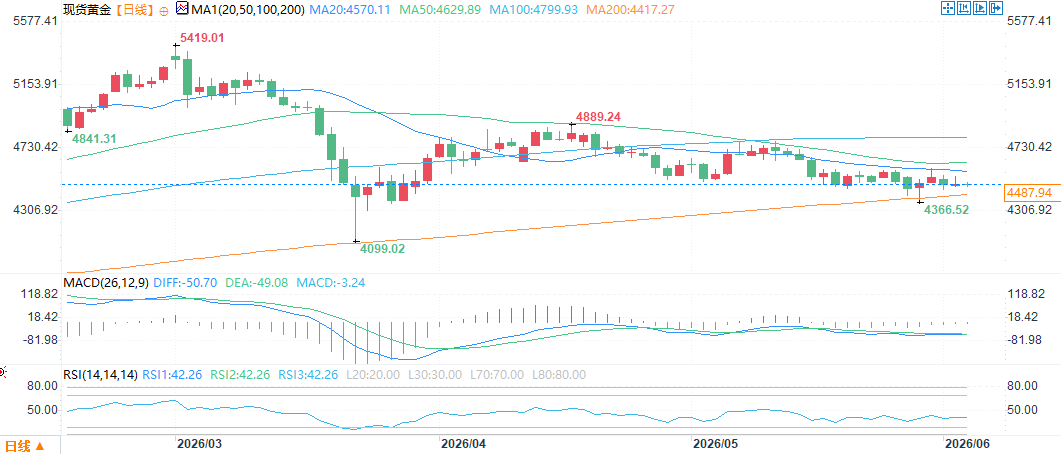
(Spot gold daily chart, source: FX678)
In terms of indicators, the RSI value is 42.26, below the 50 midline, indicating that the short-term bears have the upper hand but have not yet reached the 30 oversold line; the MACD is running below the zero line, the bearish histogram is slightly converging, the downward momentum is gradually slowing down, and there is a short-term technical rebound and correction demand.
At 9:18 AM Beijing time on June 3, spot gold was trading at $4472.22 per ounce.
While short-term gold prices are constrained by hawkish expectations from the Federal Reserve and fluctuating geopolitical tensions, the structural trend revealed in the latest report from the European Central Bank—gold has surpassed US Treasury bonds to become the world's largest reserve asset—provides solid medium- to long-term support for gold prices. Central bank gold purchases are reshaping the supply and demand landscape for gold, adding a layer of "strategic allocation by official institutions" to its pricing mechanism, beyond the traditional interest rate-driven logic.
According to the latest report from the European Central Bank, by the end of 2025, gold will account for 27% of global official reserves, surpassing US Treasury bonds (22%) and the euro (15%) to become the world's largest reserve asset.
Amidst escalating geopolitical risks, central banks around the world have continued to increase their gold reserves, driving this historic shift.
The surge in gold's market share is largely attributed to valuation effects.
In its June 2026 report, "The International Role of the Euro," the European Central Bank stated that by the end of 2025, gold would account for 27% of total official reserves, including foreign exchange and gold, surpassing US Treasury bonds (22%) and the euro (15%) to become the world's largest reserve asset. This historic shift has attracted widespread attention from the market.
However, the report also clearly points out that the increase in gold's share is largely driven by valuation effects rather than simply active buying. After rising nearly 30% in 2024, gold prices surged again by about 60% in 2025, with a cumulative increase of over 100% in two years. This price surge mechanically increased the dollar-denominated value of existing gold holdings by central banks, thereby amplifying the proportion of gold in total reserves.
Although central bank gold purchases have slowed, they remain at historically high levels.
The report shows that official gold purchases in 2025 are estimated at around 850 tons, lower than the over 1,000 tons purchased annually between 2022 and 2024, but still significantly higher than the historical average. This data indicates that although historically high gold prices have somewhat curbed the pace of central bank gold purchases, the trend of systemic accumulation has not been reversed.
Central banks' continued increase in gold holdings reflects the deeper considerations of many central banks in strengthening their balance sheets and mitigating geopolitical risks. Since the outbreak of the Russia-Ukraine conflict in 2022, the "weaponization" of Western financial sanctions against Russia has made many non-Western countries realize the potential risks of over-reliance on dollar-denominated reserve assets. Gold, as the "ultimate asset" without sovereign rights or counterparty risk, has naturally become the preferred choice for reserve diversification.
Furthermore, the ongoing instability in the Middle East and the increasing fragmentation of global geopolitics have prompted central banks to view gold as a "ballast" against external shocks. As long as these structural factors persist, the long-term logic behind central bank gold purchases will not fundamentally change.
Major gold-buying countries: China, Poland, Türkiye, India
Since the Russia-Ukraine conflict in 2022, the global central bank gold purchasing pattern has undergone significant changes. China ranks first with a cumulative purchase of over 350 tons, reflecting its systematic approach to diversifying its reserve assets. Poland follows closely behind with a cumulative purchase of 320 tons; Turkey and India purchased 220 tons and approximately 130 tons, respectively.
By 2025, Poland had become the world's largest official gold buyer, adding nearly 100 tons in a single year. This increase brought Poland's total gold reserves to over 450 tons, further solidifying its position as the leading gold reserve holder in Central and Eastern Europe. Polish Central Bank Governor Grapinski has repeatedly emphasized that gold is a "ballast" for national economic security and plays an irreplaceable role during periods of geopolitical instability.
Following Poland, Kazakhstan, Brazil, China, and Turkey rank second to fifth in terms of gold purchases in 2025. It is worth noting that Brazil, as a representative of Latin America, has significantly increased its gold purchases in recent years, reflecting a convergence in reserve management strategies among emerging market countries—increasing gold holdings has become a common cross-regional choice against the backdrop of escalating geopolitical risks.
The limitations of gold still exist.
Despite gold's continued rise in global official reserves, the European Central Bank's report also clearly pointed out its inherent limitations relative to major reserve currencies, providing an important balancing perspective for market optimism.
First, gold is a non-interest-bearing asset, generating no interest or dividend income, resulting in significant opportunity costs during its holding period. Second, gold prices fluctuate wildly, influenced in the short term by multiple factors such as the dollar's performance, real interest rates, and market sentiment, making its price stability far less stable than that of sovereign fiat currencies. Third, physical gold involves safe storage and insurance costs, which are particularly significant for central banks with large holdings. Finally, gold supply is inelastic, with annual production accounting for only 1%-2% of the total stock, making it impossible to rapidly expand through policy measures like fiat currencies to meet global liquidity demands.
These limitations determine that gold cannot completely replace the core position of major reserve currencies such as the US dollar or the euro. A more likely future scenario is that gold will coexist with sovereign credit currencies as an important "strategic supplementary asset," jointly forming the reserve portfolios of central banks worldwide.
The US dollar still dominates the international monetary system.
The report also points out that the US dollar will continue to dominate the international monetary system, accounting for approximately 57% of global foreign exchange reserves in 2025; the euro will remain the second-largest currency with a share of nearly 20%. However, the increasingly important role of gold highlights that central banks are reshaping their reserve strategies against the backdrop of geopolitical risks increasingly impacting global finance.
In summary, gold's surpassing of US Treasury bonds to become the world's largest reserve asset marks a significant shift in the global financial landscape. While valuation effects have amplified the rise in gold's share to some extent, the continuous and systematic gold purchases by central banks reflect a deeper structural change—in an era of escalating sanctions risks, financial fragmentation, and geopolitical instability, central banks are proactively seeking to diversify their reserve asset allocation.
However, gold can never fully replace the core functions of major reserve currencies. It does not generate interest, its price is highly volatile, physical storage is costly, and its supply cannot quickly respond to global liquidity demands. Therefore, the US dollar and the euro will remain the cornerstones of the international monetary system. In the future, the "rebalancing" process between gold and sovereign credit assets will continue to be driven by both geopolitical events and central bank policy stances. Gold is both a passive "thermometer" reflecting risk sentiment and a "ballast" actively chosen by central banks—its evolving role is a microcosm of this uncertain era.
Technically, spot gold is currently trading around $4470, with prices consistently under pressure below the 20-day and 50-day moving averages (MA20 and MA50), which are acting as resistance. However, the price has held above the 200-day moving average (MA200), indicating that the overall upward trend has not been completely broken. After falling from the previous high of $5419.01, the price rebounded to a secondary high of $4889.24 in April before encountering resistance and declining again. In May, it retraced to a low of $4366.52 before finding support and consolidating. Currently, it is fluctuating narrowly around $4450. Key resistance levels are at $4630 and $4889, while key support levels are at $4366 and $4100.
(Spot gold daily chart, source: FX678)
In terms of indicators, the RSI value is 42.26, below the 50 midline, indicating that the short-term bears have the upper hand but have not yet reached the 30 oversold line; the MACD is running below the zero line, the bearish histogram is slightly converging, the downward momentum is gradually slowing down, and there is a short-term technical rebound and correction demand.
At 9:18 AM Beijing time on June 3, spot gold was trading at $4472.22 per ounce.
- Risk Warning and Disclaimer
- The market involves risk, and trading may not be suitable for all investors. This article is for reference only and does not constitute personal investment advice, nor does it take into account certain users’ specific investment objectives, financial situation, or other needs. Any investment decisions made based on this information are at your own risk.