Gold prices fluctuated and fell back as the market focused on US employment data for guidance.
2026-06-03 09:58:29
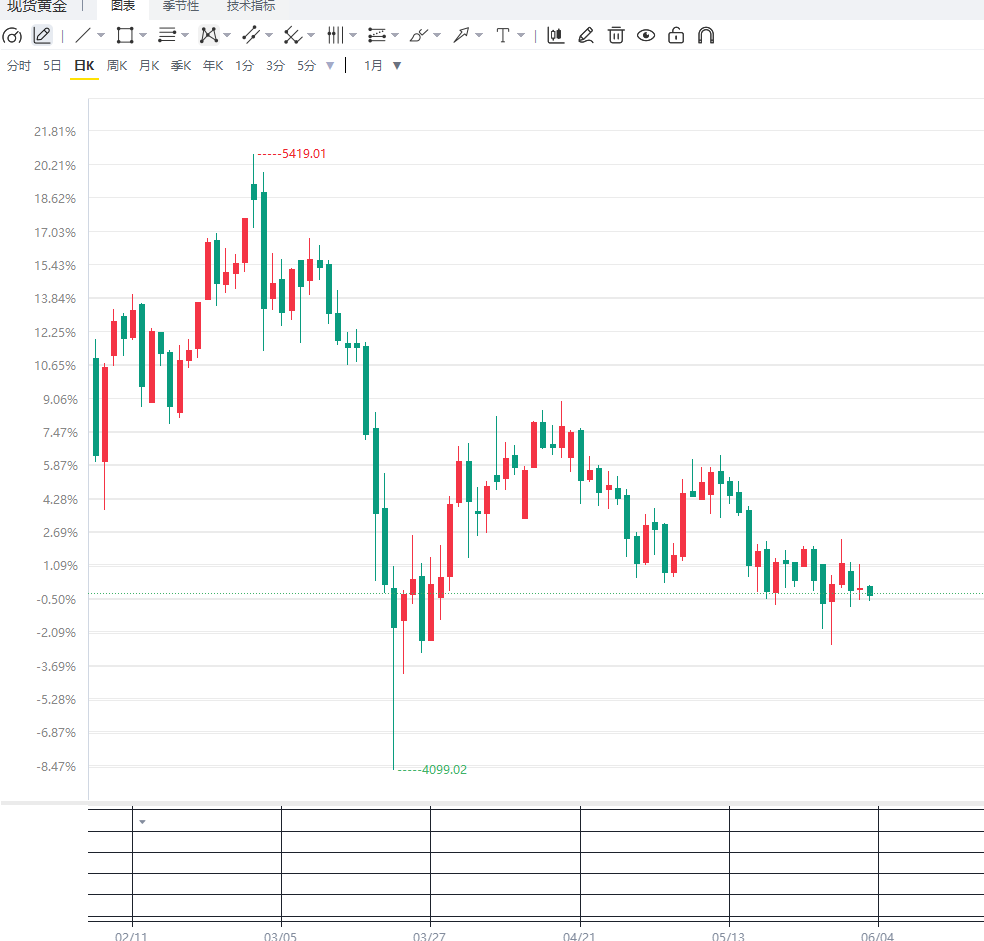
International gold prices continued to decline during Asian trading hours on Wednesday, with spot gold (XAU/USD) falling to around $4465 at one point, extending its previous downward trend. Market attention remains focused on the situation in the Middle East, but recent geopolitical risk premiums have declined to some extent, leading to some safe-haven funds withdrawing from the gold market.

Uncertainty has resurfaced regarding the prospects for negotiations between the United States and Iran. Iran has reportedly threatened to withdraw from peace talks due to Israel's military operations in Lebanon. However, US President Donald Trump subsequently pushed for the extension of the ceasefire agreement between Israel and Hezbollah, emphasizing that diplomatic engagement between the US and Iran remains ongoing. Markets believe that despite the back-and-forth negotiations, the fact that all parties have maintained communication channels has somewhat reduced investor concerns about a full-blown escalation of the situation.
Meanwhile, US Secretary of State Marco Rubio stated that the US would not lift sanctions against Iran simply because the Strait of Hormuz has fully reopened to navigation; any easing of sanctions would require substantial concessions from Iran on the issue of uranium enrichment. These statements indicate that significant differences remain between the US and Iran, and the outcome of future negotiations remains highly uncertain.
However, compared to previous market concerns about disruptions to shipping through the Strait of Hormuz leading to global energy supply shortages, investor worries about the situation spiraling out of control have eased somewhat. Market analysts point out that news over the weekend regarding continued contact between the US and Iran had weakened risk aversion, putting some pressure on gold as a traditional safe-haven asset.
From the energy market perspective, although optimism surrounding the negotiations has cooled somewhat, international oil prices have regained support. Market concerns remain that if negotiations stall, global energy supply risks could escalate again. Analysts believe that the rebound in energy prices could push up future inflation expectations, prompting the market to reassess the prospect of a Federal Reserve rate cut.
Current interest rate expectations remain one of the core factors influencing gold price movements. Since gold itself does not generate interest income, it typically faces pressure when the market anticipates the Federal Reserve will maintain high interest rates for an extended period. Recent resilient US inflation, coupled with rising energy prices, has led some investors to bet that the Federal Reserve may continue to maintain a hawkish stance.
Market focus has gradually shifted to the upcoming US May non-farm payrolls report. The market widely expects the US to add approximately 85,000 jobs in May, with the unemployment rate expected to remain unchanged at 4.3%. As a key indicator of the health of the US economy and labor market, this data will directly influence market expectations regarding future monetary policy.
If employment data is stronger than expected, it could further strengthen market expectations that the Federal Reserve will maintain its high-interest-rate policy, thus pushing the dollar higher and putting additional pressure on gold. Conversely, if job growth slows significantly or the unemployment rate rises, it could reignite market expectations for future interest rate cuts, thereby providing support for gold.
From a technical perspective, gold is still in a high-level consolidation phase on the daily chart. Short-term moving averages are beginning to flatten. The $4450 area is currently the first important support level; a break below this level could lead to a further test of the $4400 psychological barrier. On the upside, $4500 remains a key psychological resistance level; a successful retest of this level could see bulls challenge the $4550-$4600 range again.
Observing the 4-hour chart, gold's short-term trend shows a slightly weak and volatile pattern. The MACD indicator is running below the zero line, indicating that short-term momentum has weakened; the RSI indicator has fallen back to near the neutral zone, indicating that market buying power has temporarily cooled. However, as long as the support level of $4450 is not effectively broken, the overall medium- to long-term upward structure of gold remains largely intact. In the coming days, US employment data and developments in the Middle East will remain key factors determining the direction of gold.
Editor's Summary:
The recent pullback in gold prices was primarily driven by waning safe-haven demand and a market reassessment of the Federal Reserve's policy outlook. While uncertainties remain in the US-Iran negotiations, the continuation of the ceasefire agreement has temporarily eased market concerns about further escalation of the regional situation. From a fundamental perspective, rising energy prices and concerns about slowing economic growth are simultaneously impacting market sentiment. In the short term, US employment data may be a crucial variable in determining whether gold can hold the $4450 support level. If the job market shows signs of cooling, gold is likely to regain buying support; conversely, a stronger dollar may continue to suppress gold prices. Overall, gold's medium- to long-term safe-haven value remains, but short-term volatility risks have significantly increased.
Uncertainty has resurfaced regarding the prospects for negotiations between the United States and Iran. Iran has reportedly threatened to withdraw from peace talks due to Israel's military operations in Lebanon. However, US President Donald Trump subsequently pushed for the extension of the ceasefire agreement between Israel and Hezbollah, emphasizing that diplomatic engagement between the US and Iran remains ongoing. Markets believe that despite the back-and-forth negotiations, the fact that all parties have maintained communication channels has somewhat reduced investor concerns about a full-blown escalation of the situation.
Meanwhile, US Secretary of State Marco Rubio stated that the US would not lift sanctions against Iran simply because the Strait of Hormuz has fully reopened to navigation; any easing of sanctions would require substantial concessions from Iran on the issue of uranium enrichment. These statements indicate that significant differences remain between the US and Iran, and the outcome of future negotiations remains highly uncertain.
However, compared to previous market concerns about disruptions to shipping through the Strait of Hormuz leading to global energy supply shortages, investor worries about the situation spiraling out of control have eased somewhat. Market analysts point out that news over the weekend regarding continued contact between the US and Iran had weakened risk aversion, putting some pressure on gold as a traditional safe-haven asset.
From the energy market perspective, although optimism surrounding the negotiations has cooled somewhat, international oil prices have regained support. Market concerns remain that if negotiations stall, global energy supply risks could escalate again. Analysts believe that the rebound in energy prices could push up future inflation expectations, prompting the market to reassess the prospect of a Federal Reserve rate cut.
Current interest rate expectations remain one of the core factors influencing gold price movements. Since gold itself does not generate interest income, it typically faces pressure when the market anticipates the Federal Reserve will maintain high interest rates for an extended period. Recent resilient US inflation, coupled with rising energy prices, has led some investors to bet that the Federal Reserve may continue to maintain a hawkish stance.
Market focus has gradually shifted to the upcoming US May non-farm payrolls report. The market widely expects the US to add approximately 85,000 jobs in May, with the unemployment rate expected to remain unchanged at 4.3%. As a key indicator of the health of the US economy and labor market, this data will directly influence market expectations regarding future monetary policy.
If employment data is stronger than expected, it could further strengthen market expectations that the Federal Reserve will maintain its high-interest-rate policy, thus pushing the dollar higher and putting additional pressure on gold. Conversely, if job growth slows significantly or the unemployment rate rises, it could reignite market expectations for future interest rate cuts, thereby providing support for gold.
From a technical perspective, gold is still in a high-level consolidation phase on the daily chart. Short-term moving averages are beginning to flatten. The $4450 area is currently the first important support level; a break below this level could lead to a further test of the $4400 psychological barrier. On the upside, $4500 remains a key psychological resistance level; a successful retest of this level could see bulls challenge the $4550-$4600 range again.
Observing the 4-hour chart, gold's short-term trend shows a slightly weak and volatile pattern. The MACD indicator is running below the zero line, indicating that short-term momentum has weakened; the RSI indicator has fallen back to near the neutral zone, indicating that market buying power has temporarily cooled. However, as long as the support level of $4450 is not effectively broken, the overall medium- to long-term upward structure of gold remains largely intact. In the coming days, US employment data and developments in the Middle East will remain key factors determining the direction of gold.
Editor's Summary:
The recent pullback in gold prices was primarily driven by waning safe-haven demand and a market reassessment of the Federal Reserve's policy outlook. While uncertainties remain in the US-Iran negotiations, the continuation of the ceasefire agreement has temporarily eased market concerns about further escalation of the regional situation. From a fundamental perspective, rising energy prices and concerns about slowing economic growth are simultaneously impacting market sentiment. In the short term, US employment data may be a crucial variable in determining whether gold can hold the $4450 support level. If the job market shows signs of cooling, gold is likely to regain buying support; conversely, a stronger dollar may continue to suppress gold prices. Overall, gold's medium- to long-term safe-haven value remains, but short-term volatility risks have significantly increased.
- Risk Warning and Disclaimer
- The market involves risk, and trading may not be suitable for all investors. This article is for reference only and does not constitute personal investment advice, nor does it take into account certain users’ specific investment objectives, financial situation, or other needs. Any investment decisions made based on this information are at your own risk.