The strengthening of the pound and continued pressure on the yen have pushed the pound/yen exchange rate close to its year-to-date high.
2026-06-03 13:32:41
On Wednesday during Asian trading hours, the British pound against the Japanese yen (GBP/JPY) continued its volatile trend, trading around 215.30, near its year-to-date high, indicating that the overall market sentiment remains bullish. The recent rise in GBP/JPY has been primarily driven by the continued weakness of the yen and improved market risk appetite. Despite the ongoing complexity of the Middle East situation and the fluctuating progress of negotiations between the US and Iran, some investors still hope for a future agreement, thus reducing demand for safe-haven assets.

Meanwhile, the Japanese economy faces increasing pressure. Rising energy prices and slowing external demand are impacting the pace of Japan's economic recovery. As a major global energy importer, Japan is highly dependent on international crude oil supplies, and the recent escalation of tensions in the Middle East has significantly increased volatility in the energy market. It is widely believed that if shipping through the Strait of Hormuz continues to be affected, Japanese businesses and consumers will face higher energy costs. Market estimates indicate that approximately 20% of global seaborne crude oil shipments pass through this region, making Japan's energy import security particularly sensitive to changes in the situation.
Furthermore, the growth momentum in Japan's service sector has weakened significantly recently, and the slowdown in business activity has made the market cautious about the economic outlook. The coexistence of economic growth pressures and an inflationary environment presents the Bank of Japan with considerable challenges in adjusting its monetary policy.
In contrast, the UK economy has performed relatively steadily. Although the UK economy continues to be affected by the global slowdown, the higher interest rate environment continues to provide some support for the pound. The Bank of England's maintenance of a relatively tight monetary policy stance has also kept the pound relatively strong among major currencies.
From a capital flow perspective, the interest rate differentials between the US and Japan, as well as between the UK and Japan, remain high, prompting some international capital to continue carry trade. Investors borrow low-yielding yen and buy high-yielding currency assets, a trading pattern that continues to put pressure on the yen.
The market is currently paying particular attention to the USD/JPY exchange rate. As the USD/JPY gradually approaches the 160 mark, the risk of intervention by the Japanese government and the Bank of Japan is rising. Historical experience shows that when the yen depreciates rapidly, Japanese authorities often stabilize the exchange rate through verbal warnings or even direct market intervention.
However, in the current market environment, investors generally believe that unless there is large-scale, substantial intervention, the short-term weakness of the yen is unlikely to change fundamentally. The US-Japan interest rate differential and the slowdown in Japanese economic growth remain the core factors influencing the yen's exchange rate.
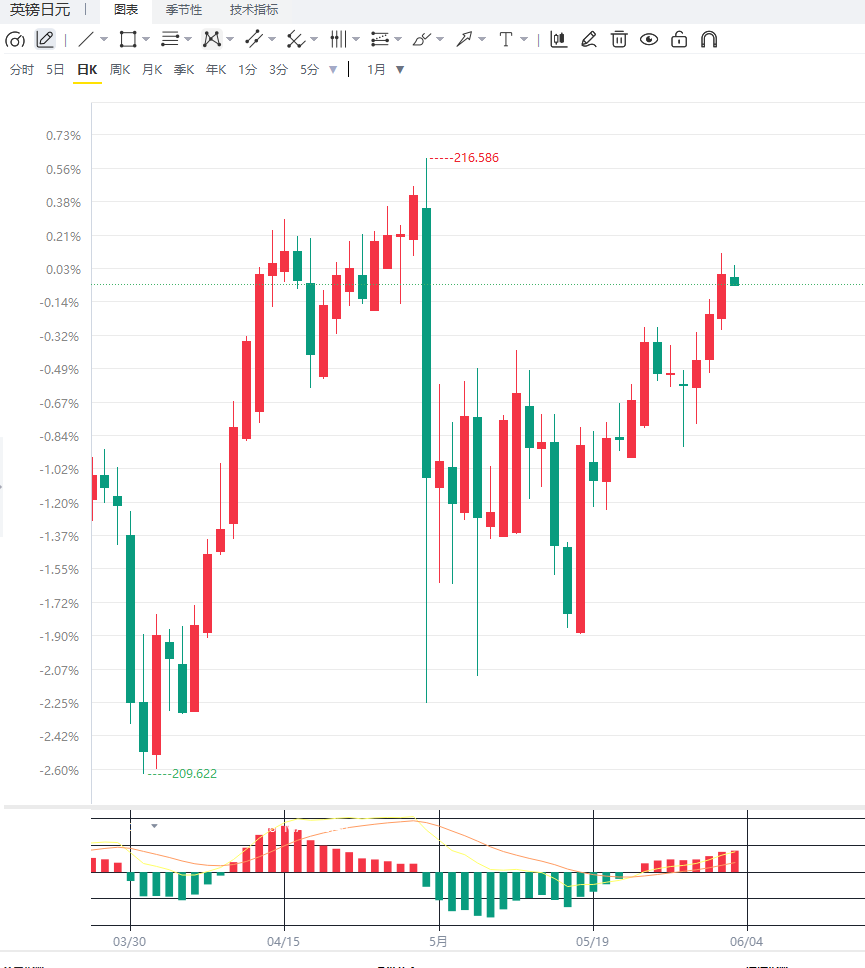
From a technical perspective, the GBP/JPY pair maintains a complete uptrend on the daily chart. The price continues to trade above major moving averages, and the bullish structure remains intact. The overall trend indicates the market remains within a medium- to long-term upward channel. Technically, the MACD remains above the zero line, indicating stable bullish momentum. If the price breaks through the 215.50-216.00 area, it could further challenge the year's high of 216.60 reached on April 30th. A decisive break above 216.60 would open up further upside potential, with the market potentially targeting the psychological level of 220.00. This level also represents significant psychological resistance and is expected to attract considerable market attention.
Observing the 4-hour chart, the short-term trend remains bullish, but the pace of the rise has slowed. 215.00 has become the first key support level. If this area is broken, a pullback to test the support near 214.68 is possible. Further support lies in the area where the 20-day and 50-day moving averages intersect, around 213.68 to 213.76. As long as the price remains above this area, the medium-term uptrend will remain intact.
Editor's Summary:
The current movement of the British pound against the Japanese yen primarily reflects the continued divergence in monetary policy and economic fundamentals between the UK and Japan. The UK's higher interest rate environment continues to support the pound, while Japan's economic growth pressures and easing policies continue to weaken the yen. In the short term, the 215-216 area will be a key observation range for the market. If the USD/JPY pair breaks further above 160, the yen may face new depreciation pressure, but the risk of Japanese government intervention will also increase simultaneously. Going forward, investors should pay close attention to developments in the Middle East, the Bank of Japan's actions, and changes in global risk sentiment.
Meanwhile, the Japanese economy faces increasing pressure. Rising energy prices and slowing external demand are impacting the pace of Japan's economic recovery. As a major global energy importer, Japan is highly dependent on international crude oil supplies, and the recent escalation of tensions in the Middle East has significantly increased volatility in the energy market. It is widely believed that if shipping through the Strait of Hormuz continues to be affected, Japanese businesses and consumers will face higher energy costs. Market estimates indicate that approximately 20% of global seaborne crude oil shipments pass through this region, making Japan's energy import security particularly sensitive to changes in the situation.
Furthermore, the growth momentum in Japan's service sector has weakened significantly recently, and the slowdown in business activity has made the market cautious about the economic outlook. The coexistence of economic growth pressures and an inflationary environment presents the Bank of Japan with considerable challenges in adjusting its monetary policy.
In contrast, the UK economy has performed relatively steadily. Although the UK economy continues to be affected by the global slowdown, the higher interest rate environment continues to provide some support for the pound. The Bank of England's maintenance of a relatively tight monetary policy stance has also kept the pound relatively strong among major currencies.
From a capital flow perspective, the interest rate differentials between the US and Japan, as well as between the UK and Japan, remain high, prompting some international capital to continue carry trade. Investors borrow low-yielding yen and buy high-yielding currency assets, a trading pattern that continues to put pressure on the yen.
The market is currently paying particular attention to the USD/JPY exchange rate. As the USD/JPY gradually approaches the 160 mark, the risk of intervention by the Japanese government and the Bank of Japan is rising. Historical experience shows that when the yen depreciates rapidly, Japanese authorities often stabilize the exchange rate through verbal warnings or even direct market intervention.
However, in the current market environment, investors generally believe that unless there is large-scale, substantial intervention, the short-term weakness of the yen is unlikely to change fundamentally. The US-Japan interest rate differential and the slowdown in Japanese economic growth remain the core factors influencing the yen's exchange rate.
From a technical perspective, the GBP/JPY pair maintains a complete uptrend on the daily chart. The price continues to trade above major moving averages, and the bullish structure remains intact. The overall trend indicates the market remains within a medium- to long-term upward channel. Technically, the MACD remains above the zero line, indicating stable bullish momentum. If the price breaks through the 215.50-216.00 area, it could further challenge the year's high of 216.60 reached on April 30th. A decisive break above 216.60 would open up further upside potential, with the market potentially targeting the psychological level of 220.00. This level also represents significant psychological resistance and is expected to attract considerable market attention.
Observing the 4-hour chart, the short-term trend remains bullish, but the pace of the rise has slowed. 215.00 has become the first key support level. If this area is broken, a pullback to test the support near 214.68 is possible. Further support lies in the area where the 20-day and 50-day moving averages intersect, around 213.68 to 213.76. As long as the price remains above this area, the medium-term uptrend will remain intact.
Editor's Summary:
The current movement of the British pound against the Japanese yen primarily reflects the continued divergence in monetary policy and economic fundamentals between the UK and Japan. The UK's higher interest rate environment continues to support the pound, while Japan's economic growth pressures and easing policies continue to weaken the yen. In the short term, the 215-216 area will be a key observation range for the market. If the USD/JPY pair breaks further above 160, the yen may face new depreciation pressure, but the risk of Japanese government intervention will also increase simultaneously. Going forward, investors should pay close attention to developments in the Middle East, the Bank of Japan's actions, and changes in global risk sentiment.
- Risk Warning and Disclaimer
- The market involves risk, and trading may not be suitable for all investors. This article is for reference only and does not constitute personal investment advice, nor does it take into account certain users’ specific investment objectives, financial situation, or other needs. Any investment decisions made based on this information are at your own risk.