The US dollar index is poised for a third consecutive day of gains, supported by both the Middle East situation and hawkish signals from the Federal Reserve.
2026-06-03 16:17:48
On Wednesday (June 3), the US dollar index continued its strength, driven by risk aversion, testing the weekly high of 99.40. The dollar index had already risen for the previous two trading days.
Escalating tensions in the Middle East have cast a shadow over the fragile prospects for a peace process, while strong U.S. economic data has provided support for the dollar.
On Wednesday, uncertainty surrounding the situation in the Middle East kept investors cautious.
A new round of hostilities between the US and Iran has put pressure on the fragile ceasefire agreement and pushed up oil prices. US authorities insist the ceasefire remains in effect, but Iran announced on Monday that it had suspended peace talks due to US and Israeli violations of the ceasefire agreement.
In terms of geopolitical dynamics, from late night on June 2 to early morning on June 3, the military standoff between the US and Iran escalated sharply—the Iranian Revolutionary Guard claimed that it had used missiles and drones to strike the headquarters of the US Fifth Fleet in Bahrain, while the US Central Command stated that all the missiles launched by Iran were intercepted or fell.
The conflict has spread to the Gulf region, with air raid sirens sounding nationwide in Kuwait, alarms blaring in Bahrain, and airports in several countries suspending operations.
Regarding the negotiations, the US and Iran have conflicting accounts. Iran claims that information exchange has been suspended for several days, while Trump quickly denies this, leaving the market caught in a dilemma of conflicting "true and false information."
From a transmission perspective, risk aversion has driven up the US dollar primarily through two paths: first, geopolitical risks have triggered capital flows into safe-haven assets such as US Treasury bonds; second, rising oil prices have strengthened the Federal Reserve's rationale for maintaining high interest rates, enhancing the dollar's interest rate advantage. As a net energy exporter, the US benefits from improved terms of trade due to rising energy prices, which is advantageous for the dollar. However, risk appetite has increased following the temporary ceasefire between the US and Iran in April, meaning that the dollar's continued strength will depend on whether the Middle East situation can maintain a sufficiently high level of tension.
At the same time, U.S. economic data continued to show resilience, providing additional support for the dollar.
Job openings at JOLTS rose to their highest level in nearly two years in April, and the ISM Manufacturing Purchasing Managers' Index for May also showed strong economic activity. These data reinforced market expectations that the Federal Reserve may raise interest rates later this year if inflationary pressures remain high.
Federal Reserve officials have recently been sending hawkish signals. Minneapolis Fed President Neel Kashkari stated that inflation has been above the 2% target for more than five consecutive years, and reducing inflation remains a top priority. The global "inflationary shockwave" triggered by the Middle East conflict may persist.
Former "dovish" Goolsby also pointed out that energy inflation related to the Middle East conflict will last longer than expected, and the main problem facing the Federal Reserve is likely that inflation is too high.
Federal Reserve Governor Cook made it clear that she is prepared to raise interest rates if the process of cooling inflation does not proceed as expected.
Ed Yardeni, founder of Yardeni Research, warned that the Federal Reserve should raise interest rates in July, much earlier than the market's general expectation of "at the earliest the end of 2026".
The US dollar index is trending slightly higher in the short term on the daily chart. Currently, the index is trading around 99.30 and has not yet stabilized above the moving averages across various timeframes. It is facing short-term pressure at the previous high of 99.55, with medium-term resistance at 100.64. Support lies at the 20-day and 50-day moving averages and the previous low of 97.63.
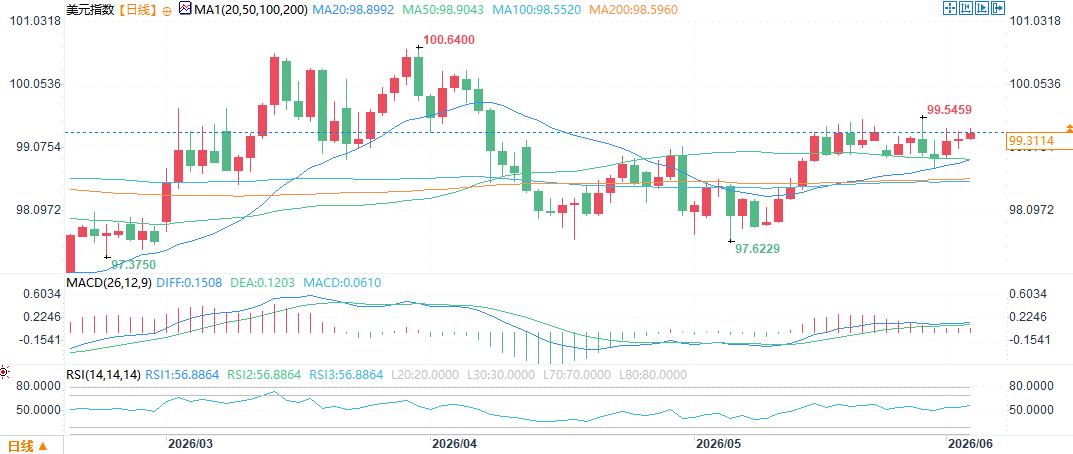
(US Dollar Index Daily Chart, Source: FX678)
The MACD remains above the zero line, with the DIFF above the DEA, indicating a slight continuation of bullish momentum. The RSI is at 56.89, above the 50 consolidation level, suggesting bulls have the upper hand but has not yet entered overbought territory. The moving average system is bullishly arranged, with the medium-term center of gravity steadily rising. In the short term, it is experiencing slight consolidation due to resistance at previous highs. The market is oscillating with a slightly bullish bias, supported by the moving averages. Key levels to watch are the 99.55 resistance level and the effectiveness of the 99 support level.
At 15:26 Beijing time on June 3, the US dollar index was at 99.33.
Escalating tensions in the Middle East have cast a shadow over the fragile prospects for a peace process, while strong U.S. economic data has provided support for the dollar.
Safe-haven demand: Middle East conflict boosts the US dollar
On Wednesday, uncertainty surrounding the situation in the Middle East kept investors cautious.
A new round of hostilities between the US and Iran has put pressure on the fragile ceasefire agreement and pushed up oil prices. US authorities insist the ceasefire remains in effect, but Iran announced on Monday that it had suspended peace talks due to US and Israeli violations of the ceasefire agreement.
In terms of geopolitical dynamics, from late night on June 2 to early morning on June 3, the military standoff between the US and Iran escalated sharply—the Iranian Revolutionary Guard claimed that it had used missiles and drones to strike the headquarters of the US Fifth Fleet in Bahrain, while the US Central Command stated that all the missiles launched by Iran were intercepted or fell.
The conflict has spread to the Gulf region, with air raid sirens sounding nationwide in Kuwait, alarms blaring in Bahrain, and airports in several countries suspending operations.
Regarding the negotiations, the US and Iran have conflicting accounts. Iran claims that information exchange has been suspended for several days, while Trump quickly denies this, leaving the market caught in a dilemma of conflicting "true and false information."
From a transmission perspective, risk aversion has driven up the US dollar primarily through two paths: first, geopolitical risks have triggered capital flows into safe-haven assets such as US Treasury bonds; second, rising oil prices have strengthened the Federal Reserve's rationale for maintaining high interest rates, enhancing the dollar's interest rate advantage. As a net energy exporter, the US benefits from improved terms of trade due to rising energy prices, which is advantageous for the dollar. However, risk appetite has increased following the temporary ceasefire between the US and Iran in April, meaning that the dollar's continued strength will depend on whether the Middle East situation can maintain a sufficiently high level of tension.
Economic data: Both the labor market and manufacturing sector are strengthening.
At the same time, U.S. economic data continued to show resilience, providing additional support for the dollar.
Job openings at JOLTS rose to their highest level in nearly two years in April, and the ISM Manufacturing Purchasing Managers' Index for May also showed strong economic activity. These data reinforced market expectations that the Federal Reserve may raise interest rates later this year if inflationary pressures remain high.
Federal Reserve officials have recently been sending hawkish signals. Minneapolis Fed President Neel Kashkari stated that inflation has been above the 2% target for more than five consecutive years, and reducing inflation remains a top priority. The global "inflationary shockwave" triggered by the Middle East conflict may persist.
Former "dovish" Goolsby also pointed out that energy inflation related to the Middle East conflict will last longer than expected, and the main problem facing the Federal Reserve is likely that inflation is too high.
Federal Reserve Governor Cook made it clear that she is prepared to raise interest rates if the process of cooling inflation does not proceed as expected.
Ed Yardeni, founder of Yardeni Research, warned that the Federal Reserve should raise interest rates in July, much earlier than the market's general expectation of "at the earliest the end of 2026".
Technical Analysis of the US Dollar Index
The US dollar index is trending slightly higher in the short term on the daily chart. Currently, the index is trading around 99.30 and has not yet stabilized above the moving averages across various timeframes. It is facing short-term pressure at the previous high of 99.55, with medium-term resistance at 100.64. Support lies at the 20-day and 50-day moving averages and the previous low of 97.63.
(US Dollar Index Daily Chart, Source: FX678)
The MACD remains above the zero line, with the DIFF above the DEA, indicating a slight continuation of bullish momentum. The RSI is at 56.89, above the 50 consolidation level, suggesting bulls have the upper hand but has not yet entered overbought territory. The moving average system is bullishly arranged, with the medium-term center of gravity steadily rising. In the short term, it is experiencing slight consolidation due to resistance at previous highs. The market is oscillating with a slightly bullish bias, supported by the moving averages. Key levels to watch are the 99.55 resistance level and the effectiveness of the 99 support level.
At 15:26 Beijing time on June 3, the US dollar index was at 99.33.
- Risk Warning and Disclaimer
- The market involves risk, and trading may not be suitable for all investors. This article is for reference only and does not constitute personal investment advice, nor does it take into account certain users’ specific investment objectives, financial situation, or other needs. Any investment decisions made based on this information are at your own risk.