Eurozone Dilemma: Service Sector Inflation Exceeds Expectations vs. Explosive US Jobs Data – Who Will Prevail?
2026-06-03 16:37:31
On Wednesday (June 3), the euro was under slight pressure against the US dollar during the European session, currently trading around 1.1610.
The Danske Bank research team pointed out that, as short-term interest rates in the US and Europe remain stable, the euro/dollar exchange rate is maintaining a narrow range of fluctuation in a temporary balance between bullish and bearish forces.
Analysts emphasize that the strong JOLTS data for April in the United States indicates that the labor market is no longer cooling down, and this combination of "strong macroeconomic data + solid earnings" is challenging the bearish view on US assets.

Danske Bank stated that the foreign exchange and fixed income markets were relatively calm yesterday. This calm was reflected in several aspects: Eurozone inflation data was largely in line with expectations, energy prices remained stable without significant fluctuations, and short-term interest rates in both the US and the Eurozone showed no significant changes. The market lacked new macroeconomic catalysts, and traders remained cautious ahead of key data releases.
In terms of actual price movement, the euro rebounded after hitting a low of 1.1613 against the US dollar yesterday, reaching a high of 1.1655, with extremely limited intraday volatility. This low volatility is not accidental—it is estimated that about 90% of the current market fluctuations are purely sideways consolidation, and investors have become "news fatigued" with both true and false news about the Middle East situation.
U.S. JOLTS job openings unexpectedly surged to 7.618 million in April, far exceeding market expectations of 6.87 million and reaching the highest level since May 2024. This data has attracted widespread market attention because its exceedance of expectations reached a statistically rare "nine-sigma level," marking the largest upward surprise relative to consensus in the history of the survey.
Structurally, the surge in job vacancies came almost entirely from the professional and business services sector, which added 668,000 jobs, marking the largest monthly increase on record. Meanwhile, jobs also rose in manufacturing and government, while job vacancies declined in the financial and insurance industry. Notably, the majority of the new jobs came from small businesses with fewer than 10 employees, indicating that the recovery in demand from SMEs was a significant driver of this data.
However, the data also reveals a "liquidity crisis" in the labor market—hiring numbers plummeted by 419,000 to 4,899,000, while voluntary resignations dropped by 183,000 to 2,977,000, the lowest level since 2020. This indicates that although companies' demand for labor is rising, employees are becoming more conservative in their willingness to change jobs, with the turnover rate falling to 1.9%, matching the lowest level since 2020.
Danske Bank points out that although these data reflect the situation in April rather than May (Friday's non-farm payrolls will cover May), they reinforce the picture of a strong labor market that is no longer cooling and may even tighten again. After the data release, market expectations for a 25 basis point rate cut before September have fallen from 48% the previous day to 35%, and some Federal Reserve officials have even begun to discuss the possibility of another rate hike to address persistent inflationary pressures.
Eurozone HICP inflation rose to 3.2% year-on-year in May, in line with expectations but slightly higher than preliminary data from various countries, marking its highest level since September 2023. The core driver of the inflation surge was energy prices – which jumped 10.9% year-on-year in May, the largest increase since February 2023. However, what worries policymakers more is the spread of inflationary pressures: core inflation rose to 2.5% year-on-year, higher than the market expectation of 2.4% and the previous reading of 2.2%, reaching its highest level in over a year. Services inflation unexpectedly jumped from 3.0% to 3.5%, becoming the main driver of the higher-than-expected core inflation.
Danske believes that overall, this should limit the market's hawkish interpretation of the data, but the better-than-expected performance of services inflation still results in a "mildly hawkish" outcome for the ECB, consistent with the bank's assessment that the ECB will raise interest rates in June.
Overall, the euro/dollar exchange rate remains range-bound in the short term, with the relative stability of interest rates in the US and Europe providing temporary equilibrium. However, strong signals from the US labor market are gradually weakening the market's bearish sentiment towards US assets, limiting the downside potential of the dollar.
Regarding the euro, stronger-than-expected core inflation provides a basis for the ECB to raise interest rates in June, but the rise in service sector-driven inflation also warrants attention regarding its impact on the subsequent policy path. Short-term exchange rate fluctuations will continue to depend on Friday's non-farm payroll data and the evolution of policy expectations from the US and ECBs.
Technically, the euro is consolidating with a slightly weak bias on the daily chart, currently trading around 1.1610, under pressure below the 20-day and 50-day moving averages. Short-term resistance is at 1.1660, while the previous high of 1.1848 forms strong medium-term resistance. On the downside, the support level to watch is the previous low of 1.1575.
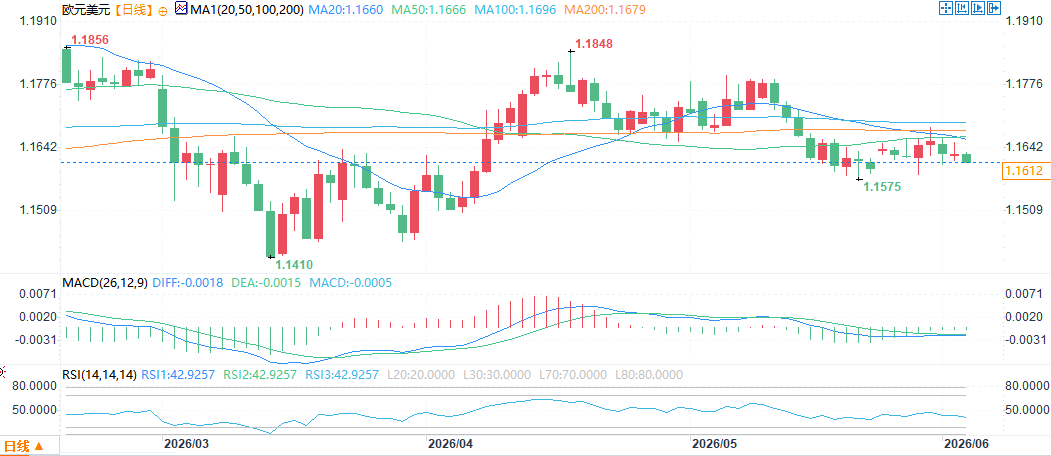
(Euro/USD daily chart, source: FX678)
The MACD is running below the zero line, indicating a slight continuation of bearish momentum; the RSI has fallen back to 42.8, below the 50 central line, suggesting an overall bearish bias. Prices are under continuous pressure from short-term moving averages, resulting in weak rebounds. In the short term, prices are expected to fluctuate weakly, supported by the moving averages. The key resistance level to watch is 1.166, while the key support level is 1.1575. A break below this level would lead to further declines.
At 16:25 Beijing time on June 3, the euro was trading at 1.1610/11 against the US dollar.
The Danske Bank research team pointed out that, as short-term interest rates in the US and Europe remain stable, the euro/dollar exchange rate is maintaining a narrow range of fluctuation in a temporary balance between bullish and bearish forces.
Analysts emphasize that the strong JOLTS data for April in the United States indicates that the labor market is no longer cooling down, and this combination of "strong macroeconomic data + solid earnings" is challenging the bearish view on US assets.
Market Review: Foreign Exchange and Fixed Income Markets Relatively Calm
Danske Bank stated that the foreign exchange and fixed income markets were relatively calm yesterday. This calm was reflected in several aspects: Eurozone inflation data was largely in line with expectations, energy prices remained stable without significant fluctuations, and short-term interest rates in both the US and the Eurozone showed no significant changes. The market lacked new macroeconomic catalysts, and traders remained cautious ahead of key data releases.
In terms of actual price movement, the euro rebounded after hitting a low of 1.1613 against the US dollar yesterday, reaching a high of 1.1655, with extremely limited intraday volatility. This low volatility is not accidental—it is estimated that about 90% of the current market fluctuations are purely sideways consolidation, and investors have become "news fatigued" with both true and false news about the Middle East situation.
US Labor Market: No Longer Cooling Down, and May Even Tighten Again
U.S. JOLTS job openings unexpectedly surged to 7.618 million in April, far exceeding market expectations of 6.87 million and reaching the highest level since May 2024. This data has attracted widespread market attention because its exceedance of expectations reached a statistically rare "nine-sigma level," marking the largest upward surprise relative to consensus in the history of the survey.
Structurally, the surge in job vacancies came almost entirely from the professional and business services sector, which added 668,000 jobs, marking the largest monthly increase on record. Meanwhile, jobs also rose in manufacturing and government, while job vacancies declined in the financial and insurance industry. Notably, the majority of the new jobs came from small businesses with fewer than 10 employees, indicating that the recovery in demand from SMEs was a significant driver of this data.
However, the data also reveals a "liquidity crisis" in the labor market—hiring numbers plummeted by 419,000 to 4,899,000, while voluntary resignations dropped by 183,000 to 2,977,000, the lowest level since 2020. This indicates that although companies' demand for labor is rising, employees are becoming more conservative in their willingness to change jobs, with the turnover rate falling to 1.9%, matching the lowest level since 2020.
Danske Bank points out that although these data reflect the situation in April rather than May (Friday's non-farm payrolls will cover May), they reinforce the picture of a strong labor market that is no longer cooling and may even tighten again. After the data release, market expectations for a 25 basis point rate cut before September have fallen from 48% the previous day to 35%, and some Federal Reserve officials have even begun to discuss the possibility of another rate hike to address persistent inflationary pressures.
Eurozone inflation: Overall in line with expectations, core slightly exceeded expectations
Eurozone HICP inflation rose to 3.2% year-on-year in May, in line with expectations but slightly higher than preliminary data from various countries, marking its highest level since September 2023. The core driver of the inflation surge was energy prices – which jumped 10.9% year-on-year in May, the largest increase since February 2023. However, what worries policymakers more is the spread of inflationary pressures: core inflation rose to 2.5% year-on-year, higher than the market expectation of 2.4% and the previous reading of 2.2%, reaching its highest level in over a year. Services inflation unexpectedly jumped from 3.0% to 3.5%, becoming the main driver of the higher-than-expected core inflation.
Danske believes that overall, this should limit the market's hawkish interpretation of the data, but the better-than-expected performance of services inflation still results in a "mildly hawkish" outcome for the ECB, consistent with the bank's assessment that the ECB will raise interest rates in June.
Overall, the euro/dollar exchange rate remains range-bound in the short term, with the relative stability of interest rates in the US and Europe providing temporary equilibrium. However, strong signals from the US labor market are gradually weakening the market's bearish sentiment towards US assets, limiting the downside potential of the dollar.
Regarding the euro, stronger-than-expected core inflation provides a basis for the ECB to raise interest rates in June, but the rise in service sector-driven inflation also warrants attention regarding its impact on the subsequent policy path. Short-term exchange rate fluctuations will continue to depend on Friday's non-farm payroll data and the evolution of policy expectations from the US and ECBs.
Technically, the euro is consolidating with a slightly weak bias on the daily chart, currently trading around 1.1610, under pressure below the 20-day and 50-day moving averages. Short-term resistance is at 1.1660, while the previous high of 1.1848 forms strong medium-term resistance. On the downside, the support level to watch is the previous low of 1.1575.
(Euro/USD daily chart, source: FX678)
The MACD is running below the zero line, indicating a slight continuation of bearish momentum; the RSI has fallen back to 42.8, below the 50 central line, suggesting an overall bearish bias. Prices are under continuous pressure from short-term moving averages, resulting in weak rebounds. In the short term, prices are expected to fluctuate weakly, supported by the moving averages. The key resistance level to watch is 1.166, while the key support level is 1.1575. A break below this level would lead to further declines.
At 16:25 Beijing time on June 3, the euro was trading at 1.1610/11 against the US dollar.
- Risk Warning and Disclaimer
- The market involves risk, and trading may not be suitable for all investors. This article is for reference only and does not constitute personal investment advice, nor does it take into account certain users’ specific investment objectives, financial situation, or other needs. Any investment decisions made based on this information are at your own risk.