World Gold Council: Global central banks resumed net gold purchases in April 2026.
2026-06-03 19:16:52
The latest official statistics show a significant reversal in global central bank gold trading. After a large-scale net sale of gold in March, global central banks resumed net gold purchases in April 2026, with net purchases reaching 17 tons, reversing the previous month's selling trend. The valid data in this statistical analysis is current as of May 29, 2026, and is compiled based on publicly available information from the International Monetary Fund and central banks worldwide, ensuring its authority.

Central banks' monthly trading performance diverges.
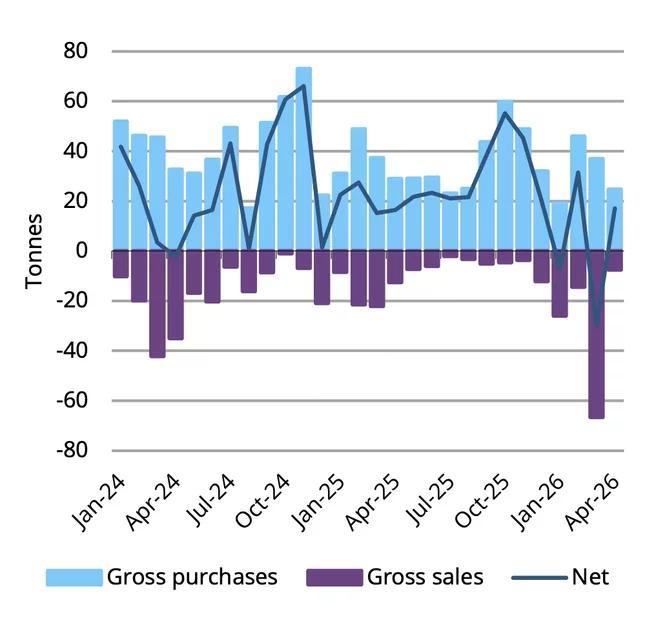
(The chart shows that central banks around the world resumed net buying of gold in April.)
Looking at the short-term trading data of central banks around the world in April, their operations showed a clear divergence, with many countries continuing to increase their gold holdings and only a few continuing to sell. Poland was the world's largest gold buyer in April, with net purchases of 14 tons. The People's Bank of China also significantly accelerated its gold purchases, with net purchases of 8 tons in the month, marking the highest monthly purchase volume since December 2024. Furthermore, the central bank's continuous gold purchases have now lasted for 18 months, demonstrating a very stable upward trend.
The Czech central bank has also maintained its long-term, normalized gold purchasing pace, with net purchases of 3 tons of gold in April, marking a stable record of 38 consecutive months of monthly gold purchases. In contrast, the Russian central bank continues its gold-selling trend, with net sales of 6 tons of gold in April, and a cumulative sales volume of 22 tons by 2026, making it the main central bank currently selling gold.
Current status of gold reserve holdings this year
Looking at the overall data for 2026, central banks around the world have steadily updated their gold reserves, with each holding having its own unique characteristics. Poland, thanks to a large purchase in April, has increased its cumulative gold purchases to 45 tons this year, bringing its total gold reserves to 595 tons, accounting for 30% of its total foreign exchange reserves, with the proportion of gold reserves continuing to rise.
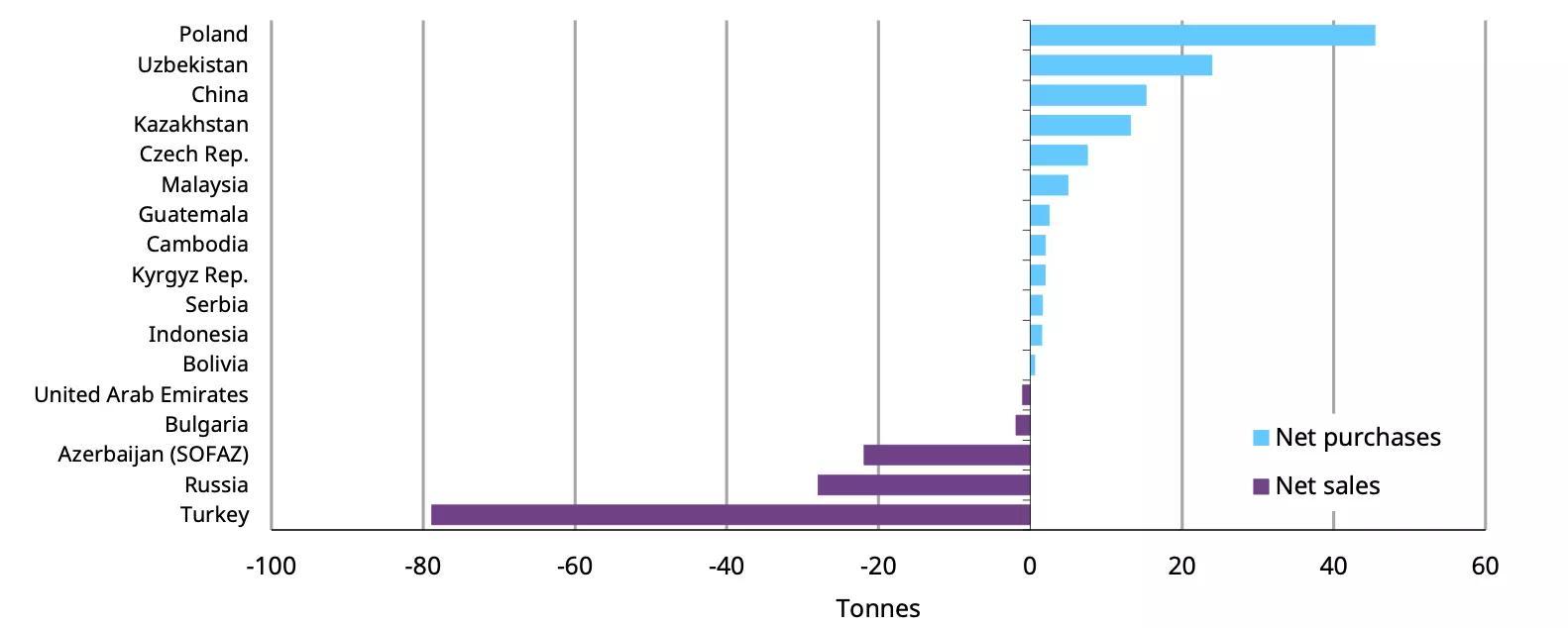
(Major net buyers: Poland, Uzbekistan, China, and Kazakhstan are the main net buyers. Major net sellers: Turkey is the absolute largest net seller, far exceeding other countries; Russia and Azerbaijan are next.)
Following its purchase of 8 tons of gold in April, China's official gold reserves totaled approximately 2,322 tons, accounting for 9% of its total foreign exchange reserves. This demonstrates the continued implementation of its long-term, steady accumulation strategy and the ongoing optimization of its reserve structure. The Czech central bank made a small net purchase of 2 tons of gold in April, increasing its total gold reserves to 79 tons, representing 6% of its total reserves, maintaining a steady pace of accumulation.
Central Bank Trading Dynamics of Other Key Countries
Aside from the core gold-buying and selling countries, the trading activities of the central banks of Uzbekistan and Turkey are relatively unique. Uzbekistan sold a small amount of gold in April, but it is still a net buyer overall this year, having purchased a total of 24 tons of gold. Its gold purchases are second only to Poland, and its gold reserves are 414 tons, accounting for a high proportion of 88% of its total reserves. Gold plays an absolutely dominant role in its foreign exchange reserves.
Turkey's central bank was a major global seller of gold in March, and its gold reserves remained largely unchanged in April, with overall trading trending towards stability. Due to the expiration of short-term gold-to-dollar swap contracts, Turkey currently only has medium- to long-term swap contracts with maturities of 1 to 3 months remaining. Its reserve management strategy leans towards a long-term, stable approach. For detailed reserve management strategies, please refer to the World Gold Council's Q1 2026 Gold Demand Trends report.
Regional Gold Purchase Patterns: Central Banks in Asia and Europe Become the Main Forces
From a regional perspective, central banks in Eastern Europe and Asia have long dominated the global central bank gold purchasing market, maintaining a consistently stable purchasing trend. Over the past 36 months, the average monthly net gold purchases by central banks in these two regions reached 12 tons and 11 tons respectively, indicating very strong demand. During the same period, the global average monthly net gold purchases by central banks totaled 29 tons, demonstrating that central banks in emerging markets in Asia and Europe are the core force in global central bank gold purchasing and a key factor supporting the steady growth of global gold reserves.
Industry Outlook: Central Banks' Intention to Purchase Gold Continues to Improve
Survey data from 2025 shows that 95% of the surveyed central banks believe that global central bank gold reserves will continue to grow in the next 12 months, significantly higher than 81% in 2024; at the same time, 43% of the surveyed central banks plan to increase their own gold reserves, a significant increase from 29% in 2024. This fully demonstrates that gold's core value in the global foreign exchange reserve system remains stable due to its safe-haven and value-preserving attributes, and the trend of central banks buying gold may continue in the future.
Central banks' monthly trading performance diverges.
(The chart shows that central banks around the world resumed net buying of gold in April.)
Looking at the short-term trading data of central banks around the world in April, their operations showed a clear divergence, with many countries continuing to increase their gold holdings and only a few continuing to sell. Poland was the world's largest gold buyer in April, with net purchases of 14 tons. The People's Bank of China also significantly accelerated its gold purchases, with net purchases of 8 tons in the month, marking the highest monthly purchase volume since December 2024. Furthermore, the central bank's continuous gold purchases have now lasted for 18 months, demonstrating a very stable upward trend.
The Czech central bank has also maintained its long-term, normalized gold purchasing pace, with net purchases of 3 tons of gold in April, marking a stable record of 38 consecutive months of monthly gold purchases. In contrast, the Russian central bank continues its gold-selling trend, with net sales of 6 tons of gold in April, and a cumulative sales volume of 22 tons by 2026, making it the main central bank currently selling gold.
Current status of gold reserve holdings this year
Looking at the overall data for 2026, central banks around the world have steadily updated their gold reserves, with each holding having its own unique characteristics. Poland, thanks to a large purchase in April, has increased its cumulative gold purchases to 45 tons this year, bringing its total gold reserves to 595 tons, accounting for 30% of its total foreign exchange reserves, with the proportion of gold reserves continuing to rise.
(Major net buyers: Poland, Uzbekistan, China, and Kazakhstan are the main net buyers. Major net sellers: Turkey is the absolute largest net seller, far exceeding other countries; Russia and Azerbaijan are next.)
Following its purchase of 8 tons of gold in April, China's official gold reserves totaled approximately 2,322 tons, accounting for 9% of its total foreign exchange reserves. This demonstrates the continued implementation of its long-term, steady accumulation strategy and the ongoing optimization of its reserve structure. The Czech central bank made a small net purchase of 2 tons of gold in April, increasing its total gold reserves to 79 tons, representing 6% of its total reserves, maintaining a steady pace of accumulation.
Central Bank Trading Dynamics of Other Key Countries
Aside from the core gold-buying and selling countries, the trading activities of the central banks of Uzbekistan and Turkey are relatively unique. Uzbekistan sold a small amount of gold in April, but it is still a net buyer overall this year, having purchased a total of 24 tons of gold. Its gold purchases are second only to Poland, and its gold reserves are 414 tons, accounting for a high proportion of 88% of its total reserves. Gold plays an absolutely dominant role in its foreign exchange reserves.
Turkey's central bank was a major global seller of gold in March, and its gold reserves remained largely unchanged in April, with overall trading trending towards stability. Due to the expiration of short-term gold-to-dollar swap contracts, Turkey currently only has medium- to long-term swap contracts with maturities of 1 to 3 months remaining. Its reserve management strategy leans towards a long-term, stable approach. For detailed reserve management strategies, please refer to the World Gold Council's Q1 2026 Gold Demand Trends report.
Regional Gold Purchase Patterns: Central Banks in Asia and Europe Become the Main Forces
From a regional perspective, central banks in Eastern Europe and Asia have long dominated the global central bank gold purchasing market, maintaining a consistently stable purchasing trend. Over the past 36 months, the average monthly net gold purchases by central banks in these two regions reached 12 tons and 11 tons respectively, indicating very strong demand. During the same period, the global average monthly net gold purchases by central banks totaled 29 tons, demonstrating that central banks in emerging markets in Asia and Europe are the core force in global central bank gold purchasing and a key factor supporting the steady growth of global gold reserves.
Industry Outlook: Central Banks' Intention to Purchase Gold Continues to Improve
Survey data from 2025 shows that 95% of the surveyed central banks believe that global central bank gold reserves will continue to grow in the next 12 months, significantly higher than 81% in 2024; at the same time, 43% of the surveyed central banks plan to increase their own gold reserves, a significant increase from 29% in 2024. This fully demonstrates that gold's core value in the global foreign exchange reserve system remains stable due to its safe-haven and value-preserving attributes, and the trend of central banks buying gold may continue in the future.
- Risk Warning and Disclaimer
- The market involves risk, and trading may not be suitable for all investors. This article is for reference only and does not constitute personal investment advice, nor does it take into account certain users’ specific investment objectives, financial situation, or other needs. Any investment decisions made based on this information are at your own risk.