Labor costs, fiscal surplus, and inflation risks: the triple constraints on the pound sterling emerge.
2026-06-03 20:29:34
On Wednesday, June 3, the pound was in a window of simultaneous reassessment of growth expectations, labor costs, and energy shocks against the dollar. On the trading floor, the exchange rate hovered around 1.3450, with limited intraday volatility, remaining within its recent trading range. The market also needs to digest the facts confirmed in the UK's June fiscal forecast review report: the economic impact of the previous budget was estimated to be overly optimistic, while new energy price disturbances have not yet been fully incorporated into the fiscal forecast.

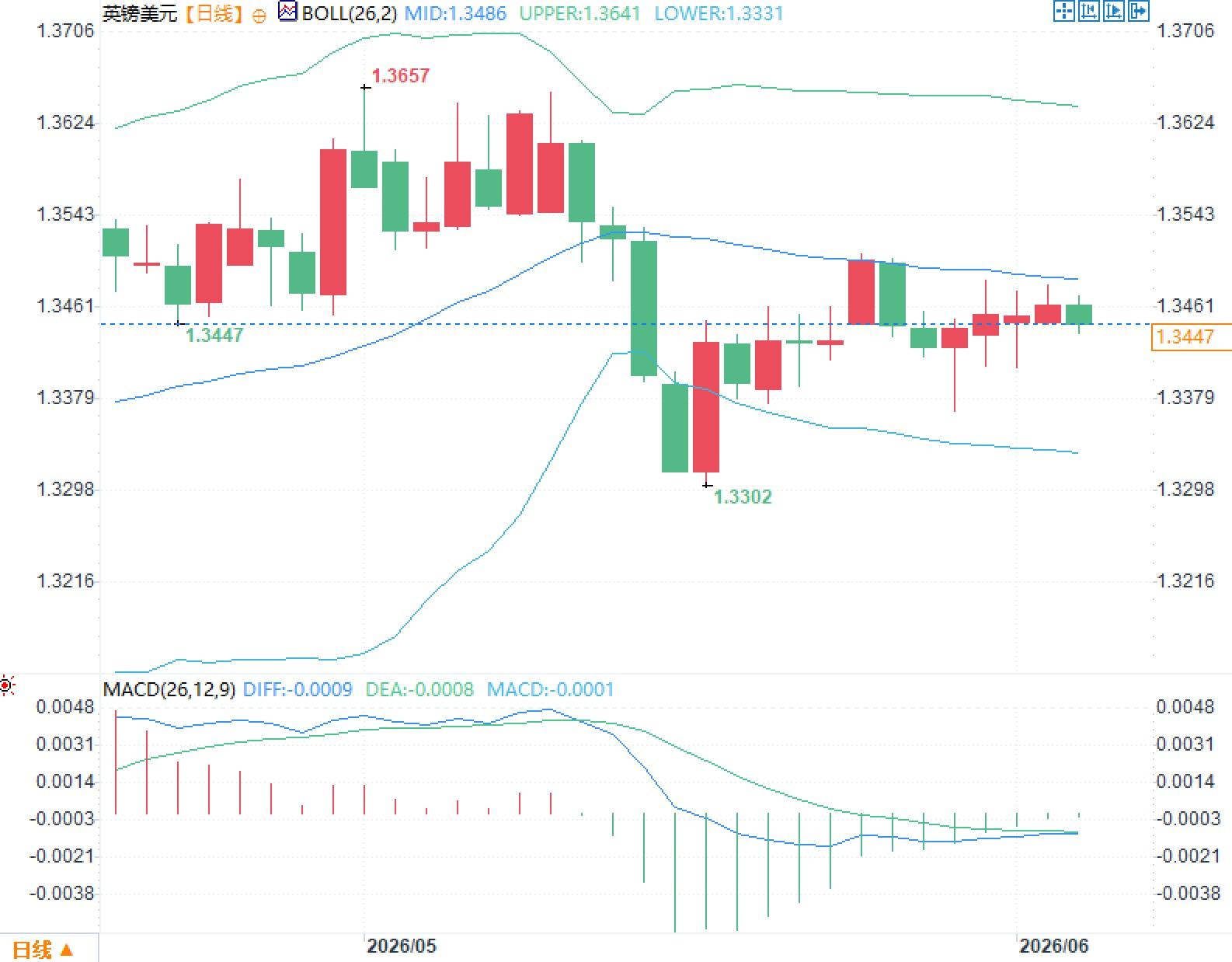
The daily chart shows that the British pound fell from 1.3657 to 1.3302 against the US dollar, a cumulative correction of 355 pips, and recently rebounded to around 1.3450, recovering only about 41% of the previous decline. The Bollinger Middle Band is at 1.3486, and the current price is still 39 pips below the Middle Band; the Upper Band is at 1.3641 and the Lower Band is at 1.3331, reflecting that the fluctuation range has shifted downward. The MACD DIFF is -0.0009, DEA is -0.0008, and the histogram is -0.0001, indicating that the downward momentum is weakening, but a medium-term momentum reversal has not yet formed. In other words, the market is moving from position repair after the previous sharp drop to a stage of pricing in fundamental evidence one by one.
The UK Office for Budget Responsibility (OBC) confirmed in its June report that its October 2024 forecast of 2% real GDP growth for 2025 was too high, with the latest figure at only 1.4%. The report noted that the error could stem from overly optimistic baseline forecasts, overly optimistic assessments of policy effects, or both. The report also reiterated that the supply-side impacts of policies in fiscal year 2025-2026 already account for the drag on labor supply and crowding out of private investment caused by increased employer National Insurance contributions, resulting in a combined potential output reduction of 0.1%.
The institutional changes are not trivial: from April 6, 2025, the employer's National Insurance contribution rate will increase from 13.8% to 15%, and the minimum wage threshold will decrease from £9,100 to £5,000 per year. The transmission path is very clear: increased fixed costs for employers will first compress the marginal returns of low-hour and entry-level positions, then affect recruitment, training, and wage bargaining, ultimately impacting service consumption, taxation, and growth expectations. For the pound, the market's pricing focus shifts from "tax increases leading to increased revenue" to "whether the tax base is being eroded by cooling employment."
The latest official statistics from the UK show that real GDP grew by 0.6% quarter-on-quarter in the first quarter of 2026, but the growth for the whole of 2025 was only 1.4%. More significant in terms of exchange rate implications is the labor market: the unemployment rate was 5.0% from January to March 2026, up 0.5 percentage points year-on-year; the number of employees on the payroll decreased by 104,000 year-on-year in March; job vacancies fell to 705,000 from February to April, the lowest level since the same period in 2021; and the year-on-year growth rate of regular wages in the private sector was only 3.0%. These indicators suggest that businesses' cost-absorbing capacity and willingness to create new jobs are both under pressure.
The price side has not provided a one-way answer. The year-on-year increase in the Consumer Price Index (CPI) fell to 2.8% in April from 3.3% in March, but the Bank of England maintained its interest rate at 3.75% in April with an 8-1 vote, and made it clear that energy price fluctuations could push up inflation this year, with policymakers monitoring whether this spreads to wages and pricing. The pound thus faces a typical supply-side dilemma: inflation risks raise the threshold for interest rate cuts, which could support interest rate expectations in the short term; however, pressure on real income, profits, and employment would weaken the growth base of the currency.
The UK's March fiscal forecast projected real GDP growth of 1.1% in 2026 and a current budget surplus of approximately £24 billion for the 2029-2030 fiscal year. However, the June review report cautioned that the energy price shocks caused by the Middle East conflict since the end of February occurred after the March forecast was finalized, and the next round of forecasts must reassess their transmission to inflation, growth, and public finances. This means that the existing fiscal buffer is not a static safety net, but rather exposed to the triple variables of energy import costs, interest expenses, and the employment tax base.
This also provides a macroeconomic explanation for the pound's rebound against the dollar being capped near the Bollinger Middle Band: High interest rates do not equate to improved growth quality. If the reason for persistently high interest rates is cost shocks rather than demand expansion, the positive reaction of the exchange rate to interest rate differentials is usually offset by fiscal risk premiums and growth discounts. Subsequent pricing will revolve around three pieces of evidence: whether the energy price shock can be mitigated, whether June's inflation and employment data indicate a second round of transmission, and whether the new round of fiscal forecasts will compress the original surplus space.
Market Structure: The rebound has not yet transformed into a trend correction.
The daily chart shows that the British pound fell from 1.3657 to 1.3302 against the US dollar, a cumulative correction of 355 pips, and recently rebounded to around 1.3450, recovering only about 41% of the previous decline. The Bollinger Middle Band is at 1.3486, and the current price is still 39 pips below the Middle Band; the Upper Band is at 1.3641 and the Lower Band is at 1.3331, reflecting that the fluctuation range has shifted downward. The MACD DIFF is -0.0009, DEA is -0.0008, and the histogram is -0.0001, indicating that the downward momentum is weakening, but a medium-term momentum reversal has not yet formed. In other words, the market is moving from position repair after the previous sharp drop to a stage of pricing in fundamental evidence one by one.
Budgeting Errors: Employer Contribution Increases Begin to Be Revalued
The UK Office for Budget Responsibility (OBC) confirmed in its June report that its October 2024 forecast of 2% real GDP growth for 2025 was too high, with the latest figure at only 1.4%. The report noted that the error could stem from overly optimistic baseline forecasts, overly optimistic assessments of policy effects, or both. The report also reiterated that the supply-side impacts of policies in fiscal year 2025-2026 already account for the drag on labor supply and crowding out of private investment caused by increased employer National Insurance contributions, resulting in a combined potential output reduction of 0.1%.
The institutional changes are not trivial: from April 6, 2025, the employer's National Insurance contribution rate will increase from 13.8% to 15%, and the minimum wage threshold will decrease from £9,100 to £5,000 per year. The transmission path is very clear: increased fixed costs for employers will first compress the marginal returns of low-hour and entry-level positions, then affect recruitment, training, and wage bargaining, ultimately impacting service consumption, taxation, and growth expectations. For the pound, the market's pricing focus shifts from "tax increases leading to increased revenue" to "whether the tax base is being eroded by cooling employment."
Data Verification: Growth Recovery Coexists with Labor Market Cooling
The latest official statistics from the UK show that real GDP grew by 0.6% quarter-on-quarter in the first quarter of 2026, but the growth for the whole of 2025 was only 1.4%. More significant in terms of exchange rate implications is the labor market: the unemployment rate was 5.0% from January to March 2026, up 0.5 percentage points year-on-year; the number of employees on the payroll decreased by 104,000 year-on-year in March; job vacancies fell to 705,000 from February to April, the lowest level since the same period in 2021; and the year-on-year growth rate of regular wages in the private sector was only 3.0%. These indicators suggest that businesses' cost-absorbing capacity and willingness to create new jobs are both under pressure.
The price side has not provided a one-way answer. The year-on-year increase in the Consumer Price Index (CPI) fell to 2.8% in April from 3.3% in March, but the Bank of England maintained its interest rate at 3.75% in April with an 8-1 vote, and made it clear that energy price fluctuations could push up inflation this year, with policymakers monitoring whether this spreads to wages and pricing. The pound thus faces a typical supply-side dilemma: inflation risks raise the threshold for interest rate cuts, which could support interest rate expectations in the short term; however, pressure on real income, profits, and employment would weaken the growth base of the currency.
Key variables in exchange rates: Fiscal buffers and a reassessment of the energy bill
The UK's March fiscal forecast projected real GDP growth of 1.1% in 2026 and a current budget surplus of approximately £24 billion for the 2029-2030 fiscal year. However, the June review report cautioned that the energy price shocks caused by the Middle East conflict since the end of February occurred after the March forecast was finalized, and the next round of forecasts must reassess their transmission to inflation, growth, and public finances. This means that the existing fiscal buffer is not a static safety net, but rather exposed to the triple variables of energy import costs, interest expenses, and the employment tax base.
This also provides a macroeconomic explanation for the pound's rebound against the dollar being capped near the Bollinger Middle Band: High interest rates do not equate to improved growth quality. If the reason for persistently high interest rates is cost shocks rather than demand expansion, the positive reaction of the exchange rate to interest rate differentials is usually offset by fiscal risk premiums and growth discounts. Subsequent pricing will revolve around three pieces of evidence: whether the energy price shock can be mitigated, whether June's inflation and employment data indicate a second round of transmission, and whether the new round of fiscal forecasts will compress the original surplus space.
- Risk Warning and Disclaimer
- The market involves risk, and trading may not be suitable for all investors. This article is for reference only and does not constitute personal investment advice, nor does it take into account certain users’ specific investment objectives, financial situation, or other needs. Any investment decisions made based on this information are at your own risk.