The dollar rose and then fell back, leading to a correction in the USD/JPY pair at its highs.
2026-06-04 09:28:08
The US dollar/Japanese yen (USD/JPY) pair ended its four-day winning streak in Asian trading on Thursday, falling back to around 159.90. As signs of easing tensions in the Middle East emerged, global market risk appetite improved, reducing demand for the US dollar as a safe haven and thus putting downward pressure on the exchange rate.

The Israeli and Lebanese governments announced on Wednesday that they had agreed to extend the ceasefire agreement. The two sides also plan to establish several pilot security zones, with the Lebanese armed forces taking full responsibility for security in these areas and excluding the presence of non-state armed forces. Markets believe this development will help reduce the risk of further escalation in the Middle East, thereby alleviating the risk aversion that had previously accumulated in global financial markets.
The partial withdrawal of safe-haven funds led to a technical correction in the US dollar index, while the Japanese yen benefited from improved risk appetite and received some support. However, market participants generally believe that the risks in the Middle East situation have not been completely eliminated. US President Trump recently stated that the US might reconsider the current ceasefire arrangement if Iranian actions result in casualties among US military personnel. Meanwhile, significant uncertainty remains regarding shipping restrictions in the Strait of Hormuz, meaning that the international energy market may still face new volatility in the future.
For the foreign exchange market, energy prices have always been a crucial factor influencing the yen's exchange rate. As one of the world's major energy importers, rising energy costs in Japan typically widen the trade deficit and weaken the yen. The recent sustained high levels of international crude oil prices have heightened market concerns about imported inflationary pressures facing the Japanese economy.
In fact, the yen has been under pressure from the widening interest rate differential between the US and Japan since the beginning of this year. Although the Bank of Japan is gradually exiting its ultra-loose monetary policy, the pace of policy normalization is significantly slower than that of the United States. With US interest rates remaining high, international capital continues to flow into higher-yielding dollar assets, thus driving the dollar/yen exchange rate to remain high for an extended period.
Meanwhile, the Japanese government's focus on exchange rate movements has also increased significantly. While Finance Minister Satsuki Katayama declined to comment specifically on recent exchange rate fluctuations or the potential scale of intervention, she emphasized that continued volatility in the energy market necessitates the government's preparation for "appropriate action." She pointed out that exchange rate intervention is not solely targeted at the foreign exchange market, but is part of overall economic management, and the Japanese government is maintaining close communication with the United States and continuously monitoring market changes.
From a market sentiment perspective, investors are currently in a phase of balancing multiple factors. On the one hand, the temporary easing of tensions in the Middle East has boosted risk appetite; on the other hand, the high-interest-rate environment in the United States and rising energy prices continue to exert long-term pressure on the yen. Furthermore, expectations of potential intervention by the Japanese government are also keeping some speculative funds cautious.
Going forward, market focus will be on US employment data, Federal Reserve policy expectations, the Bank of Japan's policy moves, and changes in the energy market. If US economic data continues to be strong, the dollar may regain support; conversely, if signs of an economic slowdown increase, the dollar's strength could ease, creating an opportunity for a yen rebound.
From the daily chart, the USD/JPY pair maintains a clear upward trend. The price continues to trade above major moving averages, with the 20-day and 50-day moving averages maintaining a bullish alignment, indicating that the medium- to long-term uptrend structure remains intact. The MACD indicator is above the zero line, but the red histogram bars are shortening, suggesting a slight weakening of short-term bullish momentum. The RSI indicator is hovering around 65; although it hasn't entered extreme overbought territory, some profit-taking has begun to emerge. Key support levels to watch are 158.50 and 157.00, while resistance levels are 160.50 and 162.00.
From a 4-hour chart perspective, the USD/JPY pair has recently been fluctuating significantly around the 160 level. The MACD indicator has formed a bearish crossover at a high level, indicating a slowdown in short-term upward momentum. The RSI has fallen back to around 55, reflecting a more neutral market sentiment. If the exchange rate regains its footing above 160.50, it may continue to challenge the 162.00 area; if it breaks below the 158.50 support, it may further retrace to around 157.00 or even 155.80.
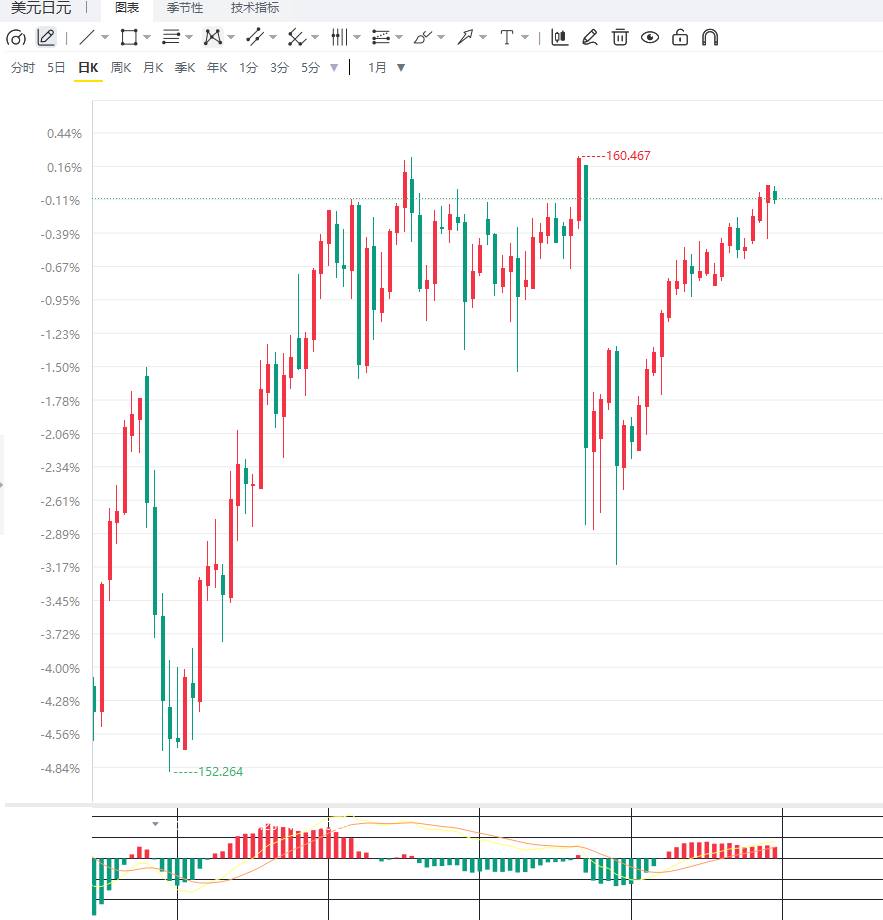
Editor's Summary : The recent USD/JPY exchange rate movement reflects the global market's search for a new balance among geopolitical risks, energy prices, and monetary policy expectations. The ceasefire agreement between Israel and Lebanon alleviated some safe-haven demand, causing a temporary pullback in the dollar, but the resilience of the US economy and relatively high interest rates continue to provide significant support for the dollar. Meanwhile, the Japanese economy still faces challenges from rising energy costs and increasing fiscal pressure, and the long-term weakness of the yen has not fundamentally changed.
The Israeli and Lebanese governments announced on Wednesday that they had agreed to extend the ceasefire agreement. The two sides also plan to establish several pilot security zones, with the Lebanese armed forces taking full responsibility for security in these areas and excluding the presence of non-state armed forces. Markets believe this development will help reduce the risk of further escalation in the Middle East, thereby alleviating the risk aversion that had previously accumulated in global financial markets.
The partial withdrawal of safe-haven funds led to a technical correction in the US dollar index, while the Japanese yen benefited from improved risk appetite and received some support. However, market participants generally believe that the risks in the Middle East situation have not been completely eliminated. US President Trump recently stated that the US might reconsider the current ceasefire arrangement if Iranian actions result in casualties among US military personnel. Meanwhile, significant uncertainty remains regarding shipping restrictions in the Strait of Hormuz, meaning that the international energy market may still face new volatility in the future.
For the foreign exchange market, energy prices have always been a crucial factor influencing the yen's exchange rate. As one of the world's major energy importers, rising energy costs in Japan typically widen the trade deficit and weaken the yen. The recent sustained high levels of international crude oil prices have heightened market concerns about imported inflationary pressures facing the Japanese economy.
In fact, the yen has been under pressure from the widening interest rate differential between the US and Japan since the beginning of this year. Although the Bank of Japan is gradually exiting its ultra-loose monetary policy, the pace of policy normalization is significantly slower than that of the United States. With US interest rates remaining high, international capital continues to flow into higher-yielding dollar assets, thus driving the dollar/yen exchange rate to remain high for an extended period.
Meanwhile, the Japanese government's focus on exchange rate movements has also increased significantly. While Finance Minister Satsuki Katayama declined to comment specifically on recent exchange rate fluctuations or the potential scale of intervention, she emphasized that continued volatility in the energy market necessitates the government's preparation for "appropriate action." She pointed out that exchange rate intervention is not solely targeted at the foreign exchange market, but is part of overall economic management, and the Japanese government is maintaining close communication with the United States and continuously monitoring market changes.
From a market sentiment perspective, investors are currently in a phase of balancing multiple factors. On the one hand, the temporary easing of tensions in the Middle East has boosted risk appetite; on the other hand, the high-interest-rate environment in the United States and rising energy prices continue to exert long-term pressure on the yen. Furthermore, expectations of potential intervention by the Japanese government are also keeping some speculative funds cautious.
Going forward, market focus will be on US employment data, Federal Reserve policy expectations, the Bank of Japan's policy moves, and changes in the energy market. If US economic data continues to be strong, the dollar may regain support; conversely, if signs of an economic slowdown increase, the dollar's strength could ease, creating an opportunity for a yen rebound.
From the daily chart, the USD/JPY pair maintains a clear upward trend. The price continues to trade above major moving averages, with the 20-day and 50-day moving averages maintaining a bullish alignment, indicating that the medium- to long-term uptrend structure remains intact. The MACD indicator is above the zero line, but the red histogram bars are shortening, suggesting a slight weakening of short-term bullish momentum. The RSI indicator is hovering around 65; although it hasn't entered extreme overbought territory, some profit-taking has begun to emerge. Key support levels to watch are 158.50 and 157.00, while resistance levels are 160.50 and 162.00.
From a 4-hour chart perspective, the USD/JPY pair has recently been fluctuating significantly around the 160 level. The MACD indicator has formed a bearish crossover at a high level, indicating a slowdown in short-term upward momentum. The RSI has fallen back to around 55, reflecting a more neutral market sentiment. If the exchange rate regains its footing above 160.50, it may continue to challenge the 162.00 area; if it breaks below the 158.50 support, it may further retrace to around 157.00 or even 155.80.
Editor's Summary : The recent USD/JPY exchange rate movement reflects the global market's search for a new balance among geopolitical risks, energy prices, and monetary policy expectations. The ceasefire agreement between Israel and Lebanon alleviated some safe-haven demand, causing a temporary pullback in the dollar, but the resilience of the US economy and relatively high interest rates continue to provide significant support for the dollar. Meanwhile, the Japanese economy still faces challenges from rising energy costs and increasing fiscal pressure, and the long-term weakness of the yen has not fundamentally changed.
- Risk Warning and Disclaimer
- The market involves risk, and trading may not be suitable for all investors. This article is for reference only and does not constitute personal investment advice, nor does it take into account certain users’ specific investment objectives, financial situation, or other needs. Any investment decisions made based on this information are at your own risk.