After four consecutive days of gains, the USD/JPY pair is nearing 160: Can it break through its "ceiling"?
2026-06-04 09:33:18
On Thursday (June 4) during the Asian session, the USD/JPY pair saw a slight correction after four consecutive days of gains, currently trading around 159.90. This slight correction reflects the larger range-bound pattern that has formed between USD/JPY over the past six months.
The USD/JPY pair has evolved into a range-bound tactical trade. As the exchange rate fluctuates within a defined range, both buyers and sellers can find trading opportunities. Over the past six months, the pair has primarily traded within a wide range of 152.50 to 160.50. When rallies approach the upper limit of this range, the risk of Japanese intervention resurfaces; conversely, when the exchange rate falls, dollar buying continues, supported by factors such as the US-Japan interest rate differential, carry trade demand, geopolitical uncertainty, and pressure on Japan from high energy costs.
The formation of this range-bound pattern is not accidental, but rather the result of a long-term interplay between two macroeconomic forces. On the one hand, the Federal Reserve maintained high interest rates for far longer than the market expected, allowing the yield advantage of dollar assets to persist; on the other hand, although the Bank of Japan gradually exited negative interest rates, its pace of interest rate hikes was cautious and its communication moderate, failing to reverse market expectations of a yen interest rate disadvantage.
Meanwhile, the volatile situation in the Middle East, persistently high energy prices, and the deteriorating terms of trade for Japan as a major resource importer have further weakened the fundamental support for the yen. It is this interplay of structural factors that has made it difficult for the USD/JPY pair to effectively break below the lower bound of 152.50, while repeatedly encountering intervention resistance near 160.50, thus creating a clear and stable trading range that traders can repeatedly utilize.
The Bank of Japan will hold its monetary policy meeting on June 15-16, followed by the Federal Reserve's interest rate decision on June 16-17. With only one day between the two meetings, this rare "back-to-back" schedule makes mid-June a crucial window for the yen's exchange rate.
Scenario 1: Bank of Japan raises interest rates + Federal Reserve holds rates steady
If the Bank of Japan unexpectedly raises interest rates (or signals a clear rate hike) at its June meeting, while the Federal Reserve keeps rates unchanged, the yen will receive a more powerful policy catalyst than a single intervention. This would be a significant step in the normalization of the Bank of Japan's monetary policy, and the market may interpret it as a systemic effort by Japanese policymakers to combat yen depreciation, rather than just temporary intervention. In this scenario, USD/JPY is expected to break below the lower end of its recent range at 156.50 and seek support in the middle of a wider six-month range (around 154-155).
Scenario 2: Wide interest rate differentials + continued uncertainty support the US dollar
Conversely, if the Bank of Japan holds its policy steady or only intervenes verbally, while the Federal Reserve maintains its high interest rates, the USD/JPY interest rate differential will continue to remain at historically wide levels. Meanwhile, if geopolitical risks and global risk aversion do not show significant signs of easing, demand for the US dollar as a safe-haven asset will remain strong. Against this backdrop, each pullback in USD/JPY to around 158 or even 156.50 could be seen as an opportunity to re-enter long positions in the dollar, with carry traders and trend followers re-entering the market, pushing the exchange rate back up to test 160 or even higher.
Therefore, the outcome of the central bank meetings in mid-June will directly determine the short-term direction of the USD/JPY exchange rate. If the policy mix favors the yen, it could trigger a sustained yen rebound; if the policy mix remains unchanged or continues to favor the dollar, buying pressure at the lower end of the range will remain effective, and the USD/JPY exchange rate will likely remain within the 156.50-160.50 range. Traders need to closely monitor the wording of both central banks—especially the Bank of Japan's hints about the future path of interest rate hikes, and the Federal Reserve's latest assessment of inflation and economic growth.
US interest rates are significantly higher than Japanese interest rates, and the US-Japan interest rate differential remains historically wide, ensuring the continued attractiveness of carry trades—the logic of borrowing low-interest yen and buying high-interest dollars is difficult to reverse. Furthermore, geopolitical uncertainty is driving demand for safe-haven assets, and high energy prices are putting additional pressure on Japan, a resource-import-dependent economy, further solidifying the dollar's strong position.
The weakening yen, approaching 160, has become a policy dilemma for Japan. Over the past month, the Japanese Ministry of Finance has intervened in the foreign exchange market with approximately $73.5 billion, the largest intervention in recent years. However, the effect has been limited—the exchange rate briefly fell to 156.50 before rebounding quickly and is currently hovering above 159. This indicates that intervention alone is unlikely to change the overall trend; it has more of a "ceiling" resistance above 160 than a trend reversal signal.
For the yen to achieve a sustained rebound, at least three conditions need to materialize simultaneously: a credible threat of intervention, easing geopolitical pressures, and a substantial narrowing of the interest rate differential through a Bank of Japan rate hike and a Federal Reserve holding rates steady. Until these three conditions are met, the USD/JPY exchange rate will likely continue to trade within a wide range of 152.50-160.50. Intervention can create volatility, but it is unlikely to reverse the overall trend.
Japan's Ministry of Finance intervened in the foreign exchange market over the past month, injecting approximately 11.7 trillion yen (US$73.5 billion), marking the largest official intervention in recent years. Initial results were significant—the dollar fell against the yen from above 160 to 156.50, a drop of over 350 points, sending a clear signal to the market that 160 was not a level to be "arbitrarily breached."
However, the intervention's effect did not last long. As geopolitical tensions escalated again and the US-Japan interest rate differential failed to narrow, dollar buying gradually returned. By the end of May, the dollar had rebounded to above 159 against the yen, almost recovering most of the losses triggered by the intervention.
The core function of intervention is to clear out overcrowded short positions, trigger a rapid rebound, and remind the market that Japanese authorities have extremely low tolerance for levels above 160. However, as long as the US-Japan interest rate differential and the macroeconomic background remain unchanged, the underlying logic of carry trades will not waver. Intervention is more like a "speed bump" on the way up—it can slow down the pace, but it is difficult to reverse the trend.
After a sharp decline, the USD/JPY pair has stabilized and rebounded on the daily chart, with the price regaining its footing above the 20/50-day moving averages. The medium- to long-term 200-day moving average continues to rise, forming a bottom support. The MACD histogram above the zero line continues to show red bars, indicating a steady recovery in bullish momentum. The RSI is in a neutral to bullish range around 60, suggesting an overall return to a bullish consolidation pattern.
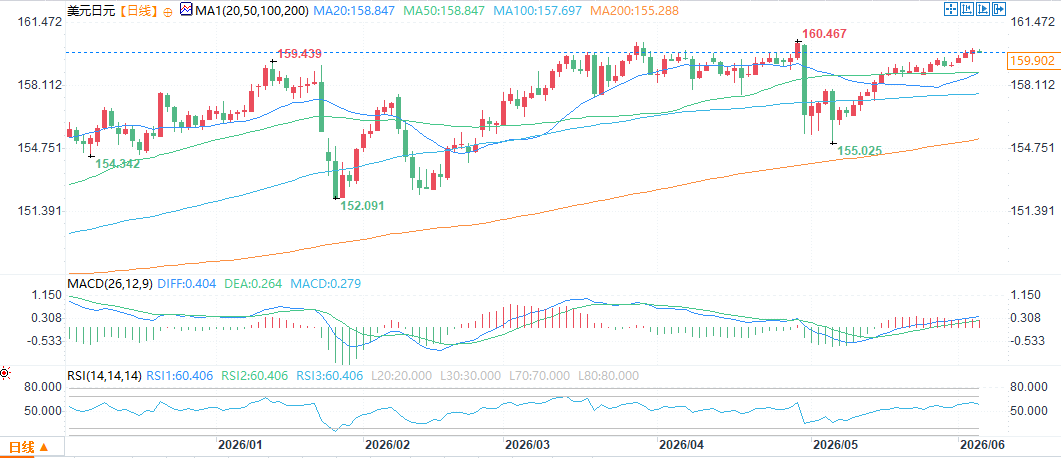
(USD/JPY daily chart, source: FX678)
Strong resistance is seen at the previous high of 160.467, while short-term support lies around the 158.85 moving average. The overall market is trending slightly upward with some volatility. If the price holds above the support level, it may test the previous high. However, if it falls back and breaks below the low of 155.025, the upward structure will weaken.
At 9:32 AM Beijing time on June 4, the USD/JPY exchange rate was 159.89/90.
Recent price action has reinforced the range-bound pattern.
The USD/JPY pair has evolved into a range-bound tactical trade. As the exchange rate fluctuates within a defined range, both buyers and sellers can find trading opportunities. Over the past six months, the pair has primarily traded within a wide range of 152.50 to 160.50. When rallies approach the upper limit of this range, the risk of Japanese intervention resurfaces; conversely, when the exchange rate falls, dollar buying continues, supported by factors such as the US-Japan interest rate differential, carry trade demand, geopolitical uncertainty, and pressure on Japan from high energy costs.
The formation of this range-bound pattern is not accidental, but rather the result of a long-term interplay between two macroeconomic forces. On the one hand, the Federal Reserve maintained high interest rates for far longer than the market expected, allowing the yield advantage of dollar assets to persist; on the other hand, although the Bank of Japan gradually exited negative interest rates, its pace of interest rate hikes was cautious and its communication moderate, failing to reverse market expectations of a yen interest rate disadvantage.
Meanwhile, the volatile situation in the Middle East, persistently high energy prices, and the deteriorating terms of trade for Japan as a major resource importer have further weakened the fundamental support for the yen. It is this interplay of structural factors that has made it difficult for the USD/JPY pair to effectively break below the lower bound of 152.50, while repeatedly encountering intervention resistance near 160.50, thus creating a clear and stable trading range that traders can repeatedly utilize.
The June central bank meeting is a key catalyst.
The Bank of Japan will hold its monetary policy meeting on June 15-16, followed by the Federal Reserve's interest rate decision on June 16-17. With only one day between the two meetings, this rare "back-to-back" schedule makes mid-June a crucial window for the yen's exchange rate.
Scenario 1: Bank of Japan raises interest rates + Federal Reserve holds rates steady
If the Bank of Japan unexpectedly raises interest rates (or signals a clear rate hike) at its June meeting, while the Federal Reserve keeps rates unchanged, the yen will receive a more powerful policy catalyst than a single intervention. This would be a significant step in the normalization of the Bank of Japan's monetary policy, and the market may interpret it as a systemic effort by Japanese policymakers to combat yen depreciation, rather than just temporary intervention. In this scenario, USD/JPY is expected to break below the lower end of its recent range at 156.50 and seek support in the middle of a wider six-month range (around 154-155).
Scenario 2: Wide interest rate differentials + continued uncertainty support the US dollar
Conversely, if the Bank of Japan holds its policy steady or only intervenes verbally, while the Federal Reserve maintains its high interest rates, the USD/JPY interest rate differential will continue to remain at historically wide levels. Meanwhile, if geopolitical risks and global risk aversion do not show significant signs of easing, demand for the US dollar as a safe-haven asset will remain strong. Against this backdrop, each pullback in USD/JPY to around 158 or even 156.50 could be seen as an opportunity to re-enter long positions in the dollar, with carry traders and trend followers re-entering the market, pushing the exchange rate back up to test 160 or even higher.
Therefore, the outcome of the central bank meetings in mid-June will directly determine the short-term direction of the USD/JPY exchange rate. If the policy mix favors the yen, it could trigger a sustained yen rebound; if the policy mix remains unchanged or continues to favor the dollar, buying pressure at the lower end of the range will remain effective, and the USD/JPY exchange rate will likely remain within the 156.50-160.50 range. Traders need to closely monitor the wording of both central banks—especially the Bank of Japan's hints about the future path of interest rate hikes, and the Federal Reserve's latest assessment of inflation and economic growth.
Policy maneuvering creates opportunities for both bulls and bears.
US interest rates are significantly higher than Japanese interest rates, and the US-Japan interest rate differential remains historically wide, ensuring the continued attractiveness of carry trades—the logic of borrowing low-interest yen and buying high-interest dollars is difficult to reverse. Furthermore, geopolitical uncertainty is driving demand for safe-haven assets, and high energy prices are putting additional pressure on Japan, a resource-import-dependent economy, further solidifying the dollar's strong position.
The weakening yen, approaching 160, has become a policy dilemma for Japan. Over the past month, the Japanese Ministry of Finance has intervened in the foreign exchange market with approximately $73.5 billion, the largest intervention in recent years. However, the effect has been limited—the exchange rate briefly fell to 156.50 before rebounding quickly and is currently hovering above 159. This indicates that intervention alone is unlikely to change the overall trend; it has more of a "ceiling" resistance above 160 than a trend reversal signal.
For the yen to achieve a sustained rebound, at least three conditions need to materialize simultaneously: a credible threat of intervention, easing geopolitical pressures, and a substantial narrowing of the interest rate differential through a Bank of Japan rate hike and a Federal Reserve holding rates steady. Until these three conditions are met, the USD/JPY exchange rate will likely continue to trade within a wide range of 152.50-160.50. Intervention can create volatility, but it is unlikely to reverse the overall trend.
Despite Japan's significant intervention, it failed to reverse the trend.
Japan's Ministry of Finance intervened in the foreign exchange market over the past month, injecting approximately 11.7 trillion yen (US$73.5 billion), marking the largest official intervention in recent years. Initial results were significant—the dollar fell against the yen from above 160 to 156.50, a drop of over 350 points, sending a clear signal to the market that 160 was not a level to be "arbitrarily breached."
However, the intervention's effect did not last long. As geopolitical tensions escalated again and the US-Japan interest rate differential failed to narrow, dollar buying gradually returned. By the end of May, the dollar had rebounded to above 159 against the yen, almost recovering most of the losses triggered by the intervention.
The core function of intervention is to clear out overcrowded short positions, trigger a rapid rebound, and remind the market that Japanese authorities have extremely low tolerance for levels above 160. However, as long as the US-Japan interest rate differential and the macroeconomic background remain unchanged, the underlying logic of carry trades will not waver. Intervention is more like a "speed bump" on the way up—it can slow down the pace, but it is difficult to reverse the trend.
Technical Analysis
After a sharp decline, the USD/JPY pair has stabilized and rebounded on the daily chart, with the price regaining its footing above the 20/50-day moving averages. The medium- to long-term 200-day moving average continues to rise, forming a bottom support. The MACD histogram above the zero line continues to show red bars, indicating a steady recovery in bullish momentum. The RSI is in a neutral to bullish range around 60, suggesting an overall return to a bullish consolidation pattern.
(USD/JPY daily chart, source: FX678)
Strong resistance is seen at the previous high of 160.467, while short-term support lies around the 158.85 moving average. The overall market is trending slightly upward with some volatility. If the price holds above the support level, it may test the previous high. However, if it falls back and breaks below the low of 155.025, the upward structure will weaken.
At 9:32 AM Beijing time on June 4, the USD/JPY exchange rate was 159.89/90.
- Risk Warning and Disclaimer
- The market involves risk, and trading may not be suitable for all investors. This article is for reference only and does not constitute personal investment advice, nor does it take into account certain users’ specific investment objectives, financial situation, or other needs. Any investment decisions made based on this information are at your own risk.