Gold Price Outlook: Non-Farm Payroll Data Will Determine the Direction of Spot Gold's Breakout
2026-06-04 18:56:29
On Thursday (June 4), spot gold rose 0.79% intraday, currently consolidating within a narrow range, with bulls fiercely defending the $4350-$4500 support zone. The entire market's attention is focused on Friday's US non-farm payroll (NFP) data, which may determine the short-term direction of the dollar, US Treasury yields, and gold. If gold prices stabilize above $4650, the short-term trend will turn bullish, with an upside target of $5000; conversely, if the $4350 support level is broken, gold prices are likely to fall sharply to $4000. This article analyzes the core macroeconomic logic affecting gold prices, key technical levels, breakout ranges, and potential risks, predicting the subsequent trend of gold.

Macroeconomic fundamentals: Gold prices are fluctuating due to the combined effects of the US dollar, oil prices, and non-farm payrolls data. Gold needs a weakening oil price and a decline in the US dollar to break through $4,650.
Gold prices are currently fluctuating around key support levels, with bulls continuing to buy within the support zone. Boosted by the US dollar index's pullback from a key resistance level, spot gold rebounded to $4480 on Thursday, while spot silver rose to $73.80. However, the dollar's pullback is only temporary and it remains generally strong. Coupled with the short-term strengthening of oil prices, gold prices remain under pressure below the $4600 mark.
Gold prices are highly correlated with crude oil and the US dollar: a decline in crude oil prices and a weakening dollar provide upward momentum for gold prices; conversely, a sustained surge in crude oil prices will raise the inflation center, prolonging the high-inflation cycle and suppressing gold's performance. The conflicting fundamentals cause gold prices to fluctuate. While gold inherently possesses inflation-hedging properties, its lack of interest income becomes a significant drawback during a rate hike cycle, and the high-interest-rate environment diminishes the attractiveness of gold as a portfolio investment.
Geopolitical news is temporarily positive for gold prices: Israel and Lebanon reached a ceasefire agreement, bringing a glimmer of hope for easing the geopolitical conflict with Iran; the US House of Representatives passed a resolution urging the Trump administration to halt the war against Iran, and anti-war sentiment is rising in Washington. De-escalating geopolitical tensions will lower the safe-haven premium for crude oil, alleviate inflation concerns, and weaken safe-haven buying of the US dollar, indirectly benefiting gold prices.
New York Fed President Williams' remarks further eased inflation fears: the Middle East conflict will not have a long-term upward impact on inflation, and the Fed has no need to adjust monetary policy at this stage. This has led to a consensus in the market that unless energy prices surge again, the Fed will not turn hawkish. As long as oil prices remain weak, gold has room to rebound.
Resilient inflation and strong US economic data are limiting the upside potential for gold prices.
The US economy demonstrates remarkable resilience, with multiple economic indicators exerting downward pressure on gold prices. Even with rising fuel prices, consumer spending remains robust, with light vehicle sales in the US reaching 16.1 million units in May 2026, indicating strong consumer demand.
New housing starts and building permits continue to exceed pre-pandemic averages, indicating robust housing demand. Strong consumer and housing activity has mitigated market recession expectations, significantly reducing the urgency for a Federal Reserve rate cut, which is unfavorable for gold price increases.
However, the sustainability of US household consumption remains questionable: the personal savings rate has fallen to a four-year low of only 2.6%, meaning that people can only maintain their existing consumption levels by consuming existing savings or taking out new loans. In the long run, once household consumption cools down, safe-haven buying will flow into gold, bringing a temporary boost.
Manufacturing data showed mixed performance: The US ISM Manufacturing PMI rose to 54 in May, entering expansion territory, but the increase concealed hidden risks—manufacturers were proactively stockpiling inventory, anticipating rising raw material prices and supply chain disruptions. Sub-indices foreshadowed inflationary risks: Rising steel and aluminum prices, coupled with increased tariffs on imported goods, continued to push up raw material costs and increase inflationary pressures.
Sticky inflation and a resilient economy create a balance between bullish and bearish factors: a weaker dollar and lower oil prices can support gold prices, while persistent inflation and better-than-expected economic data will limit the Federal Reserve's room for interest rate cuts. In short, for gold to maintain its short-term bullish trend, it relies heavily on a continued weakening of the US dollar.
Technical Analysis: The $4350 support level remains strong; gold prices are nearing a turning point ahead of the non-farm payrolls report.
From a weekly chart perspective, gold prices are oscillating around the key support level at the lower edge of a broadening rising wedge, which traces back to the lows of December 2024.
A decisive break below the $4,350 support level opened up further downside potential for gold, with a potential deep pullback to $4,000.
A firm hold above $4,650 and a further break above $5,000 confirms a bottoming signal, with a potential upside target of $5,600.
The weekly Relative Strength Index (RSI) is hovering near the midpoint, indicating increasing divergence between bulls and bears. This week's closing price will be crucial.
Gold prices closed above $4,650 on Friday; the RSI is holding steady in the middle range, suggesting continued upward movement next week.
Friday's weekly close broke below $4350: the RSI fell below the midpoint, initiating a downtrend. The non-farm payroll data will be a key catalyst in determining the weekly closing direction.
Gold prices on the daily chart continue to consolidate and fluctuate between the 50-day and 200-day moving averages.
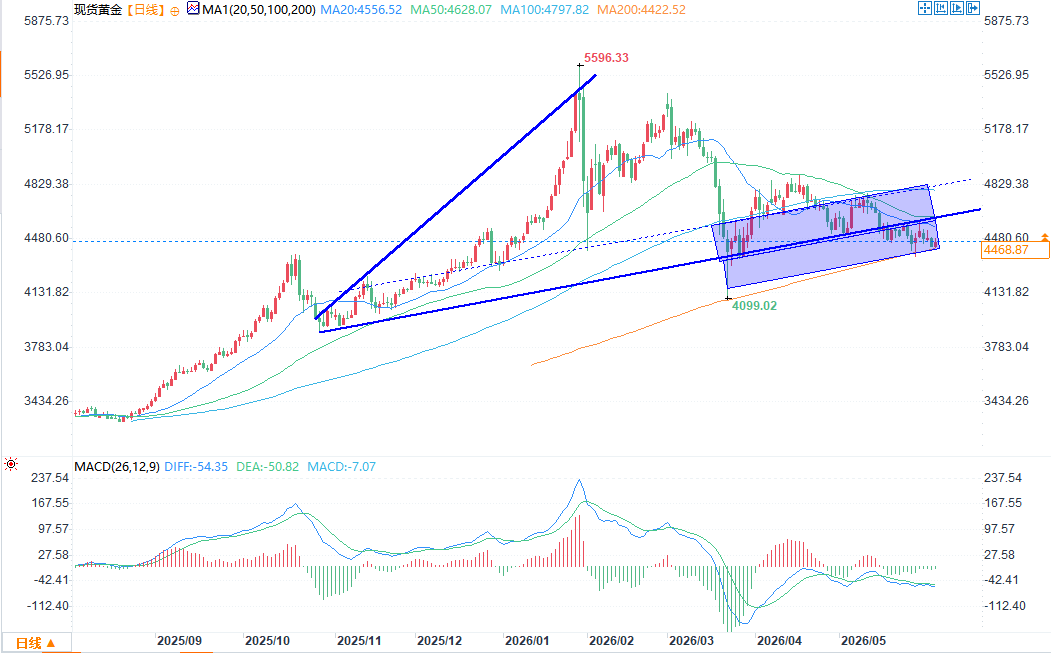
(Spot gold daily chart source: FX678)
On the daily chart, gold prices continue to consolidate between the 50-day and 200-day moving averages, with the 50-day moving average gradually converging towards the lower trendline of a broadening wedge pattern. Although gold prices briefly broke below the lower edge of the $4,500 wedge, recent volatility has cast doubt on the validity of this breakout. The $4,350 level, corresponding to the 200-day moving average, has become the last line of defense for gold bulls; if this level holds, the consolidation pattern will continue. Only a rebound above $4,650 and a return to the wedge pattern will confirm a short-term bullish trend.
In summary, the $4350-$4650 range is the key level for gold's medium-term direction. High levels of the US dollar and US Treasury yields are putting downward pressure on gold prices below $4500, while buying support is found around $4350. The direction of a breakout from this range will depend entirely on the non-farm payroll data.
Downside risks for gold prices: A break below $4,350 could trigger a deeper decline.
Risk 1: Non-farm payrolls significantly exceed expectations → US dollar strengthens, US Treasury yields rise.
The $4350 level, combined with the 200-day moving average, forms a significant support level. A break below this level with significant volume would trigger profit-taking by short sellers, pushing gold prices towards $4000. Simultaneously, the RSI indicator breaking below its midline confirms the downtrend. On Wednesday, the US dollar index closed above 99.40, a level that represents the neckline of a double bottom pattern, with a target of 100.50. If the dollar continues to strengthen on Thursday, it will further pressure gold prices.
Risk 2: Inflation rebounds + another surge in crude oil prices
The renewed rise in crude oil prices will reignite inflation concerns, coupled with strong consumption and manufacturing data, further delaying expectations of a Federal Reserve rate cut. Without a significant weakening of the US dollar, gold prices are unlikely to break through the $4,650 mark effectively.
Core Summary
Gold is currently trapped in a crucial decision-making range of $4350 to $4650. This Friday's non-farm payroll data will likely determine the direction of the dollar index and gold price breakout.
A break above $4,650 indicates a short-term shift from bearish to bullish, with the first target at $5,000. If it holds above $5,000, it will likely test $5,600.
Gold prices fell below $4,350, indicating the failure of the medium- to long-term bullish logic and a deep drop to $4,000.
Stubborn inflation, high US Treasury yields, and the resilience of the US economy remain negative factors suppressing gold prices. As long as gold prices hold above $4,350, the logic of a major bull market for gold remains valid.
Macroeconomic fundamentals: Gold prices are fluctuating due to the combined effects of the US dollar, oil prices, and non-farm payrolls data. Gold needs a weakening oil price and a decline in the US dollar to break through $4,650.
Gold prices are currently fluctuating around key support levels, with bulls continuing to buy within the support zone. Boosted by the US dollar index's pullback from a key resistance level, spot gold rebounded to $4480 on Thursday, while spot silver rose to $73.80. However, the dollar's pullback is only temporary and it remains generally strong. Coupled with the short-term strengthening of oil prices, gold prices remain under pressure below the $4600 mark.
Gold prices are highly correlated with crude oil and the US dollar: a decline in crude oil prices and a weakening dollar provide upward momentum for gold prices; conversely, a sustained surge in crude oil prices will raise the inflation center, prolonging the high-inflation cycle and suppressing gold's performance. The conflicting fundamentals cause gold prices to fluctuate. While gold inherently possesses inflation-hedging properties, its lack of interest income becomes a significant drawback during a rate hike cycle, and the high-interest-rate environment diminishes the attractiveness of gold as a portfolio investment.
Geopolitical news is temporarily positive for gold prices: Israel and Lebanon reached a ceasefire agreement, bringing a glimmer of hope for easing the geopolitical conflict with Iran; the US House of Representatives passed a resolution urging the Trump administration to halt the war against Iran, and anti-war sentiment is rising in Washington. De-escalating geopolitical tensions will lower the safe-haven premium for crude oil, alleviate inflation concerns, and weaken safe-haven buying of the US dollar, indirectly benefiting gold prices.
New York Fed President Williams' remarks further eased inflation fears: the Middle East conflict will not have a long-term upward impact on inflation, and the Fed has no need to adjust monetary policy at this stage. This has led to a consensus in the market that unless energy prices surge again, the Fed will not turn hawkish. As long as oil prices remain weak, gold has room to rebound.
Resilient inflation and strong US economic data are limiting the upside potential for gold prices.
The US economy demonstrates remarkable resilience, with multiple economic indicators exerting downward pressure on gold prices. Even with rising fuel prices, consumer spending remains robust, with light vehicle sales in the US reaching 16.1 million units in May 2026, indicating strong consumer demand.
New housing starts and building permits continue to exceed pre-pandemic averages, indicating robust housing demand. Strong consumer and housing activity has mitigated market recession expectations, significantly reducing the urgency for a Federal Reserve rate cut, which is unfavorable for gold price increases.
However, the sustainability of US household consumption remains questionable: the personal savings rate has fallen to a four-year low of only 2.6%, meaning that people can only maintain their existing consumption levels by consuming existing savings or taking out new loans. In the long run, once household consumption cools down, safe-haven buying will flow into gold, bringing a temporary boost.
Manufacturing data showed mixed performance: The US ISM Manufacturing PMI rose to 54 in May, entering expansion territory, but the increase concealed hidden risks—manufacturers were proactively stockpiling inventory, anticipating rising raw material prices and supply chain disruptions. Sub-indices foreshadowed inflationary risks: Rising steel and aluminum prices, coupled with increased tariffs on imported goods, continued to push up raw material costs and increase inflationary pressures.
Sticky inflation and a resilient economy create a balance between bullish and bearish factors: a weaker dollar and lower oil prices can support gold prices, while persistent inflation and better-than-expected economic data will limit the Federal Reserve's room for interest rate cuts. In short, for gold to maintain its short-term bullish trend, it relies heavily on a continued weakening of the US dollar.
Technical Analysis: The $4350 support level remains strong; gold prices are nearing a turning point ahead of the non-farm payrolls report.
From a weekly chart perspective, gold prices are oscillating around the key support level at the lower edge of a broadening rising wedge, which traces back to the lows of December 2024.
A decisive break below the $4,350 support level opened up further downside potential for gold, with a potential deep pullback to $4,000.
A firm hold above $4,650 and a further break above $5,000 confirms a bottoming signal, with a potential upside target of $5,600.
The weekly Relative Strength Index (RSI) is hovering near the midpoint, indicating increasing divergence between bulls and bears. This week's closing price will be crucial.
Gold prices closed above $4,650 on Friday; the RSI is holding steady in the middle range, suggesting continued upward movement next week.
Friday's weekly close broke below $4350: the RSI fell below the midpoint, initiating a downtrend. The non-farm payroll data will be a key catalyst in determining the weekly closing direction.
Gold prices on the daily chart continue to consolidate and fluctuate between the 50-day and 200-day moving averages.
(Spot gold daily chart source: FX678)
On the daily chart, gold prices continue to consolidate between the 50-day and 200-day moving averages, with the 50-day moving average gradually converging towards the lower trendline of a broadening wedge pattern. Although gold prices briefly broke below the lower edge of the $4,500 wedge, recent volatility has cast doubt on the validity of this breakout. The $4,350 level, corresponding to the 200-day moving average, has become the last line of defense for gold bulls; if this level holds, the consolidation pattern will continue. Only a rebound above $4,650 and a return to the wedge pattern will confirm a short-term bullish trend.
In summary, the $4350-$4650 range is the key level for gold's medium-term direction. High levels of the US dollar and US Treasury yields are putting downward pressure on gold prices below $4500, while buying support is found around $4350. The direction of a breakout from this range will depend entirely on the non-farm payroll data.
Downside risks for gold prices: A break below $4,350 could trigger a deeper decline.
Risk 1: Non-farm payrolls significantly exceed expectations → US dollar strengthens, US Treasury yields rise.
The $4350 level, combined with the 200-day moving average, forms a significant support level. A break below this level with significant volume would trigger profit-taking by short sellers, pushing gold prices towards $4000. Simultaneously, the RSI indicator breaking below its midline confirms the downtrend. On Wednesday, the US dollar index closed above 99.40, a level that represents the neckline of a double bottom pattern, with a target of 100.50. If the dollar continues to strengthen on Thursday, it will further pressure gold prices.
Risk 2: Inflation rebounds + another surge in crude oil prices
The renewed rise in crude oil prices will reignite inflation concerns, coupled with strong consumption and manufacturing data, further delaying expectations of a Federal Reserve rate cut. Without a significant weakening of the US dollar, gold prices are unlikely to break through the $4,650 mark effectively.
Core Summary
Gold is currently trapped in a crucial decision-making range of $4350 to $4650. This Friday's non-farm payroll data will likely determine the direction of the dollar index and gold price breakout.
A break above $4,650 indicates a short-term shift from bearish to bullish, with the first target at $5,000. If it holds above $5,000, it will likely test $5,600.
Gold prices fell below $4,350, indicating the failure of the medium- to long-term bullish logic and a deep drop to $4,000.
Stubborn inflation, high US Treasury yields, and the resilience of the US economy remain negative factors suppressing gold prices. As long as gold prices hold above $4,350, the logic of a major bull market for gold remains valid.
- Risk Warning and Disclaimer
- The market involves risk, and trading may not be suitable for all investors. This article is for reference only and does not constitute personal investment advice, nor does it take into account certain users’ specific investment objectives, financial situation, or other needs. Any investment decisions made based on this information are at your own risk.