Gold Trading Alert: A Turning Point Appears in the Middle East Ceasefire! Gold Prices Rebound Nearly 1%, Can the Dawn of Peace in Iran Ignite a New Bull Market?
2026-06-05 07:36:07
The global gold market saw a significant rebound on Thursday (June 4), with spot gold briefly touching a high of $4,515 per ounce before closing at $4,475 per ounce, a gain of nearly 1%. The August US gold futures contract also strengthened, closing up 0.9% at $4,505. Behind this volatility lies the dramatic shift in the Middle East geopolitical situation: reports of a ceasefire agreement between Israel and Lebanon ignited market optimism regarding a broader US-Iran peace deal, directly pressuring the dollar and US Treasury yields, thus injecting strong appeal into non-yielding gold assets.
However, the latest news indicates that the Iranian-backed Hezbollah militia rejected Lebanon's newly proposed ceasefire agreement on Thursday, and Israel also stated it would not withdraw its troops from southern Lebanon. This has hampered Trump's efforts to simultaneously end the local conflict and push for a peace agreement with Iran. Gold bulls' morale has been dampened, and market attention is now focused on the US May non-farm payroll report due on Friday (June 5th).
The latest developments in the Lebanese situation became a key catalyst for the rise in gold prices. The Israeli and Lebanese governments announced Wednesday evening that they had agreed to a ceasefire, which was interpreted by the market as a significant step towards a broader peace agreement between Washington and Tehran. Iran had previously made a ceasefire in Lebanon a precondition for any negotiations, and market expectations that the Strait of Hormuz might reopen directly pushed oil prices down by more than 3%. The decline in oil prices further eased global inflation concerns and weakened the safe-haven status of the US dollar.
However, the road to peace is far from smooth. Hezbollah, backed by Iran, swiftly rejected the US-brokered ceasefire agreement on Thursday, with its leader emphasizing that "the resistance will continue." Israel, meanwhile, stated it would not withdraw its troops from southern Lebanon and would continue airstrikes in the region. This series of reversals has dampened market optimism regarding a comprehensive US-Iran agreement. While the Trump administration has repeatedly hinted that negotiations might soon make progress, the conflict between domestic political pressure and battlefield realities continues ahead of the November congressional elections. Statements from Iran's Supreme Leader also indicate that Tehran hopes to obtain tangible benefits through negotiations, such as oil export waivers and the lifting of port blockades, rather than a simple ceasefire.
Nevertheless, the short-term effectiveness of the ceasefire agreement still provides the market with a breather. The Strait of Hormuz, a vital waterway for one-fifth of the world's oil shipments, had been largely closed due to the conflict, and Iranian oil exports had fallen to a six-year low. Any signal of a diplomatic breakthrough could significantly alter the energy market landscape and indirectly benefit gold's position as a safe-haven asset.
The rise in gold prices is closely linked to the movement of other assets in the financial markets. The US dollar index fell 0.2% on Thursday, retreating from a two-month high to around 99.45, making dollar-denominated gold more attractive to holders of other currencies. Meanwhile, the yield on the 10-year US Treasury note fell 2 basis points to 4.471%, and the 30-year yield also declined slightly, reducing the opportunity cost of holding gold.
Labor market data provided background support for this trend. Initial jobless claims in the U.S. rose by 13,000 to 225,000 last week, higher than expected, but the four-week moving average only rose slightly, indicating that the overall trend still shows the labor market remains relatively stable. Continuing jobless claims declined, and first-quarter labor productivity and unit labor cost data were revised downwards, showing that the economy remains resilient but its growth is slowing. Federal Reserve officials emphasized that inflation is a priority, and market expectations for a Fed rate hike this year have shifted from rate cuts at the beginning of the year to small rate hikes, adding uncertainty to gold's price movement.
Independent precious metals trader Tai Wong points out that unless a clear and lasting ceasefire is reached with Iran, the Strait of Hormuz reopens, and energy price pressures ease, it will be difficult for gold prices to reach new highs this year. Currently, gold prices are holding slightly above the key 200-day moving average, providing technical support for a short-term rebound.
Looking back at the 2026 trend, gold reached a record high of $5,596 per ounce on January 29. Since the outbreak of the conflict in Iran in late February, the price of gold has fallen by about 16%. The high-interest-rate environment continues to weaken the appeal of holding non-interest-bearing gold, while the persistence of geopolitical conflicts is also testing investors' risk appetite.
The U.S. May non-farm payrolls report, due on Friday, will be the market's focus. Economists expect 85,000 new jobs to be added, with the unemployment rate remaining at 4.3%. Weaker-than-expected data could reinforce speculation about a shift in Federal Reserve policy; conversely, stronger data could solidify the dollar and suppress gold prices. Coupled with the uncertainty surrounding the Middle East conflict—including Hezbollah's stance, Israeli military action, and domestic political constraints faced by the Trump administration—the gold market is at a sensitive juncture.
Furthermore, while oil prices have retreated due to hopes for a ceasefire, factors such as a significant drop in US crude oil inventories, strong OPEC demand expectations, and declining Russian production continue to support the medium- to long-term upside risks to energy prices. If peace efforts falter again, oil prices could climb again, exacerbating inflation concerns and pressure on the Federal Reserve to raise interest rates, thereby putting downward pressure on gold prices.
In summary, this round of gold price increases is more of a short-term rebound driven by geopolitical optimism than a complete reversal of fundamentals. Hopes for a ceasefire in Lebanon have brightened the market, but Hezbollah's refusal and Israel's hardline stance remind investors that the peace process is fraught with difficulties. The resilience of the US dollar, the stability of the labor market, and the Federal Reserve's vigilance regarding inflation all pose obstacles to further gold price increases.
For investors, key events to watch include Friday's non-farm payroll data, the latest developments in US-Iran negotiations, and oil price movements. If a ceasefire agreement is gradually implemented and energy prices continue to decline, gold may face some downward pressure. Conversely, if the conflict escalates or employment data is weak, gold could regain its safe-haven appeal and even challenge previous highs.
The gold market is currently caught in a dual game of geopolitics and macroeconomics. In the short term, the glimmer of hope for peace in the Middle East has provided support for gold prices, but the long-term trend still depends on substantial progress in resolving the conflict and the evolution of global monetary policy. Investors need to remain cautious and seek opportunities amidst volatility.
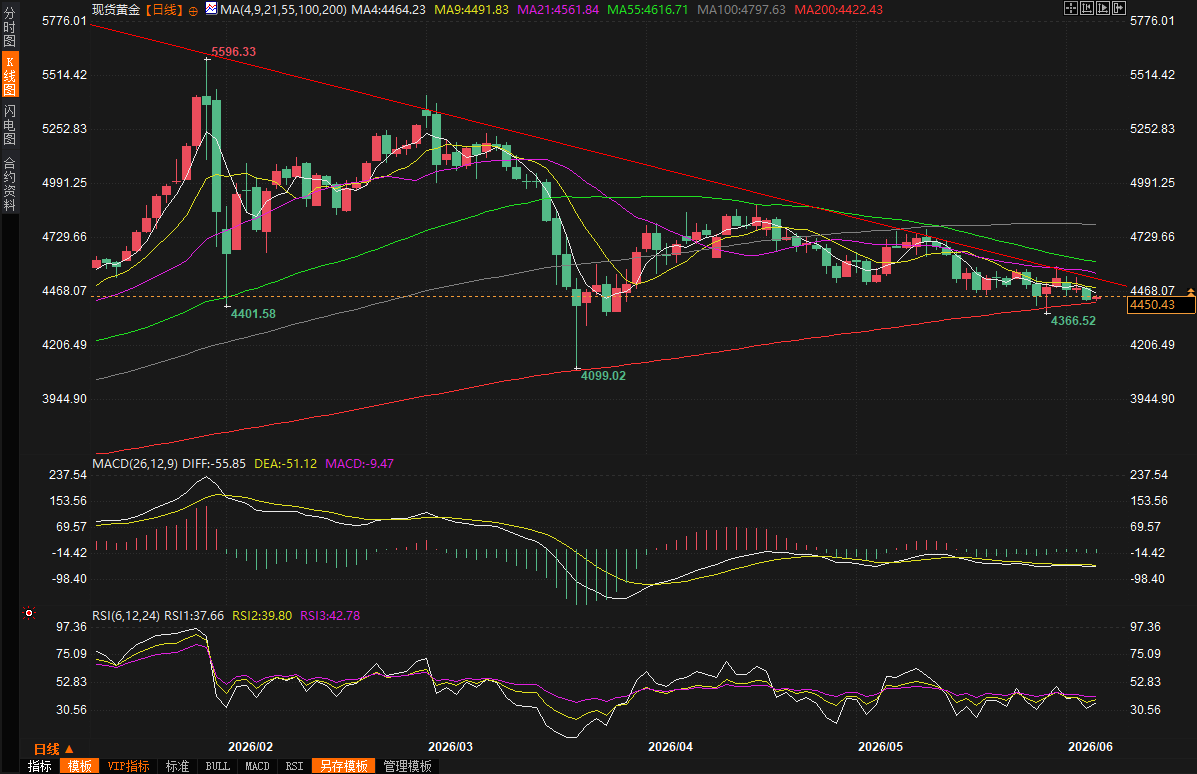
(Spot gold daily chart, source: FX678)
At 07:34 Beijing time, spot gold was trading at $4465.47 per ounce.
However, the latest news indicates that the Iranian-backed Hezbollah militia rejected Lebanon's newly proposed ceasefire agreement on Thursday, and Israel also stated it would not withdraw its troops from southern Lebanon. This has hampered Trump's efforts to simultaneously end the local conflict and push for a peace agreement with Iran. Gold bulls' morale has been dampened, and market attention is now focused on the US May non-farm payroll report due on Friday (June 5th).
Geopolitical turmoil: The complex interplay between hopes for a ceasefire and the realities of Lebanon.
The latest developments in the Lebanese situation became a key catalyst for the rise in gold prices. The Israeli and Lebanese governments announced Wednesday evening that they had agreed to a ceasefire, which was interpreted by the market as a significant step towards a broader peace agreement between Washington and Tehran. Iran had previously made a ceasefire in Lebanon a precondition for any negotiations, and market expectations that the Strait of Hormuz might reopen directly pushed oil prices down by more than 3%. The decline in oil prices further eased global inflation concerns and weakened the safe-haven status of the US dollar.
However, the road to peace is far from smooth. Hezbollah, backed by Iran, swiftly rejected the US-brokered ceasefire agreement on Thursday, with its leader emphasizing that "the resistance will continue." Israel, meanwhile, stated it would not withdraw its troops from southern Lebanon and would continue airstrikes in the region. This series of reversals has dampened market optimism regarding a comprehensive US-Iran agreement. While the Trump administration has repeatedly hinted that negotiations might soon make progress, the conflict between domestic political pressure and battlefield realities continues ahead of the November congressional elections. Statements from Iran's Supreme Leader also indicate that Tehran hopes to obtain tangible benefits through negotiations, such as oil export waivers and the lifting of port blockades, rather than a simple ceasefire.
Nevertheless, the short-term effectiveness of the ceasefire agreement still provides the market with a breather. The Strait of Hormuz, a vital waterway for one-fifth of the world's oil shipments, had been largely closed due to the conflict, and Iranian oil exports had fallen to a six-year low. Any signal of a diplomatic breakthrough could significantly alter the energy market landscape and indirectly benefit gold's position as a safe-haven asset.
Macroeconomic factors combined: a weakening dollar and declining US Treasury yields boosted gold prices.
The rise in gold prices is closely linked to the movement of other assets in the financial markets. The US dollar index fell 0.2% on Thursday, retreating from a two-month high to around 99.45, making dollar-denominated gold more attractive to holders of other currencies. Meanwhile, the yield on the 10-year US Treasury note fell 2 basis points to 4.471%, and the 30-year yield also declined slightly, reducing the opportunity cost of holding gold.
Labor market data provided background support for this trend. Initial jobless claims in the U.S. rose by 13,000 to 225,000 last week, higher than expected, but the four-week moving average only rose slightly, indicating that the overall trend still shows the labor market remains relatively stable. Continuing jobless claims declined, and first-quarter labor productivity and unit labor cost data were revised downwards, showing that the economy remains resilient but its growth is slowing. Federal Reserve officials emphasized that inflation is a priority, and market expectations for a Fed rate hike this year have shifted from rate cuts at the beginning of the year to small rate hikes, adding uncertainty to gold's price movement.
Independent precious metals trader Tai Wong points out that unless a clear and lasting ceasefire is reached with Iran, the Strait of Hormuz reopens, and energy price pressures ease, it will be difficult for gold prices to reach new highs this year. Currently, gold prices are holding slightly above the key 200-day moving average, providing technical support for a short-term rebound.
Correction after historical highs and potential risks
Looking back at the 2026 trend, gold reached a record high of $5,596 per ounce on January 29. Since the outbreak of the conflict in Iran in late February, the price of gold has fallen by about 16%. The high-interest-rate environment continues to weaken the appeal of holding non-interest-bearing gold, while the persistence of geopolitical conflicts is also testing investors' risk appetite.
The U.S. May non-farm payrolls report, due on Friday, will be the market's focus. Economists expect 85,000 new jobs to be added, with the unemployment rate remaining at 4.3%. Weaker-than-expected data could reinforce speculation about a shift in Federal Reserve policy; conversely, stronger data could solidify the dollar and suppress gold prices. Coupled with the uncertainty surrounding the Middle East conflict—including Hezbollah's stance, Israeli military action, and domestic political constraints faced by the Trump administration—the gold market is at a sensitive juncture.
Furthermore, while oil prices have retreated due to hopes for a ceasefire, factors such as a significant drop in US crude oil inventories, strong OPEC demand expectations, and declining Russian production continue to support the medium- to long-term upside risks to energy prices. If peace efforts falter again, oil prices could climb again, exacerbating inflation concerns and pressure on the Federal Reserve to raise interest rates, thereby putting downward pressure on gold prices.
Looking ahead: Short-term rebound or trend reversal?
In summary, this round of gold price increases is more of a short-term rebound driven by geopolitical optimism than a complete reversal of fundamentals. Hopes for a ceasefire in Lebanon have brightened the market, but Hezbollah's refusal and Israel's hardline stance remind investors that the peace process is fraught with difficulties. The resilience of the US dollar, the stability of the labor market, and the Federal Reserve's vigilance regarding inflation all pose obstacles to further gold price increases.
For investors, key events to watch include Friday's non-farm payroll data, the latest developments in US-Iran negotiations, and oil price movements. If a ceasefire agreement is gradually implemented and energy prices continue to decline, gold may face some downward pressure. Conversely, if the conflict escalates or employment data is weak, gold could regain its safe-haven appeal and even challenge previous highs.
The gold market is currently caught in a dual game of geopolitics and macroeconomics. In the short term, the glimmer of hope for peace in the Middle East has provided support for gold prices, but the long-term trend still depends on substantial progress in resolving the conflict and the evolution of global monetary policy. Investors need to remain cautious and seek opportunities amidst volatility.
(Spot gold daily chart, source: FX678)
At 07:34 Beijing time, spot gold was trading at $4465.47 per ounce.
- Risk Warning and Disclaimer
- The market involves risk, and trading may not be suitable for all investors. This article is for reference only and does not constitute personal investment advice, nor does it take into account certain users’ specific investment objectives, financial situation, or other needs. Any investment decisions made based on this information are at your own risk.