Rising expectations of Japanese intervention coupled with increased bets on interest rate hikes caused the USD/JPY exchange rate to fluctuate around the 160 level.
2026-06-05 10:45:55
The USD/JPY pair continued its downward trend during Friday's Asian trading session, falling back to around 159.90, marking its second consecutive day of decline. As the yen regained buying support, market expectations for potential renewed government intervention in the market continued to rise, putting significant pressure on the exchange rate near the 160 level.
The recent yen's exchange rate movement has been primarily driven by the risk of policy intervention. Japanese Finance Minister Satsuki Katayama reiterated his warning to the market in May, emphasizing that the authorities are closely monitoring foreign exchange market dynamics and will take appropriate measures to address abnormal exchange rate fluctuations if necessary. Given that the USD/JPY exchange rate had previously approached the important 160 level, the market generally believes that the Japanese government is highly vigilant against excessive yen depreciation.
In fact, speculation about Japan's intervention continues to circulate in the market. Data shows that as of the end of May, Japan's foreign exchange reserves fell to $1.31 trillion, a decrease of approximately $77.1 billion from $1.38 trillion the previous month, marking the lowest level since July of last year. Foreign exchange assets fell to approximately $1.09 trillion. Some market participants believe that the sharp decline in reserves may be related to the Japanese authorities' recent actions to stabilize the exchange rate.
Meanwhile, the Japanese government has not considered currency devaluation as an economic policy objective. Prime Minister Sanae Takaichi stated that while a weaker yen has both advantages and disadvantages, the government's policy focus is on enhancing domestic economic competitiveness, rather than stimulating economic growth by artificially suppressing the exchange rate. This statement alleviated market concerns about the policy direction to some extent.
On the economic data front, domestic consumption in Japan remains weak. Data shows that Japanese household spending fell 0.5% year-on-year in April, marking the fifth consecutive month of negative growth. However, this is a significant improvement compared to the previous month's 2.9% decline, and better than the market expectation of a 1.5% decline, indicating a slight easing of the weak consumption situation.
In contrast, wage growth in Japan has been much stronger. Cash earnings for workers rose 3.5% year-on-year in April, higher than the revised 3.1% in the previous month and exceeding market expectations of 3.2%. This marks the 52nd consecutive month of nominal wage growth in Japan, indicating that the labor market remains resilient.
The market generally believes that continuously rising wages will further stabilize domestic inflation in Japan, thus creating conditions for the Bank of Japan to exit its ultra-loose monetary policy. Currently, investor expectations for a rate hike by the Bank of Japan at its June 15-16 meeting have clearly intensified, becoming one of the key factors supporting the yen recently.
On the other hand, US economic data and the Federal Reserve's policy outlook continue to influence the dollar's performance. With the US non-farm payrolls report due soon, the market is assessing whether there are signs of a slowdown in the US labor market. If job growth is significantly weaker than expected, expectations that the Fed will maintain high interest rates in the future could be impacted, further weakening the dollar's performance.
From a market sentiment perspective, the USD/JPY exchange rate is currently in a phase of intense competition between bullish and bearish factors. On the one hand, US interest rates remain higher than Japanese interest rates, and the interest rate differential continues to support the dollar; on the other hand, the risk of Japanese government intervention and the expectation of a potential interest rate hike by the Bank of Japan limit further upside potential for the exchange rate.
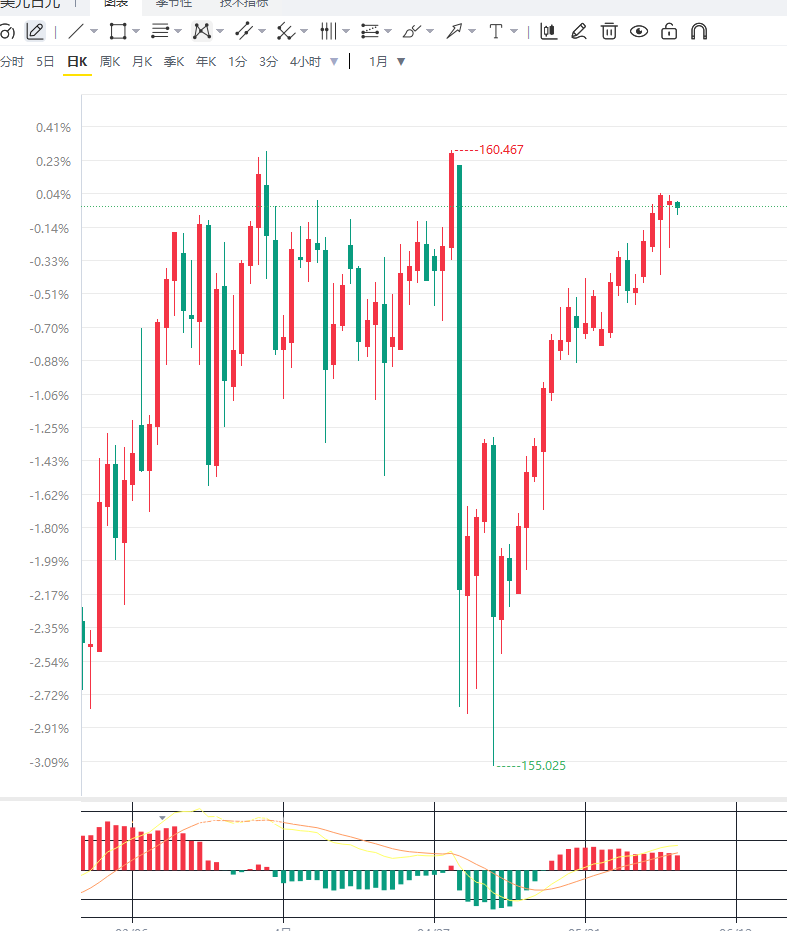
From a daily chart perspective, the USD/JPY pair remains in a long-term uptrend, but has recently encountered significant technical resistance near the 160 level. The current key support level is around 159.00, with further support at the 158.20 area; key resistance levels are around 160.50 and 161.80. The MACD indicator is showing signs of a bearish crossover at high levels, indicating weakening bullish momentum. The RSI indicator has retreated from overbought territory, suggesting increasing short-term downward pressure.
From a 4-hour chart perspective, the exchange rate has broken below short-term moving average support, entering a high-level correction phase. If it subsequently breaks below the 159.00 level, it may further decline to the 158.20 or even 157.00 area; conversely, if it regains footing above 160 and breaks through the 160.50 resistance, it may retest the high near 161.80. The short-term MACD indicator remains bearish, indicating that the short-term trend remains biased towards a weak and volatile direction.
Editor's Summary : The current USD/JPY exchange rate is influenced by both Japanese policy factors and US economic data. The Japanese government's continued signals of intervention, coupled with strong wage growth fueling expectations of a Bank of Japan (BOJ) interest rate hike, have provided temporary support for the yen. Meanwhile, the sharp decline in Japan's foreign exchange reserves has further intensified market speculation about actual intervention. Looking ahead, the 160 level will remain a key focus for the market. If the BOJ releases clearer signals of policy tightening, or if US employment data is weak, the USD/JPY may fall further; conversely, if the US economy remains resilient and the BOJ remains cautious, the exchange rate is expected to remain high. Investors should pay close attention to the BOJ meeting results, the Japanese government's statements on the foreign exchange market, and changes in US labor market data.
The recent yen's exchange rate movement has been primarily driven by the risk of policy intervention. Japanese Finance Minister Satsuki Katayama reiterated his warning to the market in May, emphasizing that the authorities are closely monitoring foreign exchange market dynamics and will take appropriate measures to address abnormal exchange rate fluctuations if necessary. Given that the USD/JPY exchange rate had previously approached the important 160 level, the market generally believes that the Japanese government is highly vigilant against excessive yen depreciation.
In fact, speculation about Japan's intervention continues to circulate in the market. Data shows that as of the end of May, Japan's foreign exchange reserves fell to $1.31 trillion, a decrease of approximately $77.1 billion from $1.38 trillion the previous month, marking the lowest level since July of last year. Foreign exchange assets fell to approximately $1.09 trillion. Some market participants believe that the sharp decline in reserves may be related to the Japanese authorities' recent actions to stabilize the exchange rate.
Meanwhile, the Japanese government has not considered currency devaluation as an economic policy objective. Prime Minister Sanae Takaichi stated that while a weaker yen has both advantages and disadvantages, the government's policy focus is on enhancing domestic economic competitiveness, rather than stimulating economic growth by artificially suppressing the exchange rate. This statement alleviated market concerns about the policy direction to some extent.
On the economic data front, domestic consumption in Japan remains weak. Data shows that Japanese household spending fell 0.5% year-on-year in April, marking the fifth consecutive month of negative growth. However, this is a significant improvement compared to the previous month's 2.9% decline, and better than the market expectation of a 1.5% decline, indicating a slight easing of the weak consumption situation.
In contrast, wage growth in Japan has been much stronger. Cash earnings for workers rose 3.5% year-on-year in April, higher than the revised 3.1% in the previous month and exceeding market expectations of 3.2%. This marks the 52nd consecutive month of nominal wage growth in Japan, indicating that the labor market remains resilient.
The market generally believes that continuously rising wages will further stabilize domestic inflation in Japan, thus creating conditions for the Bank of Japan to exit its ultra-loose monetary policy. Currently, investor expectations for a rate hike by the Bank of Japan at its June 15-16 meeting have clearly intensified, becoming one of the key factors supporting the yen recently.
On the other hand, US economic data and the Federal Reserve's policy outlook continue to influence the dollar's performance. With the US non-farm payrolls report due soon, the market is assessing whether there are signs of a slowdown in the US labor market. If job growth is significantly weaker than expected, expectations that the Fed will maintain high interest rates in the future could be impacted, further weakening the dollar's performance.
From a market sentiment perspective, the USD/JPY exchange rate is currently in a phase of intense competition between bullish and bearish factors. On the one hand, US interest rates remain higher than Japanese interest rates, and the interest rate differential continues to support the dollar; on the other hand, the risk of Japanese government intervention and the expectation of a potential interest rate hike by the Bank of Japan limit further upside potential for the exchange rate.
From a daily chart perspective, the USD/JPY pair remains in a long-term uptrend, but has recently encountered significant technical resistance near the 160 level. The current key support level is around 159.00, with further support at the 158.20 area; key resistance levels are around 160.50 and 161.80. The MACD indicator is showing signs of a bearish crossover at high levels, indicating weakening bullish momentum. The RSI indicator has retreated from overbought territory, suggesting increasing short-term downward pressure.
From a 4-hour chart perspective, the exchange rate has broken below short-term moving average support, entering a high-level correction phase. If it subsequently breaks below the 159.00 level, it may further decline to the 158.20 or even 157.00 area; conversely, if it regains footing above 160 and breaks through the 160.50 resistance, it may retest the high near 161.80. The short-term MACD indicator remains bearish, indicating that the short-term trend remains biased towards a weak and volatile direction.
Editor's Summary : The current USD/JPY exchange rate is influenced by both Japanese policy factors and US economic data. The Japanese government's continued signals of intervention, coupled with strong wage growth fueling expectations of a Bank of Japan (BOJ) interest rate hike, have provided temporary support for the yen. Meanwhile, the sharp decline in Japan's foreign exchange reserves has further intensified market speculation about actual intervention. Looking ahead, the 160 level will remain a key focus for the market. If the BOJ releases clearer signals of policy tightening, or if US employment data is weak, the USD/JPY may fall further; conversely, if the US economy remains resilient and the BOJ remains cautious, the exchange rate is expected to remain high. Investors should pay close attention to the BOJ meeting results, the Japanese government's statements on the foreign exchange market, and changes in US labor market data.
- Risk Warning and Disclaimer
- The market involves risk, and trading may not be suitable for all investors. This article is for reference only and does not constitute personal investment advice, nor does it take into account certain users’ specific investment objectives, financial situation, or other needs. Any investment decisions made based on this information are at your own risk.