US jobs data may signal weakness, while resilient consumer spending will be a key support for economic growth.
2026-06-05 17:06:01
With the release of the US May non-farm payrolls report imminent, global financial markets are on high alert. The market generally expects the employment data to be relatively lackluster, with non-farm payrolls likely to increase by less than 100,000, and the unemployment rate expected to remain around 4.3%.

However, UBS Chief Economist Paul Donovan believes that this jobs report may have limited value in assessing the true state of the US labor market. Given the current low level of job growth, changes in employment across different industries can easily distort the overall data, thus weakening the accuracy of the employment indicators.
The market currently expects the U.S. to add approximately 85,000 non-farm payroll jobs in May, a further slowdown from the previous month's 115,000. Meanwhile, there is significant divergence in market predictions for the final result, reflecting distinctly different views among investors regarding the U.S. economic outlook. Donovan points out that in an environment of slowing job growth, average hourly earnings data may also be affected by changes in the labor force structure. For example, when hiring and layoffs vary significantly across different industries, even fluctuations in average wages may not accurately reflect overall wage growth trends.
"When job growth is low, changes in the labor force composition can distort average hourly wage data, which does not necessarily mean that wage growth itself has changed substantially." Nevertheless, the US job market remains an important indicator of economic performance. This is because US consumers are currently facing significant cost-of-living pressures, and consumer spending remains a core driver of US economic growth.
In recent years, US inflation has consistently exceeded its long-term target, squeezing the growth of real income. Faced with rising prices for goods and services, many families have begun to reduce their savings to maintain their daily consumption levels and quality of life. Analysts point out that the relative stability of the US economy is largely due to the resilience of consumer spending. Even with the impact on real purchasing power, residents are still using previously accumulated savings to support their consumption needs.
However, this model is not without risk. If future price increases continue to outpace the growth of household income, consumers' savings available for spending will gradually shrink, thus impacting overall consumption capacity. Besides income factors, consumer confidence is equally crucial. Economic research shows that residents' perceptions of future job security often directly influence their willingness to consume. When the job market remains stable, consumers are more willing to maintain spending; however, if the risk of unemployment rises, they may increase savings and reduce consumption.
Donovan believes that the current US labor market is characterized by "less hiring and less layoffs." While corporate hiring demand has cooled somewhat, large-scale layoffs have not yet occurred, and this situation has stabilized consumer confidence to some extent. "The biggest characteristic of the current US labor market is 'not hiring, and not laying off,' and the 'not laying off' aspect is helping consumers maintain confidence and continue to support consumer spending."
From a macroeconomic perspective, a stable job market is crucial for the US economy. Consumer spending accounts for approximately two-thirds of US GDP, so changes in consumer behavior often directly impact economic growth prospects. Meanwhile, the Federal Reserve still considers inflation a major risk. Several Fed officials have recently stated that while the job market has slowed, price pressures remain the most pressing issue. Therefore, even if the non-farm payroll data is slightly below expectations, it is unlikely to significantly alter market expectations for future monetary policy.
The market generally believes that unless there is a significant deterioration in employment data, the Federal Reserve is likely to maintain a relatively tight policy stance. Investors will be closely watching both employment and inflation data to determine whether the US economy can achieve stable growth.
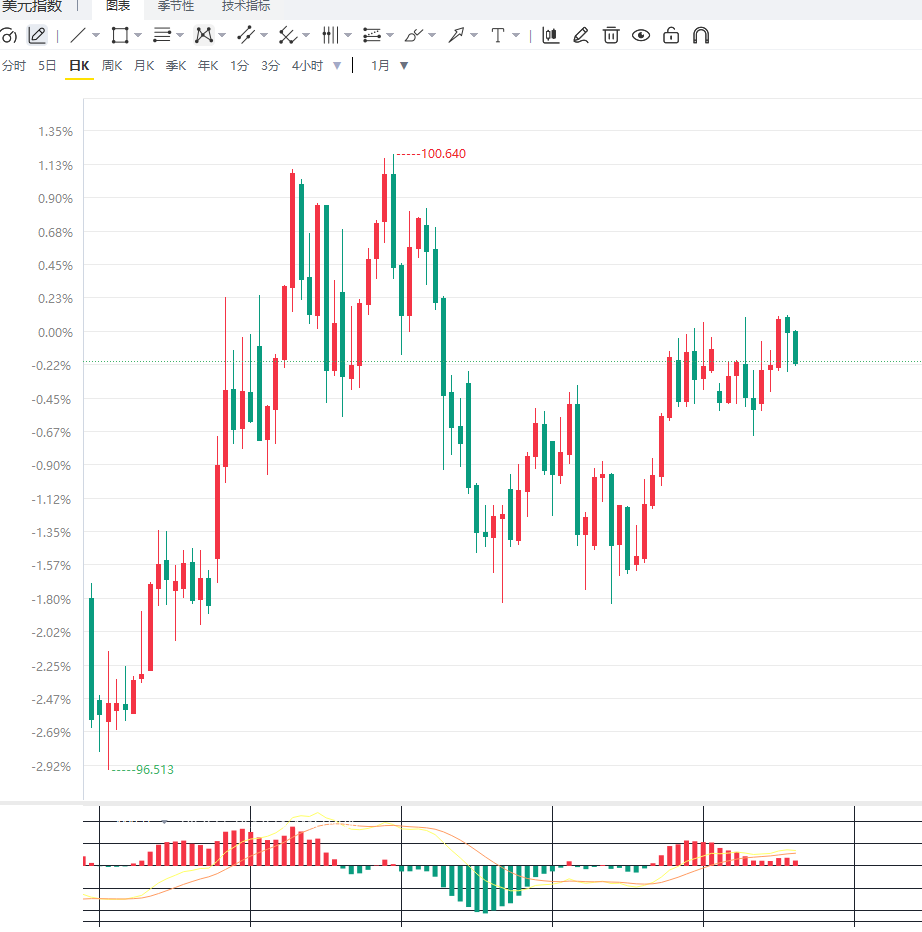
From a daily chart perspective, the US dollar index has maintained a high-level consolidation pattern recently. The market is awaiting the non-farm payroll data to provide new directional guidance. Currently, the dollar index is finding support around 99.00, with key resistance around the 100.00 level. The MACD indicator is running near the zero line, indicating a relatively balanced balance between bullish and bearish forces; the RSI indicator remains in the neutral zone, showing a strong wait-and-see attitude in the market. If the non-farm payroll data is significantly better than expected, the dollar index may retest the 100 level; if the employment data is significantly weaker than expected, it may trigger a short-term pullback in the dollar. From a 4-hour chart perspective, market volatility is gradually narrowing, indicating that investors are waiting for the key data release. The performance of the employment market, expectations for Fed policy, and consumer spending will jointly determine the future direction of the dollar.
Editor's Summary : The US labor market is transitioning from a phase of rapid growth to one of moderate expansion. While this non-farm payroll report may not fundamentally alter market sentiment regarding Federal Reserve policy, it will still provide investors with important clues about the health of the economy. Currently, the biggest support for the US economy comes from the continued resilience of consumer spending, which is closely related to a stable job market. If businesses continue to maintain a "less hiring, less layoffs" model, consumer confidence is expected to remain stable, thus supporting economic growth. However, given the continued erosion of real income by inflation, whether savings depletion can sustain consumption in the long term remains a concern. Future changes in the job market, inflation trends, and household spending power will be key variables determining the US economic outlook.
However, UBS Chief Economist Paul Donovan believes that this jobs report may have limited value in assessing the true state of the US labor market. Given the current low level of job growth, changes in employment across different industries can easily distort the overall data, thus weakening the accuracy of the employment indicators.
The market currently expects the U.S. to add approximately 85,000 non-farm payroll jobs in May, a further slowdown from the previous month's 115,000. Meanwhile, there is significant divergence in market predictions for the final result, reflecting distinctly different views among investors regarding the U.S. economic outlook. Donovan points out that in an environment of slowing job growth, average hourly earnings data may also be affected by changes in the labor force structure. For example, when hiring and layoffs vary significantly across different industries, even fluctuations in average wages may not accurately reflect overall wage growth trends.
"When job growth is low, changes in the labor force composition can distort average hourly wage data, which does not necessarily mean that wage growth itself has changed substantially." Nevertheless, the US job market remains an important indicator of economic performance. This is because US consumers are currently facing significant cost-of-living pressures, and consumer spending remains a core driver of US economic growth.
In recent years, US inflation has consistently exceeded its long-term target, squeezing the growth of real income. Faced with rising prices for goods and services, many families have begun to reduce their savings to maintain their daily consumption levels and quality of life. Analysts point out that the relative stability of the US economy is largely due to the resilience of consumer spending. Even with the impact on real purchasing power, residents are still using previously accumulated savings to support their consumption needs.
However, this model is not without risk. If future price increases continue to outpace the growth of household income, consumers' savings available for spending will gradually shrink, thus impacting overall consumption capacity. Besides income factors, consumer confidence is equally crucial. Economic research shows that residents' perceptions of future job security often directly influence their willingness to consume. When the job market remains stable, consumers are more willing to maintain spending; however, if the risk of unemployment rises, they may increase savings and reduce consumption.
Donovan believes that the current US labor market is characterized by "less hiring and less layoffs." While corporate hiring demand has cooled somewhat, large-scale layoffs have not yet occurred, and this situation has stabilized consumer confidence to some extent. "The biggest characteristic of the current US labor market is 'not hiring, and not laying off,' and the 'not laying off' aspect is helping consumers maintain confidence and continue to support consumer spending."
From a macroeconomic perspective, a stable job market is crucial for the US economy. Consumer spending accounts for approximately two-thirds of US GDP, so changes in consumer behavior often directly impact economic growth prospects. Meanwhile, the Federal Reserve still considers inflation a major risk. Several Fed officials have recently stated that while the job market has slowed, price pressures remain the most pressing issue. Therefore, even if the non-farm payroll data is slightly below expectations, it is unlikely to significantly alter market expectations for future monetary policy.
The market generally believes that unless there is a significant deterioration in employment data, the Federal Reserve is likely to maintain a relatively tight policy stance. Investors will be closely watching both employment and inflation data to determine whether the US economy can achieve stable growth.
From a daily chart perspective, the US dollar index has maintained a high-level consolidation pattern recently. The market is awaiting the non-farm payroll data to provide new directional guidance. Currently, the dollar index is finding support around 99.00, with key resistance around the 100.00 level. The MACD indicator is running near the zero line, indicating a relatively balanced balance between bullish and bearish forces; the RSI indicator remains in the neutral zone, showing a strong wait-and-see attitude in the market. If the non-farm payroll data is significantly better than expected, the dollar index may retest the 100 level; if the employment data is significantly weaker than expected, it may trigger a short-term pullback in the dollar. From a 4-hour chart perspective, market volatility is gradually narrowing, indicating that investors are waiting for the key data release. The performance of the employment market, expectations for Fed policy, and consumer spending will jointly determine the future direction of the dollar.
Editor's Summary : The US labor market is transitioning from a phase of rapid growth to one of moderate expansion. While this non-farm payroll report may not fundamentally alter market sentiment regarding Federal Reserve policy, it will still provide investors with important clues about the health of the economy. Currently, the biggest support for the US economy comes from the continued resilience of consumer spending, which is closely related to a stable job market. If businesses continue to maintain a "less hiring, less layoffs" model, consumer confidence is expected to remain stable, thus supporting economic growth. However, given the continued erosion of real income by inflation, whether savings depletion can sustain consumption in the long term remains a concern. Future changes in the job market, inflation trends, and household spending power will be key variables determining the US economic outlook.
- Risk Warning and Disclaimer
- The market involves risk, and trading may not be suitable for all investors. This article is for reference only and does not constitute personal investment advice, nor does it take into account certain users’ specific investment objectives, financial situation, or other needs. Any investment decisions made based on this information are at your own risk.