$94 is not the end; $102 is the watershed! Brent technical indicators are sending signals.
2026-06-05 17:56:36
On Friday, June 5th, the main theme in the crude oil market was no longer simple price fluctuations, but rather the repricing of geopolitical risk premiums, expectations of transportation recovery, and inventory withdrawals. Brent crude futures are currently fluctuating around $94.5 per barrel, experiencing slight intraday pressure, indicating that the market is still reserving a moderate premium for geopolitical news.

The recent pullback in oil prices from their highs does not mean that risk premiums have been completely squeezed out. What has truly changed is that traders are beginning to reprice "extreme supply disruptions" as "a coexistence of slow recovery and recurring disturbances." While communications between the US and Iran have released relatively optimistic statements, disagreements remain regarding a ceasefire in Lebanon, and the regional conflict has yet to establish a stable de-escalation path. The fact that oil prices remained above $90 per barrel after the previous trading day's decline essentially reflects that the market is no longer pricing in the worst-case scenario, but is also unwilling to quickly return to low-risk valuations.
The Strait of Hormuz remains the most critical risk valve. Information shows that this passage normally handles about one-fifth of global crude oil flows, and the current pace of resumption of traffic directly impacts the risk premium of near-month contracts. Oman's Mina Al Fahal port initially experienced concerns about loading delays due to news of an explosion, but operations subsequently returned to normal. The terminal exports approximately 800,000 to 900,000 barrels per day. While the incident did not escalate into a sustained supply shock, it demonstrates that the market's sensitivity to alternative loading points has significantly increased.
Price pullbacks easily attract attention, but inventory data better explains why crude oil prices haven't seen a linear decline. The U.S. Energy Information Administration's weekly report released on June 3rd showed that for the week ending May 29th, U.S. commercial crude oil inventories decreased by 8 million barrels to 433.7 million barrels, about 3% lower than the five-year average for the same period; refinery utilization was 94.7%, with crude oil processing volume at approximately 16.9 million barrels per day. During the same period, gasoline inventories increased by 3.4 million barrels, and distillate fuel inventories increased by 1.5 million barrels, indicating that both tightening crude oil prices and inventory accumulation in refined products occurred simultaneously.
The implication of this data is that the decline in oil prices is not entirely driven by weak demand. High refinery utilization and declining commercial inventories indicate that physical crude oil consumption remains supported, but rising refined product inventories limit the potential for further expansion of cracking margins. In other words, the current market is not a typical case of unilateral shortage, nor is it a typical case of demand collapse; rather, it reflects a misalignment between crude oil, refined products, and transportation bottlenecks. What traders really need to assess is whether the inventory decline stems from transportation disruptions, refinery restocking, or the continuation of resilient end-consumer demand.
Structural contradictions also exist on the supply side. Seven OPEC and its allies participating in the voluntary adjustment have decided to implement a production adjustment of 188,000 barrels per day in June 2026, emphasizing that they will retain the flexibility to increase, suspend, or reverse the adjustment based on market conditions. While the nominal production increase signals market stability, in an environment of transportation constraints, rising insurance costs, and exposed vulnerabilities at some ports, nominal quotas do not equate to effective supply that can immediately reach refineries.
The divergence on the demand side is also widening. OPEC Secretary General Heysem Alges recently stated that global oil demand remains resilient, and the organization will not adjust its 2026 demand growth forecast. Meanwhile, the U.S. Energy Information Administration's latest short-term outlook has lowered its 2026 global oil demand growth forecast to 200,000 barrels per day, significantly lower than previous predictions; the International Energy Agency's May report projects a 420,000 barrel per day year-on-year decrease in global oil demand in 2026, noting that the decline will be most concentrated in the second quarter.
This discrepancy in forecasts is itself the fuel for market volatility. A supply-oriented perspective amplifies inventory depletion and transportation risks, while a demand-oriented perspective emphasizes the downward pressure of high oil prices on consumption and refinery operations. The simultaneous existence of these two logics makes it difficult for Brent crude to establish a smooth trend above $90/barrel.
From the daily chart, the current price is around $94.65 per barrel, still below the Bollinger Band middle line at $102.21 per barrel. The upper band is at $115.24 per barrel, and the lower band is at $89.18 per barrel. The price previously fell from a high of $115.21 and recently rebounded after finding a low near $89.93. However, the rebound has not yet regained the middle band, indicating that the technical structure is still in a weak repair phase, rather than a trend reversal.
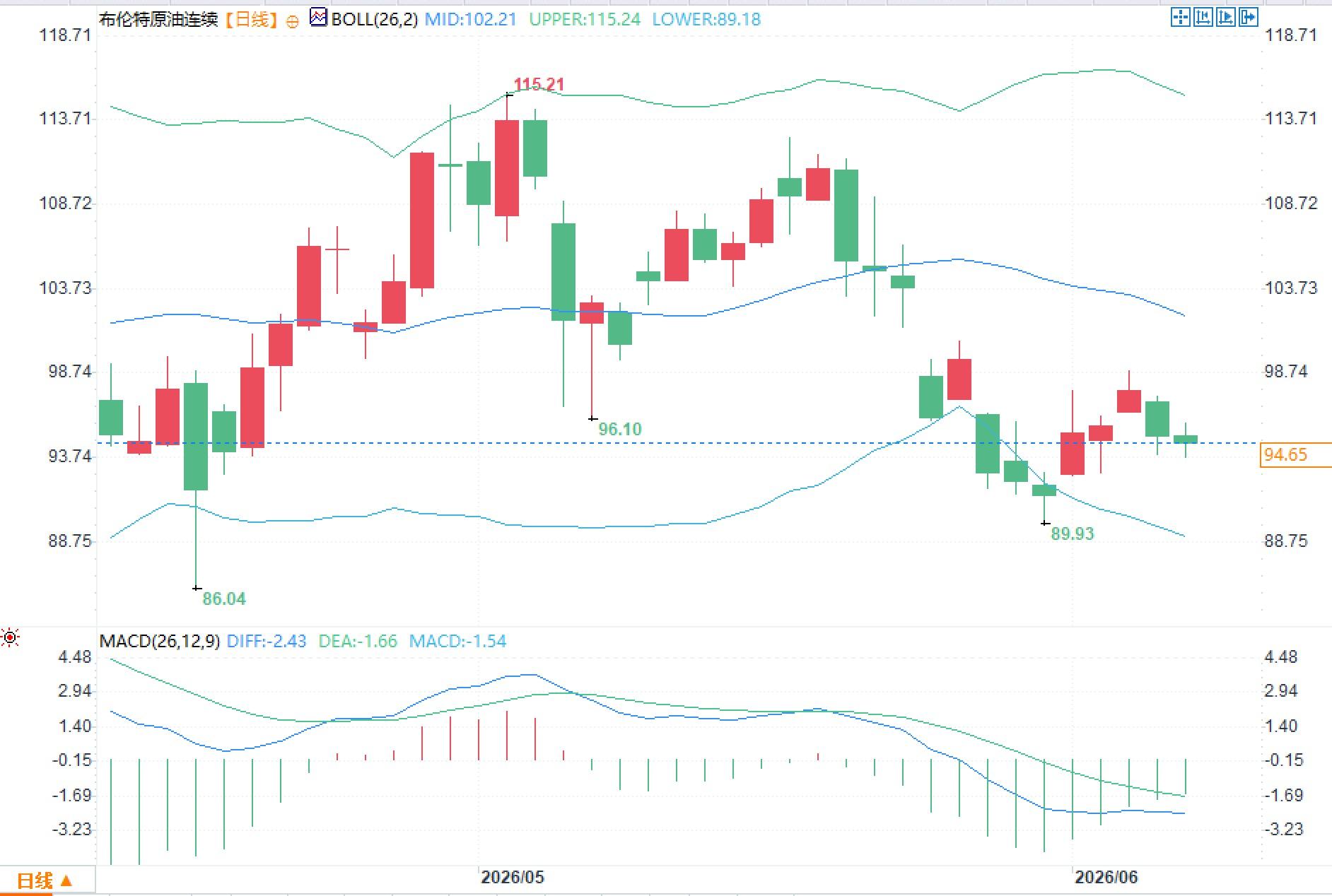
The MACD indicator also leans cautious. The DIFF is -2.43 and the DEA is -1.66, with the histogram still below the zero line, indicating insufficient momentum recovery. The area around $94 appears to be a short-term trading range, while the $102 level is a key level to observe whether the medium-term structure can improve. If the fundamentals continue to show signs of "transportation potentially recovering but not yet running smoothly," oil prices are more likely to maintain high volatility rather than quickly returning to a single trend.
Question 1: Does the drop in oil prices mean that the risks have been eliminated?
A: That's not the correct interpretation. The current pullback is mainly due to a cooling of expectations regarding extreme supply disruptions. However, the passage through the Strait of Hormuz, the ceasefire arrangements in Lebanon, and the stability of shipments are still not entirely clear. The risk premium has only been compressed, not eliminated.
Question 2: Why didn't the decline in inventory drive a surge in oil prices?
A: Because crude oil inventories are declining while gasoline and distillate fuel inventories are rising, the market is seeing a combination of tight crude oil supply and cooling refined oil supply. Inventory data alone is not enough to form a sustained trend.
Prices have not deviated from the risk premium; the core variable remains the Hormuz.
The recent pullback in oil prices from their highs does not mean that risk premiums have been completely squeezed out. What has truly changed is that traders are beginning to reprice "extreme supply disruptions" as "a coexistence of slow recovery and recurring disturbances." While communications between the US and Iran have released relatively optimistic statements, disagreements remain regarding a ceasefire in Lebanon, and the regional conflict has yet to establish a stable de-escalation path. The fact that oil prices remained above $90 per barrel after the previous trading day's decline essentially reflects that the market is no longer pricing in the worst-case scenario, but is also unwilling to quickly return to low-risk valuations.
The Strait of Hormuz remains the most critical risk valve. Information shows that this passage normally handles about one-fifth of global crude oil flows, and the current pace of resumption of traffic directly impacts the risk premium of near-month contracts. Oman's Mina Al Fahal port initially experienced concerns about loading delays due to news of an explosion, but operations subsequently returned to normal. The terminal exports approximately 800,000 to 900,000 barrels per day. While the incident did not escalate into a sustained supply shock, it demonstrates that the market's sensitivity to alternative loading points has significantly increased.
Inventory withdrawal is more important than price decline.
Price pullbacks easily attract attention, but inventory data better explains why crude oil prices haven't seen a linear decline. The U.S. Energy Information Administration's weekly report released on June 3rd showed that for the week ending May 29th, U.S. commercial crude oil inventories decreased by 8 million barrels to 433.7 million barrels, about 3% lower than the five-year average for the same period; refinery utilization was 94.7%, with crude oil processing volume at approximately 16.9 million barrels per day. During the same period, gasoline inventories increased by 3.4 million barrels, and distillate fuel inventories increased by 1.5 million barrels, indicating that both tightening crude oil prices and inventory accumulation in refined products occurred simultaneously.
The implication of this data is that the decline in oil prices is not entirely driven by weak demand. High refinery utilization and declining commercial inventories indicate that physical crude oil consumption remains supported, but rising refined product inventories limit the potential for further expansion of cracking margins. In other words, the current market is not a typical case of unilateral shortage, nor is it a typical case of demand collapse; rather, it reflects a misalignment between crude oil, refined products, and transportation bottlenecks. What traders really need to assess is whether the inventory decline stems from transportation disruptions, refinery restocking, or the continuation of resilient end-consumer demand.
There is a discrepancy between the reported increase in production on paper and the actual bottlenecks on the supply side.
Structural contradictions also exist on the supply side. Seven OPEC and its allies participating in the voluntary adjustment have decided to implement a production adjustment of 188,000 barrels per day in June 2026, emphasizing that they will retain the flexibility to increase, suspend, or reverse the adjustment based on market conditions. While the nominal production increase signals market stability, in an environment of transportation constraints, rising insurance costs, and exposed vulnerabilities at some ports, nominal quotas do not equate to effective supply that can immediately reach refineries.
The divergence on the demand side is also widening. OPEC Secretary General Heysem Alges recently stated that global oil demand remains resilient, and the organization will not adjust its 2026 demand growth forecast. Meanwhile, the U.S. Energy Information Administration's latest short-term outlook has lowered its 2026 global oil demand growth forecast to 200,000 barrels per day, significantly lower than previous predictions; the International Energy Agency's May report projects a 420,000 barrel per day year-on-year decrease in global oil demand in 2026, noting that the decline will be most concentrated in the second quarter.
This discrepancy in forecasts is itself the fuel for market volatility. A supply-oriented perspective amplifies inventory depletion and transportation risks, while a demand-oriented perspective emphasizes the downward pressure of high oil prices on consumption and refinery operations. The simultaneous existence of these two logics makes it difficult for Brent crude to establish a smooth trend above $90/barrel.
Technical Analysis: The area around $94 is not a directional indicator; $102 is the structural watershed.
From the daily chart, the current price is around $94.65 per barrel, still below the Bollinger Band middle line at $102.21 per barrel. The upper band is at $115.24 per barrel, and the lower band is at $89.18 per barrel. The price previously fell from a high of $115.21 and recently rebounded after finding a low near $89.93. However, the rebound has not yet regained the middle band, indicating that the technical structure is still in a weak repair phase, rather than a trend reversal.
The MACD indicator also leans cautious. The DIFF is -2.43 and the DEA is -1.66, with the histogram still below the zero line, indicating insufficient momentum recovery. The area around $94 appears to be a short-term trading range, while the $102 level is a key level to observe whether the medium-term structure can improve. If the fundamentals continue to show signs of "transportation potentially recovering but not yet running smoothly," oil prices are more likely to maintain high volatility rather than quickly returning to a single trend.
Frequently Asked Questions
Question 1: Does the drop in oil prices mean that the risks have been eliminated?
A: That's not the correct interpretation. The current pullback is mainly due to a cooling of expectations regarding extreme supply disruptions. However, the passage through the Strait of Hormuz, the ceasefire arrangements in Lebanon, and the stability of shipments are still not entirely clear. The risk premium has only been compressed, not eliminated.
Question 2: Why didn't the decline in inventory drive a surge in oil prices?
A: Because crude oil inventories are declining while gasoline and distillate fuel inventories are rising, the market is seeing a combination of tight crude oil supply and cooling refined oil supply. Inventory data alone is not enough to form a sustained trend.
- Risk Warning and Disclaimer
- The market involves risk, and trading may not be suitable for all investors. This article is for reference only and does not constitute personal investment advice, nor does it take into account certain users’ specific investment objectives, financial situation, or other needs. Any investment decisions made based on this information are at your own risk.