From a one-sided surge to collective selling, international oil prices as seen by CTA funds
2026-06-05 17:46:52
As the "lifeline" of global energy transportation, the navigation crisis in the Strait of Hormuz has completely disrupted the global supply and demand balance of crude oil.
In this massive oil price turmoil triggered by the protracted negotiations between the US and Iran, the most astute "hunters" in the commodity market—CTA quantitative funds—not only witnessed an astonishing surge in performance, but also demonstrated to the market, through an extremely rational set of operations, how major funds "manipulate" and "utilize" trends at the forefront of the storm.
To understand the underlying logic of this round of oil price surge, we must first understand how the US-Iran conflict has affected global energy supply.
Since the full escalation of the Middle East conflict on February 28, Iran has not chosen to completely block the Strait of Hormuz, but has instead adopted a more sophisticated "access control" approach—implementing a ship approval system.
The number of oil tankers passing through the Strait of Hormuz on a normal day can reach 120 to 150, but after the control measures were implemented, the number dropped sharply to about 20 per day. As a result, nearly 30% of the world's seaborne crude oil was stranded in port or forced to detour, and global oil inventories fell directly below the 100-day safety warning line.
The fate of this shipping route rests on the complex and unpredictable US-Iran peace negotiations. The two sides attempted to reach a settlement through a 60-day memorandum of understanding, proposing unconditional access to the Strait in exchange for easing US sanctions. However, they have reached a classic chicken-and-egg impasse on their core demands:
Iran demands that the United States first unfreeze its overseas assets and urge Israel to withdraw its troops. The United States insists that Iran must take concrete steps first on nuclear control and the security of the Strait of Hormuz.
This core disagreement led to a protracted negotiation. In early June, due to the United States' continued support for Israel, Iran announced a suspension of negotiations and threatened a blockade, causing international oil prices to surge by nearly 7% in a single day. Subsequently, Iran slightly relaxed its approval process, and the market quickly digested the expectation of a supply easing, causing oil prices to fall sharply. The ups and downs of the US-Iran peace talks directly became the trigger for the short-term surge and plunge in crude oil prices.
In such a volatile and unpredictable market, traditional subjective traders are often repeatedly proven wrong due to emotional trading, but CTA (Commodity Trading Advisor) quantitative funds are making a fortune.
As of June 2, the industry benchmark Societe Generale SG CTA Index has risen by 11.9% year-to-date.
Why did CTA become the biggest winner? This stems from its unique operating principle:
CTA funds do not predict geopolitical outcomes; they are only responsible for "trends" and "volatility."
Mathematical modeling and multi-factor driven: CTA funds rely on machine learning algorithms and mathematical statistical models to comprehensively cover all categories of futures, including crude oil, precious metals, stock indices, and foreign exchange.
Absolute procedural discipline: The system does not guess whether the US and Iran can reach an agreement, but automatically captures trends by tracking quantitative data such as price breakouts, momentum indicators, open interest, and volatility.
Once the price breaks out upwards, the system will automatically and ruthlessly execute a buy order, completely circumventing human greed and fear.
By observing the changes in CTA fund holdings in the first half of 2026, we can clearly reconstruct how these major market players manipulated the crude oil market:
In the first two months of 2026 (the first quarter), the crude oil market has not yet shown a clear trend. Due to high-frequency fluctuations, CTA funds' energy holdings are generally in a loss-making state.
However, the characteristic of major funds is that they are "not afraid of losing small amounts of money, but they are afraid of not having a trend".
On February 28, after the outbreak of the Middle East conflict and the surge in oil prices breaking through key resistance levels, the programmed bullish signals of major CTA funds were instantly triggered.
The major players quickly completed their long positions at low levels in the first quarter, accurately capturing the rapid rise in crude oil prices from the end of February to the beginning of March.
Mast Investment disclosed that the profits generated by the unilateral upward trend that began in March reached 2.5 times the previous losses, and its returns were approaching those of the energy bull market triggered by the Russia-Ukraine conflict in 2022.
Entering June, the main players' strategy underwent a complete 180-degree turn.
As negotiations between the US and Iran stalled, oil prices shifted from a "one-sided upward trend" to a "wide-range fluctuation with both an upper and lower limit."
From a quantitative perspective, the upside potential for simply going long on crude oil is continuously narrowing.
More importantly, the explosive growth of the AI industry has driven up global risk assets (such as US tech stocks), which has to some extent suppressed the overall volatility of commodities.
Once a one-sided trend is lost, the algorithmic trading system will immediately trigger a position reduction signal. At this point, leading institutions, including Abe Capital and Aspec Capital, begin to collectively and proactively reduce their crude oil exposure, realize profits in crude oil, and reduce their energy allocation.
The withdrawal of major funds from the crude oil market does not mean that quantitative funds have given up, but rather that a new round of asset rotation has begun.
The huge sums of money withdrawn from crude oil are now seeking new trends:
Precious metals and industrial metals: After capturing the surge in gold and silver prices at the beginning of the year, major funds are now pouring into industrial metals.
On the one hand, the war in the Middle East has led to a contraction in the supply of raw materials, and on the other hand, the construction of AI computing infrastructure (data centers, power grid transformation) has brought about a certain surge in demand. Industrial metals have emerged from a remarkable structural bull market.
Resource-based foreign exchange: In the foreign exchange market, the euro continued to weaken due to the Middle East conflict, while the currencies of resource-exporting countries such as the Norwegian krone, the Australian dollar, and the Brazilian real formed a very clear upward trend based on the strength of commodities, becoming the latest growth point for CTA funds.
Looking ahead, oil prices remain closely tied to the signing of the US-Iran agreement and the progress of navigation through the Strait of Hormuz. Previously, Trump and Rubio stated that an agreement would be signed this week, and Iran is also preparing to release new guidelines for navigation through the Strait. Currently, the weekend leans towards more positive developments, and oil prices have taken advantage of this to pull back.
For CTA funds that chase trends, the one-sided myth of crude oil has come to an end, but the environment of multi-commodity linkage and dramatic asset class rotation still exists.
Meanwhile, CTAs generally tend to follow momentum, which can amplify both upward and downward movements. Currently, institutions have reduced their CTA crude oil positions, but oil price trends will continue to revolve around the core logic of the US-Iran conflict.
From a technical perspective, WTI crude oil rebounded to the 0.618 level but failed to hold, and then began a pullback. The current resistance levels are the 5-day moving average and 94.62.
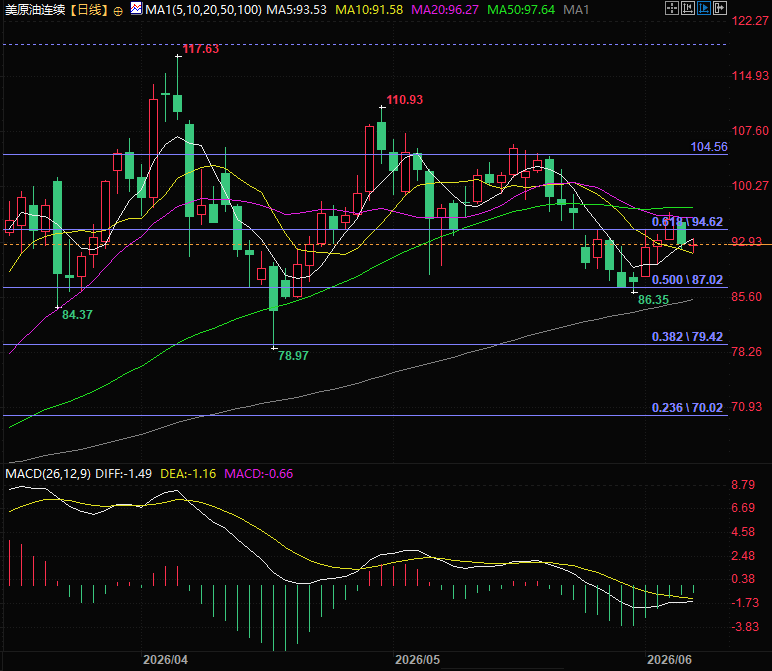
(WTI crude oil futures daily chart, source: FX678)
At 17:41 Beijing time, WTI crude oil futures were trading at $92.67 per barrel.
In this massive oil price turmoil triggered by the protracted negotiations between the US and Iran, the most astute "hunters" in the commodity market—CTA quantitative funds—not only witnessed an astonishing surge in performance, but also demonstrated to the market, through an extremely rational set of operations, how major funds "manipulate" and "utilize" trends at the forefront of the storm.
At the heart of the storm: the US-Iran rivalry and the life-or-death struggle for navigation in the Strait of Hormuz.
To understand the underlying logic of this round of oil price surge, we must first understand how the US-Iran conflict has affected global energy supply.
Since the full escalation of the Middle East conflict on February 28, Iran has not chosen to completely block the Strait of Hormuz, but has instead adopted a more sophisticated "access control" approach—implementing a ship approval system.
The number of oil tankers passing through the Strait of Hormuz on a normal day can reach 120 to 150, but after the control measures were implemented, the number dropped sharply to about 20 per day. As a result, nearly 30% of the world's seaborne crude oil was stranded in port or forced to detour, and global oil inventories fell directly below the 100-day safety warning line.
The fate of this shipping route rests on the complex and unpredictable US-Iran peace negotiations. The two sides attempted to reach a settlement through a 60-day memorandum of understanding, proposing unconditional access to the Strait in exchange for easing US sanctions. However, they have reached a classic chicken-and-egg impasse on their core demands:
Iran demands that the United States first unfreeze its overseas assets and urge Israel to withdraw its troops. The United States insists that Iran must take concrete steps first on nuclear control and the security of the Strait of Hormuz.
This core disagreement led to a protracted negotiation. In early June, due to the United States' continued support for Israel, Iran announced a suspension of negotiations and threatened a blockade, causing international oil prices to surge by nearly 7% in a single day. Subsequently, Iran slightly relaxed its approval process, and the market quickly digested the expectation of a supply easing, causing oil prices to fall sharply. The ups and downs of the US-Iran peace talks directly became the trigger for the short-term surge and plunge in crude oil prices.
The Unsung Heroes: The Operating Principles of CTA Quantitative Funds
In such a volatile and unpredictable market, traditional subjective traders are often repeatedly proven wrong due to emotional trading, but CTA (Commodity Trading Advisor) quantitative funds are making a fortune.
As of June 2, the industry benchmark Societe Generale SG CTA Index has risen by 11.9% year-to-date.
Why did CTA become the biggest winner? This stems from its unique operating principle:
CTA funds do not predict geopolitical outcomes; they are only responsible for "trends" and "volatility."
Mathematical modeling and multi-factor driven: CTA funds rely on machine learning algorithms and mathematical statistical models to comprehensively cover all categories of futures, including crude oil, precious metals, stock indices, and foreign exchange.
Absolute procedural discipline: The system does not guess whether the US and Iran can reach an agreement, but automatically captures trends by tracking quantitative data such as price breakouts, momentum indicators, open interest, and volatility.
Once the price breaks out upwards, the system will automatically and ruthlessly execute a buy order, completely circumventing human greed and fear.
Main players' moves: How have they manipulated oil prices in the past?
By observing the changes in CTA fund holdings in the first half of 2026, we can clearly reconstruct how these major market players manipulated the crude oil market:
In the first two months of 2026 (the first quarter), the crude oil market has not yet shown a clear trend. Due to high-frequency fluctuations, CTA funds' energy holdings are generally in a loss-making state.
However, the characteristic of major funds is that they are "not afraid of losing small amounts of money, but they are afraid of not having a trend".
On February 28, after the outbreak of the Middle East conflict and the surge in oil prices breaking through key resistance levels, the programmed bullish signals of major CTA funds were instantly triggered.
The major players quickly completed their long positions at low levels in the first quarter, accurately capturing the rapid rise in crude oil prices from the end of February to the beginning of March.
Mast Investment disclosed that the profits generated by the unilateral upward trend that began in March reached 2.5 times the previous losses, and its returns were approaching those of the energy bull market triggered by the Russia-Ukraine conflict in 2022.
Currently focusing on momentum decay and profit-taking.
Entering June, the main players' strategy underwent a complete 180-degree turn.
As negotiations between the US and Iran stalled, oil prices shifted from a "one-sided upward trend" to a "wide-range fluctuation with both an upper and lower limit."
From a quantitative perspective, the upside potential for simply going long on crude oil is continuously narrowing.
More importantly, the explosive growth of the AI industry has driven up global risk assets (such as US tech stocks), which has to some extent suppressed the overall volatility of commodities.
Once a one-sided trend is lost, the algorithmic trading system will immediately trigger a position reduction signal. At this point, leading institutions, including Abe Capital and Aspec Capital, begin to collectively and proactively reduce their crude oil exposure, realize profits in crude oil, and reduce their energy allocation.
The withdrawal of major funds from the crude oil market does not mean that quantitative funds have given up, but rather that a new round of asset rotation has begun.
The huge sums of money withdrawn from crude oil are now seeking new trends:
Precious metals and industrial metals: After capturing the surge in gold and silver prices at the beginning of the year, major funds are now pouring into industrial metals.
On the one hand, the war in the Middle East has led to a contraction in the supply of raw materials, and on the other hand, the construction of AI computing infrastructure (data centers, power grid transformation) has brought about a certain surge in demand. Industrial metals have emerged from a remarkable structural bull market.
Resource-based foreign exchange: In the foreign exchange market, the euro continued to weaken due to the Middle East conflict, while the currencies of resource-exporting countries such as the Norwegian krone, the Australian dollar, and the Brazilian real formed a very clear upward trend based on the strength of commodities, becoming the latest growth point for CTA funds.
Summary and Technical Analysis:
Looking ahead, oil prices remain closely tied to the signing of the US-Iran agreement and the progress of navigation through the Strait of Hormuz. Previously, Trump and Rubio stated that an agreement would be signed this week, and Iran is also preparing to release new guidelines for navigation through the Strait. Currently, the weekend leans towards more positive developments, and oil prices have taken advantage of this to pull back.
For CTA funds that chase trends, the one-sided myth of crude oil has come to an end, but the environment of multi-commodity linkage and dramatic asset class rotation still exists.
Meanwhile, CTAs generally tend to follow momentum, which can amplify both upward and downward movements. Currently, institutions have reduced their CTA crude oil positions, but oil price trends will continue to revolve around the core logic of the US-Iran conflict.
From a technical perspective, WTI crude oil rebounded to the 0.618 level but failed to hold, and then began a pullback. The current resistance levels are the 5-day moving average and 94.62.
(WTI crude oil futures daily chart, source: FX678)
At 17:41 Beijing time, WTI crude oil futures were trading at $92.67 per barrel.
- Risk Warning and Disclaimer
- The market involves risk, and trading may not be suitable for all investors. This article is for reference only and does not constitute personal investment advice, nor does it take into account certain users’ specific investment objectives, financial situation, or other needs. Any investment decisions made based on this information are at your own risk.