Risk aversion intensifies, coupled with better-than-expected non-farm payroll data, causing the US dollar index to break through the 100 mark.
2026-06-08 13:14:35
The US dollar index (DXY) remained strong during Monday's Asian trading session, trading around 100.10. Driven by both the escalating tensions in the Middle East and strong US economic data, the dollar continued to attract funds and remained near its highest level in nearly a month.

The market's primary focus remains on the evolving security situation in the Middle East. Recent news indicates a further deterioration in tensions between Israel and Iran. The Israel Defense Forces stated that it has launched strikes against multiple military targets in western and central Iran. This follows Iran's earlier response of launching multiple missile salvos into northern Israel.
Explosions were subsequently heard in several Iranian cities, including key areas such as Isfahan, Tehran, and Tabriz. While neither side released further details, market concerns about a further escalation of the regional conflict have clearly intensified. The rapid rise in geopolitical risks has driven a return of global risk aversion. As the world's primary reserve currency, the US dollar typically attracts significant safe-haven inflows during periods of increased market uncertainty. Therefore, despite heightened volatility in global financial markets, the US dollar index has remained relatively strong.
Meanwhile, the United States continues to actively pursue diplomatic mediation. President Trump stated that he will urge Israeli Prime Minister Netanyahu to avoid further retaliatory actions to prevent the situation from spiraling out of control. The US government hopes to maintain communication channels with Iran and push for continued negotiations. However, the market generally believes that geopolitical risks are unlikely to ease significantly in the short term.
Besides safe-haven demand, strong US economic data also played a significant role in supporting the dollar. Data released by the US Bureau of Labor Statistics showed that non-farm payrolls increased by 172,000 in May, far exceeding market expectations of 85,000. Although slightly lower than the revised previous figure of 179,000, this marked the third consecutive month of strong growth, indicating that the US labor market remains resilient.
Meanwhile, the US unemployment rate remained at 4.3% in May, in line with market expectations. This indicates that the US job market has not yet shown significant signs of slowing down, and the overall economic fundamentals remain strongly supported. A robust job market implies that household consumption power remains strong, and as a key driver of US economic growth, stable consumption helps maintain the overall economic expansion. Market expectations for monetary policy have therefore changed significantly.
Investors now expect the probability of a Federal Reserve rate hike in December to have risen to over 70%, a significant increase from about 45% a week ago. This indicates that the market is beginning to reassess the future path of interest rates and is gradually pricing in the possibility of maintaining high interest rates for a longer period or even further rate hikes. For the US dollar, high interest rate expectations often mean higher asset returns, thus attracting continued inflows of international capital into the US market. Therefore, even with recent pressure on global risk assets, the US dollar index has maintained a steady upward trend.
Meanwhile, the impact of the Middle East situation on the energy market is also noteworthy. International oil prices have risen continuously recently, raising market concerns that rising energy costs could push up future inflation. If inflation experiences renewed upward pressure, the Federal Reserve may extend its tightening policy, which would also benefit the US dollar. In terms of capital flows, global capital is currently reallocating to safe-haven assets. The US dollar, US Treasury bonds, and some money market funds have all seen inflows, while risk assets face some adjustment pressure. The overall decline in market risk appetite further solidifies the US dollar's safe-haven advantage.
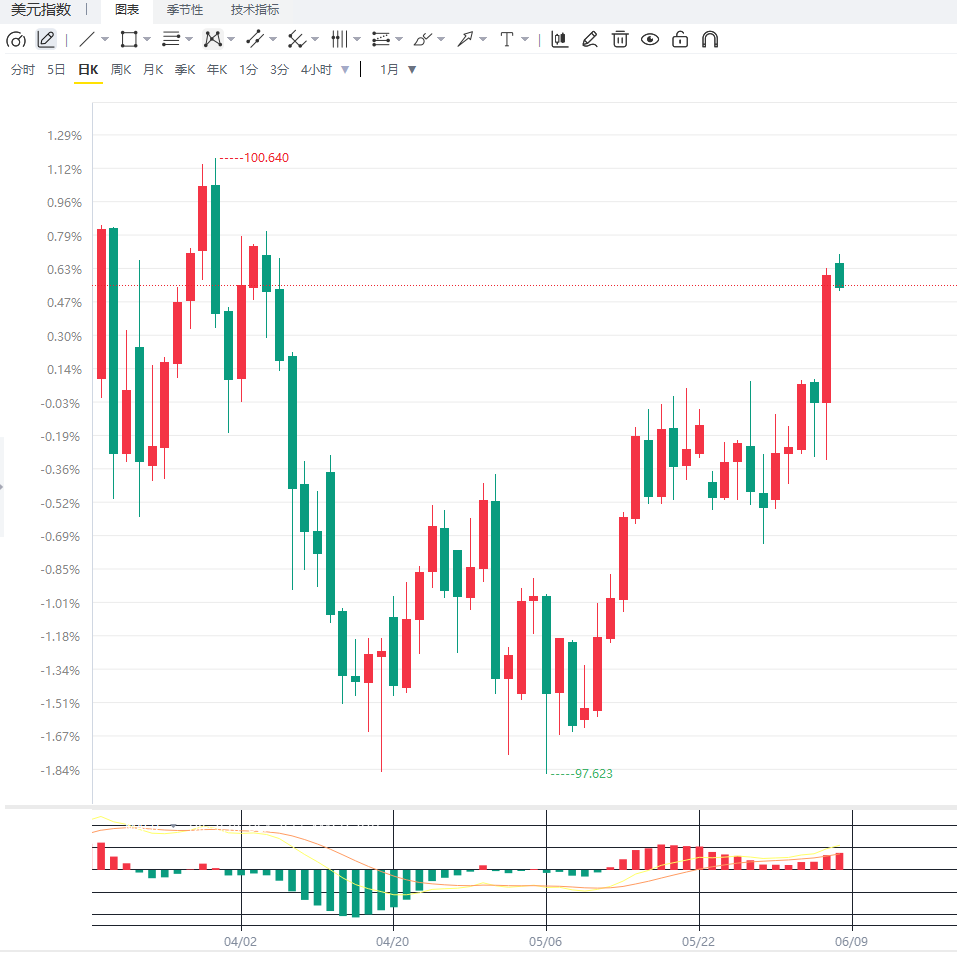
From a technical perspective, the US dollar index has successfully established itself above the 100 level on the daily chart, maintaining an overall upward trend. The price continues to trade above the 5-day, 10-day, and 20-day moving averages, indicating a bullish short-to-medium-term trend. The MACD indicator remains in a golden cross state, with the red bars continuing to expand, reflecting increasing upward momentum. The RSI indicator is hovering around 68, approaching overbought territory but has not yet formed a topping signal. Key support levels to watch are the 99.20 and 98.50 areas, while key resistance levels are around 100.80 and 101.50.
From a 4-hour chart perspective, the US dollar index is moving along an upward channel, with short-term moving averages showing a bullish alignment. The MACD indicator remains above the zero line, indicating that short-term buying power still holds the upper hand. If the situation in the Middle East deteriorates further or US economic data continues to improve, the US dollar index is expected to challenge the area above the 101 level; conversely, if risk aversion cools, it may retrace to around 100 for technical consolidation.
Editor's Summary : The US dollar index is currently supported by both safe-haven demand and monetary policy expectations. On the one hand, escalating tensions in the Middle East are driving global capital flows to safe-haven assets; on the other hand, the continued strength of the US job market is prompting a reassessment of the Federal Reserve's policy path and increasing expectations for interest rate hikes this year. In the short term, the dollar index still has further upward momentum. Going forward, the market will focus on US inflation data, speeches by Federal Reserve officials, and developments in the Middle East. If energy prices continue to rise and push up inflation expectations, the Federal Reserve may extend its tightening policy, thus continuing to support the dollar's performance. However, as the dollar index gradually approaches a key resistance area, market volatility may also increase simultaneously, and investors need to pay attention to the impact of changes in policy expectations.
The market's primary focus remains on the evolving security situation in the Middle East. Recent news indicates a further deterioration in tensions between Israel and Iran. The Israel Defense Forces stated that it has launched strikes against multiple military targets in western and central Iran. This follows Iran's earlier response of launching multiple missile salvos into northern Israel.
Explosions were subsequently heard in several Iranian cities, including key areas such as Isfahan, Tehran, and Tabriz. While neither side released further details, market concerns about a further escalation of the regional conflict have clearly intensified. The rapid rise in geopolitical risks has driven a return of global risk aversion. As the world's primary reserve currency, the US dollar typically attracts significant safe-haven inflows during periods of increased market uncertainty. Therefore, despite heightened volatility in global financial markets, the US dollar index has remained relatively strong.
Meanwhile, the United States continues to actively pursue diplomatic mediation. President Trump stated that he will urge Israeli Prime Minister Netanyahu to avoid further retaliatory actions to prevent the situation from spiraling out of control. The US government hopes to maintain communication channels with Iran and push for continued negotiations. However, the market generally believes that geopolitical risks are unlikely to ease significantly in the short term.
Besides safe-haven demand, strong US economic data also played a significant role in supporting the dollar. Data released by the US Bureau of Labor Statistics showed that non-farm payrolls increased by 172,000 in May, far exceeding market expectations of 85,000. Although slightly lower than the revised previous figure of 179,000, this marked the third consecutive month of strong growth, indicating that the US labor market remains resilient.
Meanwhile, the US unemployment rate remained at 4.3% in May, in line with market expectations. This indicates that the US job market has not yet shown significant signs of slowing down, and the overall economic fundamentals remain strongly supported. A robust job market implies that household consumption power remains strong, and as a key driver of US economic growth, stable consumption helps maintain the overall economic expansion. Market expectations for monetary policy have therefore changed significantly.
Investors now expect the probability of a Federal Reserve rate hike in December to have risen to over 70%, a significant increase from about 45% a week ago. This indicates that the market is beginning to reassess the future path of interest rates and is gradually pricing in the possibility of maintaining high interest rates for a longer period or even further rate hikes. For the US dollar, high interest rate expectations often mean higher asset returns, thus attracting continued inflows of international capital into the US market. Therefore, even with recent pressure on global risk assets, the US dollar index has maintained a steady upward trend.
Meanwhile, the impact of the Middle East situation on the energy market is also noteworthy. International oil prices have risen continuously recently, raising market concerns that rising energy costs could push up future inflation. If inflation experiences renewed upward pressure, the Federal Reserve may extend its tightening policy, which would also benefit the US dollar. In terms of capital flows, global capital is currently reallocating to safe-haven assets. The US dollar, US Treasury bonds, and some money market funds have all seen inflows, while risk assets face some adjustment pressure. The overall decline in market risk appetite further solidifies the US dollar's safe-haven advantage.
From a technical perspective, the US dollar index has successfully established itself above the 100 level on the daily chart, maintaining an overall upward trend. The price continues to trade above the 5-day, 10-day, and 20-day moving averages, indicating a bullish short-to-medium-term trend. The MACD indicator remains in a golden cross state, with the red bars continuing to expand, reflecting increasing upward momentum. The RSI indicator is hovering around 68, approaching overbought territory but has not yet formed a topping signal. Key support levels to watch are the 99.20 and 98.50 areas, while key resistance levels are around 100.80 and 101.50.
From a 4-hour chart perspective, the US dollar index is moving along an upward channel, with short-term moving averages showing a bullish alignment. The MACD indicator remains above the zero line, indicating that short-term buying power still holds the upper hand. If the situation in the Middle East deteriorates further or US economic data continues to improve, the US dollar index is expected to challenge the area above the 101 level; conversely, if risk aversion cools, it may retrace to around 100 for technical consolidation.
Editor's Summary : The US dollar index is currently supported by both safe-haven demand and monetary policy expectations. On the one hand, escalating tensions in the Middle East are driving global capital flows to safe-haven assets; on the other hand, the continued strength of the US job market is prompting a reassessment of the Federal Reserve's policy path and increasing expectations for interest rate hikes this year. In the short term, the dollar index still has further upward momentum. Going forward, the market will focus on US inflation data, speeches by Federal Reserve officials, and developments in the Middle East. If energy prices continue to rise and push up inflation expectations, the Federal Reserve may extend its tightening policy, thus continuing to support the dollar's performance. However, as the dollar index gradually approaches a key resistance area, market volatility may also increase simultaneously, and investors need to pay attention to the impact of changes in policy expectations.
- Risk Warning and Disclaimer
- The market involves risk, and trading may not be suitable for all investors. This article is for reference only and does not constitute personal investment advice, nor does it take into account certain users’ specific investment objectives, financial situation, or other needs. Any investment decisions made based on this information are at your own risk.