Rising expectations of a US interest rate hike, coupled with the impact of high oil prices, kept the US dollar against the Indian rupee fluctuating at high levels.
2026-06-08 14:30:58
The US dollar continued its rebound against the Indian rupee during Monday's Asian trading session, rising to around 95.60. A strong dollar, rising international oil prices, and continued capital outflows from the Indian market all put significant pressure on the rupee. The primary factor driving the dollar's strength was the better-than-expected performance of the US job market.
The latest data from the U.S. Bureau of Labor Statistics shows that non-farm payrolls increased by 172,000 in May, far exceeding market expectations of 85,000. Meanwhile, April's employment data was also revised upwards to 179,000, significantly higher than the previously reported 115,000. Furthermore, the U.S. unemployment rate remained at 4.3% in May, in line with market expectations, indicating that the labor market as a whole remains robust.
Strong employment data further reinforced market confidence in the resilience of the US economy and prompted investors to readjust their expectations for the Federal Reserve's policy path. Currently, the market generally believes that the Fed may maintain its tightening policy for longer than previously anticipated. Data shows that the market's expectation of at least one Fed rate hike this year has risen to 73.8%, compared to only about 45.2% a week ago.
As expectations of interest rate hikes rapidly intensify, the US dollar index continues to receive support and remains stable near the 100 mark, reaching its highest level in nearly two months. Meanwhile, the renewed deterioration of the situation in the Middle East has also become a significant factor influencing the currency market.
Military tensions between Israel and Iran escalated further over the weekend, with both sides launching mutual military strikes, raising market concerns about an escalation of the regional conflict. Investors worry that the situation could hinder the resumption of energy transport through the Strait of Hormuz, leading to continued strain on global energy supplies.
As one of the world's most important energy transportation routes, the Strait of Hormuz handles approximately 20% of global seaborne crude oil shipments. Disruptions to this transport often cause international crude oil prices to rise rapidly. Driven by this, the June crude oil futures price on the Indian Commodity Exchange (MCX) rose by about 4.6%, reaching around 9020 rupees.
The pressure from rising oil prices is particularly pronounced for the Indian economy. India is one of the world's major energy importers and is highly dependent on overseas crude oil supplies. Continued increases in international oil prices will raise import costs, widen the trade deficit, and potentially push up domestic inflation, thus typically having a negative impact on the rupee.
Besides energy factors, changes in capital flows have also exacerbated the pressure on the rupee. Data shows that since the beginning of June, overseas institutional investors have continued to reduce their holdings of Indian equity assets. To date, the cumulative net outflow of overseas funds has reached approximately 3.0814 trillion rupees. In May, overseas investors also maintained a net selling stance, with a cumulative reduction of approximately 5.5963 trillion rupees. The market is generally concerned that the high oil price environment may erode the profitability of Indian companies and put pressure on future economic growth prospects. Therefore, some international investors have chosen to reduce their allocation to Indian assets.
Capital outflows not only impacted the performance of Indian equity markets but also further weakened demand for the rupee, pushing the USD/RUB exchange rate to remain high. From a fundamental perspective, the USD/RUB exchange rate is currently supported by a strong dollar, rising energy prices, and capital outflows, suggesting a continued bullish trend in the short term.
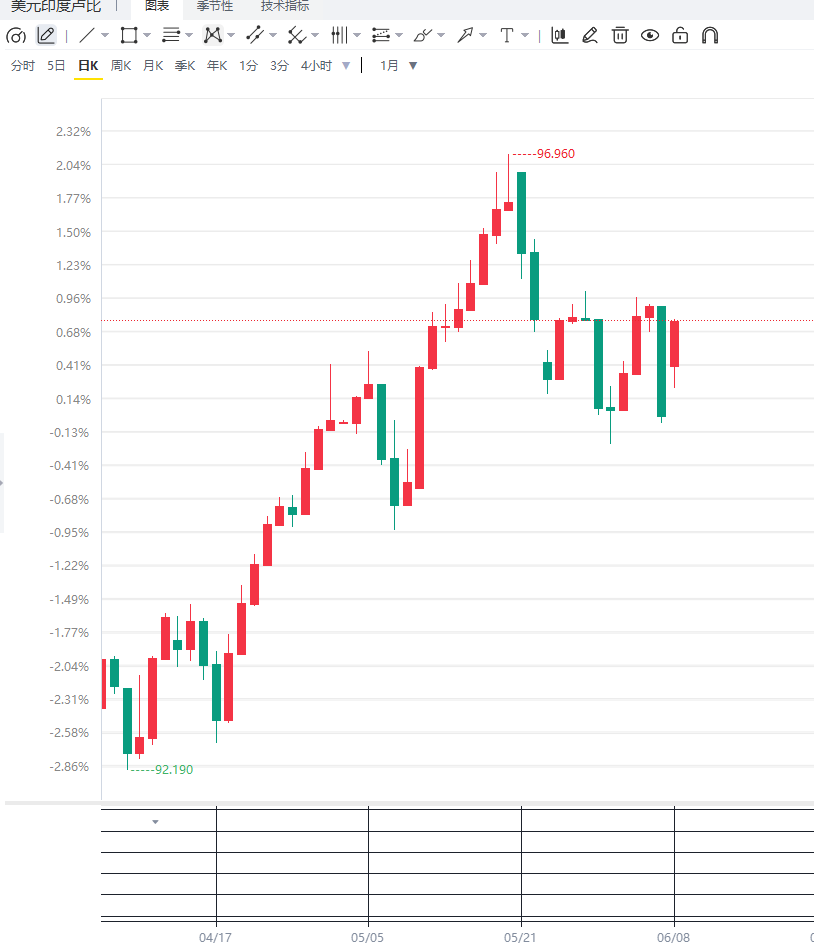
From a technical perspective, the USD/INR daily chart is trading around 95.30, maintaining a generally high-level consolidation trend. Currently, the exchange rate is slightly below the 20-day exponential moving average of 95.43, indicating a slowdown in short-term bullish momentum. While the MACD indicator remains in positive territory, upward momentum shows signs of weakening. The RSI indicator is around 49, suggesting a neutral market with relatively balanced bullish and bearish forces.
From a daily chart perspective, the 95.43 area is currently the primary resistance level. If the exchange rate can regain its footing above the 20-day moving average, it may further challenge the previous high of 96.30 and retest the historical high area around 97.10.
From a 4-hour chart perspective, the exchange rate has shown signs of stabilization after recently retreating from its highs. Short-term moving averages are gradually flattening, indicating the market has entered a consolidation phase. If the US dollar index continues to strengthen, the USD/RUB pair is expected to resume its upward trend; however, if international oil prices fall or the pressure of overseas capital outflows eases, the exchange rate may retrace to the important support area around 94.00.
Editor's Summary : The current USD/IRR exchange rate is driven by multiple factors, including strong US economic data, escalating tensions in the Middle East, and rising international oil prices. The anticipated Fed rate hike is significantly increasing, providing solid support for the dollar, while India, as a major energy importer, faces additional pressure from rising oil prices. Going forward, the market will focus on US inflation data, Fed policy moves, Middle East developments, and changes in international oil prices. If energy prices remain high and overseas funds continue to flow out of the Indian market, the USD/IRR exchange rate may have further room to rise; conversely, if oil prices fall and risk sentiment improves, the rupee is expected to find some support.
The latest data from the U.S. Bureau of Labor Statistics shows that non-farm payrolls increased by 172,000 in May, far exceeding market expectations of 85,000. Meanwhile, April's employment data was also revised upwards to 179,000, significantly higher than the previously reported 115,000. Furthermore, the U.S. unemployment rate remained at 4.3% in May, in line with market expectations, indicating that the labor market as a whole remains robust.
Strong employment data further reinforced market confidence in the resilience of the US economy and prompted investors to readjust their expectations for the Federal Reserve's policy path. Currently, the market generally believes that the Fed may maintain its tightening policy for longer than previously anticipated. Data shows that the market's expectation of at least one Fed rate hike this year has risen to 73.8%, compared to only about 45.2% a week ago.
As expectations of interest rate hikes rapidly intensify, the US dollar index continues to receive support and remains stable near the 100 mark, reaching its highest level in nearly two months. Meanwhile, the renewed deterioration of the situation in the Middle East has also become a significant factor influencing the currency market.
Military tensions between Israel and Iran escalated further over the weekend, with both sides launching mutual military strikes, raising market concerns about an escalation of the regional conflict. Investors worry that the situation could hinder the resumption of energy transport through the Strait of Hormuz, leading to continued strain on global energy supplies.
As one of the world's most important energy transportation routes, the Strait of Hormuz handles approximately 20% of global seaborne crude oil shipments. Disruptions to this transport often cause international crude oil prices to rise rapidly. Driven by this, the June crude oil futures price on the Indian Commodity Exchange (MCX) rose by about 4.6%, reaching around 9020 rupees.
The pressure from rising oil prices is particularly pronounced for the Indian economy. India is one of the world's major energy importers and is highly dependent on overseas crude oil supplies. Continued increases in international oil prices will raise import costs, widen the trade deficit, and potentially push up domestic inflation, thus typically having a negative impact on the rupee.
Besides energy factors, changes in capital flows have also exacerbated the pressure on the rupee. Data shows that since the beginning of June, overseas institutional investors have continued to reduce their holdings of Indian equity assets. To date, the cumulative net outflow of overseas funds has reached approximately 3.0814 trillion rupees. In May, overseas investors also maintained a net selling stance, with a cumulative reduction of approximately 5.5963 trillion rupees. The market is generally concerned that the high oil price environment may erode the profitability of Indian companies and put pressure on future economic growth prospects. Therefore, some international investors have chosen to reduce their allocation to Indian assets.
Capital outflows not only impacted the performance of Indian equity markets but also further weakened demand for the rupee, pushing the USD/RUB exchange rate to remain high. From a fundamental perspective, the USD/RUB exchange rate is currently supported by a strong dollar, rising energy prices, and capital outflows, suggesting a continued bullish trend in the short term.
From a technical perspective, the USD/INR daily chart is trading around 95.30, maintaining a generally high-level consolidation trend. Currently, the exchange rate is slightly below the 20-day exponential moving average of 95.43, indicating a slowdown in short-term bullish momentum. While the MACD indicator remains in positive territory, upward momentum shows signs of weakening. The RSI indicator is around 49, suggesting a neutral market with relatively balanced bullish and bearish forces.
From a daily chart perspective, the 95.43 area is currently the primary resistance level. If the exchange rate can regain its footing above the 20-day moving average, it may further challenge the previous high of 96.30 and retest the historical high area around 97.10.
From a 4-hour chart perspective, the exchange rate has shown signs of stabilization after recently retreating from its highs. Short-term moving averages are gradually flattening, indicating the market has entered a consolidation phase. If the US dollar index continues to strengthen, the USD/RUB pair is expected to resume its upward trend; however, if international oil prices fall or the pressure of overseas capital outflows eases, the exchange rate may retrace to the important support area around 94.00.
Editor's Summary : The current USD/IRR exchange rate is driven by multiple factors, including strong US economic data, escalating tensions in the Middle East, and rising international oil prices. The anticipated Fed rate hike is significantly increasing, providing solid support for the dollar, while India, as a major energy importer, faces additional pressure from rising oil prices. Going forward, the market will focus on US inflation data, Fed policy moves, Middle East developments, and changes in international oil prices. If energy prices remain high and overseas funds continue to flow out of the Indian market, the USD/IRR exchange rate may have further room to rise; conversely, if oil prices fall and risk sentiment improves, the rupee is expected to find some support.
- Risk Warning and Disclaimer
- The market involves risk, and trading may not be suitable for all investors. This article is for reference only and does not constitute personal investment advice, nor does it take into account certain users’ specific investment objectives, financial situation, or other needs. Any investment decisions made based on this information are at your own risk.