Behind the lightning-fast 12-hour ceasefire between Iran and Israel, the oil price story was quietly rewritten.
2026-06-08 21:35:39
In the midst of the major upheaval in the Middle East in June 2026, the international community witnessed an extremely bizarre and contradictory picture: on the political and military level, the United States gave Israel the "green light" to bomb Beirut while simultaneously rushing to mediate across borders.
On the economic and energy front, a disruptive change in the global oil trade landscape triggered by the Strait of Hormuz is completely ending the market norms of the past five years.
In terms of news, after Iran launched an attack on Israel this morning, the United States intervened in the evening to mediate, and both sides subsequently announced the end of the military operations against Iran and Israel.
The US (especially the Trump administration) stance in this conflict may seem capricious, but it is actually a very sophisticated and pragmatic American approach.
The United States’ biggest core strategic goal this year is to facilitate a final peace agreement between the U.S. and Iran.
However, negotiations require leverage, and the United States is unwilling to give up its control over billions of dollars of frozen Iranian assets overseas, let alone directly confront Iran head-on.
The United States gave Israel the "green light" to airstrikes on Beirut and strikes against Hezbollah in Lebanon, with the aim of using Israel's military power to completely weaken Hezbollah (Iran's most core and elite proxy armed group overseas).
Finally, by employing maximum pressure tactics, the more severely Iran's proxies are beaten, the fewer cards Iran will have left at the negotiating table. The US's leniency towards Israel is intended to force Iran to make the greatest possible concessions.
However, when Iran, having suffered a severe blow, launched a ballistic missile at an Israeli airbase on June 7, the situation risked spiraling out of control if the United States did not intervene. If a full-blown war broke out in the Middle East, not only would oil prices soar, but the United States' peace negotiations would also completely fail.
Trump first allowed his ally (Israel) to cripple the other side, and then stepped in as a peacemaker when the other side could no longer bear it. Trump directly halted Israel's further retaliation against Iranian territory and announced on social media that "both sides are seeking an immediate ceasefire and things should move forward quickly."
The core objective is to act as a savior to suppress direct airstrikes between Israel and Iran, dragging both countries back to the negotiating table, just as Trump said: "We are close to a good deal."
Israel's "expansion through war" - why is it so determined to fight Hezbollah and occupy land?
If the United States wants a "compliant regional order," then Israel wants "tangible land and security." Israel's insistence on advancing in southern Lebanon despite international opposition stems from its most core and fundamental interests.
Hezbollah in Lebanon possesses tens of thousands of rockets and advanced drones, and has long maintained a high-pressure stance against northern Israel, causing tens of thousands of Israeli border residents to flee their homes for years. Domestic political pressure has left the Netanyahu government with no way out.
Israel's goal in fighting Hezbollah is to completely drive it south of the Litani River, preventing it from posing a direct threat to northern Israel.
Another, and truly core, reason is the "salami-slicing territorial expansion" that followed the initial success.
The phrase "declaration of war, wartime occupation, and long-term occupation becoming a fait accompli" perfectly describes Israel's normalized pattern of geopolitical expansion that has been successful for decades.
This approach stems from historical benefits (the Sabah Farm/Golan Heights model): During the 1967 war, Israel seized Syria's Golan Heights and Sabah Farm under the pretext of security. Decades later, although international law does not recognize it, this land and the precious freshwater resources behind it are now under Israel's absolute control, which has become an established fact.
In 2026, Israel replicated the Lebanese version, stating that in the 21st century, directly declaring the annexation of a sovereign state's territory would be met with global condemnation.
Therefore, Israel adopted a new tactic: under the guise of self-defense, it launched an attack and, under the pretext of military strikes, completely destroyed 600 square kilometers of villages in southern Lebanon, expelled 1 million residents, and established a "no-man's-land" military buffer zone for a long-term military presence.
Hezbollah firmly rejected the US-drafted ceasefire agreement during the Washington negotiations because it implicitly acknowledged the presence of Israeli forces in a "safe zone" in southern Lebanon.
Hezbollah is well aware that once the Israeli army establishes a foothold, this land, including its precious water resources, will be virtually irretrievable.
Since the start of the war between the US and Israel against Iraq, the global oil industry originally thought that the Strait of Hormuz would be blocked for at most a few days or a week or two.
However, once the market realized that the Straits blockade had no end date, the long-term risks materialized, directly forcing Gulf oil-exporting countries to initiate a redundancy and permanent restructuring of the global oil supply chain:
As regional giants with a large amount of idle capacity, the UAE and Saudi Arabia are using Saudi Arabia's east-west oil pipeline to bypass the blockade, setting an example for emergency response.
The UAE's decision to withdraw from OPEC is not only aimed at achieving energy policy independence, but also at breaking free from quota constraints and ensuring its own crude oil production capacity. The UAE is investing heavily in accelerating the construction of an oil pipeline connecting to the port of Fujairah, scheduled to be operational next year.
Iraq, as the country in the Gulf region most severely affected, saw its southern oil field production plummet by 70% (from 4.3 million barrels to 1.3 million barrels) due to the Straits of Hormuz blockade.
Iraq is now urgently releasing a plan to triple its pipeline capacity within three months, desperately trying to ensure global supply through land-based pipelines.
Just as the market was increasingly bullish on oil prices due to growing concerns about oil shortages caused by the Middle East conflict, the supply side received another antidote to stabilize oil prices – Venezuela in the Western Hemisphere.
Following the change of government in Venezuela and the lifting of sanctions, American oil companies have made a major return to the local market. According to data from the well-known institution Kpler, Venezuela's daily crude oil production and exports have increased significantly and stabilized at 1.25 million barrels, and are expected to further increase to 1.5 million barrels by the end of this year.
Venezuela's main product is extra-heavy, high-sulfur crude oil. Its rapid recovery in production capacity has directly diverted market share of heavy, high-sulfur crude oil from Russia and Iran in the international market, thus objectively exerting strong pressure on high international oil prices.
Although the EU maintains its energy sanctions against Russia, the US has frequently introduced and extended crude oil import exemption policies in order to curb high inflation caused by rising energy prices and alleviate economic pressure.
This policy completely dispelled the psychological concerns and compliance obstacles of Asian buyers, allowing crude oil from Russia, Venezuela, and even some Iran to enter the market through "more moderate and legal" channels, continuously flowing into the hands of major Asian buyers.
In the long run, the economic costs of high inflation are forcing the US government to introduce policies to stabilize oil prices, and easing sanctions on Iranian oil is one of its core alternatives. Although the Trump administration is currently sticking to its policy line on the surface, it is only a matter of time before this potential supply is released.
On one hand, there is a geopolitical game: the United States wants a good-looking agreement, Israel is hoping to retain its wartime territory and water resources, and Iran needs oil tankers to sail out of the Strait to sell oil and obtain frozen funds. On the other hand, other oil-producing countries are restructuring their upstream and downstream operations and reforming their transportation methods to cope with the sudden energy crisis. For some countries, this is a disaster, while for others it is an opportunity.
Although the Straits crisis is still a long way from being completely over, even if an agreement is reached, it will only extend the temporary ceasefire agreement. Issues such as uranium enrichment and war reparations are still difficult to discuss. However, reaching this 60-day ceasefire agreement may not be so far away. With the agreement being reached, oil prices may fall temporarily in the near future.
From a technical perspective, WTI crude oil futures have been under pressure at the 0.618 level and have subsequently pulled back, with current support around 87.
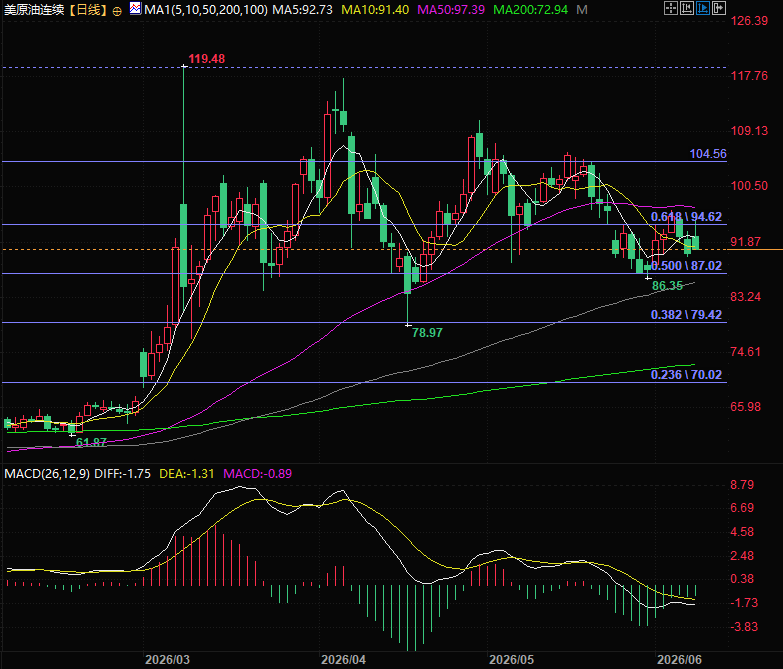
(WTI crude oil futures contract daily chart, source: FX678)
At 21:33 Beijing time, WTI crude oil futures contracts are currently trading at $90.91 per barrel.
On the economic and energy front, a disruptive change in the global oil trade landscape triggered by the Strait of Hormuz is completely ending the market norms of the past five years.
In terms of news, after Iran launched an attack on Israel this morning, the United States intervened in the evening to mediate, and both sides subsequently announced the end of the military operations against Iran and Israel.
The US's "two-pronged approach"—why give the green light on one hand while mediating on the other?
The US (especially the Trump administration) stance in this conflict may seem capricious, but it is actually a very sophisticated and pragmatic American approach.
The United States’ biggest core strategic goal this year is to facilitate a final peace agreement between the U.S. and Iran.
However, negotiations require leverage, and the United States is unwilling to give up its control over billions of dollars of frozen Iranian assets overseas, let alone directly confront Iran head-on.
The United States gave Israel the "green light" to airstrikes on Beirut and strikes against Hezbollah in Lebanon, with the aim of using Israel's military power to completely weaken Hezbollah (Iran's most core and elite proxy armed group overseas).
Finally, by employing maximum pressure tactics, the more severely Iran's proxies are beaten, the fewer cards Iran will have left at the negotiating table. The US's leniency towards Israel is intended to force Iran to make the greatest possible concessions.
However, when Iran, having suffered a severe blow, launched a ballistic missile at an Israeli airbase on June 7, the situation risked spiraling out of control if the United States did not intervene. If a full-blown war broke out in the Middle East, not only would oil prices soar, but the United States' peace negotiations would also completely fail.
Trump first allowed his ally (Israel) to cripple the other side, and then stepped in as a peacemaker when the other side could no longer bear it. Trump directly halted Israel's further retaliation against Iranian territory and announced on social media that "both sides are seeking an immediate ceasefire and things should move forward quickly."
The core objective is to act as a savior to suppress direct airstrikes between Israel and Iran, dragging both countries back to the negotiating table, just as Trump said: "We are close to a good deal."
Israel's "expansion through war" - why is it so determined to fight Hezbollah and occupy land?
If the United States wants a "compliant regional order," then Israel wants "tangible land and security." Israel's insistence on advancing in southern Lebanon despite international opposition stems from its most core and fundamental interests.
Hezbollah in Lebanon possesses tens of thousands of rockets and advanced drones, and has long maintained a high-pressure stance against northern Israel, causing tens of thousands of Israeli border residents to flee their homes for years. Domestic political pressure has left the Netanyahu government with no way out.
Israel's goal in fighting Hezbollah is to completely drive it south of the Litani River, preventing it from posing a direct threat to northern Israel.
Another, and truly core, reason is the "salami-slicing territorial expansion" that followed the initial success.
The phrase "declaration of war, wartime occupation, and long-term occupation becoming a fait accompli" perfectly describes Israel's normalized pattern of geopolitical expansion that has been successful for decades.
This approach stems from historical benefits (the Sabah Farm/Golan Heights model): During the 1967 war, Israel seized Syria's Golan Heights and Sabah Farm under the pretext of security. Decades later, although international law does not recognize it, this land and the precious freshwater resources behind it are now under Israel's absolute control, which has become an established fact.
In 2026, Israel replicated the Lebanese version, stating that in the 21st century, directly declaring the annexation of a sovereign state's territory would be met with global condemnation.
Therefore, Israel adopted a new tactic: under the guise of self-defense, it launched an attack and, under the pretext of military strikes, completely destroyed 600 square kilometers of villages in southern Lebanon, expelled 1 million residents, and established a "no-man's-land" military buffer zone for a long-term military presence.
Hezbollah firmly rejected the US-drafted ceasefire agreement during the Washington negotiations because it implicitly acknowledged the presence of Israeli forces in a "safe zone" in southern Lebanon.
Hezbollah is well aware that once the Israeli army establishes a foothold, this land, including its precious water resources, will be virtually irretrievable.
The Drastic Changes in Oil Prices and Trade: Supply and Demand Transformation in the Post-Strait Hormuz Era
Since the start of the war between the US and Israel against Iraq, the global oil industry originally thought that the Strait of Hormuz would be blocked for at most a few days or a week or two.
However, once the market realized that the Straits blockade had no end date, the long-term risks materialized, directly forcing Gulf oil-exporting countries to initiate a redundancy and permanent restructuring of the global oil supply chain:
As regional giants with a large amount of idle capacity, the UAE and Saudi Arabia are using Saudi Arabia's east-west oil pipeline to bypass the blockade, setting an example for emergency response.
The UAE's decision to withdraw from OPEC is not only aimed at achieving energy policy independence, but also at breaking free from quota constraints and ensuring its own crude oil production capacity. The UAE is investing heavily in accelerating the construction of an oil pipeline connecting to the port of Fujairah, scheduled to be operational next year.
Iraq, as the country in the Gulf region most severely affected, saw its southern oil field production plummet by 70% (from 4.3 million barrels to 1.3 million barrels) due to the Straits of Hormuz blockade.
Iraq is now urgently releasing a plan to triple its pipeline capacity within three months, desperately trying to ensure global supply through land-based pipelines.
Just as the market was increasingly bullish on oil prices due to growing concerns about oil shortages caused by the Middle East conflict, the supply side received another antidote to stabilize oil prices – Venezuela in the Western Hemisphere.
Following the change of government in Venezuela and the lifting of sanctions, American oil companies have made a major return to the local market. According to data from the well-known institution Kpler, Venezuela's daily crude oil production and exports have increased significantly and stabilized at 1.25 million barrels, and are expected to further increase to 1.5 million barrels by the end of this year.
Venezuela's main product is extra-heavy, high-sulfur crude oil. Its rapid recovery in production capacity has directly diverted market share of heavy, high-sulfur crude oil from Russia and Iran in the international market, thus objectively exerting strong pressure on high international oil prices.
Inflation-driven growth and large-country exemptions: Compliance arbitrage by Asian buyers
Although the EU maintains its energy sanctions against Russia, the US has frequently introduced and extended crude oil import exemption policies in order to curb high inflation caused by rising energy prices and alleviate economic pressure.
This policy completely dispelled the psychological concerns and compliance obstacles of Asian buyers, allowing crude oil from Russia, Venezuela, and even some Iran to enter the market through "more moderate and legal" channels, continuously flowing into the hands of major Asian buyers.
In the long run, the economic costs of high inflation are forcing the US government to introduce policies to stabilize oil prices, and easing sanctions on Iranian oil is one of its core alternatives. Although the Trump administration is currently sticking to its policy line on the surface, it is only a matter of time before this potential supply is released.
Summary and Technical Analysis:
On one hand, there is a geopolitical game: the United States wants a good-looking agreement, Israel is hoping to retain its wartime territory and water resources, and Iran needs oil tankers to sail out of the Strait to sell oil and obtain frozen funds. On the other hand, other oil-producing countries are restructuring their upstream and downstream operations and reforming their transportation methods to cope with the sudden energy crisis. For some countries, this is a disaster, while for others it is an opportunity.
Although the Straits crisis is still a long way from being completely over, even if an agreement is reached, it will only extend the temporary ceasefire agreement. Issues such as uranium enrichment and war reparations are still difficult to discuss. However, reaching this 60-day ceasefire agreement may not be so far away. With the agreement being reached, oil prices may fall temporarily in the near future.
From a technical perspective, WTI crude oil futures have been under pressure at the 0.618 level and have subsequently pulled back, with current support around 87.
(WTI crude oil futures contract daily chart, source: FX678)
At 21:33 Beijing time, WTI crude oil futures contracts are currently trading at $90.91 per barrel.
- Risk Warning and Disclaimer
- The market involves risk, and trading may not be suitable for all investors. This article is for reference only and does not constitute personal investment advice, nor does it take into account certain users’ specific investment objectives, financial situation, or other needs. Any investment decisions made based on this information are at your own risk.