UK inflation appears to be cooling down! CPI falls to 2.8% but the economy is caught in a double whammy of growth and inflation. Will the central bank make a mistake on June 18?
2026-06-08 20:59:35
On Monday, June 8th, the UK interest rate market re-entered a pricing range constrained by both inflation and growth. The Bank of England's benchmark interest rate remained at 3.75%, with the next policy meeting scheduled for June 18th. The pound was currently trading around 1.335 against the dollar, near a two-month low; the yield on 10-year UK government bonds rose to around 4.91%. On the surface, the April CPI fell from 3.3% to 2.8%, and core CPI fell to 2.5%, but expectations for energy, fuel, and corporate pricing are still rising, making it difficult for the market to simply interpret this decline in inflation as a relief in monetary policy pressure.
The Bank of England's April meeting saw an 8-1 vote to keep interest rates at 3.75%, with Hugh Peel advocating for a 25 basis point hike to 4%. The core message of this voting structure is not that the central bank is "dovish," but rather that most members still prefer to wait for more data to confirm the extent to which the energy shock has spread to service prices and wages. For traders, the key variable has shifted from a single CPI reading to the Monetary Policy Committee's tolerance for a second-round effect.
Bank of England Governor Bailey recently emphasized the need to reassure the public that the 2% inflation target will remain achievable, while acknowledging that short-term inflation exceeding the target could be explained given the weak real economy. Megan Green's stance is more cautious; she recently pointed out that energy shocks could evolve into more persistent inflation through price and wage setting channels, and policy cannot wait until the second-round effect is fully realized before reacting. These two statements combined mean that even if interest rates remain unchanged at the June meeting, a split vote could be a major trigger for the pound and the yield curve.
April's CPI fell to 2.8%, core CPI to 2.5%, and services CPI to 3.2% from 4.5%, providing a data basis for the Bank of England to remain on the sidelines. However, price pressures have not disappeared but have been structurally redistributed. In April, producer input prices rose 7.7% year-on-year, while output prices rose 4.0% year-on-year, with monthly input prices increasing by 2.4%. This indicates that upstream costs are still putting pressure on corporate profit statements.
A Bank of England business survey in May showed that businesses expect their own prices to rise by 4.0% over the next year, with a one-year CPI forecast of 3.7% and wage growth remaining at 3.4%. More notably, 57% of businesses still expect to raise prices due to the energy shock, and 68% expect profit margins to decline. If businesses choose to compress profits, the transmission of inflation to the consumer side will be delayed; if demand can still support price increases, the risk of renewed sticking to service sector inflation will rise.
First-quarter real GDP grew by 0.6% quarter-on-quarter, seemingly providing a buffer for policy tightening, but the latest high-frequency indicators have already weakened. The composite Purchasing Managers' Index (PMI) fell to 49.7 in May, with the services index dropping to 49.3, falling below the 50-point threshold for the first time; the manufacturing index, however, rose to 53.9, creating a divergence between a weakening services sector and a resilient manufacturing sector. Given the high weight of the services sector in the UK economy, the decline in services has a more significant policy implications for employment, wages, and consumption.
The labor market is also cooling. Preliminary figures for wage-earnings employment in April showed a decrease of 100,000 month-over-month and 210,000 year-over-year; the unemployment rate rose to 5.0%. Retail sales fell 1.3% month-over-month in April, the largest monthly drop in nearly a year, with motor fuel sales declining by 10.2%. This combination suggests that households are becoming more sensitive to price and income expectations, and further interest rate increases will face the real constraint of amplifying the risk of economic contraction.
Typically, expectations of interest rate hikes support the local currency, but the pound has not yet fully benefited from the repricing of UK interest rates. This is because the bond market reflects inflation risks, while the currency market also discounts growth resilience, external risks, and the monetary committee's response function. The yield on 10-year UK government bonds has risen to around 4.91%, reflecting more the energy shock and future policy uncertainty than an improved growth outlook.
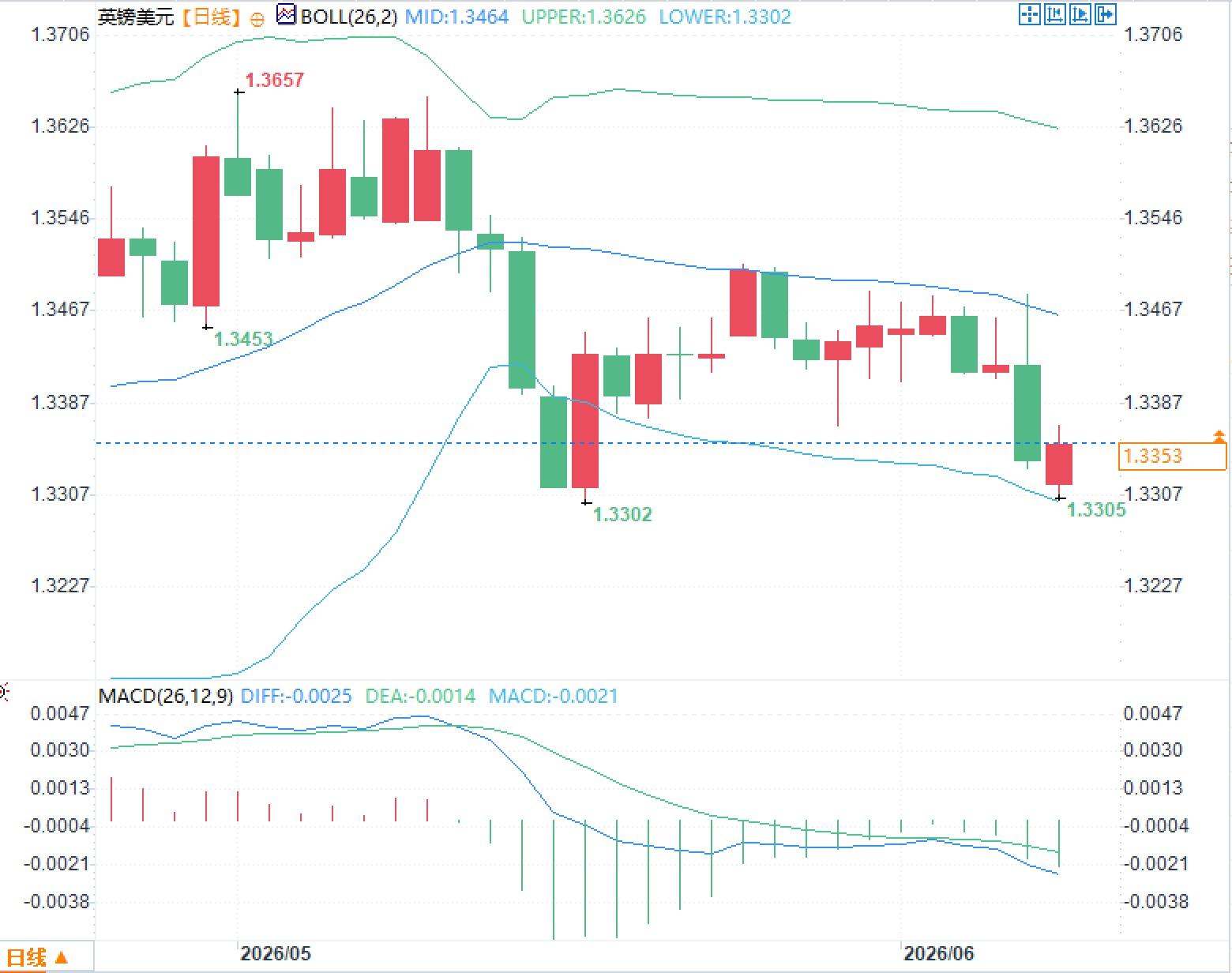
Therefore, the pricing logic for the pound is not simply "the higher the interest rate, the stronger the pound," but rather closer to "the more forced the policy, the higher the risk premium." If the service sector continues to contract and employment continues to decline, the market will question the sustainability of high interest rates; if energy costs continue to spread to wages and service prices, the market will increase its valuation of the tail risks of interest rate hikes. The real focus of the June meeting is whether the Bank of England can convince the market, without releasing operational guidance, that it can both suppress inflation expectations and avoid actively exacerbating the downward pressure on growth.
The Bank of England's April meeting saw an 8-1 vote to keep interest rates at 3.75%, with Hugh Peel advocating for a 25 basis point hike to 4%. The core message of this voting structure is not that the central bank is "dovish," but rather that most members still prefer to wait for more data to confirm the extent to which the energy shock has spread to service prices and wages. For traders, the key variable has shifted from a single CPI reading to the Monetary Policy Committee's tolerance for a second-round effect.
Bank of England Governor Bailey recently emphasized the need to reassure the public that the 2% inflation target will remain achievable, while acknowledging that short-term inflation exceeding the target could be explained given the weak real economy. Megan Green's stance is more cautious; she recently pointed out that energy shocks could evolve into more persistent inflation through price and wage setting channels, and policy cannot wait until the second-round effect is fully realized before reacting. These two statements combined mean that even if interest rates remain unchanged at the June meeting, a split vote could be a major trigger for the pound and the yield curve.
April's CPI fell to 2.8%, core CPI to 2.5%, and services CPI to 3.2% from 4.5%, providing a data basis for the Bank of England to remain on the sidelines. However, price pressures have not disappeared but have been structurally redistributed. In April, producer input prices rose 7.7% year-on-year, while output prices rose 4.0% year-on-year, with monthly input prices increasing by 2.4%. This indicates that upstream costs are still putting pressure on corporate profit statements.
A Bank of England business survey in May showed that businesses expect their own prices to rise by 4.0% over the next year, with a one-year CPI forecast of 3.7% and wage growth remaining at 3.4%. More notably, 57% of businesses still expect to raise prices due to the energy shock, and 68% expect profit margins to decline. If businesses choose to compress profits, the transmission of inflation to the consumer side will be delayed; if demand can still support price increases, the risk of renewed sticking to service sector inflation will rise.
First-quarter real GDP grew by 0.6% quarter-on-quarter, seemingly providing a buffer for policy tightening, but the latest high-frequency indicators have already weakened. The composite Purchasing Managers' Index (PMI) fell to 49.7 in May, with the services index dropping to 49.3, falling below the 50-point threshold for the first time; the manufacturing index, however, rose to 53.9, creating a divergence between a weakening services sector and a resilient manufacturing sector. Given the high weight of the services sector in the UK economy, the decline in services has a more significant policy implications for employment, wages, and consumption.
The labor market is also cooling. Preliminary figures for wage-earnings employment in April showed a decrease of 100,000 month-over-month and 210,000 year-over-year; the unemployment rate rose to 5.0%. Retail sales fell 1.3% month-over-month in April, the largest monthly drop in nearly a year, with motor fuel sales declining by 10.2%. This combination suggests that households are becoming more sensitive to price and income expectations, and further interest rate increases will face the real constraint of amplifying the risk of economic contraction.
Typically, expectations of interest rate hikes support the local currency, but the pound has not yet fully benefited from the repricing of UK interest rates. This is because the bond market reflects inflation risks, while the currency market also discounts growth resilience, external risks, and the monetary committee's response function. The yield on 10-year UK government bonds has risen to around 4.91%, reflecting more the energy shock and future policy uncertainty than an improved growth outlook.
Therefore, the pricing logic for the pound is not simply "the higher the interest rate, the stronger the pound," but rather closer to "the more forced the policy, the higher the risk premium." If the service sector continues to contract and employment continues to decline, the market will question the sustainability of high interest rates; if energy costs continue to spread to wages and service prices, the market will increase its valuation of the tail risks of interest rate hikes. The real focus of the June meeting is whether the Bank of England can convince the market, without releasing operational guidance, that it can both suppress inflation expectations and avoid actively exacerbating the downward pressure on growth.
- Risk Warning and Disclaimer
- The market involves risk, and trading may not be suitable for all investors. This article is for reference only and does not constitute personal investment advice, nor does it take into account certain users’ specific investment objectives, financial situation, or other needs. Any investment decisions made based on this information are at your own risk.