GBP/USD Analysis: Brief Rebound Unlikely to Reverse Downward Trend; Stagflation and Strong Dollar Double Impact
2026-06-10 09:00:04
On Wednesday (June 10) during the Asian session, the British pound traded in a narrow range against the US dollar, currently hovering around 1.3375.
The pound briefly rebounded on Tuesday due to better-than-expected UK retail sales data, but encountered resistance near the 200-day moving average and fell back, showing characteristics of a technical rebound within a downtrend.
On Tuesday, the pound finally received a rare piece of positive domestic data, which led to a brief rally of about half a trading day.
The pound rebounded from just below 1.3350 to above 1.3400 against the dollar, briefly touching the 200-day exponential moving average, but subsequently fluctuated back below that level. While the rebound did occur, the retreat at key technical resistance levels was equally evident. Furthermore, the real main event of the week—the US CPI—has not yet been released, suggesting that this rebound in the pound is more of a technical correction than a trend reversal.
A report from the British Retail Consortium (BRC) shows that same-store retail sales rose 3.4% year-on-year in May, far exceeding market expectations of 0.6%, completely reversing the 3.4% decline in April. While the data itself is indeed a strong retail report, its true nature needs to be viewed rationally. The retail survey, with monthly fluctuations as high as 7 percentage points, reflects more the base effect and calendar anomalies than a substantial recovery in consumer spending.
A single month's retail sales data is insufficient to determine economic trends; the Bank of England will not use it to repric monetary policy, nor will the market. The pound's rebound after the data release vanished completely within hours, directly reflecting the market's lack of confidence in the data's quality.
The Bank of England's current rate-cutting cycle was interrupted by the Middle East energy shock, and the benchmark interest rate remains at 3.75%. The central bank has publicly acknowledged that rising energy prices driven by geopolitical factors will make inflation more stubborn than previously predicted. At its April 30 meeting, the vote was 8 to 1, with the only dissenting vote supporting a rate hike, indicating growing internal disagreement on policy direction.
The Bank of England currently faces a dilemma: continuing to cut interest rates amidst rising inflation due to energy shocks is logically inconsistent and could further erode market confidence in the central bank; however, raising interest rates when the market widely expects the economy to have contracted in April could exacerbate downward economic pressure and bring the risk of recession to the fore. Whichever direction one takes, significant costs will follow.
The market has virtually no expectations for the June 18th interest rate decision, believing that whether rates are raised, lowered, or left unchanged, it will be difficult to change the current economic predicament. This has completely deprived the pound of the support of the domestic interest rate narrative, replacing it with the intractable dilemma of "stagflation"—the coexistence of stagnant economic growth and persistently high inflation. Control of the pound's direction against the dollar has completely shifted to the dollar, and this week's US CPI data will be a key variable determining the short-term direction of the exchange rate.
US CPI on Wednesday (20:30 Beijing time): Market expectations are 0.5% month-on-month and 4.2% year-on-year, accelerating from 3.8% to the fastest pace in nearly three years; core inflation is expected to be 2.9% year-on-year. The accelerating inflation is mainly due to the transmission of the oil price war premium to fuel and airfare prices. However, after last week's better-than-expected non-farm payrolls, this distinction is no longer important—the CME FedWatch Tool shows that expectations of a 2026 rate cut have disappeared, and the probability of a rate hike continues to rise. Strong CPI data will directly push up the dollar and put pressure on the pound; weak core inflation may lead to a technical rebound.
UK GDP on Friday (14:00 Beijing time): The market expects April GDP to contract by 0.1% month-on-month, accompanied by weak manufacturing output data. Even if the CPI provides a brief respite, the pound will face another severe test from domestic data within 48 hours.
The GBP/USD pair is currently exhibiting a short-term bearish trend and a medium-term consolidation pattern on the daily chart. The exchange rate has broken below the 20-day, 50-day, and 100-day moving averages (MA20, MA50, MA100) and is currently trading below the 200-day moving average (MA200) at 1.3417, indicating significant short-term pressure. Resistance is seen in the 1.3417-1.3473 area, while support lies at the 1.3300 level and the previous low of 1.3159.
In terms of indicators, the MACD's DIFF and DEA lines have turned downwards below the zero line, with the green bars continuing to expand, indicating some bearish momentum; the RSI has fallen back to 43.29, remaining in the weak zone, and has not yet shown any clear signs of stabilization.
Overall, the exchange rate has shown weak rebound after breaking below key moving averages, coupled with weak technical indicators, suggesting a likely continuation of the downward trend in the short term. A break below 1.3300 could open up further downside potential; conversely, holding above and rebounding above the 1.3417-1.3473 resistance level could lead to a return to the trading range.
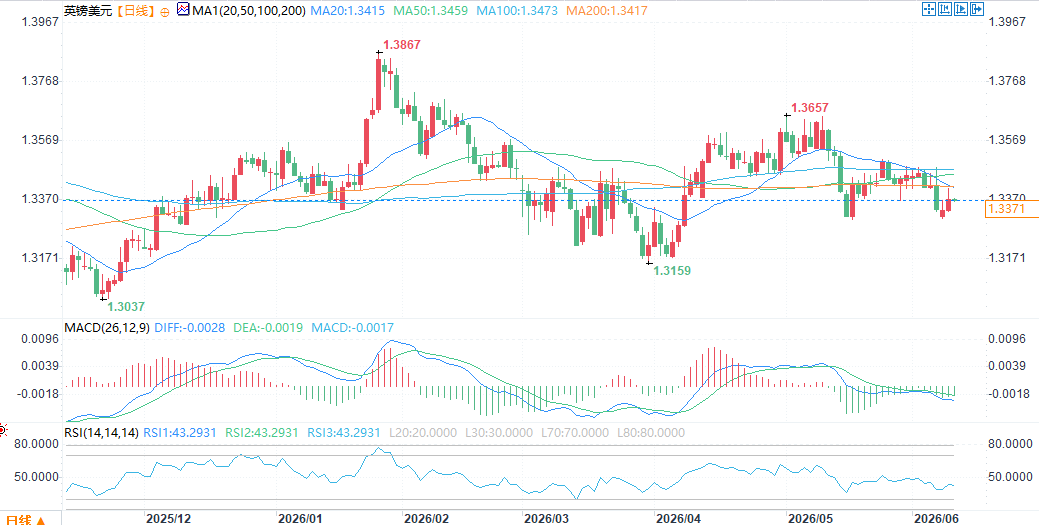
(GBP/USD daily chart, source: FX678)
At 8:59 AM Beijing time on June 10, the British pound was trading at 1.3376/77 against the US dollar.
The pound briefly rebounded on Tuesday due to better-than-expected UK retail sales data, but encountered resistance near the 200-day moving average and fell back, showing characteristics of a technical rebound within a downtrend.
Brief Rebound: Strong Retail Data, But Lacking Substance
On Tuesday, the pound finally received a rare piece of positive domestic data, which led to a brief rally of about half a trading day.
The pound rebounded from just below 1.3350 to above 1.3400 against the dollar, briefly touching the 200-day exponential moving average, but subsequently fluctuated back below that level. While the rebound did occur, the retreat at key technical resistance levels was equally evident. Furthermore, the real main event of the week—the US CPI—has not yet been released, suggesting that this rebound in the pound is more of a technical correction than a trend reversal.
A report from the British Retail Consortium (BRC) shows that same-store retail sales rose 3.4% year-on-year in May, far exceeding market expectations of 0.6%, completely reversing the 3.4% decline in April. While the data itself is indeed a strong retail report, its true nature needs to be viewed rationally. The retail survey, with monthly fluctuations as high as 7 percentage points, reflects more the base effect and calendar anomalies than a substantial recovery in consumer spending.
A single month's retail sales data is insufficient to determine economic trends; the Bank of England will not use it to repric monetary policy, nor will the market. The pound's rebound after the data release vanished completely within hours, directly reflecting the market's lack of confidence in the data's quality.
Bank of England: A Dilemma, No Cards Left to Play
The Bank of England's current rate-cutting cycle was interrupted by the Middle East energy shock, and the benchmark interest rate remains at 3.75%. The central bank has publicly acknowledged that rising energy prices driven by geopolitical factors will make inflation more stubborn than previously predicted. At its April 30 meeting, the vote was 8 to 1, with the only dissenting vote supporting a rate hike, indicating growing internal disagreement on policy direction.
The Bank of England currently faces a dilemma: continuing to cut interest rates amidst rising inflation due to energy shocks is logically inconsistent and could further erode market confidence in the central bank; however, raising interest rates when the market widely expects the economy to have contracted in April could exacerbate downward economic pressure and bring the risk of recession to the fore. Whichever direction one takes, significant costs will follow.
The market has virtually no expectations for the June 18th interest rate decision, believing that whether rates are raised, lowered, or left unchanged, it will be difficult to change the current economic predicament. This has completely deprived the pound of the support of the domestic interest rate narrative, replacing it with the intractable dilemma of "stagflation"—the coexistence of stagnant economic growth and persistently high inflation. Control of the pound's direction against the dollar has completely shifted to the dollar, and this week's US CPI data will be a key variable determining the short-term direction of the exchange rate.
Two major events this week
US CPI on Wednesday (20:30 Beijing time): Market expectations are 0.5% month-on-month and 4.2% year-on-year, accelerating from 3.8% to the fastest pace in nearly three years; core inflation is expected to be 2.9% year-on-year. The accelerating inflation is mainly due to the transmission of the oil price war premium to fuel and airfare prices. However, after last week's better-than-expected non-farm payrolls, this distinction is no longer important—the CME FedWatch Tool shows that expectations of a 2026 rate cut have disappeared, and the probability of a rate hike continues to rise. Strong CPI data will directly push up the dollar and put pressure on the pound; weak core inflation may lead to a technical rebound.
UK GDP on Friday (14:00 Beijing time): The market expects April GDP to contract by 0.1% month-on-month, accompanied by weak manufacturing output data. Even if the CPI provides a brief respite, the pound will face another severe test from domestic data within 48 hours.
Technical Analysis
The GBP/USD pair is currently exhibiting a short-term bearish trend and a medium-term consolidation pattern on the daily chart. The exchange rate has broken below the 20-day, 50-day, and 100-day moving averages (MA20, MA50, MA100) and is currently trading below the 200-day moving average (MA200) at 1.3417, indicating significant short-term pressure. Resistance is seen in the 1.3417-1.3473 area, while support lies at the 1.3300 level and the previous low of 1.3159.
In terms of indicators, the MACD's DIFF and DEA lines have turned downwards below the zero line, with the green bars continuing to expand, indicating some bearish momentum; the RSI has fallen back to 43.29, remaining in the weak zone, and has not yet shown any clear signs of stabilization.
Overall, the exchange rate has shown weak rebound after breaking below key moving averages, coupled with weak technical indicators, suggesting a likely continuation of the downward trend in the short term. A break below 1.3300 could open up further downside potential; conversely, holding above and rebounding above the 1.3417-1.3473 resistance level could lead to a return to the trading range.
(GBP/USD daily chart, source: FX678)
At 8:59 AM Beijing time on June 10, the British pound was trading at 1.3376/77 against the US dollar.
- Risk Warning and Disclaimer
- The market involves risk, and trading may not be suitable for all investors. This article is for reference only and does not constitute personal investment advice, nor does it take into account certain users’ specific investment objectives, financial situation, or other needs. Any investment decisions made based on this information are at your own risk.