The US dollar index remained strong, driving the dollar to continue rising against the yen.
2026-06-10 13:10:59
The USD/JPY pair consolidated at higher levels during Wednesday's Asian trading session, hovering around the 160.00-160.50 range, near its highest level since the end of April. Despite stronger-than-expected Japanese Producer Price Index (PPI) data, the yen failed to gain a significant boost, primarily due to continued support for the US dollar from the outlook for US interest rates and safe-haven inflows.

Latest data shows that Japan's producer price index (PPI) rose more than market expectations in May, reflecting the continued transmission of rising energy and raw material import costs to businesses, indicating that Japan still faces significant cost pressures. This data reinforces market expectations for further tightening of monetary policy by the Bank of Japan. The market has largely priced in the possibility of an interest rate hike at the Bank of Japan's June 15-16 meeting, and expectations for a gradual exit from Japan's long-term ultra-loose monetary policy are strengthening.
However, compared to the Bank of Japan's gradual shift towards a tightening policy, the expectation that the Federal Reserve may maintain higher interest rates or even raise rates further provides stronger support for the US dollar. Previously released US economic data remained resilient, and rising energy prices could potentially push up inflation again, prompting the market to reassess the Fed's future policy direction. Investors generally believe that the upcoming US May Consumer Price Index (CPI) will be a key catalyst determining the short-term trend of the US dollar.
If US inflation data continues to show increasing price pressures, market bets on the Federal Reserve further raising borrowing costs may intensify. This would push up US Treasury yields and further widen the US-Japan interest rate differential, thus keeping the dollar strong against the yen. Conversely, if inflation data shows signs of slowing, the dollar's upward momentum may weaken, and the yen may have a chance for a phased rebound.
Meanwhile, continued tensions in the Middle East have enhanced the safe-haven appeal of the US dollar. Market research indicates that the US military action against Iranian targets in response to the attack on US helicopters near the Strait of Hormuz, coupled with limited progress in peace talks between the US and Iran, has fueled persistent market concerns about a further deterioration of the regional situation.
For the Japanese economy, energy supply risks in the Middle East mean higher import costs. Given Japan's heavy reliance on imported energy, rising oil prices could increase production costs for businesses and burden residents, putting pressure on economic recovery. This concern has somewhat dampened market expectations for a significant appreciation of the yen following further interest rate hikes by the Bank of Japan.
However, the continued high level of USD/JPY above 160 has significantly increased market concerns about potential government intervention in the foreign exchange market. Previously, the Japanese government had taken measures to stabilize the exchange rate during a period of rapid yen depreciation, making some traders cautious about continuing large-scale shorting of the yen, which has limited the potential for further rapid appreciation of USD/JPY.
From a technical perspective, the USD/JPY daily chart shows that the exchange rate has maintained high levels after breaking through the previous resistance zone, with the bullish trend still dominating. The 160.00 level has now become a key short-term support; if the price continues to hold above this level, USD/JPY is expected to further challenge the 161.00 and even 162.00 areas. However, as the exchange rate approaches historical highs, market concerns about potential intervention by Japanese authorities are increasing, which could lead to significantly increased short-term volatility. Daily momentum indicators remain strong, but overbought signs are gradually emerging, and the risk of profit-taking at higher levels should be noted.
From a 4-hour chart perspective, USD/JPY is currently consolidating at high levels, with short-term moving averages still trending upwards, indicating that the bullish trend has not yet ended. If strong US CPI data further boosts expectations of a Fed rate hike, USD/JPY may break through recent highs and continue rising; if US inflation is lower than expected, or if Japan releases stronger signals of exchange rate stabilization, the exchange rate may fall back to test short-term support in the 159.00 to 159.50 area.
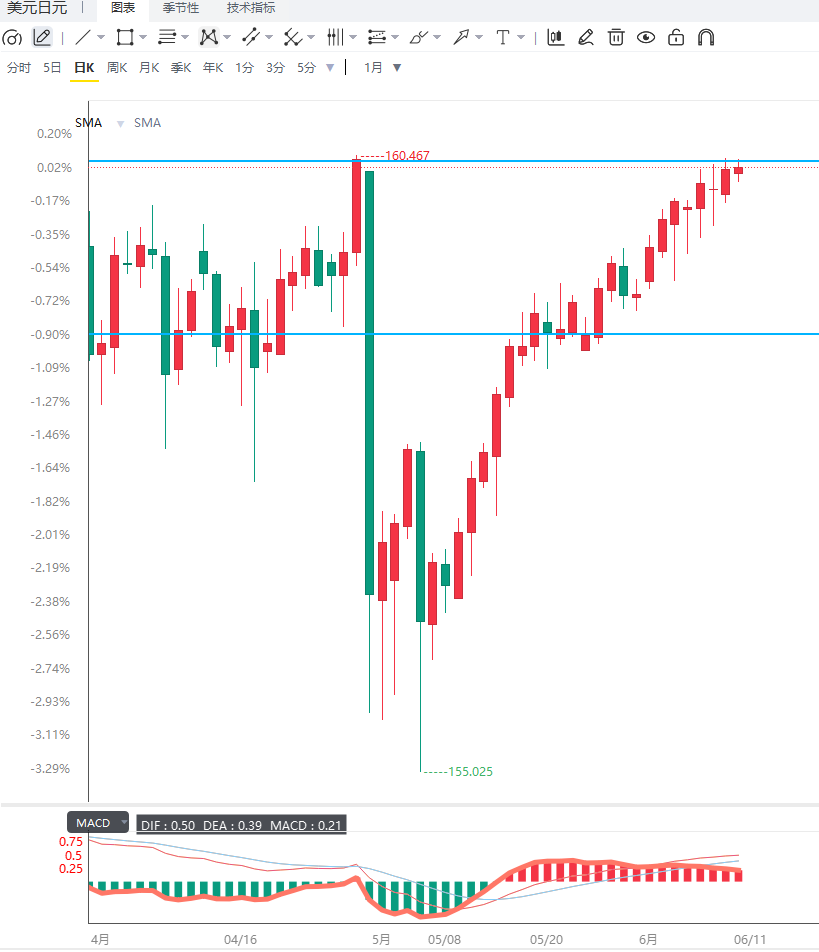
Editor's Summary : The core drivers for the current USD/JPY exchange rate are the differences in US and Japanese monetary policies, geopolitical risks, and market expectations of official intervention. The resilience of the US economy and inflation concerns support the strength of the dollar, while rising Japanese producer prices and expectations of a Bank of Japan interest rate hike provide some support for the yen. In the short term, the struggle around the 160 level will determine the next direction of the USD/JPY exchange rate. Investors should pay close attention to US CPI data, changes in Federal Reserve policy expectations, and the Japanese government's attitude towards exchange rate fluctuations.
Latest data shows that Japan's producer price index (PPI) rose more than market expectations in May, reflecting the continued transmission of rising energy and raw material import costs to businesses, indicating that Japan still faces significant cost pressures. This data reinforces market expectations for further tightening of monetary policy by the Bank of Japan. The market has largely priced in the possibility of an interest rate hike at the Bank of Japan's June 15-16 meeting, and expectations for a gradual exit from Japan's long-term ultra-loose monetary policy are strengthening.
However, compared to the Bank of Japan's gradual shift towards a tightening policy, the expectation that the Federal Reserve may maintain higher interest rates or even raise rates further provides stronger support for the US dollar. Previously released US economic data remained resilient, and rising energy prices could potentially push up inflation again, prompting the market to reassess the Fed's future policy direction. Investors generally believe that the upcoming US May Consumer Price Index (CPI) will be a key catalyst determining the short-term trend of the US dollar.
If US inflation data continues to show increasing price pressures, market bets on the Federal Reserve further raising borrowing costs may intensify. This would push up US Treasury yields and further widen the US-Japan interest rate differential, thus keeping the dollar strong against the yen. Conversely, if inflation data shows signs of slowing, the dollar's upward momentum may weaken, and the yen may have a chance for a phased rebound.
Meanwhile, continued tensions in the Middle East have enhanced the safe-haven appeal of the US dollar. Market research indicates that the US military action against Iranian targets in response to the attack on US helicopters near the Strait of Hormuz, coupled with limited progress in peace talks between the US and Iran, has fueled persistent market concerns about a further deterioration of the regional situation.
For the Japanese economy, energy supply risks in the Middle East mean higher import costs. Given Japan's heavy reliance on imported energy, rising oil prices could increase production costs for businesses and burden residents, putting pressure on economic recovery. This concern has somewhat dampened market expectations for a significant appreciation of the yen following further interest rate hikes by the Bank of Japan.
However, the continued high level of USD/JPY above 160 has significantly increased market concerns about potential government intervention in the foreign exchange market. Previously, the Japanese government had taken measures to stabilize the exchange rate during a period of rapid yen depreciation, making some traders cautious about continuing large-scale shorting of the yen, which has limited the potential for further rapid appreciation of USD/JPY.
From a technical perspective, the USD/JPY daily chart shows that the exchange rate has maintained high levels after breaking through the previous resistance zone, with the bullish trend still dominating. The 160.00 level has now become a key short-term support; if the price continues to hold above this level, USD/JPY is expected to further challenge the 161.00 and even 162.00 areas. However, as the exchange rate approaches historical highs, market concerns about potential intervention by Japanese authorities are increasing, which could lead to significantly increased short-term volatility. Daily momentum indicators remain strong, but overbought signs are gradually emerging, and the risk of profit-taking at higher levels should be noted.
From a 4-hour chart perspective, USD/JPY is currently consolidating at high levels, with short-term moving averages still trending upwards, indicating that the bullish trend has not yet ended. If strong US CPI data further boosts expectations of a Fed rate hike, USD/JPY may break through recent highs and continue rising; if US inflation is lower than expected, or if Japan releases stronger signals of exchange rate stabilization, the exchange rate may fall back to test short-term support in the 159.00 to 159.50 area.
Editor's Summary : The core drivers for the current USD/JPY exchange rate are the differences in US and Japanese monetary policies, geopolitical risks, and market expectations of official intervention. The resilience of the US economy and inflation concerns support the strength of the dollar, while rising Japanese producer prices and expectations of a Bank of Japan interest rate hike provide some support for the yen. In the short term, the struggle around the 160 level will determine the next direction of the USD/JPY exchange rate. Investors should pay close attention to US CPI data, changes in Federal Reserve policy expectations, and the Japanese government's attitude towards exchange rate fluctuations.
- Risk Warning and Disclaimer
- The market involves risk, and trading may not be suitable for all investors. This article is for reference only and does not constitute personal investment advice, nor does it take into account certain users’ specific investment objectives, financial situation, or other needs. Any investment decisions made based on this information are at your own risk.