The Bank of Japan's gradual interest rate hike path may struggle to keep pace with inflation, with Bank of America projecting interest rates to reach 1.75% by the end of 2027.
2026-06-10 15:02:48
In its latest research report, Bank of America Securities stated that although persistent inflationary pressures remain in Japan, the Bank of Japan is expected to adopt a relatively moderate and gradual strategy in normalizing its monetary policy, rather than rapidly raising interest rates. This policy approach reflects the Bank of Japan's desire to strike a balance between controlling inflation and maintaining economic stability, in order to avoid a significant impact on consumption, business investment, and economic recovery from excessively rapid tightening of the monetary environment.

According to Bank of America Securities' forecast, the Bank of Japan may raise interest rates again in October 2026, increasing the policy rate by 25 basis points, followed by two more rate hikes in March and July 2027. Based on this pace, the Bank of Japan's policy rate is expected to reach 1.75% by the end of 2027, marking a further exit from Japan's long-term ultra-loose monetary policy.
Bank of America Securities believes that the main risk of the Bank of Japan gradually raising interest rates is that the pace of policy adjustments may not be able to keep up with changes in inflation. If inflationary pressures continue to be stronger than expected, the central bank may have to implement a more frequent series of interest rate hikes or raise the final interest rate level to a higher level to ensure that inflation returns to the policy target.
The core challenge currently facing the Bank of Japan lies in the significant uncertainty surrounding the inflation trend. On the one hand, rising energy prices, increased import costs, and businesses passing on costs to consumers may perpetuate price pressures; on the other hand, the foundation of Japan's economic growth remains relatively fragile, and the sustainability of wage growth, household consumption, and corporate investment still requires further observation.
Against this backdrop, the Bank of Japan needs to balance curbing inflation with preventing an excessive economic slowdown. If inflation continues to exceed the central bank's expectations, the market may readjust its assessment of the path of Japanese interest rates, pushing up Japanese government bond yields and strengthening market support for the long-term yen.
However, gradual interest rate hikes also mean that the interest rate gap between Japan and other major economies may persist for some time. With the Federal Reserve and major European central banks maintaining relatively high interest rates, the yen is likely to remain influenced by interest rate differentials in the short term, and the risk of exchange rate volatility remains high.
From a market impact perspective, the Bank of Japan's future policy pace will be a crucial variable influencing the yen, bond markets, and global capital flows. If interest rate hikes occur faster than currently expected, the yen could receive significant support, while Japanese bond yields may rise further. If the central bank continues its cautious approach, the market may continue to focus on the duration of inflation and whether more aggressive policy adjustments will be necessary in the future.
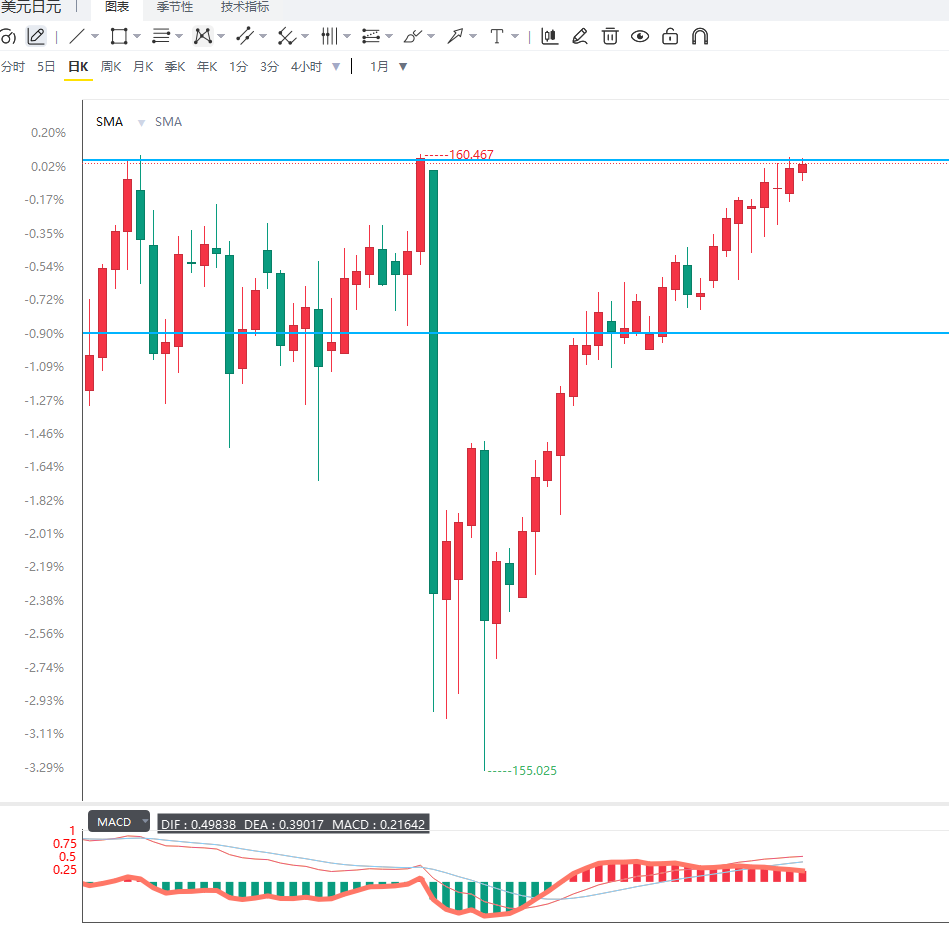
From a technical perspective, the USD/JPY daily chart shows that the exchange rate is currently fluctuating around 160.00, and the overall upward trend remains intact. In the short term, the 160.00 level has become a key battleground between bulls and bears. If the price can firmly hold above this level, the bulls may further test the resistance areas above 161.00 and 162.00. However, as the exchange rate is close to previous highs and the market remains wary of potential measures by the Japanese government to stabilize the exchange rate, the upside potential in the short term may be limited. If the exchange rate falls below 160.00, it may further decline to test the support areas around 159.00 and 158.50. Daily momentum indicators show that the upward trend still dominates, but overbought pressure has increased.
From a 4-hour chart perspective, USD/JPY has recently entered a consolidation phase at high levels, with short-term moving averages gradually flattening out, indicating that both bulls and bears are awaiting new fundamental catalysts. If US economic data continues to be strong, pushing up US Treasury yields and the US dollar index, the exchange rate may break through recent highs and continue its upward trend; conversely, if the Bank of Japan releases more hawkish policy signals, or if market expectations for future interest rate hikes in Japan significantly increase, USD/JPY may experience a technical correction.
Editor's Summary : Bank of America Securities expects the Bank of Japan to continue its cautious approach to normalizing monetary policy, with the policy rate potentially reaching 1.75% by the end of 2027. However, this gradual path carries the risk of lagging behind inflation. For USD/JPY, short-term movements will continue to be influenced by the USD/JPY interest rate differential, expectations regarding Bank of Japan policy, and market concerns about the risk of official intervention. Going forward, key factors to watch include Japanese inflation, wage growth, and central bank policy signals. If Japan raises interest rates faster than expected, the yen is likely to find support; conversely, USD/JPY may maintain a high-level consolidation pattern.
According to Bank of America Securities' forecast, the Bank of Japan may raise interest rates again in October 2026, increasing the policy rate by 25 basis points, followed by two more rate hikes in March and July 2027. Based on this pace, the Bank of Japan's policy rate is expected to reach 1.75% by the end of 2027, marking a further exit from Japan's long-term ultra-loose monetary policy.
Bank of America Securities believes that the main risk of the Bank of Japan gradually raising interest rates is that the pace of policy adjustments may not be able to keep up with changes in inflation. If inflationary pressures continue to be stronger than expected, the central bank may have to implement a more frequent series of interest rate hikes or raise the final interest rate level to a higher level to ensure that inflation returns to the policy target.
The core challenge currently facing the Bank of Japan lies in the significant uncertainty surrounding the inflation trend. On the one hand, rising energy prices, increased import costs, and businesses passing on costs to consumers may perpetuate price pressures; on the other hand, the foundation of Japan's economic growth remains relatively fragile, and the sustainability of wage growth, household consumption, and corporate investment still requires further observation.
Against this backdrop, the Bank of Japan needs to balance curbing inflation with preventing an excessive economic slowdown. If inflation continues to exceed the central bank's expectations, the market may readjust its assessment of the path of Japanese interest rates, pushing up Japanese government bond yields and strengthening market support for the long-term yen.
However, gradual interest rate hikes also mean that the interest rate gap between Japan and other major economies may persist for some time. With the Federal Reserve and major European central banks maintaining relatively high interest rates, the yen is likely to remain influenced by interest rate differentials in the short term, and the risk of exchange rate volatility remains high.
From a market impact perspective, the Bank of Japan's future policy pace will be a crucial variable influencing the yen, bond markets, and global capital flows. If interest rate hikes occur faster than currently expected, the yen could receive significant support, while Japanese bond yields may rise further. If the central bank continues its cautious approach, the market may continue to focus on the duration of inflation and whether more aggressive policy adjustments will be necessary in the future.
From a technical perspective, the USD/JPY daily chart shows that the exchange rate is currently fluctuating around 160.00, and the overall upward trend remains intact. In the short term, the 160.00 level has become a key battleground between bulls and bears. If the price can firmly hold above this level, the bulls may further test the resistance areas above 161.00 and 162.00. However, as the exchange rate is close to previous highs and the market remains wary of potential measures by the Japanese government to stabilize the exchange rate, the upside potential in the short term may be limited. If the exchange rate falls below 160.00, it may further decline to test the support areas around 159.00 and 158.50. Daily momentum indicators show that the upward trend still dominates, but overbought pressure has increased.
From a 4-hour chart perspective, USD/JPY has recently entered a consolidation phase at high levels, with short-term moving averages gradually flattening out, indicating that both bulls and bears are awaiting new fundamental catalysts. If US economic data continues to be strong, pushing up US Treasury yields and the US dollar index, the exchange rate may break through recent highs and continue its upward trend; conversely, if the Bank of Japan releases more hawkish policy signals, or if market expectations for future interest rate hikes in Japan significantly increase, USD/JPY may experience a technical correction.
Editor's Summary : Bank of America Securities expects the Bank of Japan to continue its cautious approach to normalizing monetary policy, with the policy rate potentially reaching 1.75% by the end of 2027. However, this gradual path carries the risk of lagging behind inflation. For USD/JPY, short-term movements will continue to be influenced by the USD/JPY interest rate differential, expectations regarding Bank of Japan policy, and market concerns about the risk of official intervention. Going forward, key factors to watch include Japanese inflation, wage growth, and central bank policy signals. If Japan raises interest rates faster than expected, the yen is likely to find support; conversely, USD/JPY may maintain a high-level consolidation pattern.
- Risk Warning and Disclaimer
- The market involves risk, and trading may not be suitable for all investors. This article is for reference only and does not constitute personal investment advice, nor does it take into account certain users’ specific investment objectives, financial situation, or other needs. Any investment decisions made based on this information are at your own risk.