The USD/JPY pair remains range-bound at high levels, awaiting a further acceleration of the bullish trend.
2026-06-11 13:43:20
The US dollar consolidated against the Japanese yen during Thursday's Asian trading session after rising for two consecutive days, hovering around 160.50, after earlier touching a six-week high of 160.56. As the pair approached a key level previously monitored by Japanese authorities, market expectations for potential further intervention in the foreign exchange market by the Japanese government increased, thus limiting further short-term gains for the dollar against the yen.

Japanese Finance Minister Satsuki Katayama previously stated that the government is closely monitoring foreign exchange market trends and emphasized that Japan's stance on maintaining market stability remains unchanged, and that decisive measures will be taken if necessary to address excessive volatility. This statement sent a clear warning to the market, indicating that the Japanese government remains highly vigilant regarding the rapid depreciation of the yen.
On the other hand, the Bank of Japan's policy meeting next week is the focus of market attention. Due to the rapid rise in energy prices caused by the conflict in the Middle East, the market expects the Bank of Japan to further raise interest rates to combat increasing inflationary pressures. Previously, Iran's Islamic Revolutionary Guard Corps announced the complete closure of the Strait of Hormuz, warning that any commercial ships and oil tankers passing through the area could face the risk of attack. As a vital global energy transportation route, the Strait of Hormuz handles approximately 20% of the world's seaborne crude oil transport; rising energy prices could further increase Japan's import costs and inflationary pressures.
Meanwhile, tensions in the Middle East continue to escalate. Israel stated that launches from Lebanon triggered the early warning mechanism of the Israeli Home Defense Command. The US Central Command confirmed that the US launched airstrikes against Iranian targets on Wednesday, and US President Trump stated that the US might take stronger military action if a temporary peace agreement is not reached. Iran, on the other hand, stated that it will not succumb to external pressure.
From the perspective of the US dollar, safe-haven demand stemming from geopolitical risks provides some support for the dollar, especially given the declining risk appetite in global markets, which encourages capital inflows into dollar assets. However, potential interest rate hikes by the Bank of Japan and possible foreign exchange intervention by the Japanese government have dampened the upward momentum of the USD/JPY exchange rate, resulting in a clear interplay between bullish and bearish factors.
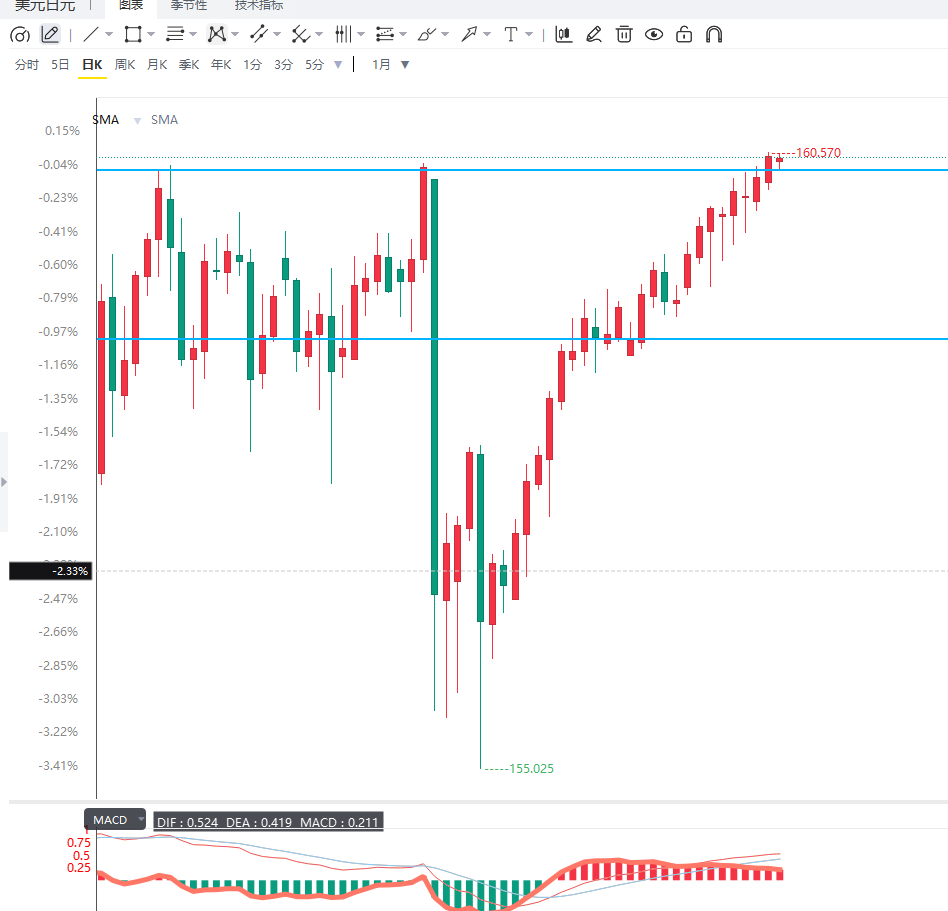
From a technical perspective, the daily chart shows that USD/JPY remains in an overall upward trend, with the price trading above major moving averages and the bullish structure still intact. If the exchange rate breaks through the 160.60 area, it may further test the 161.50 to 162.00 area; however, given the increased risk of official intervention by the Japanese government, the exchange rate may experience significant volatility around 160. The first important support level is around 159.50, with further support at the 158.50 area. The RSI indicator is approaching overbought territory, and the MACD maintains a golden cross, indicating that upward momentum still exists, but a short-term technical pullback is possible.
From a 4-hour chart perspective, the USD/JPY pair maintains a high-level consolidation pattern with a slight upward bias. Short-term moving averages remain upward, but selling pressure above 160 is gradually increasing. If safe-haven buying of the US dollar continues to increase, the exchange rate still has a chance to reach new highs. Conversely, if the Japanese government releases stronger intervention signals, or if the Bank of Japan raises interest rates more than the market expects, the USD/JPY pair may experience a rapid pullback. In the short term, close attention should be paid to market performance around the 160 level.
Editor's Summary : The current USD/JPY exchange rate is influenced by three main factors: safe-haven demand for the US dollar, expectations surrounding the Bank of Japan's policy, and the risk of Japanese government intervention. Escalating tensions in the Middle East have increased the attractiveness of the US dollar, providing upward momentum for the exchange rate. However, the Japanese government's high vigilance regarding yen depreciation, coupled with the possibility of further tightening of policy by the Bank of Japan, limits the potential for continued gains in the USD/JPY exchange rate. Going forward, the market will need to focus on the outcome of the Bank of Japan's meeting, US economic data, and developments in the Middle East, as these factors may determine the exchange rate's direction in the next phase.
Japanese Finance Minister Satsuki Katayama previously stated that the government is closely monitoring foreign exchange market trends and emphasized that Japan's stance on maintaining market stability remains unchanged, and that decisive measures will be taken if necessary to address excessive volatility. This statement sent a clear warning to the market, indicating that the Japanese government remains highly vigilant regarding the rapid depreciation of the yen.
On the other hand, the Bank of Japan's policy meeting next week is the focus of market attention. Due to the rapid rise in energy prices caused by the conflict in the Middle East, the market expects the Bank of Japan to further raise interest rates to combat increasing inflationary pressures. Previously, Iran's Islamic Revolutionary Guard Corps announced the complete closure of the Strait of Hormuz, warning that any commercial ships and oil tankers passing through the area could face the risk of attack. As a vital global energy transportation route, the Strait of Hormuz handles approximately 20% of the world's seaborne crude oil transport; rising energy prices could further increase Japan's import costs and inflationary pressures.
Meanwhile, tensions in the Middle East continue to escalate. Israel stated that launches from Lebanon triggered the early warning mechanism of the Israeli Home Defense Command. The US Central Command confirmed that the US launched airstrikes against Iranian targets on Wednesday, and US President Trump stated that the US might take stronger military action if a temporary peace agreement is not reached. Iran, on the other hand, stated that it will not succumb to external pressure.
From the perspective of the US dollar, safe-haven demand stemming from geopolitical risks provides some support for the dollar, especially given the declining risk appetite in global markets, which encourages capital inflows into dollar assets. However, potential interest rate hikes by the Bank of Japan and possible foreign exchange intervention by the Japanese government have dampened the upward momentum of the USD/JPY exchange rate, resulting in a clear interplay between bullish and bearish factors.
From a technical perspective, the daily chart shows that USD/JPY remains in an overall upward trend, with the price trading above major moving averages and the bullish structure still intact. If the exchange rate breaks through the 160.60 area, it may further test the 161.50 to 162.00 area; however, given the increased risk of official intervention by the Japanese government, the exchange rate may experience significant volatility around 160. The first important support level is around 159.50, with further support at the 158.50 area. The RSI indicator is approaching overbought territory, and the MACD maintains a golden cross, indicating that upward momentum still exists, but a short-term technical pullback is possible.
From a 4-hour chart perspective, the USD/JPY pair maintains a high-level consolidation pattern with a slight upward bias. Short-term moving averages remain upward, but selling pressure above 160 is gradually increasing. If safe-haven buying of the US dollar continues to increase, the exchange rate still has a chance to reach new highs. Conversely, if the Japanese government releases stronger intervention signals, or if the Bank of Japan raises interest rates more than the market expects, the USD/JPY pair may experience a rapid pullback. In the short term, close attention should be paid to market performance around the 160 level.
Editor's Summary : The current USD/JPY exchange rate is influenced by three main factors: safe-haven demand for the US dollar, expectations surrounding the Bank of Japan's policy, and the risk of Japanese government intervention. Escalating tensions in the Middle East have increased the attractiveness of the US dollar, providing upward momentum for the exchange rate. However, the Japanese government's high vigilance regarding yen depreciation, coupled with the possibility of further tightening of policy by the Bank of Japan, limits the potential for continued gains in the USD/JPY exchange rate. Going forward, the market will need to focus on the outcome of the Bank of Japan's meeting, US economic data, and developments in the Middle East, as these factors may determine the exchange rate's direction in the next phase.
- Risk Warning and Disclaimer
- The market involves risk, and trading may not be suitable for all investors. This article is for reference only and does not constitute personal investment advice, nor does it take into account certain users’ specific investment objectives, financial situation, or other needs. Any investment decisions made based on this information are at your own risk.