Oil price rebound supports the Canadian dollar, while divergent monetary policies between the US and Canada help the USD/CAD pair maintain high-level fluctuations.
2026-06-11 15:07:35
During Thursday's Asian trading session, the USD/CAD pair, after rebounding from a low near 1.3900, temporarily lacked further upward momentum, with the exchange rate retreating slightly and fluctuating around 1.3950. Although the short-term trend has cooled somewhat, the exchange rate remains close to its previous high for the year, and the market as a whole is still caught in a tug-of-war between bulls and bears driven by a strong dollar and a rebound in oil prices.

Tensions in the Middle East continue to escalate. Following a new round of US military action against Iran, Iran announced the closure of the Strait of Hormuz, rapidly fueling market concerns about disruptions to global energy supplies. Since the Strait of Hormuz handles approximately 20% of global seaborne crude oil transport, the resulting transportation risks have driven a significant rebound in international crude oil prices from their near two-month lows. As a major energy exporter, Canada's economy is closely linked to the crude oil market; rising oil prices typically enhance the Canadian dollar's attractiveness, thus putting downward pressure on the USD/CAD exchange rate.
On the other hand, the US dollar remains supported by safe-haven demand and hawkish expectations from the Federal Reserve. Iran's Joint Military Command stated it would respond strongly to US actions in the region, raising market concerns about a further escalation of the conflict and driving some safe-haven funds into the dollar. Meanwhile, rising energy prices reignited inflation concerns, prompting investors to increase their bets on further tightening by the Federal Reserve.
According to the CME Group's FedWatch tool, the market now expects a greater than 70% probability of the Federal Reserve raising interest rates before the end of this year. The previously released U.S. Consumer Price Index (CPI) for May rose 4.2% year-on-year, reaching its highest level in nearly three years, further reinforcing the market's assessment that the high-interest-rate environment will persist for a longer period.
In contrast, the Bank of Canada's current policy stance is relatively dovish, with policymakers focusing more on the pressure from slowing economic growth than on further addressing inflation risks. This divergence in policy paths between the Federal Reserve and the Bank of Canada provides some support for the USD/CAD exchange rate during its pullback, which is a key reason why the market is currently reluctant to overly bet on a peak in the exchange rate.
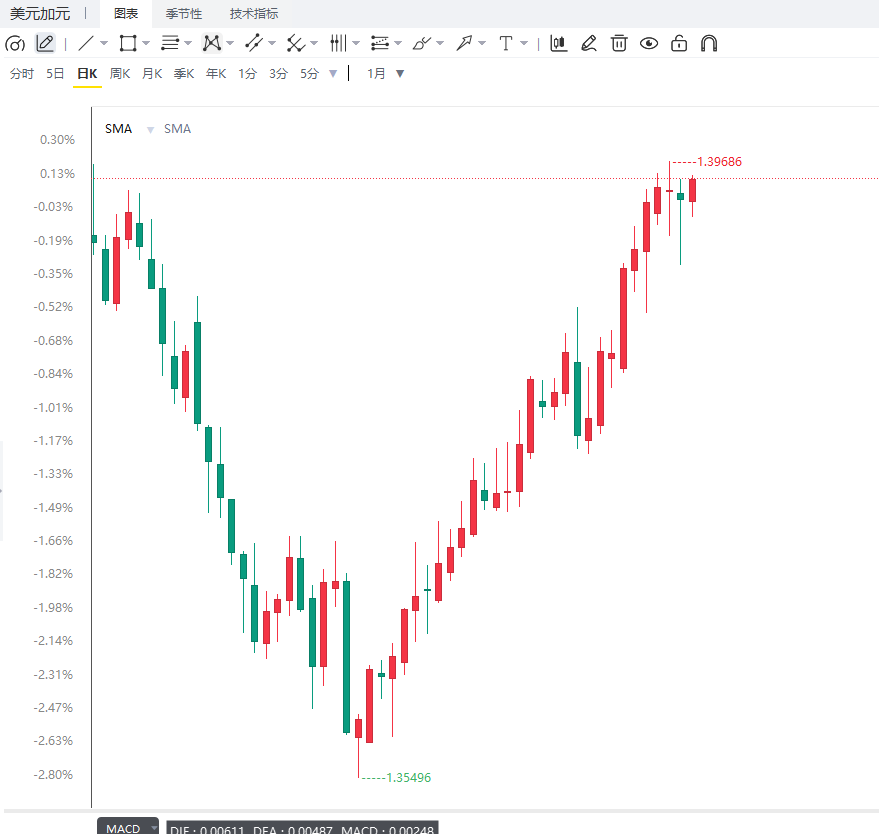
From a technical perspective, the daily chart shows that the USD/CAD pair maintains an overall upward trend, with the price trading above major moving averages. Although there has been a short-term pullback from its highs, the bullish structure has not been significantly broken. If the exchange rate regains its footing above 1.4000, it is expected to further test the 1.4050-1.4100 area. The first key support level to watch is 1.3900; a break below this level could lead to a further decline to the 1.3850 area. The RSI indicator has retreated from its highs but remains in a relatively strong zone, while the MACD remains positive, indicating that the overall upward momentum has not completely subsided.
From a 4-hour chart perspective, the USD/CAD pair has entered a short-term consolidation phase. Oil price movements and US economic data will be the core factors influencing the pair's short-term direction. If US PPI data continues to strengthen inflationary pressures and increases expectations of further Fed rate hikes, the USD/CAD pair may once again challenge its year-to-date highs. Conversely, if oil prices continue to strengthen and drive the Canadian dollar higher, the pair may experience a larger pullback. Investors should pay attention to the support level around 1.3900.
Editor's Summary : The current USD/CAD exchange rate is primarily influenced by both oil price fluctuations and the policy divergence between the Bank of Canada and the Federal Reserve. Escalating tensions in the Middle East have increased energy supply risks, driving up oil prices and providing support for the Canadian dollar. However, rising US inflation and hawkish expectations from the Federal Reserve continue to provide strong support for the US dollar. Going forward, the market will focus on US PPI data, the latest developments in the Middle East, and changes in international oil prices. Given the continued policy divergence between the Federal Reserve and the Bank of Canada, the USD/CAD exchange rate may maintain high-level fluctuations in the short term, but caution is warranted regarding potential downward pressure from further increases in oil prices.
Tensions in the Middle East continue to escalate. Following a new round of US military action against Iran, Iran announced the closure of the Strait of Hormuz, rapidly fueling market concerns about disruptions to global energy supplies. Since the Strait of Hormuz handles approximately 20% of global seaborne crude oil transport, the resulting transportation risks have driven a significant rebound in international crude oil prices from their near two-month lows. As a major energy exporter, Canada's economy is closely linked to the crude oil market; rising oil prices typically enhance the Canadian dollar's attractiveness, thus putting downward pressure on the USD/CAD exchange rate.
On the other hand, the US dollar remains supported by safe-haven demand and hawkish expectations from the Federal Reserve. Iran's Joint Military Command stated it would respond strongly to US actions in the region, raising market concerns about a further escalation of the conflict and driving some safe-haven funds into the dollar. Meanwhile, rising energy prices reignited inflation concerns, prompting investors to increase their bets on further tightening by the Federal Reserve.
According to the CME Group's FedWatch tool, the market now expects a greater than 70% probability of the Federal Reserve raising interest rates before the end of this year. The previously released U.S. Consumer Price Index (CPI) for May rose 4.2% year-on-year, reaching its highest level in nearly three years, further reinforcing the market's assessment that the high-interest-rate environment will persist for a longer period.
In contrast, the Bank of Canada's current policy stance is relatively dovish, with policymakers focusing more on the pressure from slowing economic growth than on further addressing inflation risks. This divergence in policy paths between the Federal Reserve and the Bank of Canada provides some support for the USD/CAD exchange rate during its pullback, which is a key reason why the market is currently reluctant to overly bet on a peak in the exchange rate.
From a technical perspective, the daily chart shows that the USD/CAD pair maintains an overall upward trend, with the price trading above major moving averages. Although there has been a short-term pullback from its highs, the bullish structure has not been significantly broken. If the exchange rate regains its footing above 1.4000, it is expected to further test the 1.4050-1.4100 area. The first key support level to watch is 1.3900; a break below this level could lead to a further decline to the 1.3850 area. The RSI indicator has retreated from its highs but remains in a relatively strong zone, while the MACD remains positive, indicating that the overall upward momentum has not completely subsided.
From a 4-hour chart perspective, the USD/CAD pair has entered a short-term consolidation phase. Oil price movements and US economic data will be the core factors influencing the pair's short-term direction. If US PPI data continues to strengthen inflationary pressures and increases expectations of further Fed rate hikes, the USD/CAD pair may once again challenge its year-to-date highs. Conversely, if oil prices continue to strengthen and drive the Canadian dollar higher, the pair may experience a larger pullback. Investors should pay attention to the support level around 1.3900.
Editor's Summary : The current USD/CAD exchange rate is primarily influenced by both oil price fluctuations and the policy divergence between the Bank of Canada and the Federal Reserve. Escalating tensions in the Middle East have increased energy supply risks, driving up oil prices and providing support for the Canadian dollar. However, rising US inflation and hawkish expectations from the Federal Reserve continue to provide strong support for the US dollar. Going forward, the market will focus on US PPI data, the latest developments in the Middle East, and changes in international oil prices. Given the continued policy divergence between the Federal Reserve and the Bank of Canada, the USD/CAD exchange rate may maintain high-level fluctuations in the short term, but caution is warranted regarding potential downward pressure from further increases in oil prices.
- Risk Warning and Disclaimer
- The market involves risk, and trading may not be suitable for all investors. This article is for reference only and does not constitute personal investment advice, nor does it take into account certain users’ specific investment objectives, financial situation, or other needs. Any investment decisions made based on this information are at your own risk.