Why did the dollar fall instead of rise despite inflation hitting a three-year high?
2026-06-11 14:59:32
On Thursday (June 11) during the Asian session, the US dollar index fluctuated at high levels, currently down slightly by 0.04% to around 100.
Despite higher-than-expected inflation data, the market had already fully priced in the prospect of a Fed rate hike, and the dollar instead experienced a "buy the rumor, sell the fact" correction.
Data released by the U.S. government on Wednesday showed that U.S. inflation accelerated to its fastest pace in more than three years in May, driven by energy prices rising due to the war with Iran, outpacing wage growth among Americans.
The U.S. Consumer Price Index (CPI) rose 0.5% month-over-month in May and 4.2% year-over-year, marking the largest increase since the beginning of 2023. This also marks the first time in three years that the U.S. inflation rate has returned to above 4%.
Energy prices have become the main driver of this round of accelerated inflation. Affected by the ongoing conflict in Iran, international crude oil prices have fluctuated and risen, leading to a corresponding increase in gasoline and fuel prices in the United States.
Data shows that the energy component rose more than 5% month-on-month in May, contributing nearly half of the overall CPI increase. Meanwhile, food prices and service costs remained firm, and while increases in rent and healthcare services slowed, they remained relatively high. Excluding the volatile food and energy sectors, the core CPI rose 0.2% month-on-month and 2.9% year-on-year in May, slightly below market expectations, indicating some easing of core inflationary pressures.
It is worth noting that inflation has outpaced the growth of average wages in the United States. Newly released wage data shows that average hourly earnings rose 0.3% month-over-month and 3.9% year-over-year in May, both lower than the CPI increase over the same period. This means that the real purchasing power of American households is being eroded, with consumers having less income available for other consumption after paying for essential expenses such as energy, food, and housing.
The release of inflation data further reinforced market expectations that the Federal Reserve would maintain high interest rates. Following the data release, the dollar index rose briefly, US Treasury yields climbed, and market expectations for a rate cut this year quickly cooled. Analysts pointed out that if inflation continues to be sticky in the coming months, the Fed may have to maintain high interest rates for a longer period, and further rate hikes cannot be ruled out.
The U.S. military said Wednesday it had struck multiple targets inside Iran and launched a new offensive overnight. President Trump vowed to launch more attacks if a peace agreement is not reached. The latest escalation has kept markets tense, pushing oil prices higher—Brent crude futures rose more than 2% to $95.40 a barrel.
Nevertheless, the market reaction was less dramatic than in the past, with the dollar remaining relatively calm in early Asian trading. Nick Twidale, chief market analyst at ATFX Global, said, "There's a certain degree of news fatigue in the market. A few weeks ago, this level of escalation might have pushed Brent crude back above $100 a barrel and driven the dollar higher."
He pointed out that the key lies in the market's desire to regain some certainty—whether this conflict and the closure of the Strait of Hormuz will become the new normal, or another "negotiation strategy" to bring the hope of peace back to the negotiating table.
Morgan Stanley strategists point out that the "American exceptionalism" is increasingly becoming a market consensus, which is sparking discussions about the outlook for the US dollar.
They believe that the outperformance of US stocks compared to other global stocks does support the view that the dollar is strengthening, but for the rally to continue, the US interest rate differential needs to move in a direction favorable to the dollar.
David Adams, head of G10 FX strategy at the bank, stated clearly in an interview: "From a risk balance perspective, the dollar will fall in the future, and we are bearish on the dollar." He expects the euro to rise to $1.23 in the third quarter because the European Central Bank will raise interest rates twice this year, while the Federal Reserve will remain on hold.
Adams emphasized that the dollar could weaken in the coming months if risk appetite recovers and the Federal Reserve avoids raising interest rates. Given that both the European Central Bank and the Bank of Japan are expected to raise rates this month, narrowing interest rate differentials should encourage increased risk appetite, thus putting pressure on the dollar.
In a report, BMO's chief foreign exchange strategist, Mark McCormick, noted that foreign exchange market traders were "too eager" to digest expectations of a resolution to the US-Iran conflict.
He emphasized that even if oil prices fall after the conflict ends, this remains a significant assumption, and inflation is unlikely to decline as rapidly. Rising energy costs are being transmitted to sectors such as transportation, manufacturing, and services, a second round of effects is building, and the correlation is shifting, increasingly supporting higher interest rates and a stronger dollar.
BMO maintains a bullish stance on the US dollar overall, particularly bullish on its performance against the euro, pound sterling, and yen, and expects the dollar to further outperform commodity currencies such as the Australian dollar and Canadian dollar.
McCormick stated, "We believe that higher interest rates, weaker growth, and greater macroeconomic divergence remain the more enduring narrative—and in this evolving landscape, this should continue to favor the dollar and U.S. assets outperforming. Headlines are just noise; the landscape is the signal."
The US dollar index is currently trading around 100, facing short-term pressure. However, from a technical perspective, the overall outlook remains bullish, as the index is still holding above the 20-day exponential moving average, which is currently at 99.35.
On the downside, initial support lies at the 20-day moving average around 99.35. A break below this level could signal a deeper pullback, targeting the previous price consolidation zone below 99.00. On the upside, a decisive break above the June 8 high of 100.21 could see the US dollar index further challenge the one-year high of 100.64.
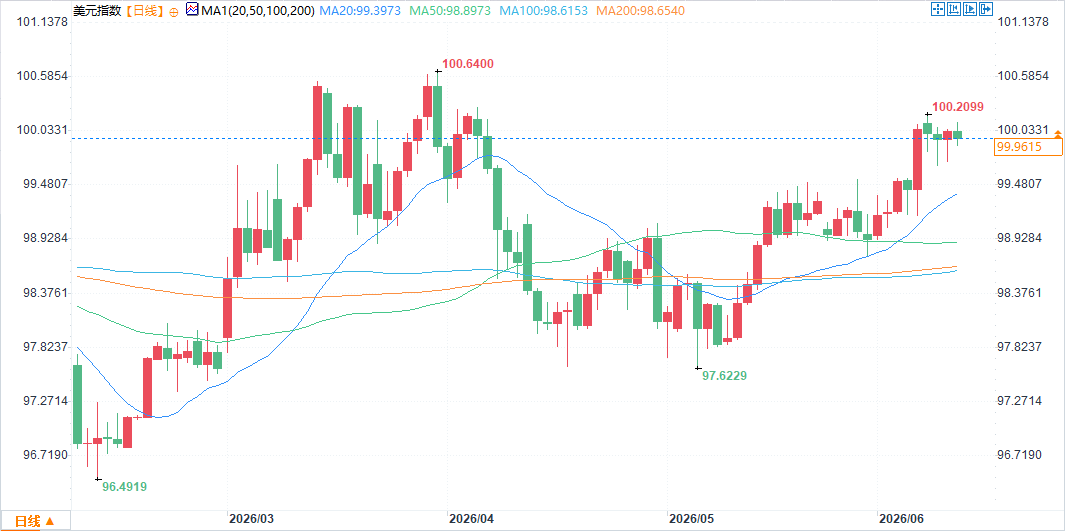
(US Dollar Index Daily Chart, Source: FX678)
At 14:59 Beijing time on June 11, the US dollar index was at 100.00.
Despite higher-than-expected inflation data, the market had already fully priced in the prospect of a Fed rate hike, and the dollar instead experienced a "buy the rumor, sell the fact" correction.
Inflation accelerated to a three-year high, with energy prices being the main driver.
Data released by the U.S. government on Wednesday showed that U.S. inflation accelerated to its fastest pace in more than three years in May, driven by energy prices rising due to the war with Iran, outpacing wage growth among Americans.
The U.S. Consumer Price Index (CPI) rose 0.5% month-over-month in May and 4.2% year-over-year, marking the largest increase since the beginning of 2023. This also marks the first time in three years that the U.S. inflation rate has returned to above 4%.
Energy prices have become the main driver of this round of accelerated inflation. Affected by the ongoing conflict in Iran, international crude oil prices have fluctuated and risen, leading to a corresponding increase in gasoline and fuel prices in the United States.
Data shows that the energy component rose more than 5% month-on-month in May, contributing nearly half of the overall CPI increase. Meanwhile, food prices and service costs remained firm, and while increases in rent and healthcare services slowed, they remained relatively high. Excluding the volatile food and energy sectors, the core CPI rose 0.2% month-on-month and 2.9% year-on-year in May, slightly below market expectations, indicating some easing of core inflationary pressures.
Wage growth has lagged behind inflation, further cooling expectations for interest rate cuts.
It is worth noting that inflation has outpaced the growth of average wages in the United States. Newly released wage data shows that average hourly earnings rose 0.3% month-over-month and 3.9% year-over-year in May, both lower than the CPI increase over the same period. This means that the real purchasing power of American households is being eroded, with consumers having less income available for other consumption after paying for essential expenses such as energy, food, and housing.
The release of inflation data further reinforced market expectations that the Federal Reserve would maintain high interest rates. Following the data release, the dollar index rose briefly, US Treasury yields climbed, and market expectations for a rate cut this year quickly cooled. Analysts pointed out that if inflation continues to be sticky in the coming months, the Fed may have to maintain high interest rates for a longer period, and further rate hikes cannot be ruled out.
The situation in the Middle East has escalated again, but the market reaction has been milder than before.
The U.S. military said Wednesday it had struck multiple targets inside Iran and launched a new offensive overnight. President Trump vowed to launch more attacks if a peace agreement is not reached. The latest escalation has kept markets tense, pushing oil prices higher—Brent crude futures rose more than 2% to $95.40 a barrel.
Nevertheless, the market reaction was less dramatic than in the past, with the dollar remaining relatively calm in early Asian trading. Nick Twidale, chief market analyst at ATFX Global, said, "There's a certain degree of news fatigue in the market. A few weeks ago, this level of escalation might have pushed Brent crude back above $100 a barrel and driven the dollar higher."
He pointed out that the key lies in the market's desire to regain some certainty—whether this conflict and the closure of the Strait of Hormuz will become the new normal, or another "negotiation strategy" to bring the hope of peace back to the negotiating table.
Institutional Views
Morgan Stanley strategists point out that the "American exceptionalism" is increasingly becoming a market consensus, which is sparking discussions about the outlook for the US dollar.
They believe that the outperformance of US stocks compared to other global stocks does support the view that the dollar is strengthening, but for the rally to continue, the US interest rate differential needs to move in a direction favorable to the dollar.
David Adams, head of G10 FX strategy at the bank, stated clearly in an interview: "From a risk balance perspective, the dollar will fall in the future, and we are bearish on the dollar." He expects the euro to rise to $1.23 in the third quarter because the European Central Bank will raise interest rates twice this year, while the Federal Reserve will remain on hold.
Adams emphasized that the dollar could weaken in the coming months if risk appetite recovers and the Federal Reserve avoids raising interest rates. Given that both the European Central Bank and the Bank of Japan are expected to raise rates this month, narrowing interest rate differentials should encourage increased risk appetite, thus putting pressure on the dollar.
In a report, BMO's chief foreign exchange strategist, Mark McCormick, noted that foreign exchange market traders were "too eager" to digest expectations of a resolution to the US-Iran conflict.
He emphasized that even if oil prices fall after the conflict ends, this remains a significant assumption, and inflation is unlikely to decline as rapidly. Rising energy costs are being transmitted to sectors such as transportation, manufacturing, and services, a second round of effects is building, and the correlation is shifting, increasingly supporting higher interest rates and a stronger dollar.
BMO maintains a bullish stance on the US dollar overall, particularly bullish on its performance against the euro, pound sterling, and yen, and expects the dollar to further outperform commodity currencies such as the Australian dollar and Canadian dollar.
McCormick stated, "We believe that higher interest rates, weaker growth, and greater macroeconomic divergence remain the more enduring narrative—and in this evolving landscape, this should continue to favor the dollar and U.S. assets outperforming. Headlines are just noise; the landscape is the signal."
Technical Analysis
The US dollar index is currently trading around 100, facing short-term pressure. However, from a technical perspective, the overall outlook remains bullish, as the index is still holding above the 20-day exponential moving average, which is currently at 99.35.
On the downside, initial support lies at the 20-day moving average around 99.35. A break below this level could signal a deeper pullback, targeting the previous price consolidation zone below 99.00. On the upside, a decisive break above the June 8 high of 100.21 could see the US dollar index further challenge the one-year high of 100.64.
(US Dollar Index Daily Chart, Source: FX678)
At 14:59 Beijing time on June 11, the US dollar index was at 100.00.
- Risk Warning and Disclaimer
- The market involves risk, and trading may not be suitable for all investors. This article is for reference only and does not constitute personal investment advice, nor does it take into account certain users’ specific investment objectives, financial situation, or other needs. Any investment decisions made based on this information are at your own risk.