Escalating tensions in the Middle East fuel inflation concerns and risks of an economic slowdown, sending LME copper to a three-week low.
2026-06-11 14:54:40
International base metals markets were generally under pressure during Thursday's Asian trading session, with three-month copper prices on the London Metal Exchange (LME) continuing to decline. LME copper fell 0.5% to $13,448 per tonne, hitting a low of $13,378 per tonne during the session, a new low since May 20, reflecting heightened investor concerns about the global economic outlook and demand for industrial metals.

Market pressure stemmed primarily from the renewed deterioration of the situation in the Middle East. The U.S. Central Command stated that the U.S. had conducted additional military operations against Iranian targets, following retaliatory measures taken after a military helicopter was shot down. As President Trump adopted a tougher stance on the protracted failure to reach a peace agreement between the U.S. and Iran, markets are concerned that the regional conflict could escalate further, increasing uncertainty in global energy supplies and financial markets.
Escalating geopolitical risks have driven up international crude oil prices, further exacerbating market concerns about a resurgence of global inflation. Previously released data showed that the US Consumer Price Index (CPI) recorded its fastest year-on-year growth in over three years in May, reinforcing market expectations that major central banks worldwide may maintain high interest rates or even further tighten monetary policy. A high-interest-rate environment not only increases corporate financing costs but may also dampen manufacturing activity and industrial metal consumption, putting significant pressure on economically cyclical commodities such as copper.
From a market performance perspective, apart from copper prices being under pressure, other base metals also showed divergent trends. London zinc prices fell by about 1%, indicating a decline in market risk appetite; while aluminum prices saw a technical recovery after a sharp drop of 2.3% in the previous trading day, rebounding by about 0.5% on Thursday, but overall market sentiment remained cautious.
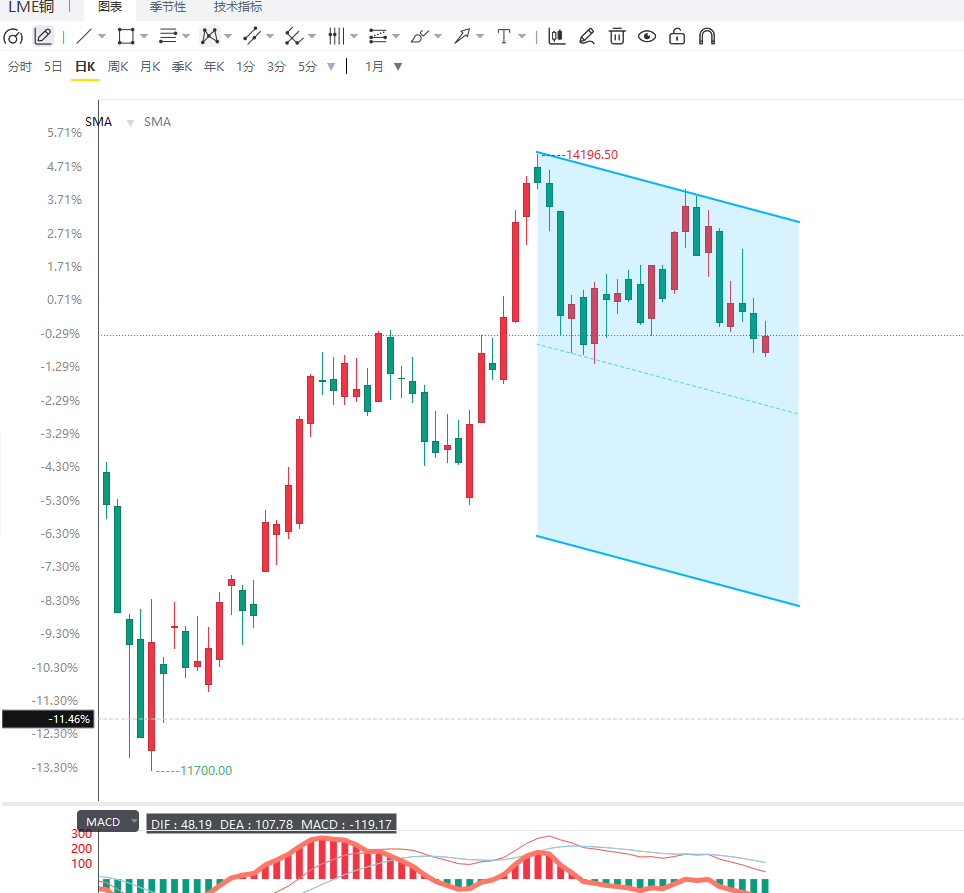
From a technical perspective, the daily chart shows that LME copper has broken below the lower edge of its recent trading range, indicating a short-term bearish trend. Prices are trading below key short-term moving averages, suggesting increased selling pressure. If copper prices continue to trade below $13,400, they may test the $13,200 to $13,000 support zone. The first resistance level to watch is around $13,600, with further resistance around $13,900. The RSI indicator is gradually entering weak territory, and the MACD shows signs of a death cross, indicating that downward momentum is still releasing in the short term.
From a 4-hour chart perspective, LME copper is showing a clear downward trend with short-term moving averages forming a bearish alignment. While a technical rebound may occur after the rapid price decline, its strength is likely to be limited until concerns about global economic growth and high interest rate expectations are significantly alleviated. Investors should pay close attention to developments in the Middle East, changes in international oil prices, global manufacturing data, and policy signals from major central banks, as these factors may determine the next direction of copper prices.
Editor's Summary : The copper market is currently facing multiple pressures from geopolitical risks, rising inflation, and expectations of slowing economic growth. Rising energy prices could further drive global inflation, prompting major central banks to maintain a tighter monetary environment, thereby weakening expectations for industrial demand. In the short term, LME copper is expected to remain weak. If tensions in the Middle East continue and market risk aversion intensifies, copper prices may continue to test lower support levels. However, if energy risks ease and economic data improves, copper prices may also see a period of recovery.
Market pressure stemmed primarily from the renewed deterioration of the situation in the Middle East. The U.S. Central Command stated that the U.S. had conducted additional military operations against Iranian targets, following retaliatory measures taken after a military helicopter was shot down. As President Trump adopted a tougher stance on the protracted failure to reach a peace agreement between the U.S. and Iran, markets are concerned that the regional conflict could escalate further, increasing uncertainty in global energy supplies and financial markets.
Escalating geopolitical risks have driven up international crude oil prices, further exacerbating market concerns about a resurgence of global inflation. Previously released data showed that the US Consumer Price Index (CPI) recorded its fastest year-on-year growth in over three years in May, reinforcing market expectations that major central banks worldwide may maintain high interest rates or even further tighten monetary policy. A high-interest-rate environment not only increases corporate financing costs but may also dampen manufacturing activity and industrial metal consumption, putting significant pressure on economically cyclical commodities such as copper.
From a market performance perspective, apart from copper prices being under pressure, other base metals also showed divergent trends. London zinc prices fell by about 1%, indicating a decline in market risk appetite; while aluminum prices saw a technical recovery after a sharp drop of 2.3% in the previous trading day, rebounding by about 0.5% on Thursday, but overall market sentiment remained cautious.
From a technical perspective, the daily chart shows that LME copper has broken below the lower edge of its recent trading range, indicating a short-term bearish trend. Prices are trading below key short-term moving averages, suggesting increased selling pressure. If copper prices continue to trade below $13,400, they may test the $13,200 to $13,000 support zone. The first resistance level to watch is around $13,600, with further resistance around $13,900. The RSI indicator is gradually entering weak territory, and the MACD shows signs of a death cross, indicating that downward momentum is still releasing in the short term.
From a 4-hour chart perspective, LME copper is showing a clear downward trend with short-term moving averages forming a bearish alignment. While a technical rebound may occur after the rapid price decline, its strength is likely to be limited until concerns about global economic growth and high interest rate expectations are significantly alleviated. Investors should pay close attention to developments in the Middle East, changes in international oil prices, global manufacturing data, and policy signals from major central banks, as these factors may determine the next direction of copper prices.
Editor's Summary : The copper market is currently facing multiple pressures from geopolitical risks, rising inflation, and expectations of slowing economic growth. Rising energy prices could further drive global inflation, prompting major central banks to maintain a tighter monetary environment, thereby weakening expectations for industrial demand. In the short term, LME copper is expected to remain weak. If tensions in the Middle East continue and market risk aversion intensifies, copper prices may continue to test lower support levels. However, if energy risks ease and economic data improves, copper prices may also see a period of recovery.
- Risk Warning and Disclaimer
- The market involves risk, and trading may not be suitable for all investors. This article is for reference only and does not constitute personal investment advice, nor does it take into account certain users’ specific investment objectives, financial situation, or other needs. Any investment decisions made based on this information are at your own risk.