Using force to promote talks is the underlying strategy; the negative factors for gold and oil have been fully priced in under the maximum pressure exerted by the US and Iran.
2026-06-11 16:22:05
On Thursday during the Asian and European sessions, international oil prices experienced a surge followed by a pullback, reflecting the realization of positive news. Currently, the gains are flat, after surging as much as 4% in the morning. Meanwhile, gold prices rebounded. As mentioned in previous articles, bad geopolitical news is generally the short-term peak for oil prices and the current level for gold prices. On the one hand, the market has become somewhat desensitized to the deterioration of the US-Iran situation, and on the other hand, the US continues to exercise restraint, with a high probability of Trump taking a taco stance.
U.S. military attacks on southern Iran have damaged several water supply facilities in the Sirik district of Hormozgan province.
On the 11th local time, the Public Relations Department of the Iranian Islamic Revolutionary Guard Corps released a war report, stating that it launched 12 ballistic missiles at the US Air Force Base Azraq in Jordan that morning, accurately striking the area where F-35, F-15, and F-16 fighter jets were parked and deployed, claiming to have completely destroyed related supporting facilities and a large number of military aircraft.
On the same day, Iran launched a multi-pronged counterattack: According to Iran's Noh News Agency, Iranian missiles attacked the US military base in Harir, northern Iraq, and destroyed a US radar station in the Iraqi Kurdish region;
Iranian media added that Iran launched drone strikes against the U.S. Fifth Fleet base in Bahrain, targeting the fleet's Patriot air defense system radar and communication antennas as a response to the U.S. military's previous large-scale airstrikes against southern Iran.
In addition, the Iranian Revolutionary Guard Navy issued a shipping warning, explicitly warning all merchant ships anchored in the Persian Gulf and the Sea of Oman that any vessel approaching the Strait of Hormuz would be considered an enemy collaborating force. This statement further tightened the risk expectations for the core global oil shipping route.

In response to Iran's comprehensive and cross-regional retaliation, Trump emphasized in a message to Qatar, which is responsible for mediating the conflict, that the military action was a retaliatory strike in response to the downing of a U.S. Apache helicopter, and not the beginning of a full-scale war.
Meanwhile, U.S. Defense Secretary Hergsays also followed the president's lead and released a tough but restrained stance to the outside world.
He stated that Iran originally had the opportunity to sign a well-deserved peace agreement, but the Iranian side failed to demonstrate any sincerity in negotiations throughout the process;
The US will continue to conduct uninterrupted airstrikes on key Iranian facilities, but emphasized that this round of strikes is not a proactive restart of a full-scale war, but rather a precondition for reaching a bilateral agreement.
Hegerseth also provided an update on the condition of the pilots of the previously crashed Apache helicopter, confirming that the crew members were unharmed, thus alleviating short-term market panic over large-scale US military casualties and the further loss of control of the conflict.
Fox News reported on the 10th that U.S. Central Command officials denied any conflict between the U.S. Navy and the Iranian Islamic Revolutionary Guard Corps Navy at sea, claiming that a new round of strikes had been completed.
This round of conflict has escalated into the third large-scale exchange of fire this week. The first round was a direct clash between Israel and Iran from Sunday to Monday, followed by two rounds of direct military confrontation between the US and Iran.
The second round of US airstrikes covered multiple Iranian cities, with the intensity and scope of the strikes surpassing those of the first day's operation. The target list included Iranian military monitoring equipment, communication hubs, air defense positions, suburban military industrial complexes, barracks, and Revolutionary Guard bases. Loud explosions were heard at key locations along the Strait of Hormuz, including Tehran's main urban area and Bandar Abbas.
This operation was carried out collaboratively by multiple branches of the U.S. military, including the Air Force, Marine Corps, and Navy. The U.S. has not disclosed the scale of the damage caused by the airstrike, and Iranian officials have not fully released information on the damage to their territory. This information asymmetry has further amplified the battle between bulls and bears in the crude oil market.
Kuwait temporarily closed its airspace for several hours after being hit by a cross-regional missile attack, and did not disclose data on damage to its ports and crude oil storage facilities; Jordanian officials did not acknowledge that its bases were attacked, and only the US Embassy in Amman issued an air defense warning.
Missile air raid sirens were sounded throughout Bahrain, but there were no public reports of damage to energy facilities. The conflict has spread to the Lebanese-Israeli border; after Israel detected ballistic targets approaching from the Lebanese direction, it urgently notified residents in the north to take shelter in air-raid shelters. Markets are concerned that the fighting may spread to the entire core oil-producing region of the Middle East.
The Strait of Hormuz is a vital lifeline for global crude oil transportation, with nearly 20% of the world's crude oil exports relying on this waterway. Iran has consistently used control of the strait's shipping as a core bargaining chip in negotiations, and its continued tightening of navigation restrictions directly disrupts global energy supply expectations.
Trump previously disclosed a secret U.S. military operation that, since last month, the U.S. military has been using covert nighttime navigation to destroy radar facilities along the Iranian coast and escort oil tankers to bypass Iranian control and blockade. More than 100 million barrels of crude oil have been transported out of the country through this channel.
This data has not yet been verified by a third-party energy agency. The transport volume is roughly equivalent to five days' normal transport volume in the strait before the outbreak of the conflict, which to some extent offsets the extreme panic in the market about the complete closure of the shipping route.
The U.S. Central Command also publicly refuted Iran's claim of a complete blockade of the Strait of Hormuz, stating that commercial oil tankers can still pass normally, thus temporarily suppressing the short-term surge in crude oil prices.
Since the joint US-Israeli airstrikes on Iran on February 28, which triggered a full-scale conflict, the stability of the global energy supply chain has been severely damaged. Crude oil prices have continued to rise, pushing up inflation levels for food and daily consumer goods. On Wednesday, the international benchmark Brent crude oil price held steady above $93 per barrel, with a cumulative increase of more than 25% compared to before the war.
With the US midterm elections approaching in November, high domestic gasoline prices continue to drag down Trump's approval ratings. The US is eager to reach a swift ceasefire agreement to lower oil prices, but the core contradictions in the US-Iran negotiations remain irreconcilable.
The US has demanded that Iran clear out all its stockpiles of highly enriched uranium. Although Iran insists that its nuclear program is for peaceful purposes only, its existing high-purity uranium is only one step away from weapons-grade enrichment.
Iran firmly refused to hand over its enriched uranium stockpile, and put forward two preconditions: the US must fully lift sanctions and its overseas frozen assets must be unfrozen before the agreement is implemented. These conditions were directly rejected by Trump.
Iran has made it clear that any ceasefire agreement must simultaneously resolve the armed conflict between Hezbollah in Lebanon and Israel.
With multiple geopolitical conflicts overlapping, the probability of a short-term bilateral reconciliation has dropped significantly.
Israeli Prime Minister Netanyahu has also continued to adhere to a hardline approach, further shrinking the space for multilateral negotiations. His three core objectives—dismantling Iran's religious and political system, completely eliminating Iran's nuclear production capacity, and eradicating Hezbollah militants in Lebanon—mean that long-term geopolitical risks in the Middle East are unlikely to dissipate.
Although both the US and Iran have a desire to end the conflict, both governments need to present the ceasefire as a diplomatic victory at the national level. Unilateral and substantial concessions have no realistic basis, and the geopolitical risk premium inherent in crude oil is unlikely to dissipate quickly.
The current situation has shifted to extreme pressure aimed at negotiation. The more harsh the rhetoric, the greater the pressure, and the more the goal is to negotiate. The underlying nature of the conflict remains to use force to promote dialogue. Therefore, both gold and crude oil are showing signs of having exhausted their negative factors.
As previously mentioned, it is very difficult for the United States to obtain a successful agreement that aligns with its domestic election prospects. This would require significant concessions from Iran, and whether Iran will make such concessions depends on the pressure exerted on Iran by the US blockade of Iranian oil. If Iran can withstand the pressure, the agreement will be difficult to sign. However, if the obstruction of Iranian oil transportation leads to oil fields approaching their storage and production limits, there is a high probability that Iran will compromise.
Regarding crude oil, any disruption to navigation in the Strait of Hormuz will quickly create a supply gap in pricing. As long as the US-Iran airstrikes and missile counterattacks continue, geopolitical premiums will continue to support the central level of oil prices. Once there is a substantial obstruction to navigation in the strait, oil prices will rebound. Conversely, if the US military increases its escort efforts and negotiations release signals of easing tensions, it will trigger a phased correction in oil prices.
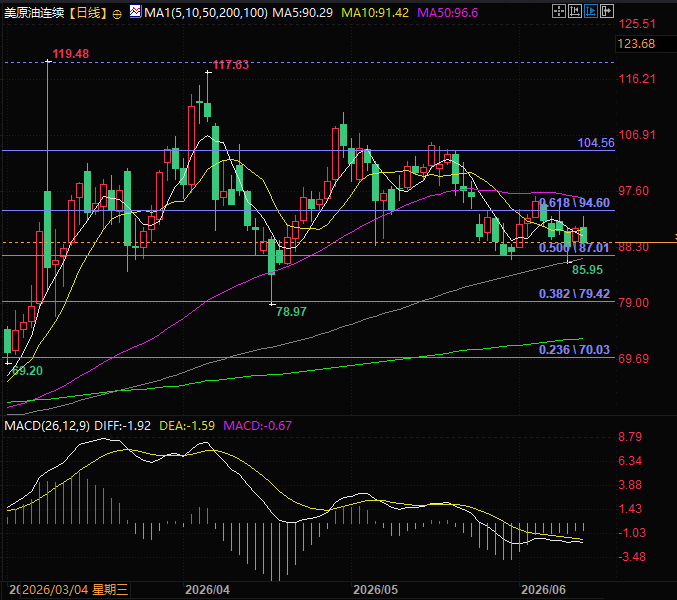
(WTI crude oil futures daily chart, source: FX678)
Gold prices are more complicated. Global oil shortages lead to a dollar shortage because oil-producing countries lack foreign exchange and need to buy dollars. At the same time, they sell US Treasury bonds and gold to exchange for dollars. This supply-driven surge in US Treasury yields, rather than short-term exchange rate fluctuations, leads to a stronger dollar that is usually more sustained. This directly suppresses gold prices. However, as mentioned in previous articles, the 4000-point level is the 0.618 Fibonacci retracement level of this round of correction, which is also the position where major players made a huge counterattack in the early stage and the bulls defended their position. At present, a rebound is highly likely.
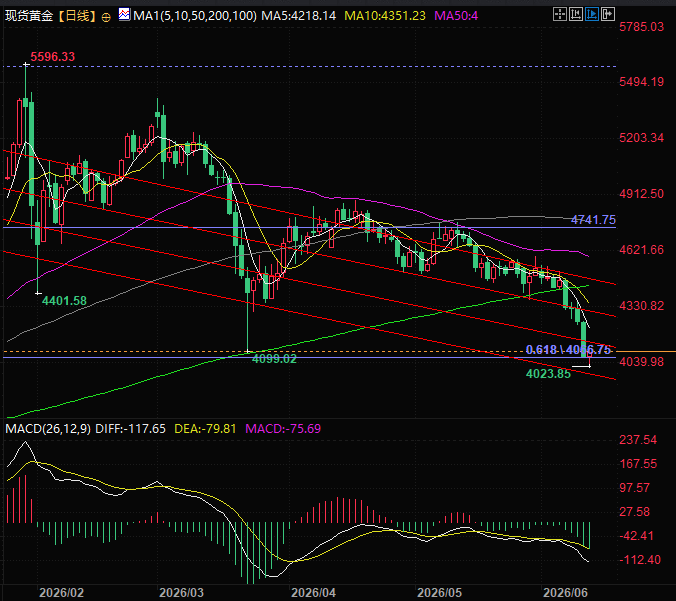
(Spot gold daily chart, source: FX678)
WTI crude oil futures are currently trading at $89.22 per barrel, while spot gold is currently trading at $4,102 per ounce.
U.S. military attacks on southern Iran have damaged several water supply facilities in the Sirik district of Hormozgan province.
On the 11th local time, the Public Relations Department of the Iranian Islamic Revolutionary Guard Corps released a war report, stating that it launched 12 ballistic missiles at the US Air Force Base Azraq in Jordan that morning, accurately striking the area where F-35, F-15, and F-16 fighter jets were parked and deployed, claiming to have completely destroyed related supporting facilities and a large number of military aircraft.
On the same day, Iran launched a multi-pronged counterattack: According to Iran's Noh News Agency, Iranian missiles attacked the US military base in Harir, northern Iraq, and destroyed a US radar station in the Iraqi Kurdish region;
Iranian media added that Iran launched drone strikes against the U.S. Fifth Fleet base in Bahrain, targeting the fleet's Patriot air defense system radar and communication antennas as a response to the U.S. military's previous large-scale airstrikes against southern Iran.
In addition, the Iranian Revolutionary Guard Navy issued a shipping warning, explicitly warning all merchant ships anchored in the Persian Gulf and the Sea of Oman that any vessel approaching the Strait of Hormuz would be considered an enemy collaborating force. This statement further tightened the risk expectations for the core global oil shipping route.
The US made a tough yet restrained statement: continued airstrikes are paving the way for negotiations, not a full-scale war.
In response to Iran's comprehensive and cross-regional retaliation, Trump emphasized in a message to Qatar, which is responsible for mediating the conflict, that the military action was a retaliatory strike in response to the downing of a U.S. Apache helicopter, and not the beginning of a full-scale war.
Meanwhile, U.S. Defense Secretary Hergsays also followed the president's lead and released a tough but restrained stance to the outside world.
He stated that Iran originally had the opportunity to sign a well-deserved peace agreement, but the Iranian side failed to demonstrate any sincerity in negotiations throughout the process;
The US will continue to conduct uninterrupted airstrikes on key Iranian facilities, but emphasized that this round of strikes is not a proactive restart of a full-scale war, but rather a precondition for reaching a bilateral agreement.
Hegerseth also provided an update on the condition of the pilots of the previously crashed Apache helicopter, confirming that the crew members were unharmed, thus alleviating short-term market panic over large-scale US military casualties and the further loss of control of the conflict.
Fox News reported on the 10th that U.S. Central Command officials denied any conflict between the U.S. Navy and the Iranian Islamic Revolutionary Guard Corps Navy at sea, claiming that a new round of strikes had been completed.
The second wave of large-scale airstrikes has landed, and many Middle Eastern countries have entered a state of air defense alert.
This round of conflict has escalated into the third large-scale exchange of fire this week. The first round was a direct clash between Israel and Iran from Sunday to Monday, followed by two rounds of direct military confrontation between the US and Iran.
The second round of US airstrikes covered multiple Iranian cities, with the intensity and scope of the strikes surpassing those of the first day's operation. The target list included Iranian military monitoring equipment, communication hubs, air defense positions, suburban military industrial complexes, barracks, and Revolutionary Guard bases. Loud explosions were heard at key locations along the Strait of Hormuz, including Tehran's main urban area and Bandar Abbas.
This operation was carried out collaboratively by multiple branches of the U.S. military, including the Air Force, Marine Corps, and Navy. The U.S. has not disclosed the scale of the damage caused by the airstrike, and Iranian officials have not fully released information on the damage to their territory. This information asymmetry has further amplified the battle between bulls and bears in the crude oil market.
Kuwait temporarily closed its airspace for several hours after being hit by a cross-regional missile attack, and did not disclose data on damage to its ports and crude oil storage facilities; Jordanian officials did not acknowledge that its bases were attacked, and only the US Embassy in Amman issued an air defense warning.
Missile air raid sirens were sounded throughout Bahrain, but there were no public reports of damage to energy facilities. The conflict has spread to the Lebanese-Israeli border; after Israel detected ballistic targets approaching from the Lebanese direction, it urgently notified residents in the north to take shelter in air-raid shelters. Markets are concerned that the fighting may spread to the entire core oil-producing region of the Middle East.
Shipping tensions escalate in the Strait of Hormuz; secret US escort missions ease supply disruption fears.
The Strait of Hormuz is a vital lifeline for global crude oil transportation, with nearly 20% of the world's crude oil exports relying on this waterway. Iran has consistently used control of the strait's shipping as a core bargaining chip in negotiations, and its continued tightening of navigation restrictions directly disrupts global energy supply expectations.
Trump previously disclosed a secret U.S. military operation that, since last month, the U.S. military has been using covert nighttime navigation to destroy radar facilities along the Iranian coast and escort oil tankers to bypass Iranian control and blockade. More than 100 million barrels of crude oil have been transported out of the country through this channel.
This data has not yet been verified by a third-party energy agency. The transport volume is roughly equivalent to five days' normal transport volume in the strait before the outbreak of the conflict, which to some extent offsets the extreme panic in the market about the complete closure of the shipping route.
The U.S. Central Command also publicly refuted Iran's claim of a complete blockade of the Strait of Hormuz, stating that commercial oil tankers can still pass normally, thus temporarily suppressing the short-term surge in crude oil prices.
The core contradictions in negotiations between the US and Iran remain unresolved, and the hope for a short-term ceasefire and reconciliation is slim.
Since the joint US-Israeli airstrikes on Iran on February 28, which triggered a full-scale conflict, the stability of the global energy supply chain has been severely damaged. Crude oil prices have continued to rise, pushing up inflation levels for food and daily consumer goods. On Wednesday, the international benchmark Brent crude oil price held steady above $93 per barrel, with a cumulative increase of more than 25% compared to before the war.
With the US midterm elections approaching in November, high domestic gasoline prices continue to drag down Trump's approval ratings. The US is eager to reach a swift ceasefire agreement to lower oil prices, but the core contradictions in the US-Iran negotiations remain irreconcilable.
The US has demanded that Iran clear out all its stockpiles of highly enriched uranium. Although Iran insists that its nuclear program is for peaceful purposes only, its existing high-purity uranium is only one step away from weapons-grade enrichment.
Iran firmly refused to hand over its enriched uranium stockpile, and put forward two preconditions: the US must fully lift sanctions and its overseas frozen assets must be unfrozen before the agreement is implemented. These conditions were directly rejected by Trump.
Iran has made it clear that any ceasefire agreement must simultaneously resolve the armed conflict between Hezbollah in Lebanon and Israel.
With multiple geopolitical conflicts overlapping, the probability of a short-term bilateral reconciliation has dropped significantly.
Israeli Prime Minister Netanyahu has also continued to adhere to a hardline approach, further shrinking the space for multilateral negotiations. His three core objectives—dismantling Iran's religious and political system, completely eliminating Iran's nuclear production capacity, and eradicating Hezbollah militants in Lebanon—mean that long-term geopolitical risks in the Middle East are unlikely to dissipate.
Although both the US and Iran have a desire to end the conflict, both governments need to present the ceasefire as a diplomatic victory at the national level. Unilateral and substantial concessions have no realistic basis, and the geopolitical risk premium inherent in crude oil is unlikely to dissipate quickly.
Summary and Technical Analysis:
The current situation has shifted to extreme pressure aimed at negotiation. The more harsh the rhetoric, the greater the pressure, and the more the goal is to negotiate. The underlying nature of the conflict remains to use force to promote dialogue. Therefore, both gold and crude oil are showing signs of having exhausted their negative factors.
As previously mentioned, it is very difficult for the United States to obtain a successful agreement that aligns with its domestic election prospects. This would require significant concessions from Iran, and whether Iran will make such concessions depends on the pressure exerted on Iran by the US blockade of Iranian oil. If Iran can withstand the pressure, the agreement will be difficult to sign. However, if the obstruction of Iranian oil transportation leads to oil fields approaching their storage and production limits, there is a high probability that Iran will compromise.
Regarding crude oil, any disruption to navigation in the Strait of Hormuz will quickly create a supply gap in pricing. As long as the US-Iran airstrikes and missile counterattacks continue, geopolitical premiums will continue to support the central level of oil prices. Once there is a substantial obstruction to navigation in the strait, oil prices will rebound. Conversely, if the US military increases its escort efforts and negotiations release signals of easing tensions, it will trigger a phased correction in oil prices.
(WTI crude oil futures daily chart, source: FX678)
Gold prices are more complicated. Global oil shortages lead to a dollar shortage because oil-producing countries lack foreign exchange and need to buy dollars. At the same time, they sell US Treasury bonds and gold to exchange for dollars. This supply-driven surge in US Treasury yields, rather than short-term exchange rate fluctuations, leads to a stronger dollar that is usually more sustained. This directly suppresses gold prices. However, as mentioned in previous articles, the 4000-point level is the 0.618 Fibonacci retracement level of this round of correction, which is also the position where major players made a huge counterattack in the early stage and the bulls defended their position. At present, a rebound is highly likely.
(Spot gold daily chart, source: FX678)
WTI crude oil futures are currently trading at $89.22 per barrel, while spot gold is currently trading at $4,102 per ounce.
- Risk Warning and Disclaimer
- The market involves risk, and trading may not be suitable for all investors. This article is for reference only and does not constitute personal investment advice, nor does it take into account certain users’ specific investment objectives, financial situation, or other needs. Any investment decisions made based on this information are at your own risk.